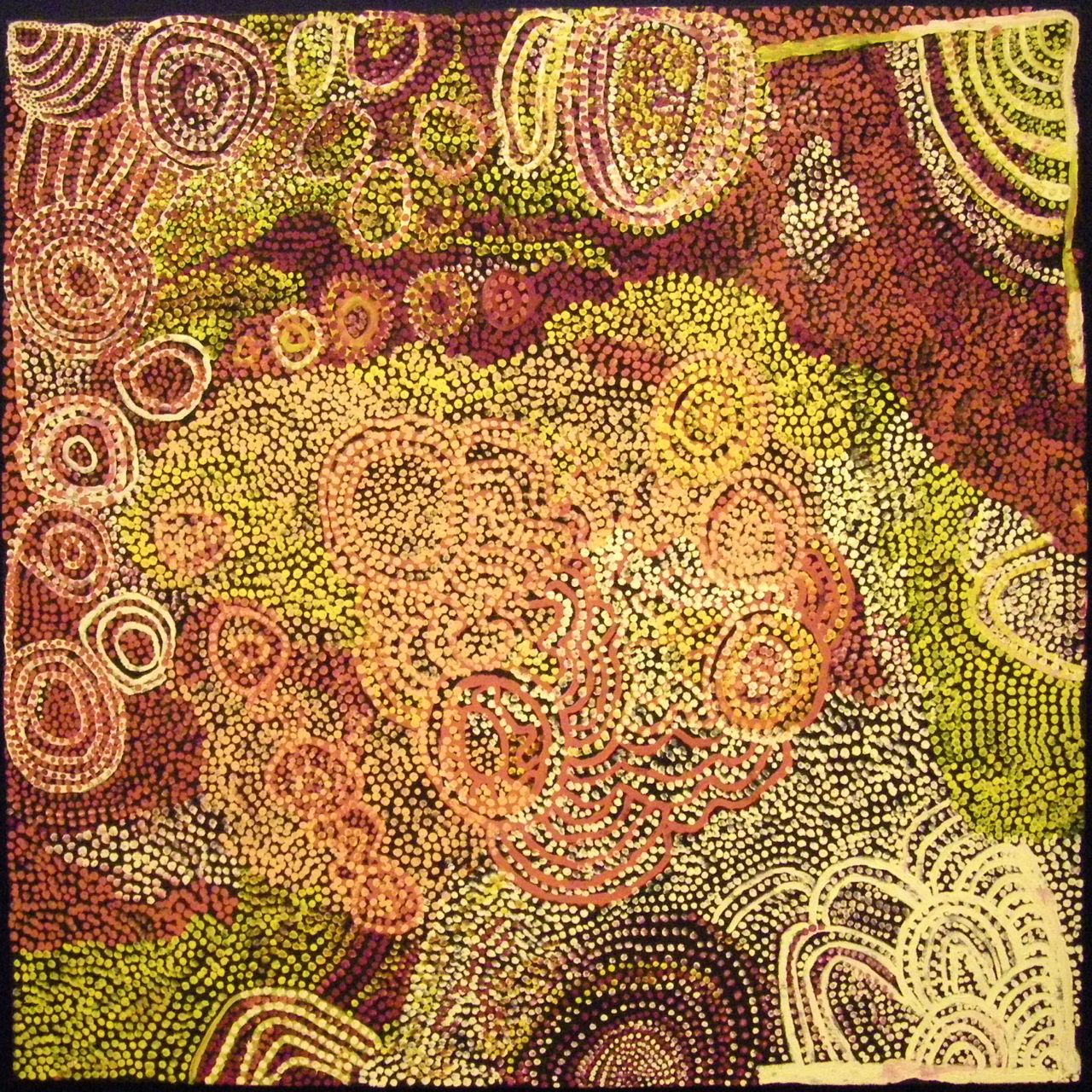
"Not to scale: On sacred mountains" starts tomorrow! I've been dithering with the syllabus, especially once I decided that syllabus ought to have illustrations! I haven't felt the need to illustrate since "Aboriginal Australia and the Idea of Religion" six years ago. That's not the only similarity I'm noticing with that earlier class. Then, too, I was aware of the oddity (to put it mildly) of a course on a territory so remote and, from where we are, inaccessible except in imagination - not to mention taught by me! But there's a difference, too, which you can see in the choice of images. Where those sought to give the word to Aboriginal people, this one is shaped by my experience as a visitor to Kailash. Some of the images are religious, but almost all are images constructed by people far from the mountains (like the photoshopped Mount Fuji); some are not even mountains, like that by Yang Yongliang below.). When it comes to sacred mountains, you might not have to be there to know them. In any case, the only knowledge we'll be having access to is that which isn't tied to direct experience of the mountaineering sort.
Showing posts with label Aboriginal Australia and Idea of Religion course. Show all posts
Monday, January 23, 2017
Tuesday, July 02, 2013
God flip
I've just finished Deborah Bird Rose's Wild Dog Dreaming, my first Kindle-for-Mac book (hence no page references, sorry). It covers a lot of territory, including a powerful meditation on the Book of Job, imagining that at least one of Job's dogs must have kept him company on the ash heap - which manages, somehow, to change everything.
Dogs, Rose shows with both dingo stories from Australia and myths and poems from ancient and contemporary societies, invite us to a more complex relationship with the earth. They care for us, engage us in our humanity in a profound way. (An essay by Levinas, "Name of a dog," is the surprise proof text for this: a dog named Bobby alone acknowledged the humanity of Jewish prisoners of war during WW2, but Levinas, writing several decades later, can't return the gesture and respond to the "face" of a dog.) Yet hers is no romantic view of cuddly puppies:
Have I mentioned that Rose's first work, her most fieldwork-based book, was called Dingo makes us human? This book fleshes that claim out more broadly. And its base notes remain Aboriginal in inspiration.
She ends this book with a description of a moment early in her fieldwork when a fraught funeral was happening outside but she was kept inside by Old Tim Yilngayarri, telling her stories about birth. This was more than a diversion. Aboriginal worlds build in oscillations between life and death, as they do between humans and other forms of life. Aboriginal ritual moves between dance and non-dance, music and non-music; the gaps between precisely scripted moments are filled with humor and improvisation. Rose quotes ethnomusicologist Cath Ellis' description of Aboriginal music as "iridescent," characterized by the shifting of figure and ground. Rose calls this the "flip."
The flip is part of what Rose commends to us as ways of living in a time of extinctions, extinctions in part triggered by the culture of human beings claiming to be, like Job's God, separate from and superior to the Earth. Her reading of Job doesn't consider the largely Earthy content of the divine speeches. The closest she'll come to theism is this gloss on Old Tim's exclamation, "True God! God's a man: Lord Jesus":
Rose's objection to God-talk is that it refuses the ambiguity of life - think of those unruly life-loving death-dealing dogs - an ambiguity falsified by categorical distinctions of nature or value and better understood in terms of an embodiment of the "law of participation" Lévy-Bruhl thought characteristic of animist cultures. What she's recommending isn't an easy New Age spirituality either.
Dingoes apparently often appear in human form, but never to us humans. We need to learn to be part of a world wiser than we are - even about what it means to be human.
Dogs, Rose shows with both dingo stories from Australia and myths and poems from ancient and contemporary societies, invite us to a more complex relationship with the earth. They care for us, engage us in our humanity in a profound way. (An essay by Levinas, "Name of a dog," is the surprise proof text for this: a dog named Bobby alone acknowledged the humanity of Jewish prisoners of war during WW2, but Levinas, writing several decades later, can't return the gesture and respond to the "face" of a dog.) Yet hers is no romantic view of cuddly puppies:
What with their howling at the threshold of
life and death, their eating of corpses, and their public sex, dogs
bring sex and death together in the most visible and stunningly
extravagant ways. The dogs’ outrageous excessiveness is so dog, and so
world, so in the present, so in the face of human conventions, and thus
forever a reminder of our connections within the world of life, lust,
death, grief, and unbounded enthusiasms and desires.
Have I mentioned that Rose's first work, her most fieldwork-based book, was called Dingo makes us human? This book fleshes that claim out more broadly. And its base notes remain Aboriginal in inspiration.
She ends this book with a description of a moment early in her fieldwork when a fraught funeral was happening outside but she was kept inside by Old Tim Yilngayarri, telling her stories about birth. This was more than a diversion. Aboriginal worlds build in oscillations between life and death, as they do between humans and other forms of life. Aboriginal ritual moves between dance and non-dance, music and non-music; the gaps between precisely scripted moments are filled with humor and improvisation. Rose quotes ethnomusicologist Cath Ellis' description of Aboriginal music as "iridescent," characterized by the shifting of figure and ground. Rose calls this the "flip."
In the performance of ceremony, there are many flips. For the dancer there is the flip between the feet on the ground and the ground on the feet: Who is the dancer, and who is the danced? If we focus on motion, it is clear that both are dancer and danced, and that the significance of this mutuality is located in the flip back and forth between us.
The flip is part of what Rose commends to us as ways of living in a time of extinctions, extinctions in part triggered by the culture of human beings claiming to be, like Job's God, separate from and superior to the Earth. Her reading of Job doesn't consider the largely Earthy content of the divine speeches. The closest she'll come to theism is this gloss on Old Tim's exclamation, "True God! God's a man: Lord Jesus":
Sometimes he is human, sometimes not, sometimes clever, sometimes not. There is always an element of uncertainty; we can’t know for sure which person or animal is god at any moment.
Rose's objection to God-talk is that it refuses the ambiguity of life - think of those unruly life-loving death-dealing dogs - an ambiguity falsified by categorical distinctions of nature or value and better understood in terms of an embodiment of the "law of participation" Lévy-Bruhl thought characteristic of animist cultures. What she's recommending isn't an easy New Age spirituality either.
The flip is not an oscillation outside of time, but rather, as part of life, it works with the dynamics of disorder and creation. It is important to note that the philosophy of the flip runs counter to two important maxims that are current within contemporary spirituality movements. It is not possible that “we are all one” in flip philosophy. Differences must exist; there must be I and You, self and other, death and life, in order for there to be flips back and forth. Nor is it possible that “everything is connected to everything.” It is the movement away that makes possible the movement toward. The unmaking and the making both matter.
Dingoes apparently often appear in human form, but never to us humans. We need to learn to be part of a world wiser than we are - even about what it means to be human.
Friday, January 25, 2013
Thursday, December 08, 2011
The twain meets
One of the great myths of the world of publishing is that some nobody gives a talk somewhere, perhaps her first, and afterward the editor of a distinguished press or journal comes up and enthsuses "I loved it! Can I publish it?" Well, something a little like that happened to me yesterday at my colleague Henry's reading series. I was of course reading from the "personal essay" H challenged me to write about my experience teaching the Aboriginal Australia course, an essay I spent a lot of time on but didn't imagine or expect would ever have a career beyond this blog. It was my first "reading," that is, the first time I'd shared something as a piece of writing rather than an argument, analysis or research - it came after reading of a short story and some poems - and I was both relieved and disappointed that the audience was small; only one other colleague came, N, a loyal trooper who attends all student and faculty work. I'm not sure my reading was very good - I hurried, and stumbled, and got lost in my text. But it is interesting material, and I'd worked on my "self-dramatization." N said he liked it, which I was grateful for. But then it turns out that he edits a journal! A journal on Australian and New Zealand literature, no less, Antipodes! And they're going to publish it!
(This map is someone's effort to show what antipodes means.)
(This map is someone's effort to show what antipodes means.)Saturday, December 03, 2011
"Conflict and fury"
Remember that essay my colleague H challenged me to write about the Aboriginal Australia course this past June? Well, he's invited me to read from it at this month's meeting of the Writing Progam's Faculty Reading Series (next week!). Exciting, but more than a little terrifying. I don't think of myself as a writer, and, while I've given papers and lectures, I have never given a reading. On the other hand, I did think this essay - a "personal narrative" more akin to my voice here in this blog than in the academic things I occasionally joylessly write - was close to ready for prime time.
Think again! H and I met this afternoon, and, more and less gently, he made clear that my attempt not to sound like an academic paper sounded like - an academic paper. In order to succeed for a general audience and especially as something personal and autobiographical, many changes are needed. These came in all sizes, from word choices and tenses to the relative proportions of different sections. (I was foolish to think the main thing was shorter sentences, though they'll help too.) The main thing, however, was that in my first version I was not "self-dramatizing."
My first reaction was that this was as it should be. "Self-dramatizing" sounds like a criticism of self-involved and self-indulgent writing. But H's use of the term was different. Part of the task of writing in the autobiographical mode is bringing the self clearly, precisely, convincingly to the fore. Academic writing does the opposite. Even as we often sense axes being ground, the voice is almost pathologically lacking in "self-dramatization." In any case, mine here was. At best I described feeling but didn't convey it. Even places where I thought I'd cannily let some emotion through - like when I said that "I was not happy" about a student's bringing Elizabeth Durack into my class - seemed to him lifeless and untrue. Judging from the way I'd described it to him, H suggested, I should have written "I was full of conflict and fury."
More than style is at issue here. Am I the sort of person who feels conflict and fury? (Actually, yes, I am.) Can I admit this - first to myself, then to my readers? It could definitely make for a more interesting read.
H's criticisms filled me with, er, fury and conflict. Didn't he see that it was me he was attacking, my voice? But the fury soon ceded place to conflict, as his precise and pitch-perfect insights into particular word choices made clear that I had not, in fact, allowed a voice - a real voice, not a bemused, detached academic one - into my essay at all! And then came gratitude, even a little pride. As he taught me to scratch the polished surface of my text, deeper, more interesting things came out. He wasn't attacking me but rescuing me. There is a deeper voice, deeper than the careful academic calibrations and modest suggestions, knowing colloquialisms and superficial ironies. I can't remember the last time anyone paid such close attention to my writing or use of language.
One example. In a passage where I worry that I have merely been projecting my own preconceptions and desires on to Aboriginal materials, I write: "But I persist in feeling that this wasn't just projection." I thought this was bold. It's really the opposite. Instead of owning my conviction, taking a risk, I disown it by attributing it to some obscure "persistence" from some "I" who isn't quite me. (It could be even worse than that, since it can seem the wilfulness of the intrepid colonizer.) It takes me another paragraph to get to the limp "This is a point where I feel I may have learned something new from Aboriginal traditions," But I've already lost the battle, and the interest of the reader/listener. What I need to be saying is something like "Projection or no, I feel I have learned something new."
So it's back to the drawing board. I must in any case omit or compress a good third of the essay. But H has inspired me to try to name and own the emotions and desires which course beneath the surface of the text. For a personal narrative they are the very heart of the matter, but I can see that greater clarity about them might help my academic writing, too. I'm not sure where I'll end up this time. It may not be conflict and fury I admit to, but I promise it'll be truer than the empty "not happy."
Think again! H and I met this afternoon, and, more and less gently, he made clear that my attempt not to sound like an academic paper sounded like - an academic paper. In order to succeed for a general audience and especially as something personal and autobiographical, many changes are needed. These came in all sizes, from word choices and tenses to the relative proportions of different sections. (I was foolish to think the main thing was shorter sentences, though they'll help too.) The main thing, however, was that in my first version I was not "self-dramatizing."
My first reaction was that this was as it should be. "Self-dramatizing" sounds like a criticism of self-involved and self-indulgent writing. But H's use of the term was different. Part of the task of writing in the autobiographical mode is bringing the self clearly, precisely, convincingly to the fore. Academic writing does the opposite. Even as we often sense axes being ground, the voice is almost pathologically lacking in "self-dramatization." In any case, mine here was. At best I described feeling but didn't convey it. Even places where I thought I'd cannily let some emotion through - like when I said that "I was not happy" about a student's bringing Elizabeth Durack into my class - seemed to him lifeless and untrue. Judging from the way I'd described it to him, H suggested, I should have written "I was full of conflict and fury."
More than style is at issue here. Am I the sort of person who feels conflict and fury? (Actually, yes, I am.) Can I admit this - first to myself, then to my readers? It could definitely make for a more interesting read.
H's criticisms filled me with, er, fury and conflict. Didn't he see that it was me he was attacking, my voice? But the fury soon ceded place to conflict, as his precise and pitch-perfect insights into particular word choices made clear that I had not, in fact, allowed a voice - a real voice, not a bemused, detached academic one - into my essay at all! And then came gratitude, even a little pride. As he taught me to scratch the polished surface of my text, deeper, more interesting things came out. He wasn't attacking me but rescuing me. There is a deeper voice, deeper than the careful academic calibrations and modest suggestions, knowing colloquialisms and superficial ironies. I can't remember the last time anyone paid such close attention to my writing or use of language.
One example. In a passage where I worry that I have merely been projecting my own preconceptions and desires on to Aboriginal materials, I write: "But I persist in feeling that this wasn't just projection." I thought this was bold. It's really the opposite. Instead of owning my conviction, taking a risk, I disown it by attributing it to some obscure "persistence" from some "I" who isn't quite me. (It could be even worse than that, since it can seem the wilfulness of the intrepid colonizer.) It takes me another paragraph to get to the limp "This is a point where I feel I may have learned something new from Aboriginal traditions," But I've already lost the battle, and the interest of the reader/listener. What I need to be saying is something like "Projection or no, I feel I have learned something new."
So it's back to the drawing board. I must in any case omit or compress a good third of the essay. But H has inspired me to try to name and own the emotions and desires which course beneath the surface of the text. For a personal narrative they are the very heart of the matter, but I can see that greater clarity about them might help my academic writing, too. I'm not sure where I'll end up this time. It may not be conflict and fury I admit to, but I promise it'll be truer than the empty "not happy."
Sunday, November 06, 2011
PIntupi in Prospect
I should have known that, if it were to be found anywhere in New York, contemporary Australian Aboriginal painting would be at the Brooklyn Museum of Art. It's just this one canvas, an untitled 1987 work of Yala Yala Gibbs Tjungurrayi, but what a joy to discover! And how strange...
Wednesday, August 17, 2011
One of the highlights of my year in Australia was the community-building Aboriginal theater piece "Ngapartji Ngapartji." How lucky that I'm here as the latest work of talented actor Trevor Jamieson and Big hART Productions plays in Melbourne's Malthouse theater. Better still, it's about Albert Namatjira (not his real name, we learned), the famous Aboriginal painter of watercolor landscapes of the 40s and 50s, whose life and art inspired several papers in my Aboriginal Australia class.

The story of "Namatjira" is a remarkable one, and it's good that a new generation will learn about it. Namatjira was celebrated by white Australia - met the queen, was even granted citizenship! - and his landscapes graced the walls of many an Australian home at mid-century, but he died of a brokem heart after being imprisoned for supplying grog to non-citizens (who happened to be family). This production, developed with Namatjira's descendants, also explores the important friendship between Namatjira and Rex Batterbee, the white artist from whom Namatjira learned the art - a Digger, we learned, unable to work after WW1 - and the possibilities of a shared Australia it suggests.
The friendship between Namatjira and Batterbee could easily have been the heart of the show, but Batterbee faded from the story at the end. This may be because the story being told was that of the Namatjira family. (They gave Jamieson - who's not even Arrernde - permission to use the name and tell the story.) And in truth the most stirring thing about the performance may have been the presence on stage of three grandchildren of Namatjira. They had no speaking or acting parts, but spent the whole time drawing in chalk on a great chalkboard set details of the landscapes their grandfather made famous, and whose style of painting has been passed to them as family property. Perhaps for copyright reasons, no images of Albert Namatjira's work were used, but here we felt the art living and breathing through his kinspeople, and the continued gift of the Australian landscape which Albert taught many to see and treasure, at once inviting and uncanny in its scale and color.

The story of "Namatjira" is a remarkable one, and it's good that a new generation will learn about it. Namatjira was celebrated by white Australia - met the queen, was even granted citizenship! - and his landscapes graced the walls of many an Australian home at mid-century, but he died of a brokem heart after being imprisoned for supplying grog to non-citizens (who happened to be family). This production, developed with Namatjira's descendants, also explores the important friendship between Namatjira and Rex Batterbee, the white artist from whom Namatjira learned the art - a Digger, we learned, unable to work after WW1 - and the possibilities of a shared Australia it suggests.
The friendship between Namatjira and Batterbee could easily have been the heart of the show, but Batterbee faded from the story at the end. This may be because the story being told was that of the Namatjira family. (They gave Jamieson - who's not even Arrernde - permission to use the name and tell the story.) And in truth the most stirring thing about the performance may have been the presence on stage of three grandchildren of Namatjira. They had no speaking or acting parts, but spent the whole time drawing in chalk on a great chalkboard set details of the landscapes their grandfather made famous, and whose style of painting has been passed to them as family property. Perhaps for copyright reasons, no images of Albert Namatjira's work were used, but here we felt the art living and breathing through his kinspeople, and the continued gift of the Australian landscape which Albert taught many to see and treasure, at once inviting and uncanny in its scale and color.
Friday, August 12, 2011
Newest from the Far West Desert
The National Gallery of Victoria's celebrating its sesquicentennial, and the bequest which has brought it many of its treasures, the Felton Bequest, has just brought in a stunning collection of recent art by Far Western Desert Aboriginal artists. The exhibition "Living Water" will show these works for the next year. They're like discovering a new world, again - especially in use of large areas of a single color, unfamiliar colors like blue and turquoise, and almost no dots. Many are totally ravishing.
One work - called "Tjintirtjintir" and painted by eight women - was displayed horizontally, the way all these works are painted, and it was a revelation to see it as it was conceived, without a top or bottom, a new work from each angle. Startling how it rearranges, indeed deprograms, one's sense of how visual meaning is made. It opens up the world anew.
It's hard to articulate just how wonderful it is to be in the presence of these works - the experience I thought I'd be able to offer my students this past semester in lieu of actual Australian experience.
One work - called "Tjintirtjintir" and painted by eight women - was displayed horizontally, the way all these works are painted, and it was a revelation to see it as it was conceived, without a top or bottom, a new work from each angle. Startling how it rearranges, indeed deprograms, one's sense of how visual meaning is made. It opens up the world anew.
It's hard to articulate just how wonderful it is to be in the presence of these works - the experience I thought I'd be able to offer my students this past semester in lieu of actual Australian experience.
Sunday, June 19, 2011
Unsettled: Possession
[This is the final installment of an essay which began here.]
The student told us about a Kimberley artist named Eddie Burrup, whose work started appearing in Aboriginal art galleries in the 1990s. In a darker palette than much Aboriginal art, Burrup's work favored cosmic or Christian topics rather than specific Dreamings; his was an exciting new voice. He won prizes and was invited to contribute to several shows, including the 1996 exhibition at the Tandanya National Aboriginal Culture Institute in Adelaide called "Native Title Now."
Then an article appeared in a small art magazine, in which it was revealed that Eddie Burrup did not exist. Or rather, a white Australian woman painter revealed that "I am Eddie Burrup," though she continues to talk about him in the third person. Elizabeth Durack, a child of the Kimberley squattocracy who had lived on the land and known Aboriginal people all her life, had been working on a biography of Burrup and decided to come clean. He was her daemon. Response from Aboriginal people was quick and furious, if more muted among her friends. Durack has a place on the Dumbartung Aboriginal Corporation's "Wall of Shame" for theft of Aboriginal property and profiting from the imposture. She nevertheless continued to paint as both Burrup and Durack until her death a few years later.
Some in our class were furious as well, but not all. Several shared the pleasure of the student who introduced us to the case; the real scandal was not Durack's supposed fraud but the hypocrisy exposed by its success. If Durack's paintings were judged worthy of prizes when presented under the name Burrup but rejected when known to be her own, what did that say about the judges? Shouldn't they admit that they weren't motivated by artistic beauty but only by ethnicity? If so, shouldn't Durack be commended for calling their bluff? On the other hand, if their artistic judgments was fair, didn't the success of the paintings of "Eddie Burrup" confirm that Durack actually was a gifted Aboriginal artist, that ethnicity was irrelevant in art?
It was an ugly case, and I was not happy that it had been brought to my classroom. But the discussion it generated was the most lively we'd had all semester. Everyone was engaged, thinking, arguing. I realized that pursuing it might take us where the Hindmarsh/Kumarangk case had failed to - to tough choices about the weight and significance of Aboriginal matters in a modern society like our own. I didn't right away realize that the Burrup/Durack case also brought to a head my angstful questions about ownership and teaching.
I told the class to read up on Durack. (Her daughter Perpetua maintains an extensive website.) I wasn't about to let the work of a fake Aboriginal be the last word in my class, however, so we read also about contemporary Aboriginal artists whose work is at a remove from Dreamings, thematizing historical and political issues with words, found objects, collage, photographic realism, etc. I also showed two short films about the Aboriginal Memorial, a forest of hollow log coffins made for the bicentenary of European settlement of Australia in 1988 - one for the untended dead of each year of colonial occupation - now displayed in the National Gallery of Art in Canberra. A bonus: it's the work of an earlier generation of elders from Ramingining, the Yolngu community we'd encountered in "Ten Canoes."
Our discussion kept slipping back to Durack, however. Her case is even stranger than it first appears. Her daughter describes Burrup as an inspired invention which brought her mother's work the attention it deserved, but Elizabeth Durack herself described the arrival of Burrup the way mediums discuss being possessed. She spoke of him always in the third person, and felt a responsibility to help him express his art. She now realized that Burrup had been "nascent" in her artistic consciousness for decades before he identified himself to her.
Durack fascinated not just for her weirdness. She was the first and only settler Australian we had gotten to know in the class. In incorporating Aboriginal traditions in her art, she seemed the mirror and complement of Aboriginal artists we had encountered whose work in western media I defended from the class's authenticity police: Albert Namatjira, who made watercolor landscapes his own, and Darlene Johnson, whose film "Crocodile Dreaming" uses the conventions of horror films to convey an Aboriginal story.
Besides, Durack was an artist. Could not and should not an artist take inspiration wherever it presented itself to her? Some of us said "not an Aboriginal artist...," recalling issues of ownership and protocol. Others responded "but she's not Aboriginal." Why should a non-Aboriginal observe Aboriginal protocol and recognize Aboriginal ownership? One student - not a Durack defender - observed that maybe Durack developed a split personality precisely because her understanding of Aboriginal culture was so deep she realized she could never paint Aboriginal art.
At the heart of this was a question to me, and the way I'd been conducting the class. None of us is Aboriginal, and we're not in Australia. Why should we honor Aboriginal understandings of property and protocol? This was the question I'd intended to force with the Hindmarsh/Kumarangk Island Bridge controversy. Durack brought it home to our classroom in the basement of The New School, a few meters from the space where Doris Humphrey and Martha Graham created modern dance.
We were not being artists in room B002, but the project of the liberal arts is closer to the arts than to law. It's about liberty - the liberty and perhaps obligation of the individual to make and remake herself in conversation with the best fruits of human culture. It resists restrictions on thought and questions authority claims, not in the service of narcissism but of a deeper and broader humanism. It celebrates the work of study and dispels prejudice. It empowers agency and respect, identifying injustices and the ways to fight them. These are my values, too, and presumably the reasons students had signed up for my class. But I had created a space in which such liberty was permitted only to Aboriginals, whose acts of reinvention and appropriation were celebrated. Aboriginal people could do no wrong, while settlers, it seemed, could do no right.
Though they weren't entirely clear to me, I had my reasons. The structure of ownership, distribution and protocol was the main "takeaway" from traditions I felt could not be translated or transported from their land. I was especially intrigued with the way the particular interlocking cycles of nature are in Aboriginal life integrated and lived socially, and the dynamic and ununified understandings of land and person it involves. It confirmed my sense that reality is so rich that no tradition can ultimately do it justice - even as it resonated with my sense that western understandings of ecology are in need of drastic revision. It suggested a model for a pluralism (though I was pulling an Eliade here: would any Aboriginal put it that way?).
In my other classes, as several of the students knew, I have been moving steadily away from the benevolent authoritarianism of phronimos and the Zen teacher - in theory if not in practice. My democratizing mantra is "who decides?" All of us, ignorant though we are, make worlds for ourselves out of what's available to us, often more creatively than the specialists of our traditions. The specialists condemn this as "syncretism." I think syncretism is probably the norm in human history; the antisyncretic impulses are what need to be explained. (I'm not praising one and condemning the other; both have their place.) This view of the creativity in syncretism is obviously part and parcel of my understanding of how traditions work. It's why I had no patience for questions about the "authenticity" of an Aboriginal person's invoking Jesus or painting in acrylics on canvas.
While the Aboriginal in my class could do no wrong, however, it seemed the settler could do no right - except, perhaps, helping Aboriginal people do right. Postcolonial historian of anthropology Patrick Wolfe insists that there can be no innocent view of Aboriginal culture. Like Gill (their books both came out within a year of each other, though I can find no evidence anyone has brought them together), he thinks the best and only thing the settler can do is deconstruct the settler's ideologies. Aboriginals have no use for a theory of the Aboriginal. Any pretended attempt to understand the Aboriginal is already another act of occupation.
I conducted my class as if one might occupy oneself with Aboriginal traditions without occupying them. This is how I approach every other tradition I teach about. I pose tough questions about the agendas of supposedly value-neutral scholarship, and seek out insider voices. Indeed, I often channel them and encourage students to do the same ("what would Hume/a devotee of Saint Jude/a Jewish reader of Eliade/Santideva say?"), increasingly in writing or improv exercises. Until this class, I had no sense of trespassing, let alone of taking something which is not mine. As I shared the fruit of my research with students and encouraged them to make it their own, I had no sense of passing on something to which I may have had no right. Have I been pulling a Durack all along?
Near the end of the semester I chaired a discussion about the liberal arts with alumni of our college. One is an indigenous Alaskan, who offered some thoughts about the liberal arts from an indigenous perspective. In some deep ways, she suggested, traditional conceptions of the liberal arts have elective affinities with settler colonialism. Suppose we understood land as knowledge rather than property, and recognized knowledge instead as property - respecting human traditions as sovereign rather than insisting on a project of "inclusion"? This hit me with the force of revelation. In my stumbling way this was what I had been trying to do, without quite knowing it. She proposed a new mission for the liberal arts: "teaching the settler to be indigenous." I don't know if I can teach about Aboriginal Australia again. But this is where we begin.
The student told us about a Kimberley artist named Eddie Burrup, whose work started appearing in Aboriginal art galleries in the 1990s. In a darker palette than much Aboriginal art, Burrup's work favored cosmic or Christian topics rather than specific Dreamings; his was an exciting new voice. He won prizes and was invited to contribute to several shows, including the 1996 exhibition at the Tandanya National Aboriginal Culture Institute in Adelaide called "Native Title Now."
Then an article appeared in a small art magazine, in which it was revealed that Eddie Burrup did not exist. Or rather, a white Australian woman painter revealed that "I am Eddie Burrup," though she continues to talk about him in the third person. Elizabeth Durack, a child of the Kimberley squattocracy who had lived on the land and known Aboriginal people all her life, had been working on a biography of Burrup and decided to come clean. He was her daemon. Response from Aboriginal people was quick and furious, if more muted among her friends. Durack has a place on the Dumbartung Aboriginal Corporation's "Wall of Shame" for theft of Aboriginal property and profiting from the imposture. She nevertheless continued to paint as both Burrup and Durack until her death a few years later.
Some in our class were furious as well, but not all. Several shared the pleasure of the student who introduced us to the case; the real scandal was not Durack's supposed fraud but the hypocrisy exposed by its success. If Durack's paintings were judged worthy of prizes when presented under the name Burrup but rejected when known to be her own, what did that say about the judges? Shouldn't they admit that they weren't motivated by artistic beauty but only by ethnicity? If so, shouldn't Durack be commended for calling their bluff? On the other hand, if their artistic judgments was fair, didn't the success of the paintings of "Eddie Burrup" confirm that Durack actually was a gifted Aboriginal artist, that ethnicity was irrelevant in art?
It was an ugly case, and I was not happy that it had been brought to my classroom. But the discussion it generated was the most lively we'd had all semester. Everyone was engaged, thinking, arguing. I realized that pursuing it might take us where the Hindmarsh/Kumarangk case had failed to - to tough choices about the weight and significance of Aboriginal matters in a modern society like our own. I didn't right away realize that the Burrup/Durack case also brought to a head my angstful questions about ownership and teaching.
I told the class to read up on Durack. (Her daughter Perpetua maintains an extensive website.) I wasn't about to let the work of a fake Aboriginal be the last word in my class, however, so we read also about contemporary Aboriginal artists whose work is at a remove from Dreamings, thematizing historical and political issues with words, found objects, collage, photographic realism, etc. I also showed two short films about the Aboriginal Memorial, a forest of hollow log coffins made for the bicentenary of European settlement of Australia in 1988 - one for the untended dead of each year of colonial occupation - now displayed in the National Gallery of Art in Canberra. A bonus: it's the work of an earlier generation of elders from Ramingining, the Yolngu community we'd encountered in "Ten Canoes."
Our discussion kept slipping back to Durack, however. Her case is even stranger than it first appears. Her daughter describes Burrup as an inspired invention which brought her mother's work the attention it deserved, but Elizabeth Durack herself described the arrival of Burrup the way mediums discuss being possessed. She spoke of him always in the third person, and felt a responsibility to help him express his art. She now realized that Burrup had been "nascent" in her artistic consciousness for decades before he identified himself to her.
Durack fascinated not just for her weirdness. She was the first and only settler Australian we had gotten to know in the class. In incorporating Aboriginal traditions in her art, she seemed the mirror and complement of Aboriginal artists we had encountered whose work in western media I defended from the class's authenticity police: Albert Namatjira, who made watercolor landscapes his own, and Darlene Johnson, whose film "Crocodile Dreaming" uses the conventions of horror films to convey an Aboriginal story.
Besides, Durack was an artist. Could not and should not an artist take inspiration wherever it presented itself to her? Some of us said "not an Aboriginal artist...," recalling issues of ownership and protocol. Others responded "but she's not Aboriginal." Why should a non-Aboriginal observe Aboriginal protocol and recognize Aboriginal ownership? One student - not a Durack defender - observed that maybe Durack developed a split personality precisely because her understanding of Aboriginal culture was so deep she realized she could never paint Aboriginal art.
At the heart of this was a question to me, and the way I'd been conducting the class. None of us is Aboriginal, and we're not in Australia. Why should we honor Aboriginal understandings of property and protocol? This was the question I'd intended to force with the Hindmarsh/Kumarangk Island Bridge controversy. Durack brought it home to our classroom in the basement of The New School, a few meters from the space where Doris Humphrey and Martha Graham created modern dance.
We were not being artists in room B002, but the project of the liberal arts is closer to the arts than to law. It's about liberty - the liberty and perhaps obligation of the individual to make and remake herself in conversation with the best fruits of human culture. It resists restrictions on thought and questions authority claims, not in the service of narcissism but of a deeper and broader humanism. It celebrates the work of study and dispels prejudice. It empowers agency and respect, identifying injustices and the ways to fight them. These are my values, too, and presumably the reasons students had signed up for my class. But I had created a space in which such liberty was permitted only to Aboriginals, whose acts of reinvention and appropriation were celebrated. Aboriginal people could do no wrong, while settlers, it seemed, could do no right.
Though they weren't entirely clear to me, I had my reasons. The structure of ownership, distribution and protocol was the main "takeaway" from traditions I felt could not be translated or transported from their land. I was especially intrigued with the way the particular interlocking cycles of nature are in Aboriginal life integrated and lived socially, and the dynamic and ununified understandings of land and person it involves. It confirmed my sense that reality is so rich that no tradition can ultimately do it justice - even as it resonated with my sense that western understandings of ecology are in need of drastic revision. It suggested a model for a pluralism (though I was pulling an Eliade here: would any Aboriginal put it that way?).
In my other classes, as several of the students knew, I have been moving steadily away from the benevolent authoritarianism of phronimos and the Zen teacher - in theory if not in practice. My democratizing mantra is "who decides?" All of us, ignorant though we are, make worlds for ourselves out of what's available to us, often more creatively than the specialists of our traditions. The specialists condemn this as "syncretism." I think syncretism is probably the norm in human history; the antisyncretic impulses are what need to be explained. (I'm not praising one and condemning the other; both have their place.) This view of the creativity in syncretism is obviously part and parcel of my understanding of how traditions work. It's why I had no patience for questions about the "authenticity" of an Aboriginal person's invoking Jesus or painting in acrylics on canvas.
While the Aboriginal in my class could do no wrong, however, it seemed the settler could do no right - except, perhaps, helping Aboriginal people do right. Postcolonial historian of anthropology Patrick Wolfe insists that there can be no innocent view of Aboriginal culture. Like Gill (their books both came out within a year of each other, though I can find no evidence anyone has brought them together), he thinks the best and only thing the settler can do is deconstruct the settler's ideologies. Aboriginals have no use for a theory of the Aboriginal. Any pretended attempt to understand the Aboriginal is already another act of occupation.
I conducted my class as if one might occupy oneself with Aboriginal traditions without occupying them. This is how I approach every other tradition I teach about. I pose tough questions about the agendas of supposedly value-neutral scholarship, and seek out insider voices. Indeed, I often channel them and encourage students to do the same ("what would Hume/a devotee of Saint Jude/a Jewish reader of Eliade/Santideva say?"), increasingly in writing or improv exercises. Until this class, I had no sense of trespassing, let alone of taking something which is not mine. As I shared the fruit of my research with students and encouraged them to make it their own, I had no sense of passing on something to which I may have had no right. Have I been pulling a Durack all along?
Near the end of the semester I chaired a discussion about the liberal arts with alumni of our college. One is an indigenous Alaskan, who offered some thoughts about the liberal arts from an indigenous perspective. In some deep ways, she suggested, traditional conceptions of the liberal arts have elective affinities with settler colonialism. Suppose we understood land as knowledge rather than property, and recognized knowledge instead as property - respecting human traditions as sovereign rather than insisting on a project of "inclusion"? This hit me with the force of revelation. In my stumbling way this was what I had been trying to do, without quite knowing it. She proposed a new mission for the liberal arts: "teaching the settler to be indigenous." I don't know if I can teach about Aboriginal Australia again. But this is where we begin.
Thursday, June 16, 2011
Unsettled: Pushing the envelope
[This is the fifth installment of an essay which began here.]
I may be giving the impression I knew what I was doing, and that the students in the class didn't. Some of the time it was perhaps the opposite. I've described what became clear to me about the experience in retrospect, but at the time I was starting and stopping. Apologies at the start about not being able to offer anything first-hand - no objects, people, land or even personal experience - morphed into anxieties when things seemed to fall into place. Warnings about the likelihood of our getting things wrong because at biased second hand passed into worries that we might be getting things right to which we had no right.
Students had heard me disavow authority before, but not so seriously. When my class on religious ethics comes to Zen, for instance, I bluntly assert: "I haven't achieved satori. You can't trust what makes sense to me." But I can't resist adding that that's just the sort of mind-game an enlightened Zen master would play, too! I allowed myself no such playfulness in this class. Students who had taken other classes with me also noticed - long before I did - that I was muzzling one of the questions I raised about almost anything: "who decides?" In the religious ethics class I follow a reading explaining Zen as a kind of humanism with some chapters from a book on Zen and war. The implication, always, is that we are in a position to question authority claims - indeed, that we owe it to those who are oppressed by religious traditions to ask such questions - but not here.
While not aware how far it would go, I had designed the class for frustration. Our trajectory had roadblocks built in. After the Yolngu reinventions around "Ten Canoes" and the deconstruction of the Arrernte's Numbakulla, we turned to Yorro Yorro, Jutta Malnic's fascinating travelogue about searching with Ngarinyin elder David Mowaljarlai for Lejmorro, a fabled rock painting site in the Kimberley. They never found it - perhaps, it was suggested, because it didn't want to be found. Sites had been known to vanish in a fog when the wrong people came to look for them in helicopters.
I hoped we would learn to be content with Malnic's gorgeous photographs of the Kimberley's amazing variety of terrains and the extraordinary wandjina paintings they did find, together with the stories which demanded to be told around them. Instead of Lejmorro we got Mowaljarlai's remarkable life story, and a remarkable series of Ngarinyin cosmogonic stories they called "Creation in the Kimberley." Even without Lejmorro there was plenty in what was offered. We got a sense of the land, and of how it was inhabited by ancestral movements, songs, and those entitled to sing them. The holiest of holies was closed to us, but what was available was enough for Malnic.* Shouldn't it be enough for us?
* We did wonder later, though, how Malnic felt when it became clear that there was a whole world of other Kimberley rock paintings - known to the Ngarinyin as gwion but celebrated by somewhat dubious settler enthusiasts as the work of a pre-Aboriginal "Bradshaw" people - Mowaljarlai told and showed her nothing about. (Myths of pre-indigenous settlement - often by people like the most recent settlers - haunts settler societies. A century earlier, other settlers had thought the wandjina paintings were too sophisticated to have been Aboriginal work.) Gwion paintings are secret, and Mowaljarlai and others only spoke publicly about them when a land rights case required it a few years after his journey with Malnic. One of my students got it before I did: "Mowaljarlai didn't mislead her. He didn't show her what he wasn't entitled to show her, that's all."
The students welcomed the wandjina stories but were nonplussed by explicitly Christian components in Mowaljarlai's creation narrative. Christianity is the disease for which they were seeking a cure in nonwestern traditions, but here was an Aboriginal man who had been raised to find both traditions true, and even informed in a dream that he should reach out to white as well as Aboriginal people. I was fascinated by his indigenized Christianity. Like many Aboriginal Christians he believed not in heaven and hell but in traditional views of spirits returning to their conception sites on death and eventually being reborn. Like Jesus, all human beings were immaculately conceived. Heaven wasn't overhead but to the west where the sun set, and creation depended on a great serpent coiled within the earth.
I knew, however, that to most of the class, Mowaljarlai's syncretism would be heresy. An authentic Aboriginal would have rejected Christianity and all its trappings! I spent the semester pushing back at student desires for "authenticity" and the quick dismissal of anything and anyone suspected of being "inauthentic." Could they explain why they thought it mattered - without using the word "authentic"? There is no innocent way of using the word authentic, I argued. Some of the smartest students pushed back though. Wasn't I embracing an idea like authenticity in saying, in essence, that no Aboriginal could do anything wrong, and no settler anything right? (I had not yet processed Patrick Wolfe's arguments that racial politics in the Australian case make anyone less than 100% Aboriginal a non-Aboriginal, or that there can be no innocent view of Aboriginal Australia by a balanda.)I knew Aboriginal Christianities would get under their skin for all sorts of reasons and, though we changed some other parts of the syllabus, insisted on reading more about it.
It is in the nature of any tradition to grow and change. Any conception of "authenticity" which permits no change is in fact a death sentence, especially for a colonized people who had no option but to come to some sort of accommodation with the culture which displaced them from their ancient sites and ways. Could not theologies like Mowaljarlai's be seen as acts of counter-appropriation, even resistance? We read about the theology of the Rainbow Spirit elders of north Queensland. They reject the Christianity of European missionaries (likening it to a kind of fig vine which chokes the life out of its hosts) in the name of Jesus - who had been one with the Dreaming ancestors in Australia tens of thousands of years before anything happened in Palestine. (I must confess to a thrill at these appropriations, a kind of payback for European usurpation of their religious heartland - but it also speaks to me religiously.)
Authenticity questions dogged us throughout the semester, in the apparently more benign context of Aboriginal acrylic painting (non-indigenous medium, no-traditional colors), and in the question of changes in Dreaming traditions over time. From Françoise Dussart, whose book on Warlpiri women ceremonial leaders at Yuendumu (in Central Australia) we read, we learned of an Aboriginal appropriation of the English word "new" for amplifications and innovations of traditional stories. This didn't mean they constituted anything unprecedented. "New" meant merely "new to us" or "newly rediscovered." (There's no room in Aboriginal cosmology for anything really new; everything's already here and accounted for.) The knowledge was guaranteed by the unchanging Dreaming ancestors. Whatever else it was, this retrofitting of the English word "new" seemed to me a clever riposte to western obsessions with the fixed and the novel, when a true tradition goes deeper than either of these options.
For the end of our trajectory of roadblocks and diversions - a sort of crash course in pluralist protocol - I planned a bump in the road so big that we’d be catapulted from our seats: the Hindmarsh Island Bridge Controversy. Hindmarsh (or Kumarangk) brought together all the thorniest of issues we'd encountered over the course of the semester - land and knowledge as property, the diversity among Aboriginal traditions, including those long incorporated into settler Australian life, gender, secret knowledge, the authority of anthropology, the transmission and recovery of traditions disrupted by colonization and the heartbreak of the "stolen generations," Aboriginal Christianities, and the invention of tradition. I'm all about complexity: my course began in the messiness of Ramingining people collaborating with a settler Australian director; it was to end with the vertigo of a controversy in which there were settled Aboriginals on both sides.
Hindmarsh (Kumarangk) Island sits at the mouth of the Murray River, just southeast of Adelaide in South Australia. Developers had proposed a bridge linking it to the mainland. There were no Aboriginal objections until the last moment, when some women from the largely assimilated Ngarrindjeri people came forward and said that such a bridge would bring disaster. They could say no more, since the knowledge in question was sacred-secret women's knowledge. What could one do with such claims? Could secret knowledge have standing in modern Australian law? On the other hand, could a court ask Aboriginal people to break protocols on secret knowledge, even in defense of their own interests? The stakes were raised even higher by the emergence of a second group of old Ngarrindjeri women who claimed never to have heard of any "secret women's business." At one stage, some of the secret knowledge was written down and sealed in white envelopes which were never to be opened by men.
In a series of hearings to which not only Ngarrindjeri people but anthropologists were called, the "secret women's knowledge" was first accepted, then declared a "fabrication," and finally - well after the bridge was built - vindicated. The case was a sensation (and gave rise to much sensationalist journalism in John Howard's and Rupert Murdoch's Australia). And it offered, I thought, a perfect consummation for our course - or crisis. Questions of authenticity and economies of knowledge weren't just academic here. Decisions had to be made. Were they made right?
The Ngarrindjeri are among the most and longest-studied Aboriginal peoples; there was no reference to women's secret knowledge - nor, indeed, to any secret sacred traditions - in the literature. Might the "proponent" women, reconstructing an Aboriginal identity in the aftermath of the disruption in cultural transmission, have lifted it from accounts of Central Desert peoples they had learned about? The thing about secret knowledge is precisely that it is not circulated carelessly. One would hardly expect Ngarrindjeri to have told anthropologists about secret sacred things. Women's traditions were systematically excluded from the analyses of male anthropologists across Australia for generations. One would also not expect those Ngarrindjeri women whose more evangelical Christianity involved a demotion of Dreaming stories to harmless "folklore" to learn of it - especially if, as emerged, it involved the abortion of mixed-race fetuses.
I gave the class texts from both camps of Ngarrindjeri women, and anthropologist Robert Tonkinson's assessment of the evidence presented to the Royal Commission which delivered the "fabrication" verdict. Tonkinson acknowledged that traditions grow but thought it unlikely a tradition of secret knowledge could have escaped detection for so long. On the other hand, he observed, neither party had any clear motive to lie. And yet it seemed at least one party was lying. I wanted to dare students to accept or reject the proponent women's view without a God's eye view of the "facts of the case."
I wanted to force a choice. Pluralism's fine until there are contested claims to the same space. I wanted students to say "don't open the envelopes" or "open them," each choice carrying complicated consequences. In the end the issue was too remote to rile anyone but me up in the desired way. Besides, didn't we know the bridge was built? Were one a settler Australian making a home on land on knew had been sung by Aboriginals for millennia, the ramifications of the case might be agonizing. For us the stakes weren't real enough even to be interesting. A different matter entirely - one brought in by a student - provided crisis and dénouement for the class, and also for me.
[The final installment of this essay is here.]
I may be giving the impression I knew what I was doing, and that the students in the class didn't. Some of the time it was perhaps the opposite. I've described what became clear to me about the experience in retrospect, but at the time I was starting and stopping. Apologies at the start about not being able to offer anything first-hand - no objects, people, land or even personal experience - morphed into anxieties when things seemed to fall into place. Warnings about the likelihood of our getting things wrong because at biased second hand passed into worries that we might be getting things right to which we had no right.
Students had heard me disavow authority before, but not so seriously. When my class on religious ethics comes to Zen, for instance, I bluntly assert: "I haven't achieved satori. You can't trust what makes sense to me." But I can't resist adding that that's just the sort of mind-game an enlightened Zen master would play, too! I allowed myself no such playfulness in this class. Students who had taken other classes with me also noticed - long before I did - that I was muzzling one of the questions I raised about almost anything: "who decides?" In the religious ethics class I follow a reading explaining Zen as a kind of humanism with some chapters from a book on Zen and war. The implication, always, is that we are in a position to question authority claims - indeed, that we owe it to those who are oppressed by religious traditions to ask such questions - but not here.
While not aware how far it would go, I had designed the class for frustration. Our trajectory had roadblocks built in. After the Yolngu reinventions around "Ten Canoes" and the deconstruction of the Arrernte's Numbakulla, we turned to Yorro Yorro, Jutta Malnic's fascinating travelogue about searching with Ngarinyin elder David Mowaljarlai for Lejmorro, a fabled rock painting site in the Kimberley. They never found it - perhaps, it was suggested, because it didn't want to be found. Sites had been known to vanish in a fog when the wrong people came to look for them in helicopters.
I hoped we would learn to be content with Malnic's gorgeous photographs of the Kimberley's amazing variety of terrains and the extraordinary wandjina paintings they did find, together with the stories which demanded to be told around them. Instead of Lejmorro we got Mowaljarlai's remarkable life story, and a remarkable series of Ngarinyin cosmogonic stories they called "Creation in the Kimberley." Even without Lejmorro there was plenty in what was offered. We got a sense of the land, and of how it was inhabited by ancestral movements, songs, and those entitled to sing them. The holiest of holies was closed to us, but what was available was enough for Malnic.* Shouldn't it be enough for us?
* We did wonder later, though, how Malnic felt when it became clear that there was a whole world of other Kimberley rock paintings - known to the Ngarinyin as gwion but celebrated by somewhat dubious settler enthusiasts as the work of a pre-Aboriginal "Bradshaw" people - Mowaljarlai told and showed her nothing about. (Myths of pre-indigenous settlement - often by people like the most recent settlers - haunts settler societies. A century earlier, other settlers had thought the wandjina paintings were too sophisticated to have been Aboriginal work.) Gwion paintings are secret, and Mowaljarlai and others only spoke publicly about them when a land rights case required it a few years after his journey with Malnic. One of my students got it before I did: "Mowaljarlai didn't mislead her. He didn't show her what he wasn't entitled to show her, that's all."
The students welcomed the wandjina stories but were nonplussed by explicitly Christian components in Mowaljarlai's creation narrative. Christianity is the disease for which they were seeking a cure in nonwestern traditions, but here was an Aboriginal man who had been raised to find both traditions true, and even informed in a dream that he should reach out to white as well as Aboriginal people. I was fascinated by his indigenized Christianity. Like many Aboriginal Christians he believed not in heaven and hell but in traditional views of spirits returning to their conception sites on death and eventually being reborn. Like Jesus, all human beings were immaculately conceived. Heaven wasn't overhead but to the west where the sun set, and creation depended on a great serpent coiled within the earth.
I knew, however, that to most of the class, Mowaljarlai's syncretism would be heresy. An authentic Aboriginal would have rejected Christianity and all its trappings! I spent the semester pushing back at student desires for "authenticity" and the quick dismissal of anything and anyone suspected of being "inauthentic." Could they explain why they thought it mattered - without using the word "authentic"? There is no innocent way of using the word authentic, I argued. Some of the smartest students pushed back though. Wasn't I embracing an idea like authenticity in saying, in essence, that no Aboriginal could do anything wrong, and no settler anything right? (I had not yet processed Patrick Wolfe's arguments that racial politics in the Australian case make anyone less than 100% Aboriginal a non-Aboriginal, or that there can be no innocent view of Aboriginal Australia by a balanda.)I knew Aboriginal Christianities would get under their skin for all sorts of reasons and, though we changed some other parts of the syllabus, insisted on reading more about it.
It is in the nature of any tradition to grow and change. Any conception of "authenticity" which permits no change is in fact a death sentence, especially for a colonized people who had no option but to come to some sort of accommodation with the culture which displaced them from their ancient sites and ways. Could not theologies like Mowaljarlai's be seen as acts of counter-appropriation, even resistance? We read about the theology of the Rainbow Spirit elders of north Queensland. They reject the Christianity of European missionaries (likening it to a kind of fig vine which chokes the life out of its hosts) in the name of Jesus - who had been one with the Dreaming ancestors in Australia tens of thousands of years before anything happened in Palestine. (I must confess to a thrill at these appropriations, a kind of payback for European usurpation of their religious heartland - but it also speaks to me religiously.)
Authenticity questions dogged us throughout the semester, in the apparently more benign context of Aboriginal acrylic painting (non-indigenous medium, no-traditional colors), and in the question of changes in Dreaming traditions over time. From Françoise Dussart, whose book on Warlpiri women ceremonial leaders at Yuendumu (in Central Australia) we read, we learned of an Aboriginal appropriation of the English word "new" for amplifications and innovations of traditional stories. This didn't mean they constituted anything unprecedented. "New" meant merely "new to us" or "newly rediscovered." (There's no room in Aboriginal cosmology for anything really new; everything's already here and accounted for.) The knowledge was guaranteed by the unchanging Dreaming ancestors. Whatever else it was, this retrofitting of the English word "new" seemed to me a clever riposte to western obsessions with the fixed and the novel, when a true tradition goes deeper than either of these options.
For the end of our trajectory of roadblocks and diversions - a sort of crash course in pluralist protocol - I planned a bump in the road so big that we’d be catapulted from our seats: the Hindmarsh Island Bridge Controversy. Hindmarsh (or Kumarangk) brought together all the thorniest of issues we'd encountered over the course of the semester - land and knowledge as property, the diversity among Aboriginal traditions, including those long incorporated into settler Australian life, gender, secret knowledge, the authority of anthropology, the transmission and recovery of traditions disrupted by colonization and the heartbreak of the "stolen generations," Aboriginal Christianities, and the invention of tradition. I'm all about complexity: my course began in the messiness of Ramingining people collaborating with a settler Australian director; it was to end with the vertigo of a controversy in which there were settled Aboriginals on both sides.
Hindmarsh (Kumarangk) Island sits at the mouth of the Murray River, just southeast of Adelaide in South Australia. Developers had proposed a bridge linking it to the mainland. There were no Aboriginal objections until the last moment, when some women from the largely assimilated Ngarrindjeri people came forward and said that such a bridge would bring disaster. They could say no more, since the knowledge in question was sacred-secret women's knowledge. What could one do with such claims? Could secret knowledge have standing in modern Australian law? On the other hand, could a court ask Aboriginal people to break protocols on secret knowledge, even in defense of their own interests? The stakes were raised even higher by the emergence of a second group of old Ngarrindjeri women who claimed never to have heard of any "secret women's business." At one stage, some of the secret knowledge was written down and sealed in white envelopes which were never to be opened by men.
In a series of hearings to which not only Ngarrindjeri people but anthropologists were called, the "secret women's knowledge" was first accepted, then declared a "fabrication," and finally - well after the bridge was built - vindicated. The case was a sensation (and gave rise to much sensationalist journalism in John Howard's and Rupert Murdoch's Australia). And it offered, I thought, a perfect consummation for our course - or crisis. Questions of authenticity and economies of knowledge weren't just academic here. Decisions had to be made. Were they made right?
The Ngarrindjeri are among the most and longest-studied Aboriginal peoples; there was no reference to women's secret knowledge - nor, indeed, to any secret sacred traditions - in the literature. Might the "proponent" women, reconstructing an Aboriginal identity in the aftermath of the disruption in cultural transmission, have lifted it from accounts of Central Desert peoples they had learned about? The thing about secret knowledge is precisely that it is not circulated carelessly. One would hardly expect Ngarrindjeri to have told anthropologists about secret sacred things. Women's traditions were systematically excluded from the analyses of male anthropologists across Australia for generations. One would also not expect those Ngarrindjeri women whose more evangelical Christianity involved a demotion of Dreaming stories to harmless "folklore" to learn of it - especially if, as emerged, it involved the abortion of mixed-race fetuses.
I gave the class texts from both camps of Ngarrindjeri women, and anthropologist Robert Tonkinson's assessment of the evidence presented to the Royal Commission which delivered the "fabrication" verdict. Tonkinson acknowledged that traditions grow but thought it unlikely a tradition of secret knowledge could have escaped detection for so long. On the other hand, he observed, neither party had any clear motive to lie. And yet it seemed at least one party was lying. I wanted to dare students to accept or reject the proponent women's view without a God's eye view of the "facts of the case."
I wanted to force a choice. Pluralism's fine until there are contested claims to the same space. I wanted students to say "don't open the envelopes" or "open them," each choice carrying complicated consequences. In the end the issue was too remote to rile anyone but me up in the desired way. Besides, didn't we know the bridge was built? Were one a settler Australian making a home on land on knew had been sung by Aboriginals for millennia, the ramifications of the case might be agonizing. For us the stakes weren't real enough even to be interesting. A different matter entirely - one brought in by a student - provided crisis and dénouement for the class, and also for me.
[The final installment of this essay is here.]
Wednesday, June 15, 2011
Unsettled: Justification comes to an end
[This is the fourth installment of an essay which began here.]
To tell the truth I was surprised to be able to teach sympathetically about Aboriginal traditions. In Australia I had been blown away by recent Aboriginal art, and entranced by the land and the idea that it had been shaped over tens of thousands of years by Aboriginal care. A spontaneous sand-painting by an Arrernte guide at the Desert Museum in Alice Spring suddenly shone with cosmic significance. But I was repelled by the initiation rituals which seem to be what most fascinates western observers of indigenous cultures, bothered by gender binarism and uninterested in kinship. I'm cool to people's enthusiasms for animals, dreams and secret knowledge and suspicious of gerontocracy. Aboriginal stories don't sing for me. Clapsticks are tedious. Hunting is a bore.
By the time it came to teaching my class, however, I felt I had come to a deeper understanding of a profoundly interesting and valuable way of being human. Amazing what a little reading can do! What I tried to get across to the class had little to do with secrets or totems, and initiations were barely mentioned. Instead I challenged students to imagine a life of participation in a radically different economy of living knowledge. It is embedded in complex and complementary kinship structures of custodianship, performance and transmission which are themselves anchored in specific sites and linked to the world of flora and fauna, ancestors and ancestral beings. Participation in this economy of knowledge - whether the knowledge in question happens to be "secret sacred" or not - interweaves people and the world.
At the end I summed it up for myself in these terms:
• ownership: Certain people own certain knowledge; their identity is defined by their responsibility for it. All knowledge is someone's responsibility, and if all are able to carry out their responsibilities, the whole world is taken care of.
• distribution: Knowledge is distributed among groups, genders and generations; even ownership is distributed, as owners of something require the permission of "managers" to use it. All is kept in balance by their a constantly recalibrating social balance; when needed, gaps are filled by dreams.
• protocol: People's relationships to knowledge are to be honored; others' knowledge cannot be used without permission. More generally, all accept that there are things they do not, cannot and need not know.
Pretty nice, eh? But pretty abstract. This was in part a response to the variety of Aboriginal traditions we explored, and to the irreducibly local character of most of their knowledges. The abstraction was also the expression of a growing uneasiness about handling the knowledges in question. If Aboriginal people are careful not to use knowledge that's not theirs, how much more should I be? These were the concepts of property and protocol which ended up complicating my relationship to my business as a teacher of religious studies more generally.
I'd not thought about these issues deeply before. Had I managed (with the help of W. E. C. Stanner, David Mowaljarlai, Howard Morphy, Deborah Bird Rose, Marcia Langton, Fred Myers, Françoise Dussart and many others) truly to open myself to other ways of being in the world - so much so that I was actually changed by them? Or had I just found my Numbakulla - cherry-picked elements which resonated with what I already believed to be important?
Reflecting on the aspects of the Aboriginal traditions which became paradigmatic in my account, I do wonder if I was merely projecting. Take Birrinbirrin's words, "this is where we stop." They became for me the key to explaining how a culture lives out ideals in messy reality. The many discussions and reviews of the film I read don't even remark on them. But I found it made sense of everything, even the awkward discovery of ethnographers who follow an Aboriginal community over time: Dreaming stories demonstrably change, but their tellers insist the Dreaming never changes. Isn't that what a living tradition looks like? Reconstructing my thinking now, I think Birrinbirrin's words resonated for me with formative intellectual experiences of my undergraduate and graduate education: virtue ethics, the later Wittgenstein and even Buddhism.
When the elder said "this is where we stop," I heard Aristotle's practical wisdom, the hard-won virtue without which none of the other virtues can be lived. Phroneisis is a virtue acquired - like every virtue - through doing, not just thinking. Discerning the morally salient qualities of a situation and moving directly to appropriate action, it cannot be fully understood except from the inside. It can't be explained to the less experienced, but they (we!) can recognize and emulate it. It can take a lifetime to acquire, and not everyone gets there.
As a student I drank deeply of the revival of "virtue ethics" rooted in a rereading of Aristotle (but also of Hegel). Human moral life is more complicated and rich (and perhaps tragic) than the simplified moral systems of modern philosophy can recognize, I learned. But in the language of the virtues - everyday language as well as philosophical - we have resources for navigating this rich and complicated world. Moral vocabularies should be studied in all their breadth and depth and even contradiction. They record a culture's efforts to do right by a reality more profound than any theoretical account of it. This is why I bring the gnomic anti-enlightenment ideas of J. G. Hamann into most of my classes. It is why I recommend that students study abroad. It is why the loss of indigenous languages - richer and finer-grained than the lean mean colonial languages - is such a tragedy for all of humanity. Reality demands all the wisdom we can muster, in all the languages which have proved themselves valuable.
If Birrinbirrin was a phronimos demonstrating the way of wisdom out of a knotty particular situation, I also heard in his words Ludwig Wittgenstein's famous claim that "justification comes to an end." Sometimes misconstrued as a refusal to do philosophy, Wittgenstein's claim is really a descriptive one. Concerns about why things are a certain way eventually end. Not because we have reached certifiable "bedrock," or have hit the wall of an authority or an obscurity. Those aren't the situations Wittgenstein is talking about. At a certain point (probably not knowable in advance) the need for further justification simply falls away. Things just make sense. Further questions seem frivolous, silly or dogmatic. Inquiry ends (for now, at least) in what I would want to call an attunement with reality. Now I see. Now I get it.
I imagine those with practical wisdom are better at getting us to this point, or to realize when we're at it. That's what I heard in Birrinbirrin's words and their effect in the story of "Ten Canoes." But there is still a gap between what the phronimos understands in the particular case, and the rest of us. We don't understand the particular case, but are swayed (sometimes, not always) by his words because they come from him. His practical wisdom probably also extends to knowing what to say to us, and when.
Aboriginal youths aren't supposed to ask questions, but to trust that their elders are telling them as much as they need to know at any given point. If you think the old no likelier to be wise than the young, this sounds like what Peter Sutton has called gerontocratic totalitarianism, but I was prepared to see it differently. The wisdom of a truly wise person (at least some of them) is recognizable to the young, the way a phronimos is. You can't yet see what she sees, but you trust that she sees farther than you do. And you trust that she knows the way to guide you eventually to see that far too. The progressive disclosure of knowledge is not designed to maintain a restrictive monopoly but, to the contrary, to ensure that all will arrive at full understanding of it.
In thinking about Aboriginal elders as teachers, I was importing ideas not just from Aristotle and Wittgenstein but from Mahayana Buddhism, whose concept of upaya has fascinated me since graduate school. Often translated as "skillful means" upaya designates the way an enlightened being breaks through the ignorance of a deluded, suffering being by saying just the right thing or taking just the right form to effect change. To borrow another famous Wittgensteinian phrase, the bodhisattva knows how to let the fly out of the fly bottle.
The bodhisattvas know our ignorance so well they know how to free us from it – something we can, being mired in ignorance, never do on our own. Ignorant efforts at self-liberation are ever self-defeating. The most interesting thing about upaya, as it is discussed in the Lotus and the Vimalakirti Sutras, is that the saving intervention of the bodhisattva is not bound by what is true. That’s not the point. The point is to save suffering beings. Wisdom isn't just knowing what's true but being able to communicate this understanding to another - always a particular someone with a particular profile of knowledge and ignorance. It's practical wisdom again. And it's not just bodhisattvas whose practical wisdom includes a pedagogical commitment, but any and all of us as we share knowledge. If we really care about conveying it, we have to know who our interlocutors are.
As a growing teacher learning his chops, upaya is an intoxicating idea. Not that you would lie exactly. You might strategically simplify, or present only one side of an issue for a time. But you’d be willing and able to lie, if that were the only way to get someone to understand something - so great is your commitment to getting the student to grasp the saving truth. (Once they understood, the ruse could be be revealed. The ladder is kicked away, the raft left behind. Bodhisattvas often fall in the line of duty: if you meet the Buddha on the road, kill him.)
Birrinbirrin not just a phronimos but a bodhisattva? For what the film presents as an often foolish old man, I certainly have him carrying a lot of my baggage! (Among the many virtues of "Ten Canoes" is its refusal to present Mingyululu and Birrinbirrin as sages. They make mistakes, as people always do.) I didn't bring any of this up in class. Indeed it's only in retrospect that I see that I was giving him an Aristotelian-Wittgensteinian-Mahayana nimbus! But I persist in feeling that this wasn't just projection. Even as I didn't understand the knowledge in question, I recognize in Aboriginal economies of knowledge the virtues and practices of wise traditions. But there's also something here I didn't learn from Aristotle or Wittgenstein or Vimalakirti. To see it you have to look beyond the sage.
Although clearly entranced by the romantic images of old sages common in our representation of other cultures, I was more interested in the stance demanded of the young. It's something like the patience the story of "Ten Canoes" taught Dayindi, and its narrator offered us viewers. And it's something like trust: the young trust older people to tell them what they need to know when they need it. But I sensed that is was a quality demanded all the time in the Aboriginal economy of knowledge. The old, too, recognize that others possess knowledge which will never be theirs. This is different and in its way deeper than waiting your turn to be full possessor of knowledge. It's accepting that you neither can possess all knowledge nor need to.
This is a point where I feel I may have learned something new from Aboriginal traditions - it's not like anything I knew before. But it also doesn't appear in this form in anything I read about Aboriginal religion. It's more like, well, the pluralism - I sometimes think of it as a polytheism - which is my own experience of cultural and religious difference. My schema of ownership-distribution-protocol could be an ethos for interreligious coexistence. There is no consensus on the real because it's too rich for any one way of responding to it, even as these responses are each a precious inheritance. The way of the wise might be recognizing how much they can't know and don't need to - especially as there are other human communities holding up other ends of our engagement with it. The phronimos attends to what he knows and is responsible for. But does it make any sense to think of Aboriginal people as pluralist? Or have I just pulled an Eliade of my own?
[The next installment of this essay is here.]
To tell the truth I was surprised to be able to teach sympathetically about Aboriginal traditions. In Australia I had been blown away by recent Aboriginal art, and entranced by the land and the idea that it had been shaped over tens of thousands of years by Aboriginal care. A spontaneous sand-painting by an Arrernte guide at the Desert Museum in Alice Spring suddenly shone with cosmic significance. But I was repelled by the initiation rituals which seem to be what most fascinates western observers of indigenous cultures, bothered by gender binarism and uninterested in kinship. I'm cool to people's enthusiasms for animals, dreams and secret knowledge and suspicious of gerontocracy. Aboriginal stories don't sing for me. Clapsticks are tedious. Hunting is a bore.
By the time it came to teaching my class, however, I felt I had come to a deeper understanding of a profoundly interesting and valuable way of being human. Amazing what a little reading can do! What I tried to get across to the class had little to do with secrets or totems, and initiations were barely mentioned. Instead I challenged students to imagine a life of participation in a radically different economy of living knowledge. It is embedded in complex and complementary kinship structures of custodianship, performance and transmission which are themselves anchored in specific sites and linked to the world of flora and fauna, ancestors and ancestral beings. Participation in this economy of knowledge - whether the knowledge in question happens to be "secret sacred" or not - interweaves people and the world.
At the end I summed it up for myself in these terms:
• ownership: Certain people own certain knowledge; their identity is defined by their responsibility for it. All knowledge is someone's responsibility, and if all are able to carry out their responsibilities, the whole world is taken care of.
• distribution: Knowledge is distributed among groups, genders and generations; even ownership is distributed, as owners of something require the permission of "managers" to use it. All is kept in balance by their a constantly recalibrating social balance; when needed, gaps are filled by dreams.
• protocol: People's relationships to knowledge are to be honored; others' knowledge cannot be used without permission. More generally, all accept that there are things they do not, cannot and need not know.
Pretty nice, eh? But pretty abstract. This was in part a response to the variety of Aboriginal traditions we explored, and to the irreducibly local character of most of their knowledges. The abstraction was also the expression of a growing uneasiness about handling the knowledges in question. If Aboriginal people are careful not to use knowledge that's not theirs, how much more should I be? These were the concepts of property and protocol which ended up complicating my relationship to my business as a teacher of religious studies more generally.
I'd not thought about these issues deeply before. Had I managed (with the help of W. E. C. Stanner, David Mowaljarlai, Howard Morphy, Deborah Bird Rose, Marcia Langton, Fred Myers, Françoise Dussart and many others) truly to open myself to other ways of being in the world - so much so that I was actually changed by them? Or had I just found my Numbakulla - cherry-picked elements which resonated with what I already believed to be important?
Reflecting on the aspects of the Aboriginal traditions which became paradigmatic in my account, I do wonder if I was merely projecting. Take Birrinbirrin's words, "this is where we stop." They became for me the key to explaining how a culture lives out ideals in messy reality. The many discussions and reviews of the film I read don't even remark on them. But I found it made sense of everything, even the awkward discovery of ethnographers who follow an Aboriginal community over time: Dreaming stories demonstrably change, but their tellers insist the Dreaming never changes. Isn't that what a living tradition looks like? Reconstructing my thinking now, I think Birrinbirrin's words resonated for me with formative intellectual experiences of my undergraduate and graduate education: virtue ethics, the later Wittgenstein and even Buddhism.
When the elder said "this is where we stop," I heard Aristotle's practical wisdom, the hard-won virtue without which none of the other virtues can be lived. Phroneisis is a virtue acquired - like every virtue - through doing, not just thinking. Discerning the morally salient qualities of a situation and moving directly to appropriate action, it cannot be fully understood except from the inside. It can't be explained to the less experienced, but they (we!) can recognize and emulate it. It can take a lifetime to acquire, and not everyone gets there.
As a student I drank deeply of the revival of "virtue ethics" rooted in a rereading of Aristotle (but also of Hegel). Human moral life is more complicated and rich (and perhaps tragic) than the simplified moral systems of modern philosophy can recognize, I learned. But in the language of the virtues - everyday language as well as philosophical - we have resources for navigating this rich and complicated world. Moral vocabularies should be studied in all their breadth and depth and even contradiction. They record a culture's efforts to do right by a reality more profound than any theoretical account of it. This is why I bring the gnomic anti-enlightenment ideas of J. G. Hamann into most of my classes. It is why I recommend that students study abroad. It is why the loss of indigenous languages - richer and finer-grained than the lean mean colonial languages - is such a tragedy for all of humanity. Reality demands all the wisdom we can muster, in all the languages which have proved themselves valuable.
If Birrinbirrin was a phronimos demonstrating the way of wisdom out of a knotty particular situation, I also heard in his words Ludwig Wittgenstein's famous claim that "justification comes to an end." Sometimes misconstrued as a refusal to do philosophy, Wittgenstein's claim is really a descriptive one. Concerns about why things are a certain way eventually end. Not because we have reached certifiable "bedrock," or have hit the wall of an authority or an obscurity. Those aren't the situations Wittgenstein is talking about. At a certain point (probably not knowable in advance) the need for further justification simply falls away. Things just make sense. Further questions seem frivolous, silly or dogmatic. Inquiry ends (for now, at least) in what I would want to call an attunement with reality. Now I see. Now I get it.
I imagine those with practical wisdom are better at getting us to this point, or to realize when we're at it. That's what I heard in Birrinbirrin's words and their effect in the story of "Ten Canoes." But there is still a gap between what the phronimos understands in the particular case, and the rest of us. We don't understand the particular case, but are swayed (sometimes, not always) by his words because they come from him. His practical wisdom probably also extends to knowing what to say to us, and when.
Aboriginal youths aren't supposed to ask questions, but to trust that their elders are telling them as much as they need to know at any given point. If you think the old no likelier to be wise than the young, this sounds like what Peter Sutton has called gerontocratic totalitarianism, but I was prepared to see it differently. The wisdom of a truly wise person (at least some of them) is recognizable to the young, the way a phronimos is. You can't yet see what she sees, but you trust that she sees farther than you do. And you trust that she knows the way to guide you eventually to see that far too. The progressive disclosure of knowledge is not designed to maintain a restrictive monopoly but, to the contrary, to ensure that all will arrive at full understanding of it.
In thinking about Aboriginal elders as teachers, I was importing ideas not just from Aristotle and Wittgenstein but from Mahayana Buddhism, whose concept of upaya has fascinated me since graduate school. Often translated as "skillful means" upaya designates the way an enlightened being breaks through the ignorance of a deluded, suffering being by saying just the right thing or taking just the right form to effect change. To borrow another famous Wittgensteinian phrase, the bodhisattva knows how to let the fly out of the fly bottle.
The bodhisattvas know our ignorance so well they know how to free us from it – something we can, being mired in ignorance, never do on our own. Ignorant efforts at self-liberation are ever self-defeating. The most interesting thing about upaya, as it is discussed in the Lotus and the Vimalakirti Sutras, is that the saving intervention of the bodhisattva is not bound by what is true. That’s not the point. The point is to save suffering beings. Wisdom isn't just knowing what's true but being able to communicate this understanding to another - always a particular someone with a particular profile of knowledge and ignorance. It's practical wisdom again. And it's not just bodhisattvas whose practical wisdom includes a pedagogical commitment, but any and all of us as we share knowledge. If we really care about conveying it, we have to know who our interlocutors are.
As a growing teacher learning his chops, upaya is an intoxicating idea. Not that you would lie exactly. You might strategically simplify, or present only one side of an issue for a time. But you’d be willing and able to lie, if that were the only way to get someone to understand something - so great is your commitment to getting the student to grasp the saving truth. (Once they understood, the ruse could be be revealed. The ladder is kicked away, the raft left behind. Bodhisattvas often fall in the line of duty: if you meet the Buddha on the road, kill him.)
Birrinbirrin not just a phronimos but a bodhisattva? For what the film presents as an often foolish old man, I certainly have him carrying a lot of my baggage! (Among the many virtues of "Ten Canoes" is its refusal to present Mingyululu and Birrinbirrin as sages. They make mistakes, as people always do.) I didn't bring any of this up in class. Indeed it's only in retrospect that I see that I was giving him an Aristotelian-Wittgensteinian-Mahayana nimbus! But I persist in feeling that this wasn't just projection. Even as I didn't understand the knowledge in question, I recognize in Aboriginal economies of knowledge the virtues and practices of wise traditions. But there's also something here I didn't learn from Aristotle or Wittgenstein or Vimalakirti. To see it you have to look beyond the sage.
Although clearly entranced by the romantic images of old sages common in our representation of other cultures, I was more interested in the stance demanded of the young. It's something like the patience the story of "Ten Canoes" taught Dayindi, and its narrator offered us viewers. And it's something like trust: the young trust older people to tell them what they need to know when they need it. But I sensed that is was a quality demanded all the time in the Aboriginal economy of knowledge. The old, too, recognize that others possess knowledge which will never be theirs. This is different and in its way deeper than waiting your turn to be full possessor of knowledge. It's accepting that you neither can possess all knowledge nor need to.
This is a point where I feel I may have learned something new from Aboriginal traditions - it's not like anything I knew before. But it also doesn't appear in this form in anything I read about Aboriginal religion. It's more like, well, the pluralism - I sometimes think of it as a polytheism - which is my own experience of cultural and religious difference. My schema of ownership-distribution-protocol could be an ethos for interreligious coexistence. There is no consensus on the real because it's too rich for any one way of responding to it, even as these responses are each a precious inheritance. The way of the wise might be recognizing how much they can't know and don't need to - especially as there are other human communities holding up other ends of our engagement with it. The phronimos attends to what he knows and is responsible for. But does it make any sense to think of Aboriginal people as pluralist? Or have I just pulled an Eliade of my own?
[The next installment of this essay is here.]
Tuesday, June 14, 2011
Unsettled: Pulling an Eliade
[This is the third installment of an essay which began here.]
The students were keen to leave the complexities and compromises of old/new, documentary/fictional, art/ceremony, Yolngu/balanda "Ten Canoes" behind. I can't blame them. Complexity and compromise are irritating before you even know what you're in for. Courses usually start with the simplified and abstracted, and work from there. When I later gave them ethnographer Howard Morphy's schematic account of the social and religious structures of Yolngu society, some wondered why we hadn't started there. Shouldn't one begin a journey with a map?
It was a good question, but one I was prepared for - indeed, one I had set up. I wanted to start with something concrete and dynamic and particular, not an abstract overview. I wanted to convey a sense of a culture as a tree, not a flowchart. I wanted a sense of cultural transmission through storytelling and image situated in the present, not the timelessness of text. I wanted an Aboriginal source, not a balanda like Morphy. ("Ten Canoes" wasn't perfect - the timelessness of cinema seems a greater problem than the role of de Heer - but close enough.)
Actually I'd hoped that by the time we came to Morphy they would have been weaned of the desire for an overview, or at least suspicious of overviews and our desires for them. Between "Ten Canoes" and Morphy I had inserted a swatch of the original idea for the course, a close reading of an influential western theorist's interpretation of Aboriginal religion juxtaposed with his sources and later critiques. It was supposed to have called in question the very idea of a God's eye view-like map or overview.
Our case study was Mircea Eliade. Eliade is a formative figure in the study of religion. Many students were familiar with his Sacred and Profane, and with the central role an Aboriginal example plays in its theory of sacred space. Further - like us - Eliade's sources were not fieldwork but texts. By familiarizing ourselves with his sources we could watch him in the act of reading - and perhaps become more reflexive readers ourselves. So we read two versions of Eliade's claims about a sacred pole among the ancestors of the Arrernte (a Central Desert people), the section from Spencer and Gillen's The Arunta Eliade cited as his source, and a rant about his claims by a contemporary scholar named Sam Gill, who traversed this material in his book Storytracking.
Eliade thought his work in the comparative study of religion equipped him to see religious meanings to which social scientists were blind. Specifically, he had his eye out for anything like an axis mundi, the paradigmatic "hierophany" which forges a link with a transcendent realm above the mundane, providing "orientation" to people lost in the existentially wearing "chaos of homogeneity and relativity." The apparent lack of a transcendent dimension in Aboriginal traditions suggested Eliade's claims could not be, as he insisted, phenomenological discoveries - true of all human beings - but merely historically contingent features of some human cultures.
To find an axis mundi among the "archaic" Australian Aborigines would validate the universality of his theory of religion, and in Spencer and Gillen's The Arunta Eliade thought he found one. When he had finished his work the creator ancestor Numbakulla departed to heaven by means of a pole, which his human followers - unable to follow him, although he invited them - carried with them as a navigational device in their restless and aimless wanderings. When, one day, the pole broke, the humans lay down awaiting death. Eliade found:
Seldom do we find a more pathetic avowal that man cannot live without a "sacred center" which permits him both to "cosmicize" space and to communicate with the transhuman world of heaven. So long as they had their [pole] the Achilpa Ancestors were never lost in the surrounding "chaos." Moreover, the sacred pole was for them the proof par excellence of Numbakulla's existence and activity. (Australian Religions, 53)
Unfortunately, the story of Numbakulla and his pole is almost entirely concocted. Numbakulla is not mentioned in the story of the breaking pole, which in any case describes only one of many different groups of wandering ancestors, the others of whom get by without a pole. Likewise there's no indication that he is a celestial being (as opposed to merely leaving the scene) and, we learned, the idea of Numbakulla as the creator was a concoction of Spencer, a consequence of mistranslation and Lutheran missionary meddling.
Arrernte traditions are resolutely horizontal and plural. The centering verticality of Eliade's interpretation speaks to his sense of the chaos of the horizontal, not any Arrernte view. We talked a fair amount about the western religious myth of the desert as empty chaos and its connection to more recent views of the meaninglessness of mere existence. It is of course entirely inapplicable to a hunter-gatherer society which did not wander aimlessly in but moved knowingly through and even cultivated the desert.
I wasn't after a mere gotcha point. Yes, Eliade cherry-picked in Spencer and Gillen, who were sidelined by prejudices of their own. But we had no right to assume we could avoid Eliade's fate, being, like him, reliant entirely on the reports of others. I found myself defending Eliade's presumption that his work as a comparativist let him see what was of universal value in an Aboriginal tradition, something even the most finely grained account just of that tradition could not distinguish. I am not a comparativist in Eliade's sense myself, but from personal experience affirm the comparativist creed that you can't know what language, culture or religion are - even your own! - until you've encountered more than one. Outsiders can have genuine insights.
Besides, there's nothing wrong with trying to understand something new in terms of what you already know. That's how understanding works - though obviously the point of discussing this was to make it work better. Claiming confirmation of your views from other traditions, without allowing them to challenge your received views, gets you nowhere. But true engagement with the other can lead to a broadening, even a fusion of horizons. Eliade had devoted an entire course to Aboriginal traditions in 1961 (?), in which he corrected some - if not all - of his earlier concoctions.
I think one is more likely to develop a salutary humility by seeing a case like Eliade's as one where someone is genuinely trying to learn and falls short, rather than as simple imperialism. The tougher imperialisms don't think they are. Eliade also in 1961 inaugurated what was to become a key journal in religious studies with an essay on a "new humanism": the renaissance in human experience which would result as the dried-up west was confronted - by the ministrations of the discipline of religious studies - with the still vital experiences of the sacred of "archaic and oriental" religions. Of course, the existential urgency of Eliade's project was one of the reasons he could plant his pole in Central Australia and then discover it there.
The absence of an axis mundi, of a creator, of centers, constitute deep challenges to Eliade's project. There are broader implications, too. Just as Numbakulla goes nowhere but just vanishes, there is no privileged view from above. Gill's discussion of "territory" let us see the God's eye view which is the hidden heart of so many of our conceptions of knowledge, from the map to the overview, and, behind that, the sense that things only have meaning because of the intention of their creator. Recognizing the connections between these and the ideas of "religion" we inevitably bring, we could get a frisson of another way of experiencing the world and organizing that experience. How might one map a world defined not by territories seen from above but by trajectories traversed - sung, danced - by embodied individuals in many different intermittently interconnected groups? Dance as map?
It all offered a change of aspect analogous to that in the "Ten Canoes" narrator's insistence that a good story is not linear but "like a tree." How and why did I think students would get it? I suppose I'm a phenomenologist in my own way, and share Eliade's sense that the discipline of religious studies has an important function restoring a fully human way of being of which the disenchanted modern West has lost sight. In non-modern traditions we don't just encounter something foreign and new but re-encounter something we've always dimly known but not known how to know.
My view isn't Eliade's, of course. He argues for the indispensability of the "sacred" as we confront the heartbreak that is historical time, and offers the study of religion as a means to partial reenchantment. On my more spacial, plural and social view, religious studies is the discipline which reminds us there is no consensus on the real.
Letting Eliade's imperialistic universalism founder on the shoals of concrete but uncentered Arrernte Dreaming tracks served my purposes nicely: Aboriginal traditions scuttled the expectation that all religions have a vertical dimension, compensate for the insufficiencies of this world with links to another, or even hang together as one world. But was I not pulling an Eliade of my own: claiming, on the basis of experience of non-Aboriginal traditions, to be able to see deeper into such traditions than my sources, and in this way, perhaps seeing even less than they did?
[The next installment of the essay is here.]
The students were keen to leave the complexities and compromises of old/new, documentary/fictional, art/ceremony, Yolngu/balanda "Ten Canoes" behind. I can't blame them. Complexity and compromise are irritating before you even know what you're in for. Courses usually start with the simplified and abstracted, and work from there. When I later gave them ethnographer Howard Morphy's schematic account of the social and religious structures of Yolngu society, some wondered why we hadn't started there. Shouldn't one begin a journey with a map?
It was a good question, but one I was prepared for - indeed, one I had set up. I wanted to start with something concrete and dynamic and particular, not an abstract overview. I wanted to convey a sense of a culture as a tree, not a flowchart. I wanted a sense of cultural transmission through storytelling and image situated in the present, not the timelessness of text. I wanted an Aboriginal source, not a balanda like Morphy. ("Ten Canoes" wasn't perfect - the timelessness of cinema seems a greater problem than the role of de Heer - but close enough.)
Actually I'd hoped that by the time we came to Morphy they would have been weaned of the desire for an overview, or at least suspicious of overviews and our desires for them. Between "Ten Canoes" and Morphy I had inserted a swatch of the original idea for the course, a close reading of an influential western theorist's interpretation of Aboriginal religion juxtaposed with his sources and later critiques. It was supposed to have called in question the very idea of a God's eye view-like map or overview.
Our case study was Mircea Eliade. Eliade is a formative figure in the study of religion. Many students were familiar with his Sacred and Profane, and with the central role an Aboriginal example plays in its theory of sacred space. Further - like us - Eliade's sources were not fieldwork but texts. By familiarizing ourselves with his sources we could watch him in the act of reading - and perhaps become more reflexive readers ourselves. So we read two versions of Eliade's claims about a sacred pole among the ancestors of the Arrernte (a Central Desert people), the section from Spencer and Gillen's The Arunta Eliade cited as his source, and a rant about his claims by a contemporary scholar named Sam Gill, who traversed this material in his book Storytracking.
Eliade thought his work in the comparative study of religion equipped him to see religious meanings to which social scientists were blind. Specifically, he had his eye out for anything like an axis mundi, the paradigmatic "hierophany" which forges a link with a transcendent realm above the mundane, providing "orientation" to people lost in the existentially wearing "chaos of homogeneity and relativity." The apparent lack of a transcendent dimension in Aboriginal traditions suggested Eliade's claims could not be, as he insisted, phenomenological discoveries - true of all human beings - but merely historically contingent features of some human cultures.
To find an axis mundi among the "archaic" Australian Aborigines would validate the universality of his theory of religion, and in Spencer and Gillen's The Arunta Eliade thought he found one. When he had finished his work the creator ancestor Numbakulla departed to heaven by means of a pole, which his human followers - unable to follow him, although he invited them - carried with them as a navigational device in their restless and aimless wanderings. When, one day, the pole broke, the humans lay down awaiting death. Eliade found:
Seldom do we find a more pathetic avowal that man cannot live without a "sacred center" which permits him both to "cosmicize" space and to communicate with the transhuman world of heaven. So long as they had their [pole] the Achilpa Ancestors were never lost in the surrounding "chaos." Moreover, the sacred pole was for them the proof par excellence of Numbakulla's existence and activity. (Australian Religions, 53)
Unfortunately, the story of Numbakulla and his pole is almost entirely concocted. Numbakulla is not mentioned in the story of the breaking pole, which in any case describes only one of many different groups of wandering ancestors, the others of whom get by without a pole. Likewise there's no indication that he is a celestial being (as opposed to merely leaving the scene) and, we learned, the idea of Numbakulla as the creator was a concoction of Spencer, a consequence of mistranslation and Lutheran missionary meddling.
Arrernte traditions are resolutely horizontal and plural. The centering verticality of Eliade's interpretation speaks to his sense of the chaos of the horizontal, not any Arrernte view. We talked a fair amount about the western religious myth of the desert as empty chaos and its connection to more recent views of the meaninglessness of mere existence. It is of course entirely inapplicable to a hunter-gatherer society which did not wander aimlessly in but moved knowingly through and even cultivated the desert.
I wasn't after a mere gotcha point. Yes, Eliade cherry-picked in Spencer and Gillen, who were sidelined by prejudices of their own. But we had no right to assume we could avoid Eliade's fate, being, like him, reliant entirely on the reports of others. I found myself defending Eliade's presumption that his work as a comparativist let him see what was of universal value in an Aboriginal tradition, something even the most finely grained account just of that tradition could not distinguish. I am not a comparativist in Eliade's sense myself, but from personal experience affirm the comparativist creed that you can't know what language, culture or religion are - even your own! - until you've encountered more than one. Outsiders can have genuine insights.
Besides, there's nothing wrong with trying to understand something new in terms of what you already know. That's how understanding works - though obviously the point of discussing this was to make it work better. Claiming confirmation of your views from other traditions, without allowing them to challenge your received views, gets you nowhere. But true engagement with the other can lead to a broadening, even a fusion of horizons. Eliade had devoted an entire course to Aboriginal traditions in 1961 (?), in which he corrected some - if not all - of his earlier concoctions.
I think one is more likely to develop a salutary humility by seeing a case like Eliade's as one where someone is genuinely trying to learn and falls short, rather than as simple imperialism. The tougher imperialisms don't think they are. Eliade also in 1961 inaugurated what was to become a key journal in religious studies with an essay on a "new humanism": the renaissance in human experience which would result as the dried-up west was confronted - by the ministrations of the discipline of religious studies - with the still vital experiences of the sacred of "archaic and oriental" religions. Of course, the existential urgency of Eliade's project was one of the reasons he could plant his pole in Central Australia and then discover it there.
The absence of an axis mundi, of a creator, of centers, constitute deep challenges to Eliade's project. There are broader implications, too. Just as Numbakulla goes nowhere but just vanishes, there is no privileged view from above. Gill's discussion of "territory" let us see the God's eye view which is the hidden heart of so many of our conceptions of knowledge, from the map to the overview, and, behind that, the sense that things only have meaning because of the intention of their creator. Recognizing the connections between these and the ideas of "religion" we inevitably bring, we could get a frisson of another way of experiencing the world and organizing that experience. How might one map a world defined not by territories seen from above but by trajectories traversed - sung, danced - by embodied individuals in many different intermittently interconnected groups? Dance as map?
It all offered a change of aspect analogous to that in the "Ten Canoes" narrator's insistence that a good story is not linear but "like a tree." How and why did I think students would get it? I suppose I'm a phenomenologist in my own way, and share Eliade's sense that the discipline of religious studies has an important function restoring a fully human way of being of which the disenchanted modern West has lost sight. In non-modern traditions we don't just encounter something foreign and new but re-encounter something we've always dimly known but not known how to know.
My view isn't Eliade's, of course. He argues for the indispensability of the "sacred" as we confront the heartbreak that is historical time, and offers the study of religion as a means to partial reenchantment. On my more spacial, plural and social view, religious studies is the discipline which reminds us there is no consensus on the real.
Letting Eliade's imperialistic universalism founder on the shoals of concrete but uncentered Arrernte Dreaming tracks served my purposes nicely: Aboriginal traditions scuttled the expectation that all religions have a vertical dimension, compensate for the insufficiencies of this world with links to another, or even hang together as one world. But was I not pulling an Eliade of my own: claiming, on the basis of experience of non-Aboriginal traditions, to be able to see deeper into such traditions than my sources, and in this way, perhaps seeing even less than they did?
[The next installment of the essay is here.]
Sunday, June 12, 2011
Unsettled: Birrinbirrin
[This is the second installment of an essay which began here.]
The idea of teaching a course on Aboriginal Australia was not originally mine. I'd spent a year in Australia for family reasons - my sister makes her home there - and developed an interest in Aboriginal traditions there, as Americans apparently regularly do. Returned to my little college in New York, students asked for a course on Aboriginal Australia. I declared myself unqualified to teach it, but I could perhaps teach a course on the great theorists of religion who claimed Aboriginal confirmation of their most cherished views.
Emile Durkheim's Elementary Forms of the Religious Life and Sigmund Freud's Totem and Taboo: Resemblances between the Mental Lives of Savages and Neurotics are the most famous of the great theorists' book-length engagements with the indigenous peoples of Australia. Godfather of academic religious studies in the US Mircea Eliade taught a course on Australian religions just as he defined the world-historical role the new discipline could play in the new world defined by the dangerous "descralization" of western life and the "emergence into history" of colonized peoples. One might look at these theories, tracing their sources and confronting them with newer, better accounts of Aboriginal traditions. One's mind might be opened not just about Aboriginal traditions but about the study and nature of "religion" more generally.
By the time it came to teaching the course, however, I had lost interest in the dead white men. Students would have plenty of other opportunities to engage with them. Besides, the pleasures of poking holes in dated ideas don't last long. Others in my field have made careers of exposing the founders' complicity in problematic political ideologies, including those of of colonialism and empire. Theirs is invaluable work, and my own approach to the subject is indebted to it. But this occasion seemed to demand something else. Why teach a course using Aboriginal traditions to shine new light on western theory when you could teach a course on these traditions themselves? A course on Aboriginal religion is a great rarity. Why turn it into yet another course on us? The students who enrolled in the class were of the same mind, though this brought its own problems.
The film "Ten Canoes," made by in 2006 by the Yolngu people of Ramingining (in northern Arnhem Land) with director Rolf de Heer, was to launch us into the Aboriginal present as well as its traditions. Its nearly documentary feel initially gives the sense of a timeless Aboriginal world, unchanged - at least until the arrival of Europeans - for tens of thousands of years. Some of the students thought the world it depicted was still intact, and were dismayed to learn from the making-of documentary "The Balanda and the Bark Canoes" that it was a work of historical reconstruction. ("Balanda" is a Yolngu word for white people.) It wasn't enough for them that this reconstruction was the project of the people of Ramingining, cannily making use of western film-making technology and a cooperative settler Australian film director and crew to tell their story. Their very choice of subject betokened a felt "inauthenticity" in their current, more westernized, way of living.
These students weren't ready to consider that the Ramingining might have good reasons of their own to present an image of a world impervious to change. They certainly didn't know what to make of the fact that many of the images in the film were based on photographs taken during what Ramingining people call "Thomson time," the period of first contact in the 1930s, when ethnographer Donald Thomson photographed their forbears. And it was too early to expect the students to understand that the people appearing in the movie were not just not professional actors; they were not acting. The ancient elder Birrinbirrin was played by a current elder named Birirnbirrin, like most of the "cast" taking the place of a kinsman in photographs from Thomson time.
I wanted students to see "Ten Canoes" as only contingently a film, more fundamentally a ceremonial act of cultural transmission. Old message, new medium. It was my hope that letting our first encounter with Aboriginal peoples be contemporary and in a non-textual medium would set the stage for a dynamic understanding of a non-literate but meticulously structured and artfully performed culture. The presence of Thompson and de Heer and their media would suggest there might be constructive ways "balanda" scholars and artists could be part of the picture of Aboriginal survival and thriving. Perhaps I was a bit naive here about how much complexity students could understand so early in a course, and about the complexity of what I was doing.
The story in which Birrinbirrin appears is actually embedded in another. It's a story told by a relatively recent ancestor Mingyululu to his younger brother Dayindi, who's been wondering why Mingyululu should have three wives and he none. That Mingyululu's third wife is Dayindi's age and making eyes at him doesn't help. The embedded story about ancient ancestors seems to replicate their situation - older brother with three wives, younger brother chafing at having none - but the complications which lead to misfortune have little to do with it. They nevertheless make a gripping story. The telling takes the brothers through an entire magpie goose egg hunt (and a movie), during which Dayindi grows a bit toward manhood and respect for elders.
The narrator of the film - the famous actor David Gulpilil (who's from Ramingining), speaking the film's only English - chides viewers for wanting to find out what happened to Dayindi. A good story is like a tree, he said, with many branches. "Ten Canoes" presents a thicket of stories of which Dayindi's seems the least important. Superficially, the message - for Dayindi and for the viewers Gulpilil addresses - is patience. The social disruption which would result from Dayindi's eloping with his sister in law has been forestalled. But he and the viewer don't get a clear ending. Gulpilil won't say if Dayindi ever gets a wife. The clincher is the sense of the continuance of the community's life made possible by Birrinbirrin's "this is where we stop." For life to go on, the stories may have to stop.
"Ten Canoes" works by naming and defying the expectations of a modern film-going audience. Is it an origins story? Is it a story of young love? Is it even a story? It's about stories and storytelling, but it describes a world too messy to be corralled in one story - and how one lives in such a world. "Patience" doesn't really describe all that is being taught. It's not that everything will eventually be revealed and explained and reconciled. What we learn through stories is the messiness of life, and the importance of moving on when the demands of love stories and vengeance stories compound that messiness. To understand a tradition it is not enough to know its stories; one needs to know how they tell stories and when, and when they stop.
I pinned a lot of hopes on our discussion of this film. Circling around it with the making-of documentary, some articles about it and the website "12 Canoes" which it subsidized, I hoped the class would start with a sense of an Aboriginal world as a dynamic and complicated whole, engaged with past and present. Not the artificial and brittle coherence of an ethnographer's account of how Yolngu society works, but a demonstration that it works, is working. And that work is required. Cultures don't automatically reproduce themselves (as we too readily assume about other people's cultures). They are ever having to navigate the messiness of the world through judgment calls like Birrinbirrin's. The challenges to Yolngu survival posed by colonialism are great but responding to challenges isn't new to these traditions. Modern western challenges, I said somewhat wishfully, are different only in degree, not in kind. "This is where we stop" isn't the exception which proves the rule of cultural continuity, but the rule itself.
[The next installment of the essay is here.]
The idea of teaching a course on Aboriginal Australia was not originally mine. I'd spent a year in Australia for family reasons - my sister makes her home there - and developed an interest in Aboriginal traditions there, as Americans apparently regularly do. Returned to my little college in New York, students asked for a course on Aboriginal Australia. I declared myself unqualified to teach it, but I could perhaps teach a course on the great theorists of religion who claimed Aboriginal confirmation of their most cherished views.
Emile Durkheim's Elementary Forms of the Religious Life and Sigmund Freud's Totem and Taboo: Resemblances between the Mental Lives of Savages and Neurotics are the most famous of the great theorists' book-length engagements with the indigenous peoples of Australia. Godfather of academic religious studies in the US Mircea Eliade taught a course on Australian religions just as he defined the world-historical role the new discipline could play in the new world defined by the dangerous "descralization" of western life and the "emergence into history" of colonized peoples. One might look at these theories, tracing their sources and confronting them with newer, better accounts of Aboriginal traditions. One's mind might be opened not just about Aboriginal traditions but about the study and nature of "religion" more generally.
By the time it came to teaching the course, however, I had lost interest in the dead white men. Students would have plenty of other opportunities to engage with them. Besides, the pleasures of poking holes in dated ideas don't last long. Others in my field have made careers of exposing the founders' complicity in problematic political ideologies, including those of of colonialism and empire. Theirs is invaluable work, and my own approach to the subject is indebted to it. But this occasion seemed to demand something else. Why teach a course using Aboriginal traditions to shine new light on western theory when you could teach a course on these traditions themselves? A course on Aboriginal religion is a great rarity. Why turn it into yet another course on us? The students who enrolled in the class were of the same mind, though this brought its own problems.
The film "Ten Canoes," made by in 2006 by the Yolngu people of Ramingining (in northern Arnhem Land) with director Rolf de Heer, was to launch us into the Aboriginal present as well as its traditions. Its nearly documentary feel initially gives the sense of a timeless Aboriginal world, unchanged - at least until the arrival of Europeans - for tens of thousands of years. Some of the students thought the world it depicted was still intact, and were dismayed to learn from the making-of documentary "The Balanda and the Bark Canoes" that it was a work of historical reconstruction. ("Balanda" is a Yolngu word for white people.) It wasn't enough for them that this reconstruction was the project of the people of Ramingining, cannily making use of western film-making technology and a cooperative settler Australian film director and crew to tell their story. Their very choice of subject betokened a felt "inauthenticity" in their current, more westernized, way of living.
These students weren't ready to consider that the Ramingining might have good reasons of their own to present an image of a world impervious to change. They certainly didn't know what to make of the fact that many of the images in the film were based on photographs taken during what Ramingining people call "Thomson time," the period of first contact in the 1930s, when ethnographer Donald Thomson photographed their forbears. And it was too early to expect the students to understand that the people appearing in the movie were not just not professional actors; they were not acting. The ancient elder Birrinbirrin was played by a current elder named Birirnbirrin, like most of the "cast" taking the place of a kinsman in photographs from Thomson time.
I wanted students to see "Ten Canoes" as only contingently a film, more fundamentally a ceremonial act of cultural transmission. Old message, new medium. It was my hope that letting our first encounter with Aboriginal peoples be contemporary and in a non-textual medium would set the stage for a dynamic understanding of a non-literate but meticulously structured and artfully performed culture. The presence of Thompson and de Heer and their media would suggest there might be constructive ways "balanda" scholars and artists could be part of the picture of Aboriginal survival and thriving. Perhaps I was a bit naive here about how much complexity students could understand so early in a course, and about the complexity of what I was doing.
The story in which Birrinbirrin appears is actually embedded in another. It's a story told by a relatively recent ancestor Mingyululu to his younger brother Dayindi, who's been wondering why Mingyululu should have three wives and he none. That Mingyululu's third wife is Dayindi's age and making eyes at him doesn't help. The embedded story about ancient ancestors seems to replicate their situation - older brother with three wives, younger brother chafing at having none - but the complications which lead to misfortune have little to do with it. They nevertheless make a gripping story. The telling takes the brothers through an entire magpie goose egg hunt (and a movie), during which Dayindi grows a bit toward manhood and respect for elders.
The narrator of the film - the famous actor David Gulpilil (who's from Ramingining), speaking the film's only English - chides viewers for wanting to find out what happened to Dayindi. A good story is like a tree, he said, with many branches. "Ten Canoes" presents a thicket of stories of which Dayindi's seems the least important. Superficially, the message - for Dayindi and for the viewers Gulpilil addresses - is patience. The social disruption which would result from Dayindi's eloping with his sister in law has been forestalled. But he and the viewer don't get a clear ending. Gulpilil won't say if Dayindi ever gets a wife. The clincher is the sense of the continuance of the community's life made possible by Birrinbirrin's "this is where we stop." For life to go on, the stories may have to stop.
"Ten Canoes" works by naming and defying the expectations of a modern film-going audience. Is it an origins story? Is it a story of young love? Is it even a story? It's about stories and storytelling, but it describes a world too messy to be corralled in one story - and how one lives in such a world. "Patience" doesn't really describe all that is being taught. It's not that everything will eventually be revealed and explained and reconciled. What we learn through stories is the messiness of life, and the importance of moving on when the demands of love stories and vengeance stories compound that messiness. To understand a tradition it is not enough to know its stories; one needs to know how they tell stories and when, and when they stop.
I pinned a lot of hopes on our discussion of this film. Circling around it with the making-of documentary, some articles about it and the website "12 Canoes" which it subsidized, I hoped the class would start with a sense of an Aboriginal world as a dynamic and complicated whole, engaged with past and present. Not the artificial and brittle coherence of an ethnographer's account of how Yolngu society works, but a demonstration that it works, is working. And that work is required. Cultures don't automatically reproduce themselves (as we too readily assume about other people's cultures). They are ever having to navigate the messiness of the world through judgment calls like Birrinbirrin's. The challenges to Yolngu survival posed by colonialism are great but responding to challenges isn't new to these traditions. Modern western challenges, I said somewhat wishfully, are different only in degree, not in kind. "This is where we stop" isn't the exception which proves the rule of cultural continuity, but the rule itself.
[The next installment of the essay is here.]
Saturday, June 11, 2011
Unsettled
It might seem that my mind has been completely taken over by seasonal blooms of Southern California, but that's not entirely true. Besides the larger project of the summer - finish the Job book manuscript at last! - I am trying to pull together an essay about my experience with the Aboriginal Australia course last semester. This last was the suggestion of a friend and colleague, who noted the particular intensity with which I was going on about the class. Maybe you should try writing a personal narrative about it, he said. I'm trying! And now, with help of this blog, I'm going to finish it, or at least a draft of it.
I'll take this in five parts for which I'll find zingier titles:
• Birrinbirrin
• Pulling an Eliade
• Justification comes to an end
• Pushing the envelope
• Possession
In this post, a sort of introduction.
Near the end of the story of "Ten Canoes," the elders of a Yolngu Aboriginal clan confer on how to respond to the latest in a series of misfortunes, misunderstandings and retaliations. The group's leader had been mortally wounded in a payback ceremony after he killed someone he thought - erroneously - the abductor of one of his wives. (In fact it wasn't even the one mistakenly suspected but his brother.) But then the wife had returned, and told she had being abducted by people from a different band entirely. Should they punish this new group? Go to war? Abduct their women? Various possibilities were bruited, until the most senior elder, Birrinbirrin, spoke. "This is where we stop," he said (in translation).
"Ten Canoes," the first feature film entirely in Aboriginal language, was where my seminar on "Aboriginal Australia and the Idea of Religion" started. An oral and visual work of nested stories, a meeting of old and new media, it seemed the perfect way to kick off a course engaging with the theory of religion's favorite indigenous tradition: Freud, Durkheim and Eliade are only the most famous early theorists to have anchored a global theory of religion in the "primitive," "elementary" or "archaic" forms they discerned in Aboriginal traditions. I also counted on "Ten Canoes" to ensure that we did not fall into our predecessors' trap of understanding Aboriginal traditions as timeless and unchangeable. Birrinbirrin's words were to become one of the course's mantras. The vitality and resiliency of a tradition lies in its ability to decide when to stop looking back. Understood as alive and engaged with our world, Aboriginal traditions would help us see beyond our forbears.
But Birrinbirrin's words resonated with me in other ways, too. They connected to unexamined assumptions which inform my understanding of culture and history and religion - and of the craft and vocation of teaching. The effort to engage with Aboriginal Australian traditions in my little seminar classroom in New York City raised questions about why I do what I do - powerful and disturbing questions: the best word is probably unsettling. In this essay I will try to articulate why I came to wonder if I had any business teaching any of this, although my business is teaching.
(Continue here.)
I'll take this in five parts for which I'll find zingier titles:
• Birrinbirrin
• Pulling an Eliade
• Justification comes to an end
• Pushing the envelope
• Possession
In this post, a sort of introduction.
* * *
Near the end of the story of "Ten Canoes," the elders of a Yolngu Aboriginal clan confer on how to respond to the latest in a series of misfortunes, misunderstandings and retaliations. The group's leader had been mortally wounded in a payback ceremony after he killed someone he thought - erroneously - the abductor of one of his wives. (In fact it wasn't even the one mistakenly suspected but his brother.) But then the wife had returned, and told she had being abducted by people from a different band entirely. Should they punish this new group? Go to war? Abduct their women? Various possibilities were bruited, until the most senior elder, Birrinbirrin, spoke. "This is where we stop," he said (in translation).
"Ten Canoes," the first feature film entirely in Aboriginal language, was where my seminar on "Aboriginal Australia and the Idea of Religion" started. An oral and visual work of nested stories, a meeting of old and new media, it seemed the perfect way to kick off a course engaging with the theory of religion's favorite indigenous tradition: Freud, Durkheim and Eliade are only the most famous early theorists to have anchored a global theory of religion in the "primitive," "elementary" or "archaic" forms they discerned in Aboriginal traditions. I also counted on "Ten Canoes" to ensure that we did not fall into our predecessors' trap of understanding Aboriginal traditions as timeless and unchangeable. Birrinbirrin's words were to become one of the course's mantras. The vitality and resiliency of a tradition lies in its ability to decide when to stop looking back. Understood as alive and engaged with our world, Aboriginal traditions would help us see beyond our forbears.
But Birrinbirrin's words resonated with me in other ways, too. They connected to unexamined assumptions which inform my understanding of culture and history and religion - and of the craft and vocation of teaching. The effort to engage with Aboriginal Australian traditions in my little seminar classroom in New York City raised questions about why I do what I do - powerful and disturbing questions: the best word is probably unsettling. In this essay I will try to articulate why I came to wonder if I had any business teaching any of this, although my business is teaching.
(Continue here.)
Tuesday, May 31, 2011
It's taken me months (I kid you not) but I have finally arrived at the end of Alexis Wright's big Aboriginal novel Carpentaria. It's epic. Vast and fruitful and violent and teeming with story-spinning details, it switches in and out of tenses, idioms and eras with the agility of a school of flashing fish - sometimes in mid-sentence. It's hard to follow (by design, apparently), but if you go the distance with it, a world opens up around you opulent almost to the point of oppressive with power and life. It's continental in its scale, like Leslie Marmon Silko's 1992 Almanac of the Dead. Somewhat less apocalyptically than Silko's book, Carpentaria imagines a continent shucking off the accretions of settler society, the cycles of nature and of indigenous people's ancestors working together. But Wright's book conveys a more powerful sense of the natural world - the land, the sea, flocks of birds, schools of fish, weather systems, subterranean rivers - and of what it must be like to feel your human identity rooted deeply deeply in this power and its ever-unspooling stories. There's no romanticizing in the midst of this mythicizing; the story is hard, and the human characters are as complex and agitated as nature, but not without pathos. Wright's language is by turns oracular, colloquial and onomotopoeic-free associative. The sound track, though? Against a drone of Aboriginal singing the land made as much visible as audible by the flows of Wright's writing, it's an uncanny country and western.
Tuesday, May 17, 2011
Regimes of knowledge
I've just finished (only slightly belatedly!) Margaret Simons' fascinating but quite long book on the Kumarangk/Hindmarsh Island Bridge saga, The Meeting of the Waters. There's much to praise in it, and if I teach the Aboriginal Australia course again, I'll use her chapter on the Mathews Enquiry instead of the Tonkinson essay. Not, or not just, because she vindicates the "sacred women's business," but because with clarity and compassion she shows all of the very many sides in the long series of investigations and judgments in dynamic interaction.I don’t think that it was Ngarrindjeri culture that was romanticised during the Hindmarsh Island Bridge Affair — or not only Ngarrindjeri culture. I think it was our own, by which I mean Western European culture. We believed in judicial process, and the ability to find the truth. We believed in books over the testimony of oral culture. We were very confident about our ‘common sense’ and where it might lead us.
We like to think of our culture as open. We value transparency as a democratic virtue. This is one of the stories we tell about ourselves. But in fact, as this story shows, information is distributed unevenly and communicated when it suits people to do so. Information follows the lines of power. Aboriginal culture makes this explicit. Western European culture — and my own journalistic culture — like to pretend it isn’t necessarily so.
(Sydney: Hodder, 2003), 454
Monday, May 16, 2011
Presencing
This lovely photograph is part of the final reflection to "Aboriginal Australia" of one of the students in the class, Abigail Amalton. She describes it:'PRESENCE' is a representation of a world in which all of time exists in the present moment. Images representing the prehistoric/natural past, the historical past and the current post-industrial era blend together in a single space. Objects from all timelines exist simultaneously - they do not follow a linear progression separate from each other.
She follows this thought to a sort of politics of multiculturalism, grounded in an Aboriginal-inspired sense that there are things we don't and perhaps won't understand.
Do we have to understand something fully to allow it a place in this world?
This world is not merely for us. I do not believe we have the right to eliminate from the world anything that we find incompatible with our way of life. It is arrogant (and plainly incorrect) to believe that the human experience is limited only to what is within our cultural boundaries.
Not unlike a young child, the mainstream of the dominant culture in this world is insistent on demanding how exactly the world should conform to its wishes. But perhaps it now needs to listen instead of dictate.
I wonder what it will take for people to listen.
---
I do not understand Aboriginal culture. This does not mean I cannot seek to protect it.
Sunday, May 15, 2011
Suspending knowledge...
I've been trying to find the best way of articulating where the experience of teaching about Australian Aboriginal traditions has left me, what led one student to liken my closing remarks to the moment when Tibetan monks, who've spent days making a sand mandala, abruptly sweep it all away.
Our final readings related to the Kumarangk/Hindmarsh Island Bridge controversy. Last week we read an assessment of the anthropological evidence offered to the Royal Commission by Robert Tonkinson that came close to endorsing the “fabrication” view. But for the last class, the readings were from the two rival groups of Ngarrindjeri women themselves: Listen to Ngarrindjeri Women Speaking, compiled by the so-called “proponents” of “secret women’s business," and The Cost of Crossing Bridges by Dulcie Wilson, a leader of the so-called “dissidents.” (The former was in our library; the latter I had to order especially from a used bookseller in Australia.) It seemed important to me to leave the last word of the class to Aboriginal voices, but also to make clear that there is no single Aboriginal voice to which to defer.

This was partly scholarly due diligence, partly my own commitment to provide voice to un-PC positions. It's also the sort of way I like ending a class - not with closure but with a membership card in an ongoing enterprise: after our work together this semester I trust you know enough about what's going on here to come to your own conclusions or further inquiries - over to you!
But this time was different. The Kumarangk case hinges on alleged secret knowledge, and my intention was in fact for them to reach an impasse. We don't have enough evidence to come to our own conclusions, and, if we have learned anything in this class, we know we are neither likely nor entitled to get enough evidence. I suppose I suspended knowledge to make room for faith - whom do you trust? One student said he appreciated the importance of faith's appearing here, since this was after all a Religious Studies class, but my point was more political. We - the academic community - can't be the judges here. It's not our business. The best we can do is recognize whose business it is.
I've been planning to let this be the course's finale from the start, as you know. It brings together issues of difference across Aboriginal traditions and pan-Aboriginal movements, problems of sedentarization and assimilation and Aboriginal Christianities, the "invention of tradition," challenges of different understandings of gender in Aboriginal as well as European Australian culture, tensions in the role of scholars - especially anthropologists... and of course it's a signal case of the collision of Aboriginal cultures of traditional knowledges with western law. What a great way to finish, I thought, a fireworks finale! (At one point I'd even contemplating fabricating copies of the infamous sealed envelopes to use as visual aids.)
I expected to end with a positive spin on a bitter irony: although even the South Australian government has dropped its fabrication charge, the bridge has been built - but the Ngarrindjeri haven't been destroyed by it. In January I was taken by the claim of a (male) Ngarrindjeri elder in a TV spot about the bridge: "We may use the bridge to access our land and waters but culturally and morally we cannot come to terms with this bridge." This seems like a powerful image of the forced reinventions of Aboriginal traditions, I reflected. Some gaps are meant to stay unbridged. But in time, especially colonial and postcolonial time, nothing meant to stay apart is safe from being bridged. How do I teach without invidious bridge-building?
That was the question, and the sweeping away was my last-ditch effort to ensure that no bridges had been built. But isn't building bridges what education is all about?
This might sound little but it's huge. I expected at the outset that I'd be teaching about a fascinatingly different economy of knowledge, one embedded in complex and complementary kinship structures of custodianship, performance and transmission which are themselves anchored in specific sites and linked to the world of flora and fauna, ancestors and ancestral beings. That happened. But I didn't anticipate that teaching this in my familiar liberal arts setting would start to pose fundamental questions about the economy of knowledge of the liberal arts, not really. But has it ever!
How can I put it? You could put it in terms of the knowledge system among Aboriginal peoples, misunderstood as founded in "secrecy." As we learned early on, "secret" doesn't mean a given person isn't acquainted with it but that s/he can't use it. The Warlpiri use the English words "cheap" and "dear" for public and restricted performances, but it's a mistake to think that "cheap" business is any less important than the "dear"; indeed, since it unites the community, it's arguably the most important.
It's better to think of the "sacred-secret" instead as part of a larger system of knowledge generation and transmission defined by:
• ownership: certain people own certain knowledge but are also owned by it; they are responsible for it, and their identity is defined by this responsibility
• distribution: knowledge is distributed among groups, genders and generations and kept in balance by their constantly recalibrating social balance; even ownership is distributed, as owners of something require the permission of "managers" to use it
• protocol (as a Kaurna elder described it to Margaret Simons, The Meeting of the Waters, 129): respecting other people's relationships to knowledge; more generally, accepting that there are things you do not and cannot and need not know
If you wanted to add a grand Stannerian coda, you could say that the living out of this system is Aboriginal philosophy and metaphysics.
This is quite appealing in various ways - I see myself attracted to it for nostalgic, ecological and socially utopian reasons. But it is very different from the project of knowledge to which I am committed as a scholar and teacher. All knowledge should be available to all people, and efforts should be made to distribute it widely. Everyone should be taught to feel entitled to full knowledge about anything, and all of us should object to any effort to monopolize or restrict access, or, especially, to create dependence or exclusion by such restriction. True knowledge doesn't require authority, and is better maintained and expanded by a culture of critical questions and ongoing inquiry. Knowledge, and democracy, too, will flourish if all citizens exercise the freedom which this system of knowledge affords.
Of course this was the position of the conservative lawyers in the Kumarangk case! Shouldn't the moral of the story be that nobody is hurt when knowledge is shared? Why doesn't this settle it?
Ah, "settle," the word of the hour. Eve Tuck, the third of the alumni panelists at our Lang @ 25 discussion on the liberal arts, suggested that there's an affinity between the liberal arts and settler colonialism, but that a different kind of liberal arts might "teach the settler to be indigenous." I haven't been able to stop thinking about it. For it is in settler terms that I have been accustomed to think about what I do. Every field of knowledge (notice that we use land language for knowledge) can be yours if you work for it. A liberally educated person has broad horizons, can navigate the terrain of many fields, and is always looking for new knowledges to make her own. Sounds... like colonialism! Knowledge as theft!
So my impasse. Even if I somehow understand the Aboriginal knowledge system (I'm not saying I do), by what right am I entitled to share it? Do I or don't I teach about it as another territory my students might make their own through study, something they can "learn from," a study from which they can "take away" something of use to them? I'm still tangled up here, as you can see... but I don't want to leave it as a puzzle, a paradox. This isn't something to think through, but to do something about. Do what?
A playwright I've recently met wrestled with some similar questions in writing a (commissioned) play about a Native American figure famous in the region where he too grew up. I've only read about the play, but I think that part of what made it successful was his giving himself - his story, his (settler) family, his fears, his hopes - to it. He was able to incorporate the questions into his performance - and to offer his performance to Native American as well as settler audiences. Perhaps there's a way I could do something like this?
Our final readings related to the Kumarangk/Hindmarsh Island Bridge controversy. Last week we read an assessment of the anthropological evidence offered to the Royal Commission by Robert Tonkinson that came close to endorsing the “fabrication” view. But for the last class, the readings were from the two rival groups of Ngarrindjeri women themselves: Listen to Ngarrindjeri Women Speaking, compiled by the so-called “proponents” of “secret women’s business," and The Cost of Crossing Bridges by Dulcie Wilson, a leader of the so-called “dissidents.” (The former was in our library; the latter I had to order especially from a used bookseller in Australia.) It seemed important to me to leave the last word of the class to Aboriginal voices, but also to make clear that there is no single Aboriginal voice to which to defer.

This was partly scholarly due diligence, partly my own commitment to provide voice to un-PC positions. It's also the sort of way I like ending a class - not with closure but with a membership card in an ongoing enterprise: after our work together this semester I trust you know enough about what's going on here to come to your own conclusions or further inquiries - over to you!
But this time was different. The Kumarangk case hinges on alleged secret knowledge, and my intention was in fact for them to reach an impasse. We don't have enough evidence to come to our own conclusions, and, if we have learned anything in this class, we know we are neither likely nor entitled to get enough evidence. I suppose I suspended knowledge to make room for faith - whom do you trust? One student said he appreciated the importance of faith's appearing here, since this was after all a Religious Studies class, but my point was more political. We - the academic community - can't be the judges here. It's not our business. The best we can do is recognize whose business it is.
I've been planning to let this be the course's finale from the start, as you know. It brings together issues of difference across Aboriginal traditions and pan-Aboriginal movements, problems of sedentarization and assimilation and Aboriginal Christianities, the "invention of tradition," challenges of different understandings of gender in Aboriginal as well as European Australian culture, tensions in the role of scholars - especially anthropologists... and of course it's a signal case of the collision of Aboriginal cultures of traditional knowledges with western law. What a great way to finish, I thought, a fireworks finale! (At one point I'd even contemplating fabricating copies of the infamous sealed envelopes to use as visual aids.)
I expected to end with a positive spin on a bitter irony: although even the South Australian government has dropped its fabrication charge, the bridge has been built - but the Ngarrindjeri haven't been destroyed by it. In January I was taken by the claim of a (male) Ngarrindjeri elder in a TV spot about the bridge: "We may use the bridge to access our land and waters but culturally and morally we cannot come to terms with this bridge." This seems like a powerful image of the forced reinventions of Aboriginal traditions, I reflected. Some gaps are meant to stay unbridged. But in time, especially colonial and postcolonial time, nothing meant to stay apart is safe from being bridged. How do I teach without invidious bridge-building?
That was the question, and the sweeping away was my last-ditch effort to ensure that no bridges had been built. But isn't building bridges what education is all about?
This might sound little but it's huge. I expected at the outset that I'd be teaching about a fascinatingly different economy of knowledge, one embedded in complex and complementary kinship structures of custodianship, performance and transmission which are themselves anchored in specific sites and linked to the world of flora and fauna, ancestors and ancestral beings. That happened. But I didn't anticipate that teaching this in my familiar liberal arts setting would start to pose fundamental questions about the economy of knowledge of the liberal arts, not really. But has it ever!
How can I put it? You could put it in terms of the knowledge system among Aboriginal peoples, misunderstood as founded in "secrecy." As we learned early on, "secret" doesn't mean a given person isn't acquainted with it but that s/he can't use it. The Warlpiri use the English words "cheap" and "dear" for public and restricted performances, but it's a mistake to think that "cheap" business is any less important than the "dear"; indeed, since it unites the community, it's arguably the most important.
It's better to think of the "sacred-secret" instead as part of a larger system of knowledge generation and transmission defined by:
• ownership: certain people own certain knowledge but are also owned by it; they are responsible for it, and their identity is defined by this responsibility
• distribution: knowledge is distributed among groups, genders and generations and kept in balance by their constantly recalibrating social balance; even ownership is distributed, as owners of something require the permission of "managers" to use it
• protocol (as a Kaurna elder described it to Margaret Simons, The Meeting of the Waters, 129): respecting other people's relationships to knowledge; more generally, accepting that there are things you do not and cannot and need not know
If you wanted to add a grand Stannerian coda, you could say that the living out of this system is Aboriginal philosophy and metaphysics.
This is quite appealing in various ways - I see myself attracted to it for nostalgic, ecological and socially utopian reasons. But it is very different from the project of knowledge to which I am committed as a scholar and teacher. All knowledge should be available to all people, and efforts should be made to distribute it widely. Everyone should be taught to feel entitled to full knowledge about anything, and all of us should object to any effort to monopolize or restrict access, or, especially, to create dependence or exclusion by such restriction. True knowledge doesn't require authority, and is better maintained and expanded by a culture of critical questions and ongoing inquiry. Knowledge, and democracy, too, will flourish if all citizens exercise the freedom which this system of knowledge affords.
Of course this was the position of the conservative lawyers in the Kumarangk case! Shouldn't the moral of the story be that nobody is hurt when knowledge is shared? Why doesn't this settle it?
Ah, "settle," the word of the hour. Eve Tuck, the third of the alumni panelists at our Lang @ 25 discussion on the liberal arts, suggested that there's an affinity between the liberal arts and settler colonialism, but that a different kind of liberal arts might "teach the settler to be indigenous." I haven't been able to stop thinking about it. For it is in settler terms that I have been accustomed to think about what I do. Every field of knowledge (notice that we use land language for knowledge) can be yours if you work for it. A liberally educated person has broad horizons, can navigate the terrain of many fields, and is always looking for new knowledges to make her own. Sounds... like colonialism! Knowledge as theft!
So my impasse. Even if I somehow understand the Aboriginal knowledge system (I'm not saying I do), by what right am I entitled to share it? Do I or don't I teach about it as another territory my students might make their own through study, something they can "learn from," a study from which they can "take away" something of use to them? I'm still tangled up here, as you can see... but I don't want to leave it as a puzzle, a paradox. This isn't something to think through, but to do something about. Do what?
A playwright I've recently met wrestled with some similar questions in writing a (commissioned) play about a Native American figure famous in the region where he too grew up. I've only read about the play, but I think that part of what made it successful was his giving himself - his story, his (settler) family, his fears, his hopes - to it. He was able to incorporate the questions into his performance - and to offer his performance to Native American as well as settler audiences. Perhaps there's a way I could do something like this?
Subscribe to:
Posts (Atom)