Friday, November 03, 2006

Prophetic


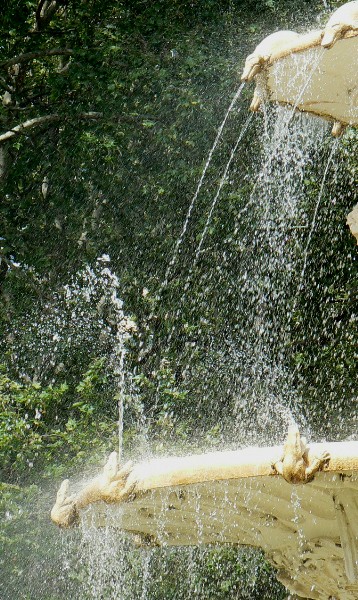
The drought's come to Melbourne: all the city's fountains have been shut off! That includes the rather grandly silly one in front of the Royal Exhibition Building. Here's the scene just a few weeks ago as a platoon of platypi kept malevolent mini-crocs from entering a pool in which little boys representing commerce, industry, science and the arts were at play.

Who's to stop the crocs now?

Thursday, November 02, 2006

Inga vs. Kate

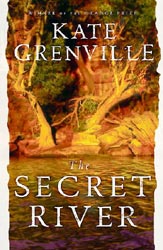
An interesting row has broken out between Inga Clendinnen, a distinguished historian, and the author Kate Grenville, whose book The Secret River was shortlisted for this year's Man Booker Prize. (I read Secret River last month, and found it moving and profound.)

The Secret River is a fiction of first contact, based on research in Grenville's family history - her account of researching the book is a fascinating read, too. It's the story of a London boatsman sent to New South Wales for theft, whose son and pregnant wife get to come along, too. Ferrying goods up an apparently undeveloped river north of Sydney the protagonist Thornhill spots a flat verdant area between loops of the river, and eventually settles his family there. Of course it was not uninhabited, and conflict with the Aborigines ensues.

The other settlers along the river run the gamut from friendly to the Aborigines to murderous. Thornhill tries to mind his own business, which of course is more easily said than done. The brutality of one of his fellow settlers provokes Aboriginal reprisals - and all the while the Thornhills are sitting on land the local Aborigenes relied on for food. Bad things happen. But the Thornhills survive and thrive. (All his children survive, a minor miracle for the early 19th century.) His wife Sal gives up her dream of returning to London - most of her children were born in this land, she says - and enjoys life as a wealthy countrywoman. Thornhill remains haunted by the cliffs across the river, which he can't stop scanning for Aborigenes.

This summary doesn't do the book justice - it's well worth reading. It's a moving and well-written book, working slowly but powerfully to the tragic climax and in some ways even more unnerving continuation of the story. It makes the challenges and compromises of ordinary people in the first decades of European settlement comprehensible and moving, acknowledging the crimes which attended the nation's founding.

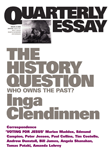
Or so I thought until I read Inga Clendinnen's "The History Question: Who Owns the Past?" - a lengthy essay (in a wonderful publication called Quarterly Essay, which each season publishes one long essay on a current topic and a dozen responses to the last one) on contemporary discussions about history, especially Australian history. It's mainly provoked by Prime Minister John Howard's critique of the "black armband version" of Australian history and call for an affirming national narrative which will communicate "core Australian values" to future generations, especially immigrants. Attacking his view is like shooting fish in a barrel, so Clendinnen's discussion ranges broadly to include not only the "Stolen Generations" but Waltzing Matilda (extract available online) and ANZAC Day.
And Grenville's Secret River. In a television interview Grenville had rather unwisely claimed that in novels like her own novelists were doing a new kind of history, indeed a work of history historians could not match, since it lets the reader really enter into the past. Clendinnen, who's done important work on past cultures and events like the Aztecs and the Holocaust, will have none of this. The past is a foreign country, our empathy is more likely to blind us to it than to give us entry. One of the things historians do is protect the past from contemporary appropriations.

Here's Clendinnen's retort to Grenville's claim to have written more authentic history because she not only read early colonial sources but subjected herself to a stormy passage across the bay and spent a night in the bush:

Some engaged reading, some preliminary flexing of the imagination, a run, a vault, and presto! you are there. How do you know you are are now in the Past? Because while the place might look exotic, you understand it so much better than the complicated place in which you usually live. In the novelist’s “past” everyone behaves delightfully, “in character”, and everyone submits to the plot. The novelist might surprise her readers. She will never surprise herself.

I can't wait for the responses!
Delicate

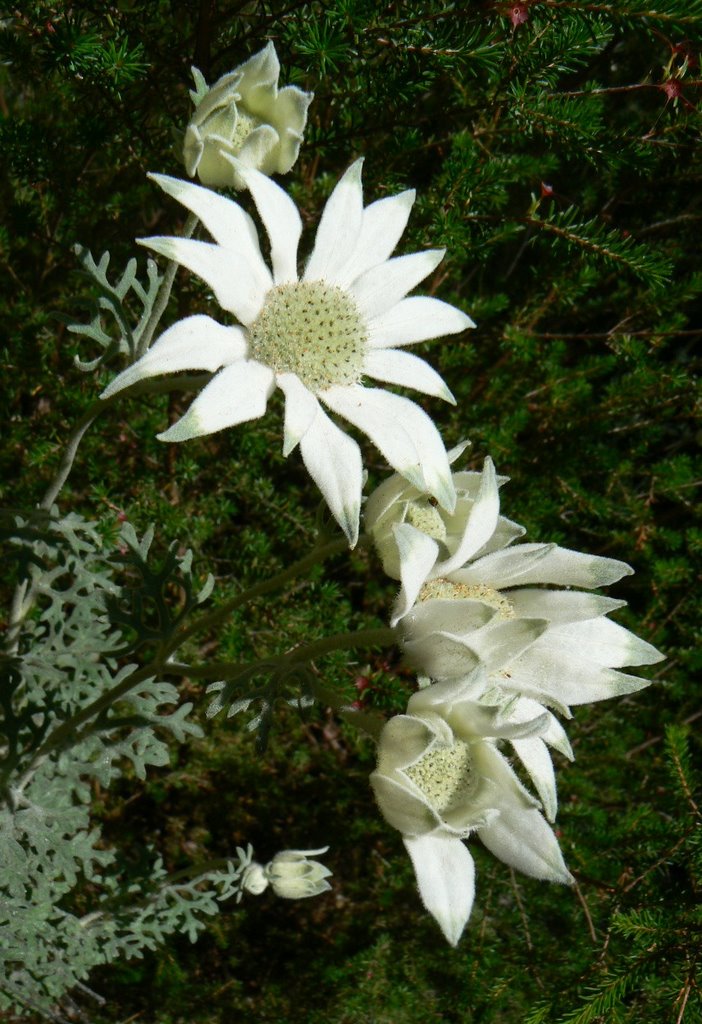
Here's another local flower, about 3" in diameter with thin soft furry petals you can hardly feel when you touch them.

Monday, October 30, 2006

Taipei personality

Today I'm sending off my paper for a symposium on the theory of religion as a resource for the study of Chinese religion to be held in a few weeks in Taiwan. As I know next to nothing about Chinese religion (and won't be learning much, as all the other papers but one will be delivered in Mandarin!), I'll be talking about the theory of religion.

In fact it will be my first chance to try out some of the key ideas from my book project on an unsuspecting world - specifically that modern western theory of religion has focused on problems of evil and meaninglessness, overlooking the continuing experience of the good. The new idea in this paper is that understanding religion as responding to evil makes ritual incomprehensible - it's just magical busywork meant to take our minds off things. If we see religion as a response to a world "ethically irrational" also in good - grace, serendipity, harmony, order, fecundity - things like ritual make more sense, since the goods of the world are more like an invitation to dance than a philosophical problem or existential challenge.

Some ritual surely works to anesthetize, and some to placate fears of dangerous powers. But there's also ritual like the dancing in Australian Aboriginal traditions, which someone has eloquently described as being part of the earth's own movement.

Sunday, October 29, 2006

Exhibition

The Royal Exhibition Building, one of Melbourne's 19th-century marvels, was open to the public yester- day. Its dome is apparently inspired by Florence's. I discovered what must be the inspiration for "The Adventures of Priscilla, Queen of the Desert" - that Hermes at top right is a little over the top, no?

Tallis

In church today we got to sing the hymn melody by Thomas Tallis around which Ralph Vaughan Williams wove his exquisite if melancholy "Fantasia on a Theme by Thomas Tallis" (New English Hymnal 373). I'd never sung it before. I felt Vaughan Williams' achingly beautiful orchestration welling up just outside the church as we sang...
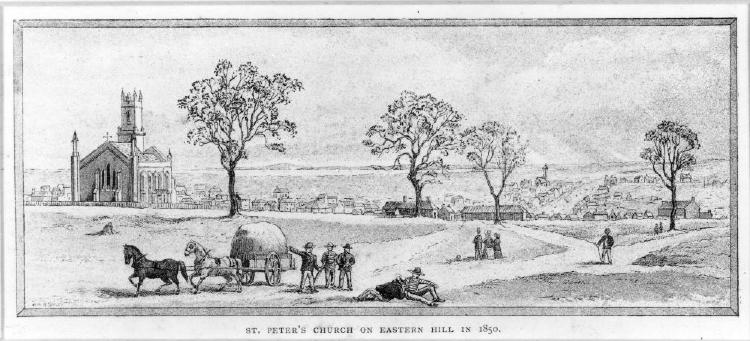
I haven't told you much about St. Peters Eastern Hill, the church I've been attending. (My housemates don't know: they figured that as a philosopher of religion I must have seen through the pretensions of all religions!) It has a long history, apparently very engagingly described in From Tories at Prayer to Socialists at Mass by Colin Holden, a book I've taken out of the library but haven't yet read. Next year will be its 160th anniversary.

Its environs no longer look as they did in the 1850 print above; on Eastern Hill it's been joined by the Catholic Cathedral, a synagogue, a Lutheran church - and Parliament. Old prints on the wall of the parish hall show an unadorned indeed stark Protestant-looking hall, but it has for a long time now been an Anglo-Catholic church, with that perhaps surprising combination of high liturgy and progressive theology characteristic of that movement. The sanctuary is gilt, six tall candles sit atop the altar at the end of the choir, the stations of the cross adorn the walls, and a Lady Chapel is off to the side, with a replica of the reconstructed statue of Our Lady of Walsingham in England. Just this year an icon panel was installed in the rafters - though that's more Orthodox than Catholic.

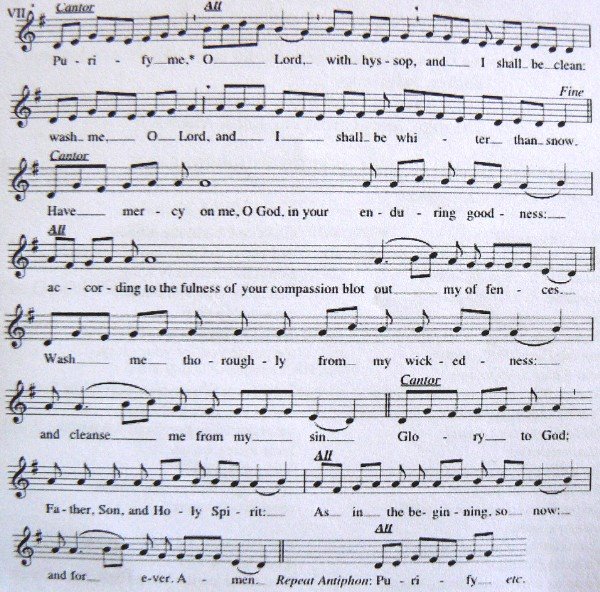
High Mass (as it's called, feel the Sydney Puritans cringe) has the congregation on its knees a lot, as when the choir sings the "Kyrie" and "Sanctus" from mass settings by Palestrina, Vittoria, Haydn or Mozart. (We stand for the "Gloria," and sing a setting of the Nicene Creed, so don't get to hear the "Credo.") But we start - at least in this season - like monastics, singing at a brisk clip the following lovely Gregorian melody
as the priest sprinkles the congregation with holy water. (Feel the Sydney Puritan's blood boil.)

Which reminds me of a time, years ago, when an undergraduate I knew at Princeton was baptized a Catholic. A fellow graduate student friend of mine, an atheist, came to the evening mass in the Princeton University Chapel. The priest sprinkled us, and she was splashed - and freaked out by it. I don't suppose I helped much by remarking that she wasn't going to hell after all...

Saturday, October 28, 2006

The Melbourne Model

A bundle of my mail from New York arrived yesterday - it had been sent in September by courier to Shepparton and returned for some reason (!), and then sent again and once again returned (!!), but has now safely arrived at the Philosophy Department. It includes a letter from the University of Melbourne dated 2 August (!!!) offering me status as an Honorary Lecturer within the Faculty of Arts, associated with the Department of Philosophy.

Honored, I'm sure! I thought I was just a somewhat shady Visitor. Whom can I lecture?

Melbourne Uni is actually about to embark on the biggest curricular change in its history, a sort of half-way accommodation with the American model and the Bologna Process making its way through the EU universities. Instead of applying into 3-year degrees in one of a huge number of subjects, effectively choosing their careers as they enter university, students starting in 2008 will enter one of six broader fields - and will get a "liberal arts" education, taking many courses outside that field. If they want, they can then stay on for a more specialized 2-year masters degree; they're assured a place if they've performed well.

I've heard it described lots of ways. (I dare you to brave the lame music and twangy students in their video for future students.) It will be good for students, I'm assured, because it's a more broad-based education, and allows them to make later and more informed choices about careers; it will also allow them to change field as they enter a masters, very difficult under the present system. It will be good for the humanities, I'm told, as more students will be taking courses in the humanities to satisfy the outside-your-major distribution requirement. It will be good for faculty, I'm let know, as they'll be able to teach more upper-level courses - and there'll be more of them.

But not everyone is enthusiastic. How will the broad undergraduate majors be structured with intellectual integrity? Some see the Melbourne Model as a grab for more tuition money for more faculty - students interested in specializing will now have to spend five years getting a general undergraduate degree and a masters, instead of four in a more specialized field culminating in a demanding honors year of research. (Under the present system, strong students are encouraged after their first year to aim for the honors year, effectively turning their remaining 2 + 1 years into a higher level course.)

I'm sure there's much of it I haven't yet understood, but it's exciting to be around as such big changes are bruited - though it might have been more exciting still half a year ago, before the Model was finalized and approved.

Needless to say this brings back endless discussions about curriculum, liberal arts, and the like back home! As you know, I think a liberal arts education is the way to go, not just because it anchors you in a more complete awareness and understanding of the world's richness and complexity (the traditional argument) but because most of the preprofessional stuff we teach will be obselete in a few years. Our students, at least in the US, are looking forward to switching career twice before they retire (if they can afford to retire, but that's another issue), - and not always because they want to.

So by all means give them a good foundation for redefining themselves and learning to learn new things, and some of the wisdom of the past for reflecting on what's happening. They'll need it.

Friday, October 27, 2006

Four seasons in one day

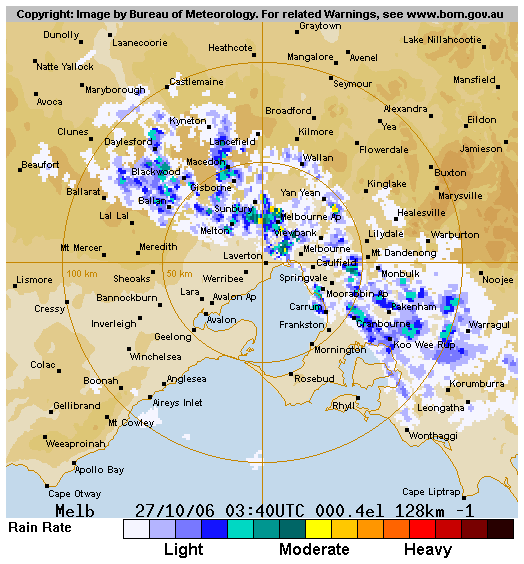
One thing of which Melburnians are proud is the weather - Syndeysiders have no weather, I hear, just endless sun. And no seasons, whereas Melbourne gives you all four seasons in one day, every day! ("Four seasons in one day" is a catchphrase, like "world's most livable city.") Sure enough, in the time it's taken me to write this the wet grey out the window gave way to blue sky on the horizon, then sun lit up the window frame, and now ... fades, the blue patch in the sky vanished. Dressing in this city is all about layers, many thin ones (like cross country skiing) rather than a few thicker ones, and cardigans with their ease of opening and shutting and half-opening will never go out of fashion. Happily humidity is low!

Today we've actually had what passes for precipitation in these days of drought, enough to mottle and briefly darken the ground! But the parched fields around Shepparton (north of the map as far again as Seymour), remain dry as dust. (Ah, but some of it might dribble on Shepparton, which you can see in this bigger, animated and regularly updated map.) And while I have your attention, do notice what a lovely natural harbor Melbourne boasts.

And allow me to say that, four seasons in one day notwithstanding, I am feeling great autumn withdrawal. My heart aches as friends and family describe walks in woods radiant in gold and red, and I picture buttoning up a coat, wrapping around a scarf, and thrilling at the wind's promise of colder times to come, when you'll be able even to see through the trees.

Which isn't to say, though, that I don't follow all the other residents of Melbourne to the sunny side of the road when the sun does show!

Thursday, October 26, 2006

Doping!

Sorry for the pause, I was up in Shepparton, which still feels like stepping into an alternate reality: the reality not only of the country but of the full-time stay-at-home childcare which is my sister's life at the moment. Two kids keep two (and even three!) adults plenty busy. I don't know how she does it alone most of most days... So my forays into Shepparton are also transitions from the lightness of being of a gentleman of leisure in the city, his commitments on hold far away, to the non-stop needs of a young nuclear family in a society (like the US) uncommitted to public childcare.

In other news, a classic story of American perfidy has been overturned. Phar Lap was not poisoned by American mafiosi, the widely held view apparently confirmed by a recent Australian study which found large quantities of arsenic in his hair, but by the cumulative effects of a toxic elixir his trainer used to help him win - doping avant la lettre! (You must know that Phar Lap might as well have been poisoned yesterday, as far as Australian memory goes, a few hours after Gallipoli - another case of betrayal - so it may be a while before the truth of this is acknowledged.)

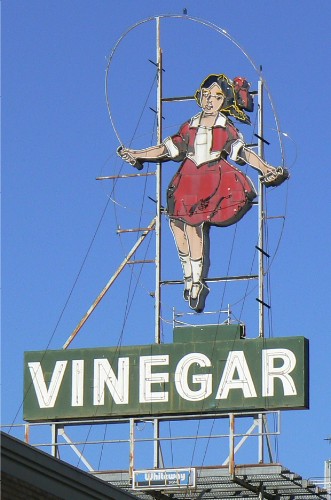
Today's picture has nothing to do with my sister or Phar Lap. It's Audrey the Skipping Girl, one of Melbourne's favorite neon signs, though her present form and location are shaped by the ironic twists and turns of retro nostalgia. (I've seen her because she's across the street from Ikea.)

Oh, and there's earthshine again today...

Monday, October 23, 2006

Like a child unsure of the sea

On Saturday I went to a poetry reading somewhat awkwardly called "What are poets for in an age of ecological crisis?" Six Australian poets read their work. One, whose poetry I found hard to grasp, gave the best answer to the question: "to a poet, every part of the poem is equal," he said, and this attitude is valuable more generally as one thinks about ecology. Another read a religious poem called "Master of energy and silence" which I found wonderful, particularly the middle stanza (... or perhaps only the middle stanza). Sadly Blogspot won't let me reproduce the format: every second line should be indented:

Master of energy and silence,
Embracer of Contradictions
Who withdraws behind death
Like horizons we never touch
Who can be One and Many
Like light refracted through glass,

Stepping in and out of logic
Like a child unsure of the sea
In and out of time
Like an old man dozing, waking,
In and out of history
Like a needle through cloth,

Who we chase and bother with theories
Who hides in equations and wind
Who is constant as the speed of light
Who stretches over the Empty Place
Who hangs the Earth upon Nothing
Who strikes like lightning.

The poet is Kevin Hart, and I found the poem in an anthology he edited, The Oxford Book of Australian Religious Verse (Melbourne, etc.: OUP, 1994), 89. Originally from England, Hart was a long time in Melbourne, and has only recently left - for a professorship in Theology and Literature at the University of Notre Dame. Indiana's climate has led him, he said, to write more about snow than was decent for an Australian poet.

Sunday, October 22, 2006

Brief


In light of the length of yesterday's post-inspired post (I thought it a somewhat inspired post in its own right, actually), I'll confine myself to a photo today.

What in heaven's name... ?

Friday, October 20, 2006

Share

What does the place I'm living in look like? Well, here's a taste, the post at the foot of the stairs. I count six different colors of paint, all of them eroded by the hands of people who lived here before any of us present residents arrived. I'd especially like to know who lived here when the stairs were painted yellow! Don't suppose I could find out even if I really wanted, though: the house has long been self-governing, and the landlord doesn't know or care who comes or goes so long as the rent is paid.

House shares seem an institution in this part of Melbourne, only partly because of the proximity of the Uni. I went to a party last night a bit north of here - a sort of welcome party for two recently arrived housemates in a house of similar design - and nobody there had been a student in a while. Phil has lived there twenty years. David, the friend who took me along, knows Phil because his (David's) partner Karen first lived there when she came to Melbourne many years ago, moved out for research (she's a linguist) and moved back, several times! Another of the housemates is a chipper bushwalking pyschologist from Adelaide, a third a rather morose doctor in training (or maybe he was just drunk). Makes for a more interesting, diverse mix of people than everyone living in a place of their own, and socializing only with people they know from school or work.

It reminded me of discussions about Wohngemeinschften I've had with family and friends in Germany. My cousin Agnes in Berlin lived in big apartments shared among four or six or more people for many years (grand 19th century bourgeois apartments with many rooms but few facilities), and says she thinks them a great laboratory for learning to respect different kinds of people. Different WG are governed in different ways, but you're always getting to know/having to cope with new arrivals, new kinds of food in the fridge, and perhaps new kinds of music from next door. My friend Lisa in Göttingen, a political theorist, has actually written about WG as sites of democratic praxis!

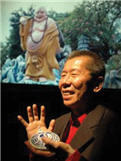
In an interesting, gently Taoist performance piece for the Melbourne International Festival called "Objects for Meditation," the gay Chinese Australian photographer and monologist William Yang talked (among many other things) about why he likes coming home to his empty apartment in Sydney. "Not lonely, but empty: empty can be filled, while lonely implies longing." That's sort of been my experience living alone these past few years - one needs a room of one's own - but sharing a house with relative strangers (I haven't told you about them because I don't yet know much) is reacquainting me with the pleasures of another way of living which seems every bit as natural.

As some of you may know, I'm working on a book on the good, and this is a nice way of discovering in reality something I've been persuaded of in theory for a while, that (as Aquinas argued) the greatest goods are intrinsically shared and shareable. It takes a bit of coordination about who showers when and you do have to clean up after yourself in the kitchen, but the very spaces you live in seem happier to participate in several lives - and to have participated in those of others who've moved on.

Heart of Victoria?

Just had lunch with some of the Melbourne Uni Philosophy Department people, and have to let you know that Shepparton, which might seem the middle of nowhere, is in fact the secret heart of Victoria. (Or at least it suddenly seemed so - and the internet's the home for baseless rumors, right?) Of three faculty members present, one grew up in Shepparton, and another's wife spent five year of her childhood there. A PhD candidate reported that her great grandparents (who had eighteen children) settled in Mooroopna, a stone's throw from Shepp. More: Brian Scarlett, the retired philosopher whose office I share and whom I finally met just now, has a car which says "Darryl Twitt Shepparton" on its back window. The car, which Brian bought used, originated at Twitt Motors in Shepp, and he's found the decal too amusing to remove. Even those not from Shepparton might seem, to the hungry eye, to hail from there!

"Heart of Victoria" puts me in mind of a desolate little park to which a Japanese friend took me once, dominated by a huge mirrored sphere and other abstract furnishings characteristic of the "bubble" period in the 1980s (when local governments had too much money for their own good). It's called "Haato [Heart] of Okayama," and is in fact in the very geographical center of Okayama Prefecture, though atop one of a series of bumpy mountains miles from any settlement. When we went the chrome sphere reflected other bumpy hills, the sky and Amakusa's car, all alone in the big parking area - and us, looking like twiggy extraterrestrials disappointed but a bit relieved not to have found the makers of this scar in the landscape!

By comparison, Shepparton veritably teems with people. And, somewhat off center (like the human heart), it might in fact be the heart of Victoria after all! I'll keep you posted.

Thursday, October 19, 2006

More local flora

Today's actually cold and grey with a threat of rain (promise, more like, for this drought- ravaged land), but my pics, as you'll have noticed, are posted with a certain time lag - and not just that it's Friday lunchtime but blogger will tell you it's dinnertime Thursday!

Wednesday, October 18, 2006

Meanwhile back in Melbourne

People look at me funny when I say I'm interested in learning an Aboriginal language, but I suppose I might do the same to an Aussie who came to the US and wanted to learn a native American language. Perhaps after this stay in Australia, (part of) which is in the midst of a facing up to the history of Aboriginal oppression, I'll respond differently.

It's not as though mainstream Australian culture isn't plenty interesting, of course; witness this billboard for one of the shopping centers in the middle of town! 'Course it might make Leonardo warm to Dan Brown.

Tuesday, October 17, 2006

Ngapartji ngapartji

As part of the Melbourne International Arts Festival (it's nonstop festivals in this town) I went last night to a performance called "Ngapartji ngapartji" (I give you something, you give me something). It's a multimedia storytelling of the experience of Aboriginals from the "Spinifex mob," whose land in the southwest of Australia was used by Britain for nuclear weapons tests, resulting in cancer for many and rootlessness for all. The narrator, Trevor Jamieson, told it through his family's trail of sorrows, and he was accompanied by a choir of old women, a Japanese butoh dancer, an Afghan refugee girl (the first foreigner Jamieson's ancestors met was an Afghan, brought in by the British to tame the desert) - and a language teacher.

We were taught to sing in the Pitjantjatara language:

Tjamu, kami

Mama, ngunytju
Kuta, kangkuru, kulali-ya
Ngangatja tjukurpa nyuntumpa ngalimpa
Nyaakun kulira wantinyi nyangatja?

Grandpa, grandma
Father, mother
Brother, sister, listen all of you
This story is yours, ours
Why have you stopped listening to this one?

The performance is part of a larger project which includes internet instruction in Pitjantjatara, "the oldest language in the world." (http://ninti.ngapartji.org/) There's a group of learners just down Lygon Street... I'm signing up!

Monday, October 16, 2006

Aboriginal art

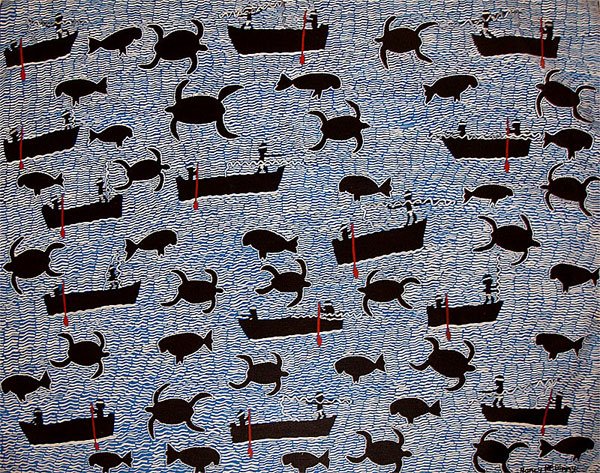
Just found online the image of a lovely work of contemporary Aboriginal art I had the good fortune to see in an exhibit connected to the just-ended Melbourne Fringe Festival (at a gallery called Indigenart): Nancy McDinny's "Dugong and Turtle Hunting." The canvas is quite large and as you swim around in it, fishing boats are as easy (or hard) to make out as turtles or dugong (relatives of the manatee)!

Unsurprisingly, the painting's been snatched up by the Australian National Maritime Museum.

Sunday, October 15, 2006

Landscape zipper

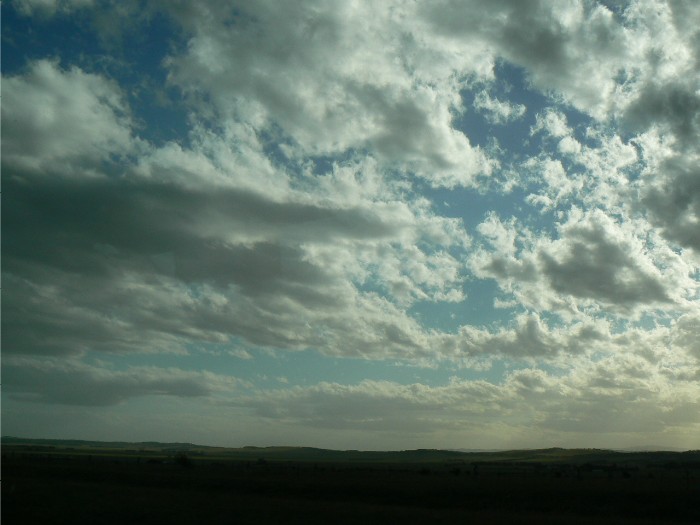
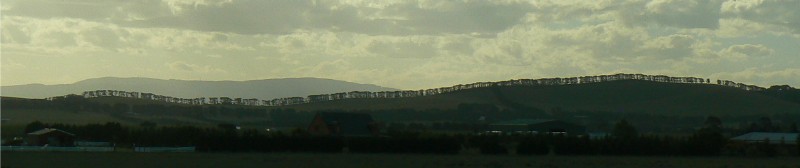
There's not much between Melbourne and Shepparton, leaving plenty of room for sky. All the gums (=eucalyptus trees) sneaking bluffly or cagily by the train window meant I didn't realize the emptiness until I took an evening train which might as well have been in a tunnel for two hours. But from the bus the horizon's far far away and the big sky is visible and endless!

Some interesting phenomena along the horizon eventually when you look more closely, though, a landscape zipper only the white man would think of...

Rural cosmopolitanism

Turns out Shepparton is quite the cosmopolitan country town. In the bus I took back to Melbourne last weekend I was surrounded by Chinese, Italian and Russian speaking passengers. My sister's friends (all mothers in tow to their husband's careers) hail from New Zealand, South Africa, Sri Lanka and Trinidad. An English neighbor lived in Qatar and Boca Raton before winding up here. A little shopping jaunt Saturday morning took my sister and me to a European deli, a fruit and vegetable grocer with five kinds of pasta imported from Italy, and an Indian shop (Sikh) sandwiched happily between two Muslim grocers. On one of Shepparton's main shopping streets Mustafa's, at left, has a market of Turkish goods, many of which are labeled in Turkish and German.

In fact, it turns out that Shepparton is well known for successful multiculturalism, especially for the settlement of refugees. It has a sizable Iraqi population, another of Macedonians and Albanians, and a new population of Congolese. It makes sense, I guess: refugees from rural areas settle better, and can find work more easily, in an agricultural area than in a city. The Goulborn Valley has long depended on migrant fruit pickers, and seems to be taking well to these populations settling in.

I probably shouldn't be surprised. The latest US census showed that immigrants there no longer head for the big gateway cities, but often go straight to smaller cities and towns. And in Japan I remember hearing that Filipinos and others were being sought to maintain farmlands whose youngsters were bolting to the cities. (Swiss farmers haven't dared think that far.) We tend to hear more about high culture and middle class and suburban trends, but globalization is happening at all levels.

Saturday, October 14, 2006

Back to work

After a lovely three days in Shepparton, it's back to Melbourne and back to the books for me. This, by the way, is the (way classy) office the nice folk at the Philosophy Department are letting me use. I may have mentioned that the building, the Old Quadrangle, was the first building of the university campus, started in 1853. (It was 3/4-finished until a few decades ago, which presumably accounts for why the building is represented as an inverted U rather than a square on the map below.) I'm on that computer (a Mac no less!) as we speak. And I may figure out the problem of good on that whiteboard!