
Monday, December 31, 2018
Prosit!

Sunday, December 30, 2018


Friday, December 28, 2018

Thursday, December 27, 2018
Desert getaway

Dried bloom of Nolina Parryi (wolfii) at Joshua Tree National Park,
Dale Chihuly's "End of the Day #2" (1996) at Palm Springs Museum of Art

Wednesday, December 26, 2018


Monday, December 24, 2018

Sunday, December 23, 2018

Saturday, December 22, 2018
Border

One more photo from yesterday's Torrey Pines trek, evoking
the way the beach functions as a borderlands of earth and sky.
Friday, December 21, 2018


Thursday, December 20, 2018

Wednesday, December 19, 2018


Tuesday, December 18, 2018
RItual ending
The final class session of "Theorizing Religion" is devoted to final reflections - students each get a chance to share theirs, and I surprise them by telling them I've done one as well. This is becoming something a ritual for me, since I've taught some version of this course pretty much every year since I started teaching. I didn't point out that that is longer than many of them have been around! But, in response to a question from one student, I did reflect a little on how things have changed. There was a time when most of the students believed the secularization thesis - that religion was on the way out. Then there was a time when students couldn't understand how anyone could ever have thought religion wouldn't be here, for better or for worse. This year's class was a mix of the two - though their responses suggested that each had found their assumptions challenged. I must still be doing something right!
Other things have changed about the course too, like the inclusion of the MOOCs as a way of acknowledging students ignorance of religious traditions, and discussions of religious freedom in American law which put the "what is religion and who decides?" questions in a stark new light. But something else emerged in this year's iteration, a better way of folding "lived religion" into a theory of religion course. After lots of reading and discussion on religion and "world religions," we turned to "lived religion" as a recognition that religion is lived differently by different people, usually in ways which the systematizers and centralizers of traditions deplore. This resonates with the "DIY religion" approach Winnifred Fallers Sullivan has described as the American way in religion, intuitively right for our class. But we weren't finished: the next section of the course introduced the masters of suspicion and was centered on the question "do religious people know what they're doing?"
I think I'll keep this for next time, as it's uncomfortable in all the right ways (for me too). We'd like to think that people know what's best for themselves - the "I'm okay, you're okay" relativism which I've long seen as students' decent if flabby response to religious diversity (not to mention the premise of a "self-designed" college curriculum!). But in the real world, people are challenging others' self-understandings all the time. And not just psychologists, sociologists and the like. Consciousness raisers and social critics more generally are doing that, too, and missionaries for various faiths and unfaiths. Friends, too! Next time I want to play up the theological (in the broad sense - not just Christian) challenge. We came close to it a few times this year in discussion of "white Evangelicals," most explicitly in James Cone's claim that many white Americans' faith wasn't actually Christianity at all. We didn't do full justice to the complement later in the course, Karl Barth's argument that "religion" in all its forms is a form of faithlessness. Next time? Maybe with a Buddhist complement?
I imagine next year's reflection roundup will be enough like its predecessors. Someone will say they still haven't arrived at a definition of religion, and another will say there's value in the many different ones we encountered, and someone will wonder if this isn't true of all categories. Perhaps, as again this year, someone will opine that, in fact, everything that exists just is, beyond definition. Several will say they came in with strong views about religion and religious people and that these have been tempered by something like respect; today someone said ours has been the most "compassionate" space for discussion of religion she's ever been in. That made me happy. And another, whose response said your method of teaching has ... help[ed] me to approach the topic of religion completely unbiased and neutral, open to everything, while also accepting and being conscious of my biases and opinions and went on to say I want to know more words, I want to know more perspectives, and I want to use those new words to say exactly what I mean when I respond to those perspectives. Bingo!
Other things have changed about the course too, like the inclusion of the MOOCs as a way of acknowledging students ignorance of religious traditions, and discussions of religious freedom in American law which put the "what is religion and who decides?" questions in a stark new light. But something else emerged in this year's iteration, a better way of folding "lived religion" into a theory of religion course. After lots of reading and discussion on religion and "world religions," we turned to "lived religion" as a recognition that religion is lived differently by different people, usually in ways which the systematizers and centralizers of traditions deplore. This resonates with the "DIY religion" approach Winnifred Fallers Sullivan has described as the American way in religion, intuitively right for our class. But we weren't finished: the next section of the course introduced the masters of suspicion and was centered on the question "do religious people know what they're doing?"
I think I'll keep this for next time, as it's uncomfortable in all the right ways (for me too). We'd like to think that people know what's best for themselves - the "I'm okay, you're okay" relativism which I've long seen as students' decent if flabby response to religious diversity (not to mention the premise of a "self-designed" college curriculum!). But in the real world, people are challenging others' self-understandings all the time. And not just psychologists, sociologists and the like. Consciousness raisers and social critics more generally are doing that, too, and missionaries for various faiths and unfaiths. Friends, too! Next time I want to play up the theological (in the broad sense - not just Christian) challenge. We came close to it a few times this year in discussion of "white Evangelicals," most explicitly in James Cone's claim that many white Americans' faith wasn't actually Christianity at all. We didn't do full justice to the complement later in the course, Karl Barth's argument that "religion" in all its forms is a form of faithlessness. Next time? Maybe with a Buddhist complement?
I imagine next year's reflection roundup will be enough like its predecessors. Someone will say they still haven't arrived at a definition of religion, and another will say there's value in the many different ones we encountered, and someone will wonder if this isn't true of all categories. Perhaps, as again this year, someone will opine that, in fact, everything that exists just is, beyond definition. Several will say they came in with strong views about religion and religious people and that these have been tempered by something like respect; today someone said ours has been the most "compassionate" space for discussion of religion she's ever been in. That made me happy. And another, whose response said your method of teaching has ... help[ed] me to approach the topic of religion completely unbiased and neutral, open to everything, while also accepting and being conscious of my biases and opinions and went on to say I want to know more words, I want to know more perspectives, and I want to use those new words to say exactly what I mean when I respond to those perspectives. Bingo!
Monday, December 17, 2018


Saturday, December 15, 2018
Winter colors

 Some of these red leaves were among the first to turn, still holding out!
 Witch hazel! And among the reeds and golden berries: a mockingbird!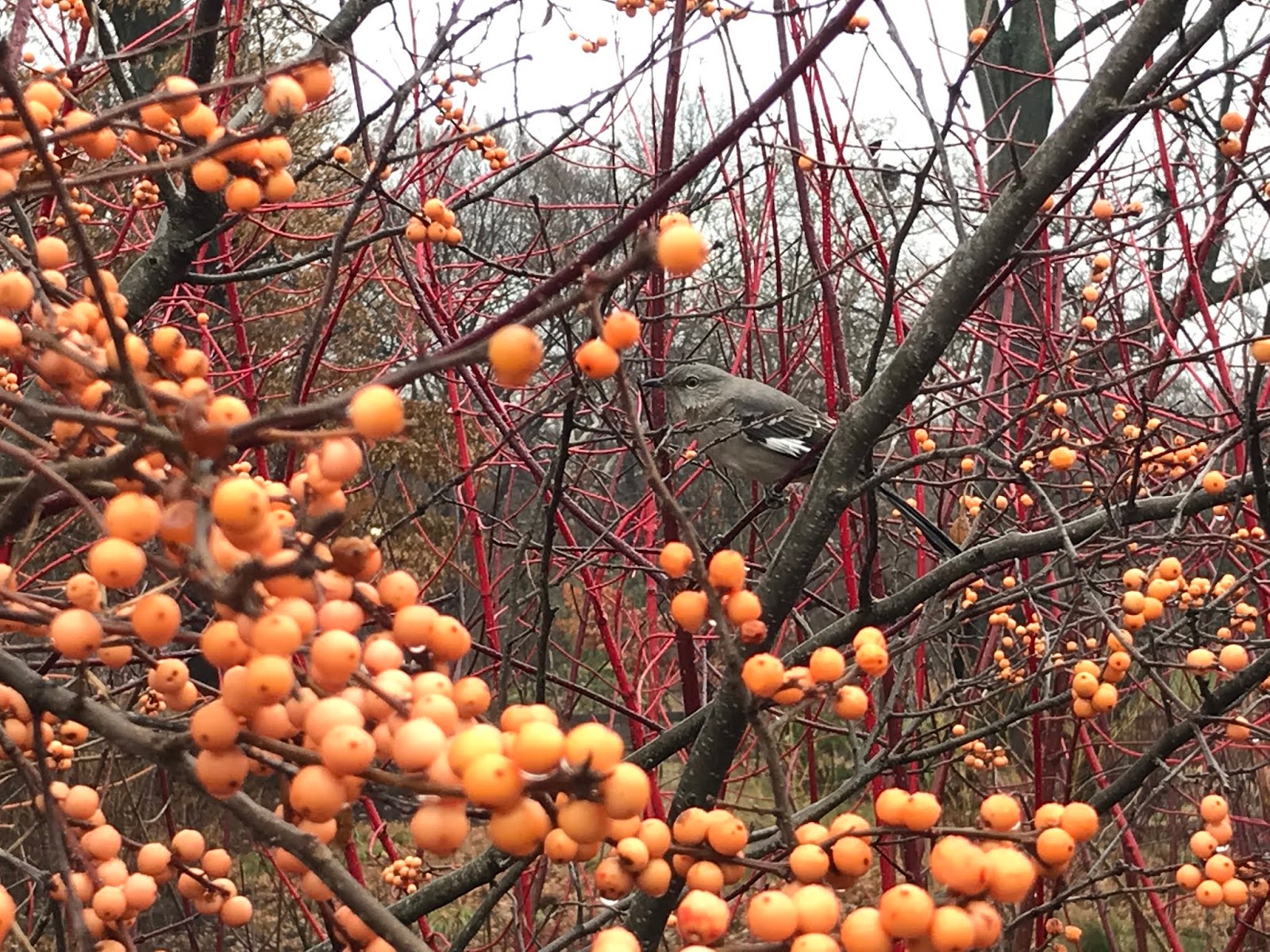
Friday, December 14, 2018
Library virtuoso
 The newest installment in the New School Histories vertical appeared today, an account of the quite different legacies of classical music teaching at the New School and at the Mannes School of Music, which merged in 1989. It's by musicologist Sally Bick, who is ideally positioned to tell this story as she has not only an authority on music in the interwar period but was once a performer, and is now a scholar:
This disciplinary divide is rarely understood by the public, let alone the educational institutions that house music programs. I am often reminded of this confusion when, for example, I’m asked what I do for a living. My answer, “I’m a musicologist,” is invariably followed by the immediate question, “What instrument do you play?” At this juncture, I usually stop to allow a rhetorical moment of contemplation and then answer, “I play the library.”
It's a great piece, and suggests ways in which the New School and Mannes, now together, have bridged this divide. It also helps us establish the project of the vertical, both in terms of its scope (all parts of the New School family, including the pre-New School years of units later grafted on to the New School tree, are included) and its authorship (Bick teaches in Canada, and was never a New Schooler).
Thursday, December 13, 2018
Hope beyond hope
Two new faculty members at The New School are anthropocene specialists. We all recently got together and I listened in as the two of them traded stories of their courses, getting some pointers for my own upcoming class. Managing hope and despair is clearly going to be central - as if one could. One colleague described her surprise when students, in an assignment late in her course which asked them to imagine some aspect of the world in 50 years, went full dystopia. The other told us his courses often lead students to an existential crisis about a third of the way in - many arrive unfamiliar with the realities of climate change, biodiversity loss and political failure - and then builds toward an almost optimistic position. Disruption and contingency are places for creativity and resilience. Dwelling in the despair is a sign of privilege; we must learn from the indigenous and dispossessed of the world, who have been living with crisis - Kyle White says in a sci-fi world - for centuries.
Subscribe to:
Posts (Atom)