All of the advertising space in the Union Square subway concourse has been filled with New School swag this week. Come join the cool kids at the Festival of New! Many of the people invited to its assorted conversations are names unknown to me - new, I guess! But two discussions I attended today had me thinking in a new way about 1919 and why one might have thought that universities weren't up to the task of preparing us for an increasingly complex and dynamic world...
In one, dedicated to new thinking on climate resilience, a speaker and his host, both of whom encourage people to envision futures 50 or 60 years from now as part of urban planning, disagreed over whether human beings were hard-wired for short-term thinking. The speaker thought not: while the amygdala forces short-term thinking, the prefrontal lobes are designed to help us think long term, as ancient societies show. Short-term concerns have to be addressed before people can really settle into longer-term visioning, but it can be done. (Meditation can help too, apparently!) Our culture, however, trains us to be short-term thinkers in every way - a culture we need to change if we are to develop the "ethics of the anthropocene" we urgently need.

I got to thinking about what a school could to encourage longer-term thinking, and whether our school does it. We talk a lot about wicked problems, challenging the status quo, being unafraid of the new. But our curriculum's determinedly presentist. Can people envision a more than immediate future if they never learn about the past?
The other panel was about decolonizing the university, and also touched on the anthropocene. One speaker recalled alum Roy Scranton's argument that we need to learn to let our (western) civilization die before it destroys all possibility of life on this planet, and went on to argue that universities, as producers of colonialist knowledge and validators of colonialist structures and institutions may need to go, too. It's not enough to bring indigenous knowledges, epistemologies and scholars into the university; as long as they are just a supplement to a settler colonial institution the institution is unchanged, or even made more dangerous. Referring to the
Universidad de la Tierra in Oaxaca, he imagined new institutions serving the needs of indigenous people and the ecological lifeworlds they alone understand how to sustain (a kind of long term thinking!). The authority we enjoy as credentialed university professors? We may need to give it away.
This too got me thinking of 1919. The founders' criticisms of universities as reactionary, dangerously committed to old ways of knowing and thinking, aren't as radical as these critiques (though they too had seen a civilization collapsing in WW1). But to the extent that they abandoned university careers to throw in their lot with a fledging "school" which disdained disciplines and degrees and an education built around inheritances, they too gave away the prestige of being part of an institution which didn't realize it was bankrupt and complicit. We're a university ourselves now, of course... Much to ponder!
In other news, the US
president shot someone on Fifth Avenue today.


 I got to thinking about what a school could to encourage longer-term thinking, and whether our school does it. We talk a lot about wicked problems, challenging the status quo, being unafraid of the new. But our curriculum's determinedly presentist. Can people envision a more than immediate future if they never learn about the past?
 We opened "Theorizing Religion" to the public today as part of the Festival of New... four of the people who signed up even came! But it gave me an excuse to invite Matthew Kaufman to speak, and to put together a series of archival images chronicling religious studies at the New School - or perhaps New School history through religious studies.
 1929: Another Kallen course puts religion on notice
 1934: The University in Exile brings sociology of religion
 1945: New School is where Reinhold Niebuhr analyzes the postwar

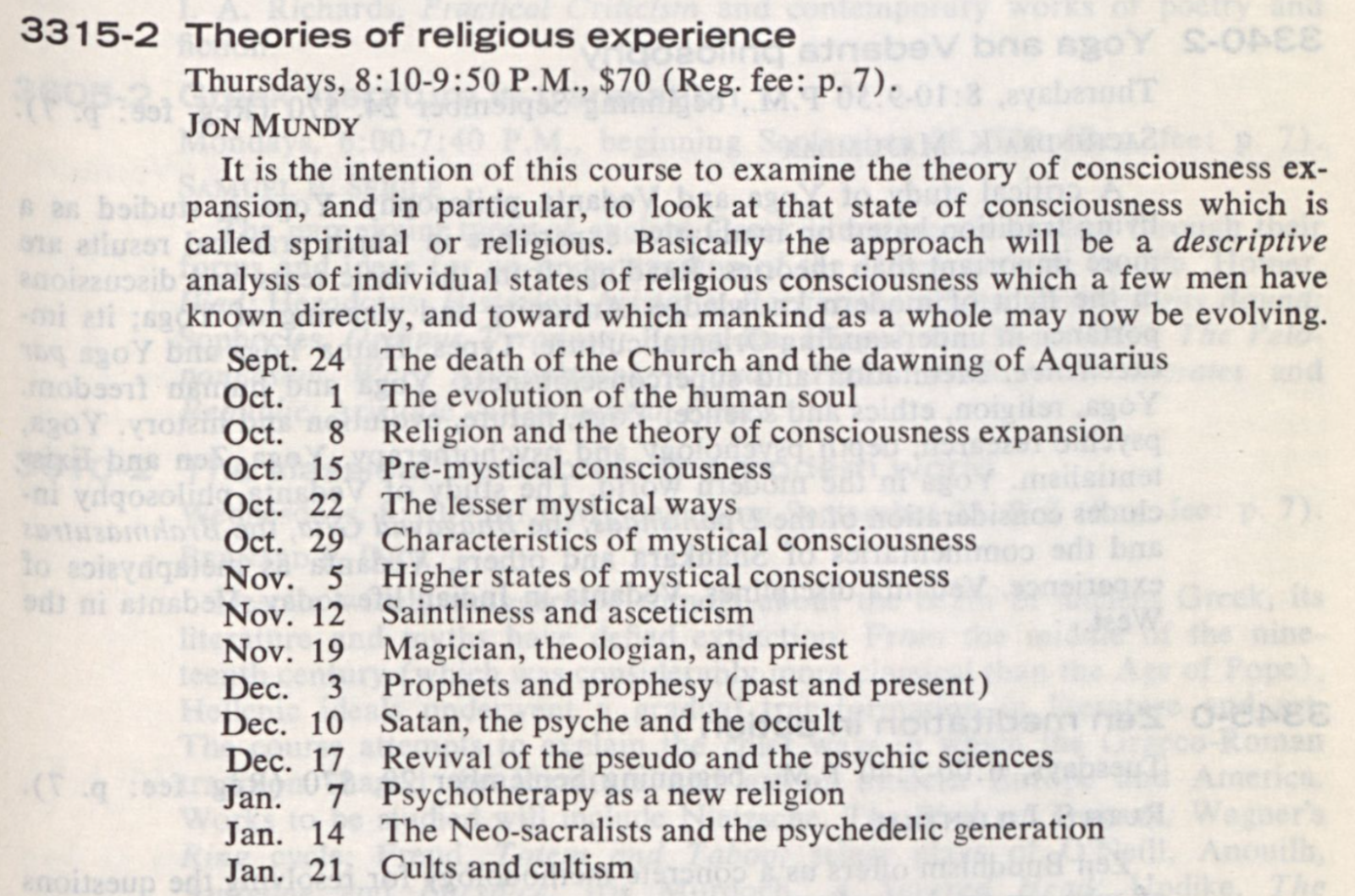 1970: The New School embraces the Age of Aquarius
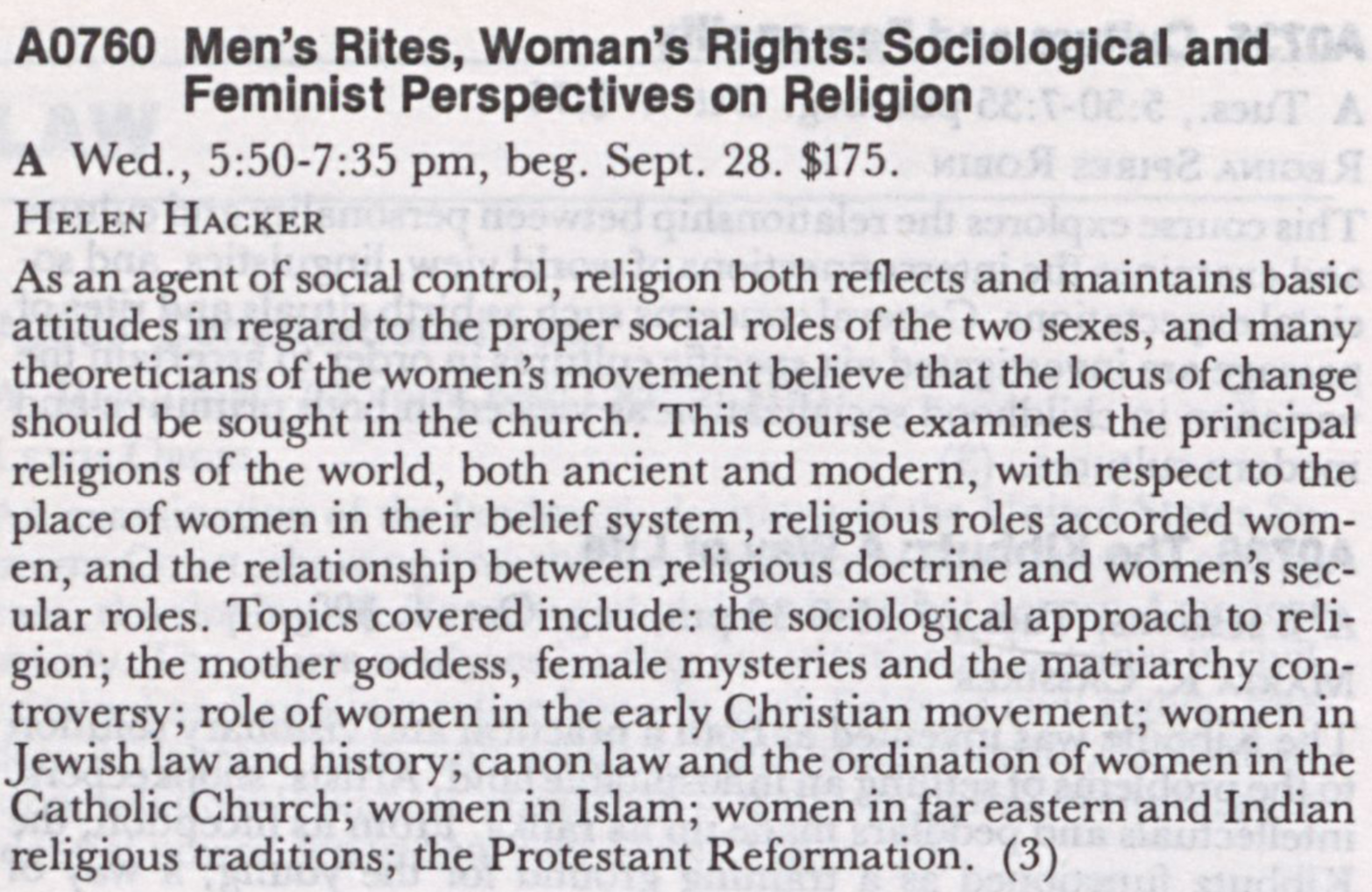 1983: We explore feminist reimaginings of religion
 1995: Our tradition of interrogating secularism is alive and well
 2012: We bring together scholarship, theology and lived religion
  At the festive opening of the centennial "Festival of New" this morning, something remarkable happened. In semio-scripted and off the cuff remarks by assembled deans, provost, president and chair of the student senate (faculty and staff were not represented) none of the usual suspects at the scene in 1919 were mentioned (John Dewey, Charles Beard, James Harvey Robinson, Thorstein Veblen) but Clara Mayer was, several times! Kudos to all who have recovered the memory of the woman who, for nearly four decades, helped make the New School what it was - only to be written out of the story for another six. She's such a hot property now, the dean of one of the divisions she wasn't involved in told me as we munched commemorative babka after the festivities, that everyone wants to claim her! There's some kind of justice in this.


 The latest installment of our newer truer history of The New School (the 24th!) relates our storied murals and other works by our muralists to contemporary controversies around political art in schools. Fascinating!
 through their scriptures" MOOCs (Islam and Buddhism) and producing
  outlines of courses of their own! I had little to do but chaperone...
 Unpacking in the new apartment is nearly complete! And guess what: I was so zealous in shedding books, donating the equivalent of twenty boxes to the Brooklyn Public Library, carrying many others to my office and leaving not a few for the Brooklyn street, that this is all that's left. Overdid it a little...! But I don't doubt their numbers will soon swell.
 Barely into the new academic year and already thinking about the next one. Course planning has to start early at a university where a relatively small corps of full time faculty are stretched across many programs and divisions, so the ULEC program to which I regularly contribute (Job and the Arts, and the New School History class) sent feelers out this week. As it happened, their query arrived just as I was preparing the reading from Tomoko Masuzawa's The Invention of World Religions for "Theorizing Religion."


 The latest installment of our newer truer history of The New School is up on Public Seminar - one of mine. The prehistory of the school I teach at, it brings together questions and discoveries of many years trying to figure this place out. I'd originally entitled it Experimental Colleges: The New School's Long Road to a Four-Year College, but the PS editors bumped my subtitle to title and added a slightly more boosterish subtitle of their own, 100 years in, the New School's experimental ethos lives on. That sounds rather more coherent and consistent than the story warrants! No matter, anyone who actually reads the piece will discover that the prehistory of our 4-year college is full not only of cool ideas but also of false starts and abandoned experiments.


