Friday, April 30, 2021
What lies beneath
Thursday, April 29, 2021
As knot is to net
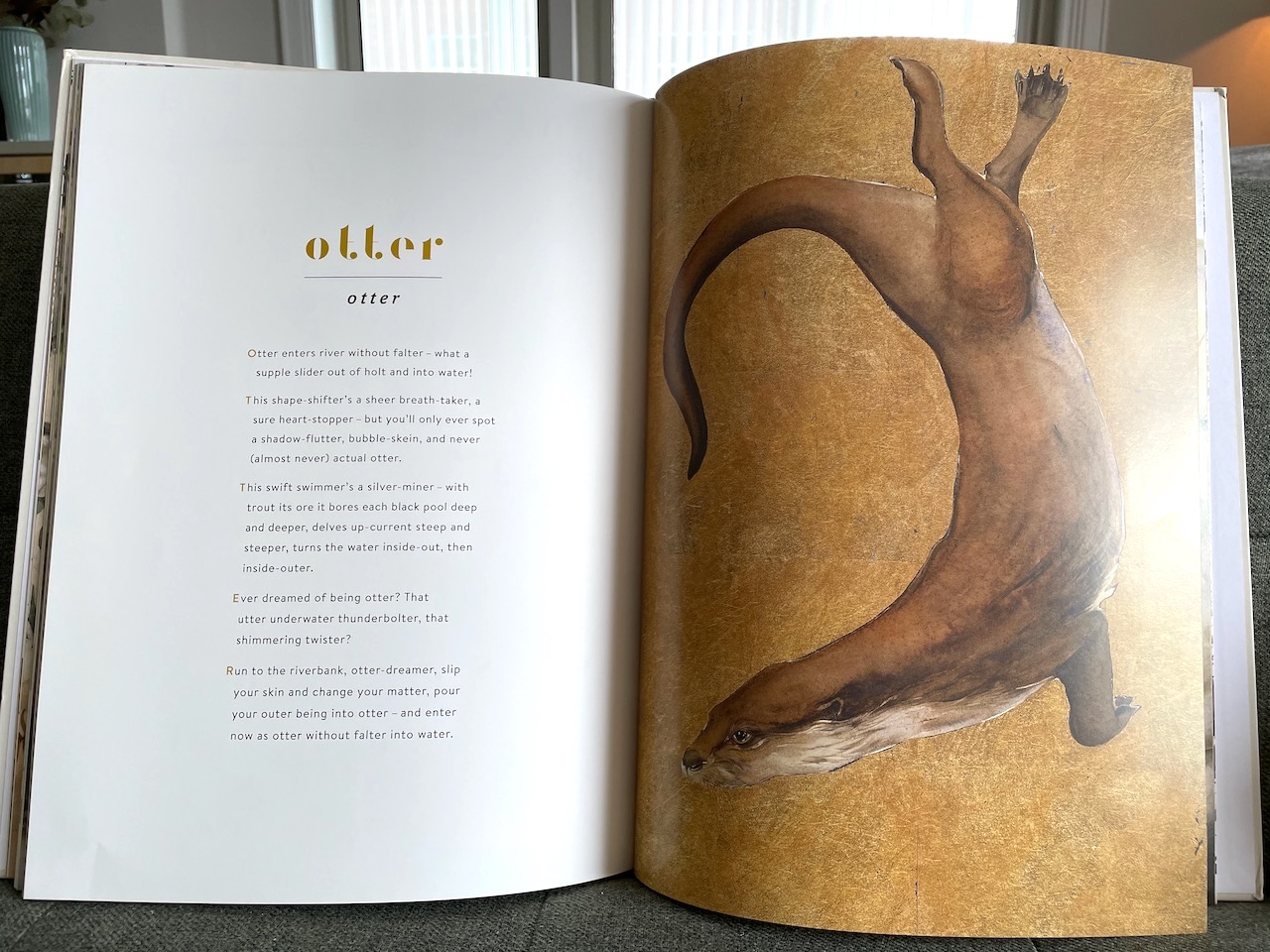
A quite wonderful object has found its way into my world, a big book, ostensibly for children, called The Lost Words: A Spell Book. The work of poet Robert Macfarlane and illustrator Jackie Morris, it's huge - I had to prop it up on the sofa to take a picture. The book appeared in 2017 as a response to a revision of the Oxford Junior Dictionary a decade before, which had made room for new words like "broadband" by eliminating others, based on "the current frequency of words in daily language of children." Among the words dropped were many relating to the natural landscape, and as these omissions were uncovered - fern, raven, kingfisher, ivy, wren, bramble, heron, willow... - public dismay ensued. If these words were no longer much used, oughtn't one, rather, to work to make sure they came back, rather than ratifying their loss?
Hence this book, which conjures back these "lost words" with gorgeous images and, for each one, an acrostic poem - "a spell" - to restore the word to its lived splendor. It always begins with a riddle - the letters of a word hidden among natural shapes - and continues through a "spell," facing a portrait of the thing itself on gold leaf, to a double-page spread of the thing in its natural setting.
The first suite of images and poem establish the whole project. Conveniently, if shockingly, the alphabetically first of their "lost words" is one it boggles the mind anyone could have thought dispensable: acorn. This is Macfarlane's spell for it:
acorn
As flake is to blizzard, as
Curve is to sphere, as knot is to net, as
One is to many, as coin is to money, as bird is to flock, as
Rock is to mountain, as drop is to fountain, as spring is to river, as glint is to glitter, as
Near is to far, as wind is to weather, as feather is to flight, as light is to star, as kindness is to good, so acorn is to wood.
Sublime, profound, and such fun to say... Without ever even having to use the word "oak," we see the worlds which acorns open to us in meaning and promise, microcosm and macrocosm, change and charm. Macfarlane challenges us to consider how important acquaintance with acorns has been for human thinking on all those things - and how bereft we would be, not only of oak knowledge, were the word and its world to vanish. What were those Junior Dictionary editors thinking?!
Wednesday, April 28, 2021
Javitz jabbed again!
Three weeks to the minute later, second jab complete! You're not supposed to take pictures inside but I had to get a picture of my freshly earned sticker, which says VACCINATE NEW YORK: I GOT MY VACCINE AT THE JAVITS CENTER.
Aibo
"After Religion" is almost done! We have a final session next week, a showcase of student final projects (due and presented in discussion sections this week), but there won't be any more occasions for lecture or discussion. And there wasn't much time for a lecture today, either, as we decided to give some of the lecture time to the discussion sections so students had a decent amount of time to present and receive feedback on their projects... and we're supposed to allot class time for course evaluations, too! So we had an absurd half hour. I decided the best use of it would be a google.doc and discussion, so everyone had a chance to contribute in some way, but I prefaced that with a very quick roundup of inspiring things in the course materials for this week. If I keep the section on transhuman religion next time round, I'll make sure I have time to screen and discuss this video, which was linked to in one of our assigned readings.
It shows a Buddhist ritual for aibo, the first generation of robotic AI puppies, programmed to be companions for human beings young and old, with endearing and even "mischievous" features; these robots are especially widely used for very old people living alone, and produce true joy and comfort. It's traditional in Japan to ritually thank the other-than-human companions which have attended us in life - dolls, tools of various trades, etc. - and it makes sense to do so for aibo too. Their relationships with us are not unreal or meaningless just because they are inanimate - if indeed they aren't animate! The article suggests Shinto and Buddhism undergird a willingness to recognize animacy widely in the land of 鉄腕アトム (Astro Boy).
There's more media attention to robotic priests, like the animatronic Mindar (also in Japan), who teaches about the Heart Sutra, but our capacity to bond with robotic dogs (and to create robotic dogs people can bond with) seems a more interesting way into thinking about religion and new technologies. Coming after a section on the wisdom of traditional indigenous ways of knowing and being, which recognize the animacy of the other-than-human world and the necessity of being in just relation with it, this would raise all sorts of cool human-transcending questions. The dots were there to connect this year, too.
Our discussion today was abbreviated but the google.doc helped students imagine an AI bot which would be an amalgamation of religious teachers/mentors (one student quipped it could be called Baha'i Bot), and which everyone seemed keen and ready to learn from. After Religion indeed!
Sunday, April 25, 2021
Nomadland
Some Confucian wisdom found its way to the Oscars this year. Chloé Zhao, who won Best Director for "Nomadland," quoted from the 13th century 三字經 / Three Character Classic she memorized as a child:
Saturday, April 24, 2021
Friday, April 23, 2021
Mandala-dimensional
Had the pleasure today of seeing a fab exhibition at the Rubin Museum of Art with a friend who hasn't been to a museum - or to New York City - in a year! Since the exhibition, "Awaken: A Tibetan Buddhist Journey Toward Enlightenment," is about expanding one's perception, it was especially trippy. The exhibition begins with this fantastic (and wall-filling) work by Tsherin Sherpa, "Luxation 1" (2016), painted in response to the 2015 Nepal earthquake but here an invitation to recognize how jumbled our consciousness is. The exhibition, originally from the Virginia Museum of Fine Arts, was designed before the pandemic but for its Rubin iteration someone's put together, facing Sherpa's work, a wall of pad- and phone-sized screens busily flashing a sequence of images from the past year, in case we needed reminding!
The deity here, Vajrabhairava, a wrathful manifestation of Mañjushri, is the star of this show, which we discover is patterned after the meditation journey to which a 300 century old Mandala of Vajrabhairava (above) invites you. Of course what a mandala invites you to do is to visualize in three dimensions what it presents in two (and eventually to visualize yourself as the deities you've three-dimensionally visualized: nonduality realized). The exhibition manages to make this real in quite astounding ways you need to experience yourself. (It's open through early next year.) Ritual implements made from human skulls reinforce the reality of what Vajrabhairava is doing with two of his 34 hands: grinding up someone's brains in a bowl made of the top of (someone else's?) skull. Behold: a 15th century Tibetan "flaying knife-chopper" and 19th century Mongolian "skull cup":
(You can see the hands at work in the 3rd row, 2nd column of the Sherpa painting at the top.) It would flatten the exhibition's achievement back to two dimensions for me to show you pictures of its discoveries, not to mention undo the necessary work of journeying. But I have to say that it really was a double-taking and brain-scrambling experience - and not just for my friend who's been in two-dimensional zoom world for a year... It's like discovering the three-dimensional world - and your own three-dimensional body moving through it - for the first time. So no photos for our screen world of "Awaken"'s culminating 3D show-stoppers. But I guess I can share another painting of Sherpa's from the mid-point of the journey, the two-panel 2013 "Multiple Protector (Peach)." This controlled generative whirl is what is happening to your senses as you move through the plays of light and darkness, the straight and curved walls - maybe the edges of Vajrabhairava's flaying knife-chopper in our own brains! - of this expertly mandalically-designed exhibition!
Thursday, April 22, 2021
Earth Day
Don’t Bother the Earth Spirit
Don’t bother the earth spirit who lives here. She is working on a story. It is the oldest story in the world and it is delicate, changing. If she sees you watching she will invite you in for coffee, give you warm bread, and you will be obligated to stay and listen. But this is no ordinary story. You will have to endure earthquakes, lightning, the deaths of all those you love, the most blinding beauty. It’s a story so compelling you may never want to leave; this is how she traps you. See that stone finger over there? That is the only one who ever escaped.
Wednesday, April 21, 2021
Black Lives Matter
A day after the announcement of the verdict in the trial of Derek Chauvin - guilty on all counts - a welter of feelings. It began with a confusion of tears. It is a good thing that justice was served, but not that justice was necessary. That there was any doubt at what the outcome would be - how apprehensive we all were - shows how suspicious we have become of our institutions; relief that the system can work gives way to gloomy awareness of how often it doesn't.
Yet George Floyd remains dead, his family bereft. Most other victims of police brutality get even less than this, of course; their killers are unpunished and often the victims are blamed for their own deaths.
My second thought, after relief and a kind of delirious joy at the announcement, was "who's next? those responsible for Sandra Bland's death? Philando Castile's? Breonna Taylor's? Daunte Wright's?..." We know too many names, though we don't know nearly enough of them, and it strains credulity to imagine there will be justice for all or even many of them. Let's work and hope for it anyway, and for more. Retributive justice by itself is still part of an unjust system.
Tuesday, April 20, 2021
Monday, April 19, 2021
Exhaustion
A friend of mine at another university, finding the energy among the students in one of her classes flagging, invited them to share how they were feeling. These are anonymous virtual post-its, and I'm sure almost any class in the country - in the world - right now might generate similar expressions of shame and guilt given an instructor compassionate to inquire. We're all worn out, on many levels, but her students, like mine and many others, are also struggling with all this through screens in their childhood bedrooms or parents' basement. My friend remarked: isolation from peer groups means that many students don't have school social groups to talk to, which helps to contextualize and collectivize their feelings. Many of them are taking in the exhaustion as an individual failure. Seeing each other's distress may have helped here! How compassionate we need to be to each other in this pandemic time, and how much we still cannot fix.
Sunday, April 18, 2021
我第五千五百篇的博客文章
Saturday, April 17, 2021
Three million souls lost
Since I'm in a wealthy vaccine-producing country, every conversation I have these days is about vaccines - who's how far along, side effects, when they'll be fully covered, travel, what to do about those unwilling to vaccinate, what life will look like when and where "herd immunity" is reached. (I realize I've posted about it only once in over a month - for my vaccination!) The US government's pause on the Johnson & Johnson vaccine has added anxieties (for one of my students, who'd taken it two days before the announcement, it was occasion for terror), but one feels on a road to recovery. Not so other parts of the world, many of which are suffering from new waves and new variants, vaccine shortages, exhaustion and protest. It seems naive to suppose the US, too, won't be hit by a new wave... Indeed, as hospitals reach capacity across the land, the situation remains perilous here, too. NYC, over the latest hump, remains at "very high risk" of exposure.
Friday, April 16, 2021
Wari
Thursday, April 15, 2021
Wednesday, April 14, 2021
I hope you dance
In revising the syllabus for "After Religion" at mid-semester I decided to add a week on "nature spirituality." It took the place of an envisioned discussion of "religious fictions" which would have looked at books like Left Behind and The Shack, televised Mahabharatas in India, Journey to the West movies, and the various imaginings of the afterlife in Pixar movies. These would have been fun, too, but, given students' interests (as I've been able to glean them through the double-filter of zoom and lecture distance) it seemed more important to address the frontiers of spirituality beyond inherited religious traditions, rather than creativity within them.
"Nature spirituality" is an awkward phrase. I found it in the title of Bron Taylor's Dark Green Religion: Nature Religion and the Planetary Future (2009), a book which argued that we're witnessing the appearance of a new religion based in experiences of the sacredness of nature. (I gave students a radio interview about the book to listen to.) The force behind the International Society for the Study of Religion, Nature and Culture and editor of the landmark Encyclopedia of Religion and Nature, Taylor draws on fieldwork with radical environmentalists, official and off-the-record reports from scientists, surfers, the spirituality of Disney movies and much else, with special attention to Thoreau and Darwin. He sees "Animist" and "Gaian" forms of this new religion, each appearing in a "spiritual" form (believing in otherworldly, divine, supernatural intelligences), and a "naturalistic" form (which finds enough in what the senses and the natural sciences offer us). Taylor's sympathies lie with the naturalistic, which he thinks will prevail as more people discover the spiritual sustenance offered by them - who needs the word of ancient seers and exalted gurus when you can taste and see the sacred for yourself?
As I thought about other things I might want students to taste - the subject is at least as vast as Taylor's 2000-page Encyclopedia - I decided to talk about "religious naturalism," especially as articulated by Carol Wayne White in conversation with emergence theory and African American history. But as I pondered emergence I decided it might also be fun to spend a little time on the question if we are "religious by nature," a question I provocatively put this way: "Were we religious before we were human?" It's a trippy question.
While a highlight would be the delirious argument of Ursula Goodenough and Terrence Deacon (among the sources Carol Wayne White discusses) that the elements of most of our religious inklings are shared with other life forms, many quite widely, I felt I had also to introduce discussions about the spirituality some have claimed to witness in our closest kin. So we watched chimpanzees at Gombe and Jane Goodall's assertion that their unusual behavior around a waterfall must be expressions of "awe and wonder." Tuesday, April 13, 2021
Left behind
Learned a heap at today's Religious Studies Roundtable on QAnon and Religion - including how odd our methodo-logical agnosticism ("we're not discussing whether this is true or false") sounds outside the familiar contexts. Well done, students!
Monday, April 12, 2021
Festive
This week our college is celebrating the work of our intrepid students, who have continued, despite pandemic and zoom quarantine, to do remarkable things. Religious Studies is a comparatively tiny program but is well represented. The poster session of today's Dean's Honor Symposium included three projects which grew out of our classes - Mia Perez's "Seminarium: Literary Mysticism and Us" and Skye Telleen's "Jesus as Mother," inspired by the course "Meetings with Remarkable Mystics," and Kate Zibluk's "Cyclical Scripture," which began as a final project for "Performing the Problem of Suffering: The Book of Job and the Arts." And tomorrow our Spring Roundtable will feature the work of two graduating seniors, Elliott Ryan and Stephanie Zamarripa, whose capstone research projects afford them special insights into the unnerving phenomenon of "QAnon and Religion." Congrats!