Showing posts with label william james. Show all posts

Friday, May 09, 2025

Back in the Dacks

All three of my classes wrapped up this week - rather sweetly, too, if you ask me. Papers need to be read and grades tabulated before graduation next week, but all that can be done anywhere. So we hopped in the car and are back in our beloved Adirondacks. 

I could devise a meaningful-seeming segue if you wish: the Friday class was the one on William James' Varieties, and a nearly mystical experience in the Adirondacks seems to have been decisive in that work's composition. Call it research! And of course, it's the perfect segue back to my own religion of trees work, too. 

We decamped to the 'Dacks around this time last year, too, but this is a week and a half earlier - even deeper back in the spring which, in New York City, is already passign the baton to summer. We've been here in early May before, but didn't notice these gaggles of ferns popping up along the rain-flush Hudson before!

Friday, May 02, 2025

Not infinite, not solitary

Since all facts are particular facts (522) ... the practical needs and experiences of religion seem to me sufficiently met by the belief that beyond each man and in a fashion continuous with him there exists a larger power which is friendly to him and to his ideals. All that the facts require is that the power should be both other and larger than our conscious selves. Anything larger will do, if only it be large enough to trust for the next step. It need not be infinite, it need not be solitary. (525) 

To process the quietly explosive implications of William James' "piecemeal supernaturalism," the Varieties class (well, the students who could make it) today pulled out guitar and watercolors. I provided tea. 


We have one more session, next week, to come to a more academic conclusion of our explorations, but it was nice to extend our textual discussions by articulating the ways the stuff of Varieties speaks to us more personally. (Several of us tried to make visual sense of the claim that In the religion of the twice-born, ... the world is a double-storied mystery, 166) It was nice to see the friendships forged in the class, too!

Saturday, April 26, 2025

Gospel of James

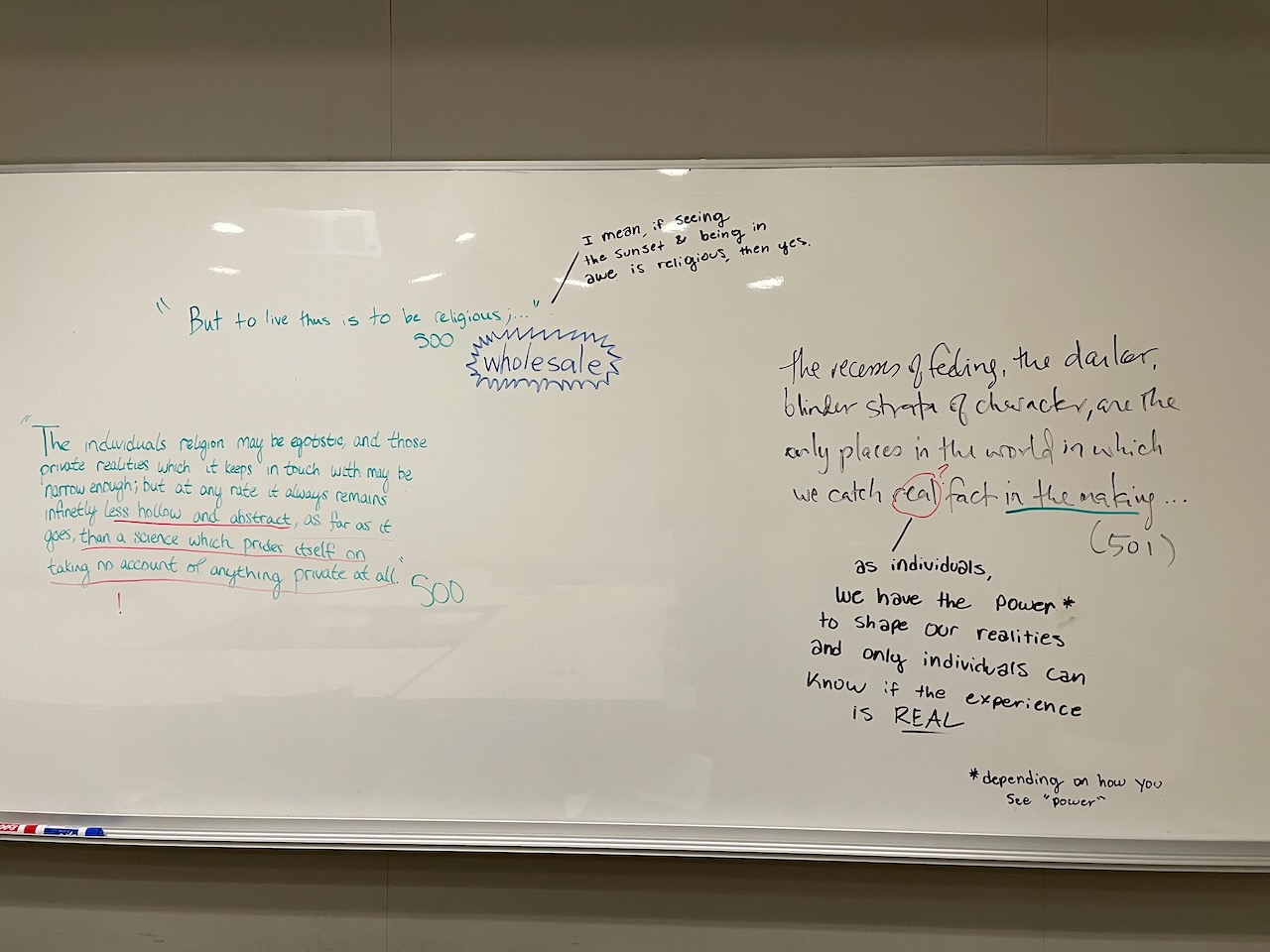
We've nearly finished our semester-long read-through of James' Varieties (all but the Postscript). I had everyone write out something they found significant from his "Conclusion" on one of the two whiteboards which frame our class, and then move around the room and underline, comment or otherwise respond to some of what their classmates had written. 

Instead of taking the quotes in the sequence in which they appear in the text we went clockwise around the room, hearing from those who'd chosen and from those who'd responded to each passage. This somewhat jumbly approach proved perfect for teasing out the most important themes in the book as a whole and our enduring questions about them. 

In particular it helped me make clear that James thinks the evidence he's assembled and parsed entitles him to make some bold claims - not just about religious experiences and their variety but about their significance. For it is in these experiences, which in their irreducible personalness are "fuller" than the abstracted and general teachings of the sciences, philosophy and theology, that we appreciate that reality itself is more than the sciences, philosophy and theology can conceive. 

Epitomized by prayer, the mutual intercourse of an individual with what they take to be divine, religion in this way is not just relational but transactional. We and God have business with each other. Human beings don't just access new energy, peace and inspiration in the experiences he calls religious, but it might be there that we make our signal contribution to the universe.

The quote I put up for us to engage (which I made sure came at the end of our movement around the room) was: the recesses of feeling, the darker, blinder strata of character, are the only places in the world in which we catch real fact in the making (501). 

By this time we'd revisited James' sense that religious experience comes through a "subliminal door" and had seen the ways he bends and stretches words like "real" and "fact." We remembered our impatience with the squishiness of his language and frustration at his almost solipsistic emphasis on the individual when human lives are social and many of our most important experiences are too. 


We'd seen Oliver Wendell Holmes' observation that on religion James had always made a point to turn the lights down low so as to give miracle a chance but this time we found ourselves willing to join him. How exciting to conclude with the pregnant paradox of fact in the making, how electrifying the hope that one might achieve effective occupation of a place in life, with its dynamic currents passing through your being.

I found myself quite the evangelist for James, delivering the good news that there is enough openness in a reality that at its deepest is about relationship that received accounts of the world and our place in it are always incomplete. Just as the saints lead us redefine our human possibilities, so our experience and attention forge new connections within reality as a whole, "new facts." As James concludes the book, Who knows whether the faithfulness of individuals here below to their own poor over-beliefs may not actually help God in turn to be more effectively faithful to his own greater tasks?

Next week we'll see James move beyond the "God" language he settled into for the comfort of the audience of the Varieties lectures and suggest that the personal transactional reality disclosed to us in the variety of religious experiences is more polytheistic, the "piecemeal supernaturalism" which Mary-Jane Rubenstein celebrates as a "pluralistic pantheism." How many of us will be willing to go there with him?

Friday, April 18, 2025

Hill of beans

William James on the illusion of order - or disorder - in the world.

When one views the world with no definite theological bias one way or the

other, one sees that order and disorder, as we now recognize them, are purely

human inventions. We are interested in certain types of arrangement, useful,

æsthetic, or moral,—so interested that whenever we find them realized, the fact

emphatically rivets our attention. The result is that we work over the contents

of the world selectively. It is overflowing with disorderly arrangements from

our point of view, but order is the only thing we care for and look at, and by

choosing, one can always find some sort of orderly arrangement in the midst of

any chaos. If I should throw down a thousand beans at random upon a table, I

could doubtless, by eliminating a sufficient number of them, leave the rest in

almost any geometrical pattern you might propose to me, and you might then

say that that pattern was the thing prefigured beforehand, and that the other

beans were mere irrelevance and packing material. Our dealings with Nature

are just like this. She is a vast plenum in which our attention draws capricious

lines in innumerable directions. We count and name whatever lies upon the

special lines we trace, whilst the other things and the untraced lines are neither

named nor counted. There are in reality infinitely more things 'unadapted' to

each other in this world than there are things 'adapted'; infinitely more things

with irregular relations than with regular relations between them. But we look

for the regular kind of thing exclusively, and ingeniously discover and preserve

it in our memory. It accumulates with other regular kinds, until the collection of

them fills our encyclopædias. Yet all the while between and around them lies an

infinite anonymous chaos of objects that no one ever thought of together, of

relations that never yet attracted our attention. (Varieties, 438n)

Is our cherry-picking too unambitious? Noticing the unremarked "relations" among the "infinite chaos of objects" might be part of making them into adaptations. I love the bean game. Maybe Bruno Munari can help us take it farther! Courtyard maples in red/green/yellow approve!


Friday, March 28, 2025

Saints vs. strongmen

We discussed my favorite part of James' Varieties today, "The Value of Saintliness." (We go way back. It gave me the name for one of my first first year seminars at The New School, "Preposterous Saints," a preposterously long time ago.) As our society suffers a hostile takeover by the worst kind of patriarchal bullies, some passages resound with a new urgency. This one, for instance, in James' discussion of the prophetic character of the "excess of tenderness" of many saints, something that turns their unworldliness into a promise.

A society where all were invariably aggressive would destroy itself by inner friction, and in a society where some are aggressive, others must be non-resistant, if there is to be any kind of order. This is the present constitution of society, and to the mixture we owe many of our blessings. But the aggressive members of society are always tending to become bullies, robbers, and swindlers; and no one believes that such a state of things as we now live in is the millennium. 

This is characteristic James in this section - speaking for a supposed skeptical "common sense," only to argue that this common sense can already see beyond itself, thanks to the inspiration of the saints. 

It is meanwhile quite possible to conceive an imaginary society in which there should be no aggressiveness, but only sympathy and fairness,—any small community of true friends now realizes such a society. Abstractly considered, such a society on a large scale would be the millennium, for every good thing might be realized there with no expense of friction. To such a millennial society the saint would be entirely adapted. His peaceful modes of appeal would be efficacious over his companions, and there would be no one extant to take advantage of his non-resistance. The saint is therefore abstractly a higher type of man than the “strong man,” because he is adapted to the highest society conceivable, whether that society ever be concretely possible or not. 

My discussions of this passage have tended to stop here, with some reflections on James' will/right to believe, which pertains precisely in cases where there's not enough information to decide an existential question, but how you respond to it is of "momentous" significance to you - and might even contribute to the reality of what you commit to believing. In fact the passage here continues for two more sentences: 

The strong man would immediately tend by his presence to make that society deteriorate. It would become inferior in everything save in a certain kind of bellicose excitement, dear to men as they now are. (374-5) 

James moves quickly on from this, as the saints do, guided by the better possibilities, but reading this in March 2025 it's hard not to see a warning of an anti-millennium. Don't let the haters convince you that humanity is capable of less than you already know it to be capable of: be as saintly as you can. It might not bring about the millennium, just preventing utter societal collapse... or it might.

Monday, March 24, 2025

In nuce

Religious studies folks know that William James was thinking about religion long before and well after Varieties but it's still fun to what what seems like the kernel of that major project in his first public address on pragmatism, "Philosophical Conceptions and Practical Results," delivered in California in 1898.

Friday, February 21, 2025

Just asking

We took a breather from James' Varieties today to consider the proposed update in David B. Yaden and Andrew Newberg's Varieties of Spiritual Experience: 21st Century Research and Perspectives. Professing to revive and renew James' "phenomenologically sensitive," "philosophically sensible" and "scientifically oriented" approach to the psychology of religion (8-9), Yaden and Newberg synthesize a century's worth of work and report the results of their own psychometric work building on it. 

Our class moved toward trying their survey ourselves, but started with some of the research James' book worked from, findings assembled by James' student Edwin Starbuck for his Psychology of Religion. People love writing about themselves, especially when told they need not share what they wrote, so we first spent time answering a subset of six of Starbuck's questions which appears in Varieties (above). I thought the questions pretty 19th century but the students were game. Later learning about the broader set of "autobiographical" questions Starbucks' questionnaires inquired about, they were even more intrigued. If 19th century, this was the formula for a novel - about you!

A few students recalled having seen the set of six questions in James Varieties itself but none remembered that it was in a place where James quotes a robustly "healthy-minded" person cheerily responding "nothing," "no," "none" to most of them! 


A good moment to reinforce the provocation of James' counting such a view as "religious." We realized how Starbuck and James had managed, despite the Christian language shaping of their work, to offer questions open and open-ended enough to allow for a wide variety of experiences to reveal themselves in response.

It was time for the online survey, called Varieties Corpus. Everyone enjoys an online poll but this one (which takes about thirty minutes) rankled, if perhaps in fruitful ways. It opens by asking participants to describe a powerful experience in their own words ("phenomenologically sensitive") but then asks participants a barrage of questions about that experience in terms gleaned from past iterations of their survey, and over and over again in different positive and negative formulations.

It was hard not to feel badgered. Really, like any such device, it's wittingly or unwittingly an education in the terms the researchers think important. Yaden and Newberg claim to have discovered six different varieties of spiritual experience: unity, divinity [or numinous], revelatory, synchronicity, paranormal and aesthetic. But maybe these are terms worth adding to our autobiographies? Near the end the survey asks participants are asked to count the number of times they've had each.

Quantitative research, even "phenomenologically sensitive," ick! It all left us ready to return to James's 19th century characters - we left his "sick souls" twisting in the wind this week, though we know we'll find "conversion" rescuing many of them next week - but alert in a new way to the stakes of this line of inquiry. The "science of religions" language is James'. Science of what, for what?

Punting on the religious questions (is any of it, well, real?) in their "philosophically sensible" agnosticism, Yaden and Newberg are interested in the therapeutic applications of their findings - as part of "positive psychology." James' concerns seem to have been more personally existential, but also more curious about what "religious" experiences reveal about the often painfully pluralistic universe of which we're a part.

Friday, February 14, 2025

Timing

It would be a busy semester even without the carnage of the old-new presidential regime, tearing at the foundations of our world. But somehow I'm managing to keep things on track, generating welcoming learning communities in which students are making friends and engaging challenging ideas - part of "carrying on" as resistance to chaos and paralysis. As I stagger to the end of the week I'm particularly pleased with the way I was able to end the last two.

The week had started with reading some classic texts in "Religion and Ecology": Lynn White's field-creating 1967 essay on the religious origins of the ecological crisis, and one of the texts he refers to, the creation narrative in Genesis 1 - home of the "dominion clause" which, White argues, in western Christianity formed the uniquely anthropocentric civilization despoiling our planet. 

Then, in "After Religion," came the travails of secularism, an embattled ideal in need of challenging and perhaps also championing. Heady stuff; I might share some of the class's ideas with you next week.

Let me say a little more about the second session of "Religion and Ecology." Following up on Genesis 1 we read the alternate (actually older) creation narrative of Genesis 2, then contrasted both with the cosmology of the Skywoman story with which Robin Wall Kimmerer starts Braiding Sweetgrass. Despite glaring differences, there was no relation - let along community - recognized among the human and other than human in either Genesis. Then we rubbed it in more with a reading of Genesis 3 - the banishment from Eden - and a reread of Kimmerer's words about the fateful encounter of the "offspring of Skywoman and the children of Eve," which we read two weeks ago.

On one side of the world were people whose relationship with the living world was shaped by Skywoman, who created a garden for the well-being of all. On the other side was another woman with a garden and a tree. But for tasting its fruit, she was banished from the garden and the gates clanged shut behind her. That mother of men was made to wander in the wilderness and earn her bread by the sweat of her brow, not by filling her mouth with the sweet juicy fruits that bend the branches low. In order to eat, she was instructed to subdue the wilderness into which she was cast. 

Same species, same earth, different stories. Like Creation stories everywhere, cosmologies are a source of identity and orientation to the world. They tell us who we are. We are inevitably shaped by them no matter how distant they may be from our consciousness. One story leads to the generous embrace of the living world, the other to banishment. One woman is our ancestral gardener, a cocreator of the good green world that would be the home of her descendants. The other was an exile, just passing through an alien world on a rough road to her real home in heaven.

We'd read this together before; now we get it, the class said! We turned then to Kimmerer's "grammar of animacy," the urgent need to learn to recognize all the other than human peoples around us, who offer us wisdom and relation - which might start with the use of a new pronoun, ki.

All of this, amazingly, we did in 75 minutes, and class is 100. For the balance of class I led the group in a Thich Nhat Hanh-inspired silent group walking meditation around the block. I'd promised them both a field trip and meditation, and this wasn't what they were expecting, so I thought I might as well throw ki into it too. Mind your walking slo-o-o-owly, I said, and connect with the other than human kin along the way. We'll take 20 minutes, and I'll make sure we finish on time by setting my timer for 15 minutes: you can silence your phones. At 15 minutes the class had settled a little restlessly into the ultra-slow pace I'd set (from the rear) and we'd reached only halfway around the block! It felt like crazy speeding up returning to the normal pace which delivered us back at school at exactly 3:40. That was amazing, said one student, perhaps a little insincerely. The amazing thing, I responded, is that you could do this around any block, any time. 

I stuck the landing for the James' Varieties class today, too. We had a friendly and wide-ranging discussion of the "sick soul," and the profound sense of the cruelty and meaninglessness of the world which James argues some of these "religious pessimist" are "congenitally fated" to dwell on. This class professes to be more "healthy-minded" than others I've guided through this book, and many thought the agonies of the sick souls overwrought. "Don't ruin it for it for everyone," responded one in half-jest to Tolstoy's account of the bottom falling out of his outwardly successful life. 

But James wants us to face the fact that anyone's life could come unmoored due to forces beyond our control. So in the class' last minutes I had someone read aloud the text James put in a footnote to the chapter's final paragraph, a terrifying account of a group walking at night (presumably in India) whose leader was suddenly dragged away by a tiger. The rush of the animal, and the crush of the poor victim's bones in his mouth, and his last cry of distress, ‘Ho hai!’ involuntarily reëchoed by all of us, was over in three seconds. The shell-shocked survivors found themselves on the ground, we heard, initially unable to move for fright, and only a whisper of the same ‘Ho hai!’ was heard from us. Eventually, still stunned, they were able to sprint to safety, but were surely tiger-haunted for the rest of their days. How's that for the precarity of good fortune? 

Class was in its final minute. "Ho hai," I said. "See you next week." 

I'm pleased with the elegance of these class endings, but really I'm happy that in this fourth week of the semester the class communities feel like they have become enough of a reality that I can throw such disconcerting things at them in parting. They know we'll be together again next week. And, I hope, they feel - from the precise timing of the class finales - that I can be trusted to keep these spaces safe for abiding with the big, hard questions together.

Friday, January 24, 2025

Overlapping

A rather full day - first session of "Varieties of Religious Experience," followed by a five hour "Faculty Retreat on AI and Higher Education." Since I was running out of the adrenaline that has somehow kept jetlag at bay all week, I smushed them together.

More specifically, so as not to squander one of our fifteen weekly sessions, "Varieties" started with William James' essay "The Will to Believe."  (Its shorter precursor did too.) It's a good introduction to Jamesian matters and (almost) short enough to cover in one class. And, I realized rereading it, it's the text of a lecture given to college students, the philosophy clubs at Yale and Brown, and begins with James' challenging these student audiences to hear him out on subjects his own students won't follow him on. James' argument is a "justification of faith," a defense of the value of believing rather than suspending belief even where evidence is insufficient, at least in the cases where the decision is "momentous" and "forced," and notably with regard to moral and religious issues.

I have long defended to my own students the lawfulness of voluntarily adopted faith; but as soon as they have got well imbued with the logical spirit, they have as a rule refused to admit my contention to be lawful, philosophically, even though in point of fact they were personally all the time chock-full of of some faith or other themselves. (2)

James' students, inspired by the apparently high-minded idea that "It is wrong always, everywhere, and for every one, to believe anything upon insufficient evidence" (8), are naive about the ways the human mind works (it's always driven by its passions) as well as the reality of the universe. Deciding not to believe is itself a decision, James argues, and there are worse things than being duped, since one can correct. Sometimes believing is good, even existentially necessary, for the believer. And there may even be cases where faith in a fact can help create the fact (25)!

A stranger set of arguments than many suspect, ranging from epistemology through psychology to something like a theory of religion. 

Religions differ so much in their accidents that in discussing the religious question we must make it very generic and broad. ... [R]eligion says essentially two things. ¶ First, she says that the best things are the more eternal things, the overlapping things, the things in the universe that throw the last stone, so to speak, and say the final word ... ¶ The second affirmation of religion is that we are better off even now if we believe her first affirmation to be true. (24-25)

The Varieties of Religious Experience will comes at religion in a different way, as we'll be seeing, more "scientific" and distanced. But it's animated by the same sense that the religious question is not merely academic but deeply personal. Ultimately its terms are as evocatively vague as James' here, but that's part of the Jamesian thing. It might seem, I said, "squishy" to refer not to "eternal" but "more eternal things" (so things can be more or less eternal?!) and what on earth does "overlapping" mean? But I confessed, too, that this squishiness, which can frustrate the more analytical, is part of what I love about James.

In any case, I had to run to our faculty retreat, where the university president was just wrapping up some introductory reflections which apparently centered on the question whether artificial intelligence is really artificial. Our dean added that it seemed an open question whether or not it was intelligence, too.

There followed several presentations by local faculty, a zoom presentation by one of the authors of Teaching with AI, and some invitations to use AI ourselves. (For some of my colleagues, perhaps amazingly, this was their very first time!) A philosopher colleague invited us to feed a scannable article to Mistral's Le Chat (one of six main forms of generative AI, of which ChatGPT is the most famous but not necessarily best), first asking for a summary and assessing it, and then asking it questions until we succeeded in getting it to report something false. 

I tried with "The Will to Believe":

Break down the main claims in William James' "The Will to Believe" and suggest more accessible language for these claims.

It did very well with the first half of the prompt. For the second, well...

I guess I succeeded at the prompt I'd been given. James thinks the "will to believe" pertains only in limited cases (although "forced" and "momentous" are pretty squishy categories too), offering nothing like this license to believe whatever makes you feel good. But I suppose this is how James' pragmatism sounds to a lot of people who don't get the existential undercurrents. In this bowdlerized version at least, it makes me want to agree with James' students that such an argument is more than a little reckless. 

But I wasn't with students. I was with AI, as a colleague was lecturing about the different ways large language models synthesize data. "Hallucinations," where AI seamlessly segues from plausible to bizarre claims, arise when they're asked questions about things which have not been addressed in the materials they're trained on. As they train farther (and as more people feed them their own prompts and responses), there are fewer and fewer of them. They're driven by the probabilities of proximities of words and concepts. 

How can William James' "The Will to Believe" explain the mechanisms and ethics of AI?

It gave me an answer, of course. 


Was this spot-on or hallucinatory? Suddenly my jet lag hit.

Thursday, January 23, 2025

Syll up!

This is one of my three-course semesters and I have my work cut out for me. All material I love to teach! But still a lot...!

Thursday, October 24, 2024

Correlations


Behold the eye-popping view down on the Lang courtyard maples, through a gap in the window from my classroom on the 6th floor. I swooned Most of my pictures, like this one at left, are taken from the fourth floor. Since the leaves' undersides are pale, the deep red is diluted a bit. Down in the courtyard below, the light is golden but the flaming colors are visible only among the fallen leaves. 

But that was enough today to allow for a charmed conversation with a Chinese student I'm doing an independent study with. (We're reading around James' Varieties of Religious Experience, and have moved into David Yaden and Andrew Newberg's Varieties of Spiritual Experience which - how to put it? - lacks James' existential urgency. More about that another time (for me this is prep for one of my spring 2025 classes, a course around James' Varieties).

After lamenting that the studies Yaden and Newberg synthesized offered at best correlations - areas of the brain or surveys that light up during particular kinds of reported or live experience, but what causes what? - we found ourselves talking about what they call the "circumstances" in which spiritual experiences seem more likely to arise. This is a useful complement to James, who rather too quickly privileges experience in "solitude." Contemplative practices, repetitive rituals, nature, etc. are discussed, but we wound up talking together about language, and why it's often said (sic!) that spiritual experiences are ineffable, beyond language. Don't you need a name or category for certain kinds of experience even to recognize what they are - even if that word is "ineffable"? or 道可道 非常道 名可名 非常名?

We were thinking of the subjects of Tonya Luhrmann's studies, who are attentive to the possibility that something in their own inner monologue - an attempted dialogue with God - didn't just come from themselves. If there are such things, knowing of their possibility - having names for them - would make all the difference. What other linguistic things might change people's experience - either make them aware of otherwise unrecognized realms of experience or make them think such realms exist? I suggested the habitual use by a whole society of a phrase like inshallah (God willing) could make a person aware of every juncture as potentially one in which the divine intervenes, make any event an occasion for gratitude. 

But perhaps even more was given to those who knew more than one language (as James did, fluent in German and French), allowing them to experience everything as something linguistically modulated... My student was thinking Sapir-Whorff, and told me the English language makes him, he thinks, more open to spiritual experience (and God). Were there any realities Mandarin alone offered him awareness of, I asked? He mentioned count nouns (counters, classifiers), something which to a non-native seems pretty arbitrary, but he was thinking especially about the ways human lives are counted: 一百条命. That this was the same counter used for other long things, like ribbons, roads and rivers, made it seem obvious that lives were something of which one would have many.

Is English, which renders everything an object or a subject, better, as it insists on linear causality, I wondered? We considered western languages which gender all nouns, as English doesn't. Or pronouns English has shed, like the intimate thou (as in the inshallah-like "thy will be done"), not to mention the long lost dual (which Chinese has analogs, I think, in 俩 or even 咱们), or the middle voice. The student mentioned ki, the new pronoun Robin Wall Kimmerer proposed for living things, which made the whole space light up a little more. Spirit was flowing, though don't ask me to tell you what caused what! And kin were part of it all along, it seemed!

Friday, March 11, 2022

Spinoza?

Spinoza was a guest star in one of my classes today, the first time in decades. The long maligned and now endlessly celebrated Dutch Jewish philosopher is central to the modern history of "pantheism," and so plays an important part in Mary-Jane Rubenstein's Pantheologies, focus of one of my classes this semester. Students are required to trace some of Rubenstein's important sources, and so we had two back-to-back presentations on Spinoza today, one on the Ethics and one on the Theological-Political Tractatus. One presentation started with this image, which was new to me, and which I took for something recent and second rate. Rediscovered less than a decade ago, it turns out it may be the only portrait for which Spinoza sat, though the evidence for it is circumstantial. It's dated to 1666 and probably by one Barend Graat, known to have known people Spinoza knew, but the pagan Roman background is improbable. Still, it looks like a graduate student in philosophy and that was enough for my students. 

I've long resisted Spinoza's charms, since he was he has so often been contrasted (always favorably!) with Leibniz, my dissertation subject, but there is a nerdy "charisma" to him, as one student presenter put it today. Pantheologies gives pride of place to Spinoza, too. In what she calls a "faithful betrayal," Rubenstein argues that the pantheistic view Spinoza lays out is more pluralistic than he could imagine, given 17th century science. I'm (so far) resisting the temptation to say that if you want a pluralist Spinoza you need look no farther than Leibniz. 

But isn't Leibniz in the American philosophical canon in part because William James - another star of Pantheologies - thought he offered a pluralistic alternative to the Spinozan monism of Josiah Royce? (That claim, made in an essay by Bruce Kuklick called "Seven thinkers and how they grew," was the basis of the last class I taught in which Spinoza came up, "Spinoza, Leibniz, Royce and James," in a different life long ago.) I'm not quite ready to trot out the "Monadology," but Leibniz' - quite Spinozan - theory of the "striving possibles" seems like something Rubenstein's "hypothetical pluralist pantheist" might like.

Friday, February 11, 2022

Concatenation of systems

The Pantheologies course was trippy today! It was a first week of "dig deeper," where teams of students had been charged with tracking down some of the sources and inspirations of our class text, Mary-Jane Rubenstein's Pantheologies. I wasn't sure what they'd have to offer after just a week, since sources are hard to find on short notice and group projects are usually a bridge too far - indeed, this is but wek 3 of a semester whose first two weeks were in the aspic of zoom - but they delivered! Even the group whose assigned book, Grace Jantzen's unjustly neglected Becoming Divine (1999), is nowhere available on short notice, being too old to be digitized and the only local library copy being listed as missing, managed to reconstruct the argument from other sources. The presentations (each group had collaborated on a deck of powerpoint slides) were overwhelmingly rich, especially as I insisted on their being presented back to back without a break. By the time of our well-deserved break, Pantheologies was floating atop a churning sea of American cultural queasiness about pantheism, feminist philosophy of religion, pluralist pragmatism and the impish and unnerving figure of Pan.

But this was just the start. After the break, one of our gifted research librarians was scheduled to show us how to read references. During the break I showed her the powerpoints and she said "I guesss I'm not needed here!" but we decided it was always worth a review. She's prepared by reading our class text and in short order what had to some (not all) seemed familiar research tips became more and more exciting for the worlds of references and discussions and debates to which this book was inviting us. Who knew how much would be turned up by searches of databases, reviews, etc.? Most fun was learning that you need to use asterisks for certain searches, as there may be typos in catalog entries - case in point, the elusive Becoming Divine is listed in one library as Becoming Diving!! Most exciting were the citation indexes, which could show us who else was citing the works Rubenstein was citing - and what other things they tended to cite. I've always tried to introduce students to the idea that scholarship is a conversation, but it's never offered a rush like this.

It all resonates with Pantheologies, too, whose description of a "pluralist pantheist" world - an open, relational and self-exceeding concatenation of systems that are themselves open, relational and self-exceeding (24) - seemed an uncannily apt description also of the worlds of interconnected works the librarian had shown us. More, one group had shared the ideas, from William James' A Pluralistic Universe, undergirding Rubenstein's pluralist pantheism. Unlike the "monistic pantheism" which holds everything connected in a single all-comprehending unity (which we may or may ont one day grasp), "pluralistic pantheism" understands everything to be connected and related, yes, but not everything with everything else. Relations and connections overlap and are still being formed. There may be never be a final all-inclusive collection. In the meantime there is discovery, creativity! Was I the only one to feel that spirit in our classroom?

Thursday, February 10, 2022

I believe!

Letting Mary-Jane Rubenstein's Pantheologies open new worlds for us - we're alternating weeks reading her book and reading sources she cites - is turning out to be a wonderful education. As part of this week's digging into the sources of her project, as outlined in her introducion, I had occasion to return to William James' A Pluralistic Universe, which I don't think I've looked at since graduate school. 

Rubenstein takes the idea of a "pluralist pantheism" from this book, even as, she argues, James isn't ultimately willing to go there. She's right but no matter. James of all people would expect others to see farther, and the vista is splendid. I'll doubtless have occasion to dwell on some of James' pluralist thoughts, with which I resonate deeply. But here's a gem, from the book's last pages, which ties together all his thinking about religion going back to "The Will to Believe." What he calls the "Ladder of Faith" is the way, he proposes, that anyone arrives at believing anything - and why it matters that we do. 

A conception of the world arises in you somehow, no matter how. Is it true or not? you ask. 

It might be true somewhere, you say, for it is not self-contradictory. 

It may be true, you continue, even here and now. 

It is fit to be true, it would be well if it were true, it ought to be true, you presently feel. 

It must be true, something persuasive in you whispers next; and then—as a final result— 

It shall be held for true, you decide; it shall be as if true, for you

And your acting thus may in certain special cases be a means of making it securely true in the end.

Monday, March 08, 2021

Pantheistic pluralisms

So I said a fantastic book I'd started reading, called Pantheologies: Gods, Worlds, Monsters, seemed like the kind to change your life. Well, after taking a big intoxicating swig each day for a week, I've finished it! Has my life changed?

First I need to say that it made me green with envy. Such sweep, such brilliant interweaving, such wit! And it brought together many things I've been interested in, thinking thoughts to their conclusion which I hadn't gotten around to - or dared to. It has William James on pluralism at the beginning, Lynn Margulis and Donna Haraway and Deborah Bird Rose in the middle, and Octavia Butler on "God is Change" at the end, and these aren't even the main figures discussed, which include Spinoza, Bruno and Einstein! It also integrates insights from feminist, queer, post-colonial, anti-racist and new animist literatures - and Christian theology, too. Stitching it all together are a series of delightful cameos by the polymorphous figure of Pan. A friend tells me this book represents to him what philosophy of religion, which many have written off as dead, should be. My thought was that this sort of work was what the Gifford Lectures were designed for, showing the affinities and synergies of science and religion in a new key. It's a reminder, too, of how exciting work in the history of ideas can be.

The larger project of the book is to make pantheism - the identification of the universe and divinity (a term Rubenstein favors over God) - thinkable. This is startlingly hard to do as, she shows, much of western thought has been premised on its unthinkability. Certainly, a particular version of pantheism - with James she calls it "monistic pantheism" - is thinkable, if almost always only in caricaturing the perceived dangers of others' ideas, but it's not what she's after. "Pluralistic pantheism" focuses on the immanence of divinity in the universe, rather than positing any sort of unity, and it's wild. In her careful readings of Spinoza, Einstein and even James, she finds thinkers whose thought was pointing toward such a pluralistic pantheism who were ultimately unwilling to complete the thought, falling back into some sort of monism or, worse still, what she dubs "mantheism": God is immanent, not in the material universe, but rather in one (allegedly) exclusive conscious corner of it (37). 

Perhaps these thinkers are blinkered by the limits of western imagination - at least since the later Stoics shut down their pluralistic pantheism and Christians followed. Rubenstein introduces the "new animist" idea that personhood isn't a human monopoly - we are surrounded by what Irving Hallowell called "other-than-human persons" - then takes it further. These persons (which, with the new materialism, Rubenstein argues include the supposedly "inanimate") sympoeitically constitute each other in relations. This world of relations, glimpsed at various points by various thinkers and given a scientific pedigree by relativity and Karen Barad's Bohrian concept of "intra-action," is one of the things Rubenstein's "pantheologies" propose.

Beings become the kinds of being they are in relation to other beings who interact with them in a particular time and place. In short, beings do not carry properties around with them; rather, like quantum particles, they obtain those properties by means of the relational apparatus that produces them. (94)

Another pantheological proposal is that the universe necessarily eludes our totalizing imagining because it is perspectival. Rubenstein grabs Spinoza at both ends: deus, sive natura is only the tip of the iceberg, since God has an infinite number of attributes, not just two. But these attributes, while infinite, are also in some way contingent, as the "modes" through which they manifest somehow manage to be. It's dizzying and delirious and disconcerting ... and divine. Pantheism, reclaimed from the panic of the polemicists and from the hesitation of its prophets, discloses a world of vibrant stuff which makes most theisms seem human all too human. And it's better than atheism, she argues, because it generates awe, mutual responsibility, and wrests reality from the dead hand of monotheistic hierarchies and their soulless secularized successors (184-87).

It's an exciting book, and I thrilled to learn new things, revisit old ones, and see them brought into such a dynamic and multi-faceted conversation. In recent years I've drifted away from intense engagement with western intellectual history, and this book both showed profound new problems within it and introduced a community of heretics and visionaries who demonstrated you could do brilliant things with its terms, monstrous and wondrous things neither boosters nor critics have thought of. Maybe all those things I used to know may serve some purpose in this decolonial Anthropocene era after all, I found myself thinking, gratefully. Maybe the energetic affinities I've sensed with material from other traditions and perspectives are more than figments of my halting imagination.

But has this book changed my life? It's too early to tell but for now my life seems, for better or worse, mostly unchanged. This is less because so many of the sources, historical and contemporary, engaged in Pantheologies had already seemed promising to me than because its synthesis of them isn't the one I was getting around to making - or resisting making.

This wouldn't surprise Rubenstein, who calls her book Pantheologies precisely to avoid suggesting her perspective is the only one! The point isn't just to start thinking about what a pluralistic pantheism might be, but to invite us to the world(s?) of pluralistic pantheisms. A part of her argument, braided from threads of Spinoza, particle-wave relativity and Amerindian perspectivism (of which more below), is that no account can ever be final, or finally reconciled with all others, and part of the upshot of this is that this should ground a new kind of wonder and engagement. 

I get it, sort of, but I don't find myself in the wonder she describes, and not, I think, because I am wedded to the bad old views she helps us see through. (I should hedge my bets here: I'm sure I remain unconsciously beholden to many such problematic perspectives, and am anticipatorily grateful for how Rubenstein's insights will further liberate me from them as they take root in my thinking.) Perhaps it's a difference - to use another notion of James' - of philosophical temperament. The difference in wonders became clear for me in her comfort with something I find simply baffling, the aforementioned Amerindian perspectivism. Here's how she describes it:

as [Eduardo] Viveiros de Castro explains, any being that can call itself a subject "sees itself as a member of the human species" and sees others as nonhuman predators or prey. So, according to the Jurana (Tupi) people of central Brazil, when a jaguar looks at a jaguar, she sees a human being. When that same jaguar looks at a Tupi man, however, she sees a monkey, or perhaps a peccary. ... As it turns out, every other ontic grouping, no matter how mundane, works the same way. From a vulture's perspective, what the Adhanika (Campa) people call maggots are actually grilled fish; from a jaguar's perspective, blood is beer; from a tapir's perspective, mud is a hammock. ... In other words, there are no "substances" at all ... every term is akin to the designation "mother-in-law": any thing is only what it is from the perspective of the one for whom it is that thing. So, as [Tânia Stolze] Lima points out, a Jurana person will not say that it rained yesterday, but that "to me, it rained." After all, in this multiperspectival social system, where "peccaries" see flutes in the things that "humans" judge to be coconuts, it would be hard to say whether it rained from anyone's perspective other than "mine." (137)

I've tried to wrap my mind around "Amerindian perspectivism" before and failed, so maybe I'm just jealous that it makes sense to her. I know there are flocks of scare-quotes in her recounting that everything understands itself as human, and in the familiar sorts of relationships humans have with prey and predators, pleasures and pains: this would be another "mantheism," surely, not obviously better for being attributed to all beings. And it's fantastically suggestive to bring this together with relativity, etc., a shooting the moon of the ultimate significance or insignificance of the human. But the cachet of Viveiros de Castro's fashionable "multinaturalism" bothers me to no end, and I am confused at Rubenstein's comfort with it. With Margulis I want to protest that microbes do not see themselves as members of the human species. And I don't think it's a holdover from the bad old days to want to believe that, for all our different places in the emergent wonders of symbiotic creativity, it rains on all of us alike. Does that make me, ultimately, a monistic pantheist? Perhaps my recoil at certain and comprehensive views, however multiple or perspectival, aligns me rather with the polytheism of James' piecemeal supernaturalism? Pantheism's messiness seems too orderly to me.

I'll keep pondering Pantheologies' arguments, and have generated a significant list of must-reads from its remarkable bibliography. I can't wait to read Rubenstein's other books. But for now, the divinity of the world remains for me piecemeal, opaque.

Friday, March 06, 2020

Naturally mean?

In the James' Varieties reading course today it was time for "The Value of Saintliness," one of my favorite sections. This is where you find the words (possibly the most frequently quoted in this blog!):

the human charity which we find in all saints, and the great excess of it which we find in some saints, [are] a genuinely creative social force ... The saints are authors, auctores, increasers, of goodness.... The world is not yet with them, so they often seem in the midst of the world's affairs to be preposterous. And yet they are impregnators of the world, vivifiers and animaters of potentialities of goodness which but for them would lie forever dormant. It is not possible to be quite as mean as we naturally are, when they have passed before us. One fire kindles another; and without that over-trust in human worth which they show, the rest of us would lie in spiritual stagnancy. (Varieties, 1902 edition, 357-58)

These aren't the only kinds of saints James discusses, and it's not clear that the indispensable contribution to human progress here represented is also made by the saints who go to extremes of "devotion," "purity" or even "asceticism" (which appears - ugh - as a "manly" complement to the charming "mystery of gentleness in beauty" which the saints of charity share with "woman"!). It's these saints who seem responsible for the moral progress observable in James' history of religion, a history he thrillingly imagines as ongoing. Thank goodness for the saints who can't or won't play by the religious rules of their time and so nudge or draw all of us to live into greater "potentialities of goodness"! Saints are unlike us in having fewer inhibitions to the "yes, yes!" inclinations which embrace the world. Their "over-trust" inspires our own capacity to trust in human goodness (and doesn't all trust involve "over-trust" to some degree?). Risk believing in the potential goodness of human nature, including your own!

I've often dwelt with students on the seeming paradox in the claim that

It is not possible to be quite as mean as we naturally are,
when they have passed before us.

What's "natural" and what's "possible" for us shift in a suitably "preposterous" way within that very sentence. How mean are we by nature? The lives of the saints change the answer to that question by the way their example changes our sense of our own possibilities. The saints, as James says, seem excessive, even maladapted to human life today, but are perfectly adapted to a society not yet achieved - and through the power of their example make that society to which they are adapted more likely as they go.

It's quite an optimistic view, really - that human nature is changeable in a good direction, and liable to continue moving in that good direction given half a chance. (Institutional religion doesn't help much, in his view, but science and democracy will.) Despite James' commitment to individuals and varieties. students often balk at the moral realism of this. Isn't "good" an unfounded value judgment, subjective, relative, different for each person or era? But rereading these words in 2020 I was struck by another question. Can there be saints of evil?

impregnators of the world, vivifiers and animaters of potentialities
of [evil] which but for them would lie forever dormant.
It is not possible to be quite as [good] as we naturally are,
when they have passed before us...

I'm thinking of course of the culture of moral cynicism and tribalism which animates the "populisms" of our day, and of our president, in particular. He and his followers think goodness is usually just "virtue signalling": only losers don't see through that, don't see that human goodness is a con. We'll all be better off accepting greed, selfishness, partiality, cruelty, even cheating as human nature: you know what you're dealing with. Don't trust anyone - including yourself! - to be so capable of goodness as people say. Lose the inhibitions when you're inclined to be mean. It's terrifying...

Friday, February 14, 2020

On thin ice

Much has been made of the "oriental fable" Tolstoy recounts in his Confessions and James quotes in the "Sick Soul" part of the Varieties:

“Seeking to save himself from the fierce animal, the traveler jumps into a well with no water in it; but at the bottom of this well he sees a dragon waiting with open mouth to devour him. And the unhappy man, not daring to go out lest he should be the prey of the beast, not daring to jump to the bottom lest he should be devoured by the dragon, clings to the branches of a wild bush which grows out of one of the cracks of the well. His hands weaken, and he feels that he must soon give way to certain fate; but still he clings, and see two mice, one white, the other black, evenly moving round the bush to which he hangs, and gnawing off its roots. 
The traveler sees this and knows that he must inevitably perish; but while thus hanging he looks about him and finds on the leaves of the bush some drops of honey. These he reaches with his tongue and licks them off with rapture."
“Thus I hang upon the boughs of life, knowing that the inevitable dragon of death is waiting ready to tear me, and I cannot comprehend why I am thus made a martyr. I try to suck the honey which formerly consoled me; but the honey pleases me no longer, and day and night the white mouse and the black mouse gnaw the branch to which I cling. ..."

The fable turns out to come from the legend of the saints Barlaam and Josaphat, and has been traced across many centuries, languages and even religious traditions: the origin appears to have been in a story about a Bodisaf, the Buddha-to-be. But by the time James presents it, he's offered two stories structurally similar enough to resonate interestingly. The first appears in the discussion of "Healthy-Mindedness":

A story which revivalist preachers often tell is that of a man who found himself at night slipping down the side of a precipice. At last he caught a branch which stopped his fall, and remained clinging to it in misery for hours. But finally his fingers had to loose their hold, and with a despairing farewell to life, he let himself drop. He fell just six inches. If he had given up the struggle earlier, his agony would have been spared.

The other appears between these two, and it's in James' own voice. It comes early in the discussion of the "Sick Soul," where James makes common cause with his presumably dour Scottish audience in finding healthy-mindedness misses the centrality of evil to human life.

For naturalism, fed on recent cosmological speculations, mankind is in a position similar to that of a set of people living on a frozen lake, surrounded by cliffs over which there is no escape, yet knowing that little by little the ice is melting, and the inevitable day drawing near when the last film of it will disappear, and to be drowned ignominiously will be the human creature’s portion. The merrier the skating, the warmer and more sparkling the sun by day, and the ruddier the bonfires at night, the more poignant the sadness with which one must take in the meaning of the total situation.


I kind of like that one for its sense of collective doom, and for the cruel detail that every sunny day, every bonfire, and every cut of an ice skate will hasten this doom. (There's no suggestion here that, in fact, the lake is only six inches deep!) The other cases are stages on the journey of a soul - everyone knew that Tolstoy didn't stay in that deep funk.

I drew a picture of the scene, complete with ice skater and sun, as students shared responses, but it turned out they didn't like the story as much as I did, let alone relish the polyphony of James' stories as did a class a decade ago. I still saw a beautifully crafted fable, but in 2020 the ice melting doom scenario isn't just a fable. Rather is one inclined to say of it what Tolstoy said of the "oriental fable":

This is no fable, but the literal incontestable truth which every one may understand.

Friday, March 09, 2018

Varieties XVIII-Epilogue: Almost a bodhisattva

I had completely forgotten how the Varieties ends. Not just with the lowest common denominator which goes lower still to a mere "MORE," which might be no more than approaching the world as if it's friendly to you, but that the Epilogue, in which he reiterates the "piecemeal supernaturalism" of his pragmatic way in religion, expresses an affinity not only with polytheism but with Buddhism as he understood it.

But what really moved me was a line I'd forgotten, from the Epilogue:

the current of thought in academic circles runs against me, and I feel like a man who must set his back against an open door quickly if he does not wish to see it closed and locked (523)

This is a dramatic image for the pragmatist resistance against an all-smothering universalism, whether naturalist or supernaturalist, and it speaks to James' somewhat difficult position within the science of religion he is proposing. The Varieties refers repeatedly to a "subliminal door," that space at the edge of conscious experience through which anything supernatural which might come to us can only come (243). James has repeatedly let on that his own door is shut, maybe even bolted. (I've always taken this line in his discussion of the Sick Soul to express a personal hope: Even late in life some thaw, some release may take place, some bolt be shot back in the barrenest breast, and the man's hard heart may soften and break into religious feeling. (205))

Holding a door open with your back, strange and striking image! He's not going through the door except incidentally, and not facing into the religious but away from it. Or perhaps one should say, in the direction it faces as it enters human lives: he sees how it helps, even if he is not himself helped. But he helps it help. Which might be enough:

Some men are even disinterested enough to be willing to be in the unsaved remnant as far as their persons go, if only they can be persuaded that their cause will prevail (526)

Not quite the bodhisattva (his Buddhism is the Victorian idea of karma, the self-made sufferer), this is more like a martyr. That's a religious variety he didn't highlight in his discussion, even among the saints, but it fits within the heroism he thinks all men called to.

Wednesday, March 07, 2018

Once for all and definitively

It's been a while since I read James' Varieties closely enough to recall that Job has a part here, too. After all isn't he the ultimate pragmatist?
That's in the chapter on philosophy (448), which James thinks had better give up trying to cook up its own religion out of ratiocination and instead accept its role as a Science of Religions, vetting hypotheses arising from experience, where religion truly lives. The Job of 40:4 and 42:5 has certainly left philosophical theology behind! But Job features twice before, too. Once, he's a paragon of religious seriousness (76):
The one speaking at 11:8 - it is as high a heaven &c - is really Zophar, not Job, but no matter. The first citation in the book (42) is to the infamous 13:15, Job as poster child for a masochistic Christianity:
Emotionally superior to mere Stoic resignation is the same trust which survives the rout of philosophical religion by the problem of evil.

Friday, March 02, 2018

Varieties XVI-XVII: Ripples and pebbles

Having now read "Mysticism," we are reconciled to James. After the uncertainty about his argument and the abrasive characters he presented to us in healthy-mindedness and sick souls (can they be taken seriously? are some people doomed?), converts (is such change real?) and saints (why such extravagance?), he had us just where he wanted us. Who could not envy the person who had this experience (399);
And how reassuring James' tripartite conclusion that, while anyone who has as powerful an experience as this is entitled to build a life around it, it constitutes no kind of claim in the rest of us - just that, confronted with such experiences, we might safely conclude that there is more to life than we can articulate! We can listen to their accounts as to music. Indeed, the mystical speaks to us best through music, which gives us ontological messages which non-musical criticism is unable to contradict... There is a verge of the mind which these things haunt; and whispers therefrom mingle with the operations of our understanding, even as the waters of the infinite ocean send their waves to break among the pebbles that lie upon our shores. (421)

All was forgiven, as James knew it would be. At the end of "Mysticism," after he's arrived at these versatile conclusions, he confesses to over-generalizing and cherry-picking: he knows we'll excuse, even bless these inevitable editings. Nobody at this stage wants to hear more of most of the kinds of people whose testimonials he's "extracted"! And, more fundamentally, we're grateful for what he's given us. What he's slogged through for us, excerpting what we can use, are experiences which may determine attitudes though they cannot deliver formulas, and open a region though they fail to give a map. At any rate, they forbid a premature closing of our accounts with reality. (388) Latitudinarian! We noticed the usual terminological fuzziness, some new omissions - where is the erotic in his account of the mystical? - and tut-tutted at the "diabolical mysticism" he acknowledges but relegates to an aside, but he's our friend now. Nobody's perfect, he has his limits, there was more material than he could have included in any event... most fundamentally, he means well, we like where he's going.

Or where we think he's going! "Mysticism" offers a rest, but the journey continues. Will all still feel so warm and fuzzy when he turns to philosophy, science and the pragmatist metaphysics of "piecemeal supernaturalism" in the book's concluding chapters? Stay tuned!