I have three weeks here in California to sort through all kinds of academic projects, from books (the Job
book proofs have to be returned next week, and another press awaits our reactions to the generally positive reader's reports of the "queer Christianities" anthology) to courses (need to update my "Theorizing Religion" syllabus and submit book orders)... and then there's planning for the rest of the summer!

Had an enjoyable first foray into New School history to get started. (J and I are teaching that course again this coming semester, under the cuter name "Who New?"). Meet Alfred Schütz, the Viennese banker-phenomenologist famous for exploring the life world of the everyday and bridging philosophy and the social sciences, who was affiliated with The New School in various ways from his arrival in New York in 1939 until his death in 1959. He's someone I should really know better anyway, since some smart thinking on "lived religion" is based on his work.
We are thinking of using Schütz's essay "The Stranger" (
American Journal of Sociology 49/6 [May 1944]: 499-507) in the class. We used his New School colleague Julie Meyer's "The Stranger and the City" (1951) last time, but its founding ideas are taken explicitly from Schütz' still influential piece, which uses a sympathetic phenomenology of the precarious achievement of "thinking as usual"

to account for the difficulties people have on leaving one culture or milieu for another, and for the reactions they often encounter. A cultural world is navigated in "habituality, automatism and half- consciousness," making use of "recipes" which provide "typical solutions for typical problems available for typical actors" (505). The stranger brings the "recipes" of one place to another and, trying to make sense of the new surroundings, mistaking individuals for types, and finding everything questionable because her own "natural attitude" has met shipwreck (507). Schütz' case-study is the "stranger," his paradigmatic case the immigrant, but he thinks similar processes at work in every encounter with the strange or new. Good stuff!
Today I happened on an another interesting angle. It turns out that Schütz had a long correspondence with fellow phenomenologist Aron Gurwitsch, who also wound up in the Philosophy Department at The New School (1959-71). (You can listen to Gurwitsch dictating an essay of Schütz's
here.) They seem to have had only one major disagreement; it occasioned a year-long break in the correspondence - and was about "The Stranger." Gurwitsch wondered what a philosopher like Schütz was doing consorting with the semi-unconscious "natural attitude" of ordinary people, let alone explaining how people displaced from one society's "thinking as usual" had to lose themselves in another's.
We thought,—I appeal to the philosopher Schutz—that man must be responsible for the world. That is what we learned from our master Husserl .. . And now we learn that that is not the point at all, that the point is to have recipes which allow one to deal with things. We wanted to understand the world and now we learn that the only thing that matters is a smooth and effortless operation in which certain results can be produced.
Philosophers in Exile: The
Correspondence of Alfred Schutz and Aron Gurwitsch, 1939-1959, ed. Richard Grathoff,
trans. J. Claude Evans (Indiana UP, 1989), 70
Schütz had imbibed a lot of pragmatist ideas, quoting James and Dewey prominently in the essay. To Gurwitsch it seemed that he had turned his back on transcendental questions, on the questions only philosophers asked and which civilization needed philosophers to keep asking.
We don't want to forget, dear friend, that our genealogy as philosophers goes back to a fool and a martyr. Back to the martyr Socrates, who, as I learned, made a nuisance of himself becuase he continually contradicted everyone and asked questions about things which public opinion had long since dealt with, and was in addition very successless. But concerning the fool Thales they tell the story that, absorbed in deep reflection, he fell into a manure pit and was jeered at by a milkmaid, since he knew his way around with the stars but was incapable of finding his way on the street. (71)
I confess, as a recovering philosopher (and, in studying lived religion, a recovering philosopher of religion), to feeling the pinch of these questions. A similar indignation at pragmatism's low aspirations animates a tiff between our two mascots - Hannah Arendt's review of John Dewey's
Problems of Men in 1946, "The Ivory Tower of Common Sense."
Ira Katznelson has told the story of the New School in terms of just this clash of American pragmatist democrats and war-scarred European intellectuals. The issues are back in a new form in questions about the value of liberal arts in a university now dedicated primarily to design thinking and problem solving.
But still, Schütz was an emigré himself, wasn't he? His student Maurice Natanson gave a talk about the Gurwitsch-Schütz disagreement in 1995. He thought Gurwitsch misunderstood Schütz, who was ever the philosopher - he even dared to think there is a kind of ideal typical social science and a philosophical phenomenology
in ordinary encounters with strangeness. But Gurwitsch knew this, too. Natanson concludes that Gurwitsch's negative reaction to "The Stranger" was really about something else - the absence in the piece, and in the world it described, of the experience of the exile.
This raises deep questions I shall have to ponder between now and our lecture on The New School of the 1940s and 1950s. Gurwitsch seems right to sense a kind of assimilationist fatalism in Schütz' account - it does not imagine that anyone might find herself a permanent stranger in a place, or even seek out such a status, even embrace it as an identity and a calling. At play, explicitly and implicitly, are weighty issues of the significance of exile, philosophy, civilization, culture, the everyday, the modern mass society typified by America, and - hidden in plain sight - the perhaps world-historic role of the Jewish outsider. Fun fun!
Since we've come as far as Natanson, I'll leave you with a reminiscence he offers of the New School in the early 1950s, when he was there.

“Alfred Schütz: Philosopher and Social Scientist,”
Human Studies 21/1 (Jan 1998): 1-12, 11
But this is only half his recollection. He's a phenomenologist, after all, in particular a student of Schütz's, one of whose great interests was time - the "inner time" of conscious experience (characterized by "recollections, retentions, protensions, and anticipations which interrelate the various elements") and the "outer time" of action, both coming together in what he called "growing older together" (
Social Research 18:1/4 [1951], 88, 96).
As described in his lovely essay "Making Music Together: A Study in Social Relationship" (from which I just quoted), Schütz thought that we were able sometimes to enter the stream of consciousness of others, present and past - and here all bets of "outer time" are off. Natanson suggests that there is a particular kind of "present of things imaginable" one might call "irreality" (11), and ends his essay with this sketch (12):
(von Mises and Weber were teachers Schütz studied with in Vienna; Dauber and Pine's was a vast used bookstore at 66 Fifth Ave., now one of the Parsons buildings; the student who mispronounces Schütz's name - perhaps a little understandable because it was published as Schütz, Schuetz and Schutz - had objected in a class to the idea that there could be anything like a philosophy of death, to which the teacher had responded, laughing, "You are joking, you are joking!")


 The luminous furry yellow Weed's mariposa lilies - once a relative rarity - are all over Torrey Pines State Reserve (and extensions) this year! Even where's it's been too dry for other plants to grow, Weed's shine forth.

 Wow, I haven't done that in 24 years but the skill is still there! I wonder if it's affected the way I approach anything else? The funkier historians of culture and ideas now focus on things like this and the way they formed and facilitated certain practices rather than others...
 "The Book of Job: A Biography" moves steadily toward publication! I just sent in the corrected proofs - hope they don't balk at my 222 requests for inserting or removing commas, inverting or replacing words, as well as embarrassing cases of subject-verb agreement I can't believe I didn't catch before! (They've been very obliging about my request that three of the images be recropped.) Here's a taste of what's to come, some of my best-turned phrases.
 B, an old friend from high school, directs a non-profit recognizing women's leadership here in San Diego. A few weeks ago she discovered (quite by accident - she was showing an intern from abroad the difference between a Bing search and a Google search) that someone had set up a copycat site, using the same charity name, text and photos - and a "donate now!" button of its own. Sleuthing a little, B discovered that the copycat site was the work of one of her organization's past honorees, who had listed herself and a friend as board members and had been calling people soliciting donations, and also pays her rent from these fraudulently gained donations. I couldn't believe my ears. B is more philosophical. She's read a book claiming that one person in 25 is a sociopath - "has no conscience" - and they've had 300 honorees so far so it's not that surprising... besides, self-aggrandizing and fraudulent charities are, unfortunately, nothing new. They've hired an attorney and are working to get the copycat site's host to take it down - more easily said than done. (The fake site is still up; I just checked.)
 Mindful of events at Gezi Park and the Iranian election, I made İmam bayıldı tonight, a Turkish dish whose name means "the imam swoons."
 Today I discovered the Eden of the scarlet larkspur in the Torrey Pines State Reserve Extension. Almost as exciting: I learned that some of the dualism-dynamiting ideas I most appreciate in Maurice Merleau-Ponty have antecedents in Nicolas Malebranche. Chair du monde - divine?
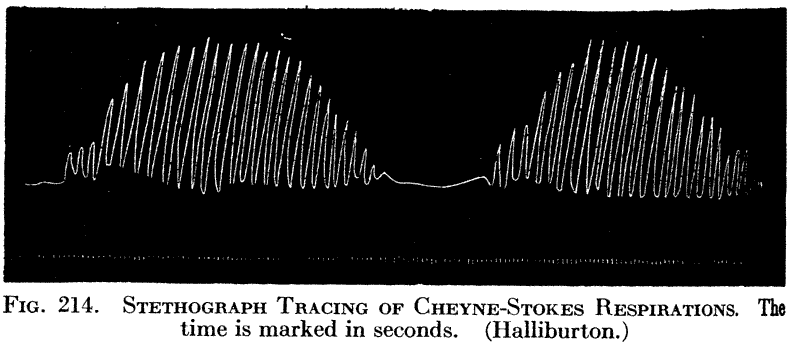 many people's breathing pattern changes, to what's called "periodic" or Cheyne-Stokes breathing. One might well awake in the middle of the night (not that anyone sleeps well up there) and find that one's breathing has stopped. No cause for alarm: the usual triggers for breathing related to CO2 are disrupted in these oxygen-poor climes, but the body will resume breathing as needed. Forewarned is forearmed.
 friend V used to call it "teutonic") by going for shorter sentences without
  transitions... Read it word for word and you sometimes don't know how the reader is supposed to get from one idea to the next! At this stage all I can do is trust the process...
 One of the cool things about hanging around UCSD is that it reminds me of the worlds of young Asian-Pacific Islander Americans. So for instance, thanks to a poster in the Price Center I learned about and was able to watch the first half of what may be the world's first internet-adapted play, David Henry Hwang's "Yellow Face" on the angry-funny YOMYOMF (You Offend Me, You Offend My Family) channel. Part 2 tomorrow, so far so good!
 How does one prep for a 52km trek in the High Himalaya? I'm starting slow, walking a few miles each day up and down hills in my new hiking boots - though of course we're near sea level here. Today, I did the roughly 5km from the Torrey Pines State Reserve lodge to the library at UCSD in about an hour.

 to account for the difficulties people have on leaving one culture or milieu for another, and for the reactions they often encounter. A cultural world is navigated in "habituality, automatism and half- consciousness," making use of "recipes" which provide "typical solutions for typical problems available for typical actors" (505). The stranger brings the "recipes" of one place to another and, trying to make sense of the new surroundings, mistaking individuals for types, and finding everything questionable because her own "natural attitude" has met shipwreck (507). Schütz' case-study is the "stranger," his paradigmatic case the immigrant, but he thinks similar processes at work in every encounter with the strange or new. Good stuff!
 (von Mises and Weber were teachers Schütz studied with in Vienna; Dauber and Pine's was a vast used bookstore at 66 Fifth Ave., now one of the Parsons buildings; the student who mispronounces Schütz's name - perhaps a little understandable because it was published as Schütz, Schuetz and Schutz - had objected in a class to the idea that there could be anything like a philosophy of death, to which the teacher had responded, laughing, "You are joking, you are joking!")


