Although we're quarantining we ventured out for a late afternoon walk. For the next months, starting with tomorrow's Daylight Savings Time, the sun will set before the workday ends. The last days have been rainy, too, and gloomy weather is forecast for the anxious days ahead, so it seemed right to mask up and - carefully keeping well more than 6 feet from anyone else - get a taste of some golden outdoors light and air.
Saturday, October 31, 2020
Breather
Friday, October 30, 2020
Last week
I've been posting in the blog this week as if this were any week but of course it's anything but, something which has become clearer and clearer as conversations with students in and out of class wind down, as they always do, with "next week..." What world will we find ourselves in next Wednesday, Friday? As we contemplate the uncertainties of next week, the current week seems like the last week before something new and, at least for a time, terrifying. "I'm afraid we're going to be in a civil war," said one student this morning, naming my greatest fear. "I sort of hope we will be," replied another, confirming it. I don't know what miracle to pray for. The shambling but steady functioning of democracy which I've grown up counting on now feels like a miracle, too.
(10/31: I added the picture of Grant's Tomb for its inscription LET US HAVE PEACE.)
Thursday, October 29, 2020
Religion rejiggered
My suggestion is that the subject matter of such courses would be best taught through an approach that does not remove (what we assume to be) modernity, but instead uses it as the entry into our engagement with the material. That is, to teach from the present backwards—through looking at the postcolonial present and how that has been created by the forces of the past. The organizations and traditions of the postcolonial world that are now classified as religions have been formed into their contemporary practices and structures by the legacies of colonialism, even when they draw on rich and diverse pre-colonial histories and sources. (13)
I have been planning a structure something like this, beginning with contemporary events before swooping back to the artifact of world religions en route to ending with Anthropocene challenges. In the middle section, I was imagining I'd find some way of giving students what I was assuming they'd come for ("I've always wanted to take a course on religion" or "learn about world religions") without selling my soul, but just how to pull this off I didn't know. Nye suggests a way to me. We'll use something like the great anthology Figures of Buddhist Modernity in Asia to undermine the idea that any modern form of a tradition is somehow inauthentic, also making clear that even if everything happens in a landscape shaped by western colonialism, the construction of Buddhism as a religion (say) is something that's done not only by western colonial institutions - including the western "Academy."
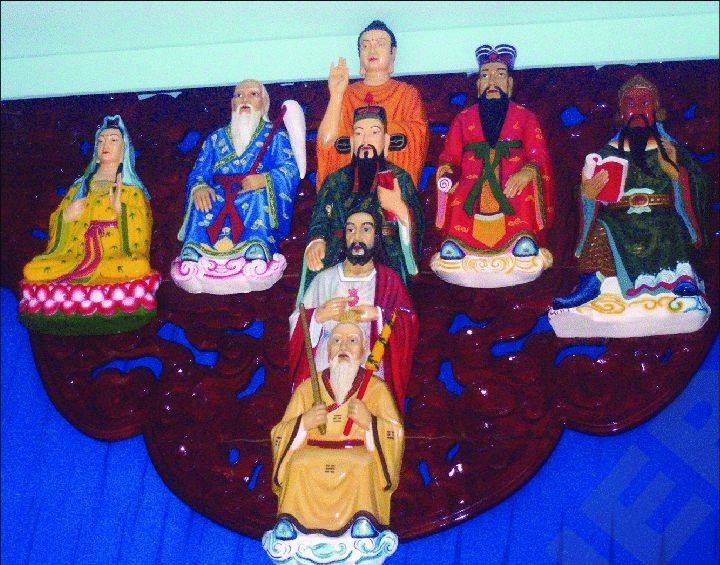
Perhaps I could try to talk about traditions like Vietnamese Caodai - whence the image above (it's from a temple in California!). In some ways this is the natural extension of things I've taught regarding "lived religion" and "religion-making" but in a broader way. It's not just that "religion" lives in the syncretic adaptations of members, and that it's not just scholars who have commitments regarding "religion" and its value. It's facing that western colonialism and the capitalist forces it unleashed have remade the religious world. Fantasies of religious worlds untouched by this process (hello, "world religions") are themselves products of this process, and perhaps more beholden to it than are religious innovators, especially those on the colonial peripheries, who have no choice but to face fully the complicated realities of our time.
Wednesday, October 28, 2020
Virtual chorister
Our choir is back! Well, virtually. Our director sent us a short piece and directions on how to record our bit so we can all be synched as a virtual choir. He warned that it involved many steps and it's true. Singers need two devices, one to play the recording of the notes they have to sing (earbuds are best for delivering this direction discreetly) and another to record the singer. You also need a way to prop up your filming device and a neutral background. Oh, and sheet music... It was too much for me; the piece was short enough that I memorized my part, which doesn't mean I didn't keep getting it wrong. And then there's how you look as you sing, oy!
Tuesday, October 27, 2020
Monday, October 26, 2020
Witness
Some of our neighbors, who have been keeping a Black Lives Matter vigil going every day for months at the corner of our complex, are in the Times today. Among them is our intrepid next door neighbor Joan!
Future of religion
The New School finds itself a few painful steps into what may be a protracted journey through uncertainty - and not because we're special. Much of American higher ed is facing economic crises staggering enough to provoke identity crises.
Indeed our leadership hired a consulting firm to avail itself of a broader view to guide the sequence of hiring freezes, pay cuts, furloughs, layoffs and early retirements we've already endured; next on the agenda is restructuring. It's not clear how the "Liberal Arts" space currently occupied by three different divisions with dramatically different cultures - the graduate faculty of social and political science, the schools of public engagement and Lang - will be reconfigured, or even how the decision will be made (a faculty-staff taskforce has been convened but given an impossibly short time to come up with recommendations). Perhaps the changes will all be under the hood and we'll continue to offer the degrees and curricula we've been offering, just in an administratively "leaner" way, but enough has already been destabilized that everything has a question mark over it.
LREL, my little fiefdom, might continue or might be absorbed into something else; in any case, its curriculum might in the not too distant future look quite different from this year's pleasing array...
Sunday, October 25, 2020
Circling back
Our journey is complete! It was only a fifth of the way across the US but it felt like more. The freedom of the open road! And of people living their lives in parks, museums, restaurants, beer gardens, apple orchards, covered markets, shopping malls... (Our hosts kept us busy!)
Except of course our drive across Ohio, a spit of West Virginia, Pennsylvania and New Jersey meant crossing a multiply-blighted land, the blight
often metastasizing in the form of lawn signs with the name of our super
spreader president. Ohio's one of many states
which have been recording new records in coronavirus infections recently, so we've gone straight from turnpike to quarantine, as New York State requires; good thing I got myself an absentee ballot for the election next week!
Saturday, October 24, 2020
New horizons
Our week out of town was a great success. Not just the getting out of town, though that was a lot. And not just driving across foliage-draped Appalachian and Allegheny mountains, though that was magical. But Columbus turned out to be a marvel, too! It helped that we were visiting friends who've recently moved back and have deep roots there, proud of the city's past as well as its recent ascent to being Ohio's biggest city. And it was also nice to have company during these anxious days in the lead-up to November 3rd (we even braved the final presidential debate together) and to add to our sense of the fundamental decency of America. (Don't ask me about how progressive Columbus is dismembered by Republican gerrymandering, though.)
Friday, October 23, 2020
In the air
Thursday, October 22, 2020
Family values
Pope Francis has endorsed civil unions for gay people in the most wonderful way:
"They’re children of God and have a right to a family."
This isn't an official papal pronouncement, nor is it really a surprise given Francis' views before he became pope. It's also not marriage. But it's a big deal, as James Alison explains:
Francis’s position is inconceivable for someone who believes same-sex acts to be mortal sins, leading those involved to go to hell. If you believed those things you would seek to break up such couples, not stabilise them. ... The presenting issue is one of anthropology, and is fairly simple: either it is true that being gay or lesbian is a vicious or pathological form of a humanity which is only authentically heterosexual; or it is true that being gay or lesbian is simply something that is a non-pathological minority variant in the human condition. If the former, then “giving in” to being gay or lesbian is to follow the path of your objective disorder, and ultimately to exclude yourself from grace. If the latter, then becoming who you are starts from who you find yourself to be, including your sexual orientation, and the appropriate humanisation of your sexual desire will be worked out in appropriate relationships over time.
Wednesday, October 21, 2020
Religion of humanity
It was time for Durkheim in "Theorizing Religion" today, one of the thinkers I've been struggling to do justice to in past years - and one year I simply forgot! The problem is Elementary Forms of the Religious Life, his magnum opus on religion, which you really need more time than I can afford to really engage with; if you just include the introductory section students will wonder if he didn't already know what he was going to "find" in the accounts of Aboriginal Australia he goes on to analyze - and rightly so. Convincing students that there's value in the kind of primitivist view he offers is queasy-making too. So this year I skipped it, instead assigning to earlier works. One was the religion chapter from Suicide (1897), which I've used before and proves a good way to introduce the promise of sociology.
The other was an 1898 essay I remember being assigned my first semester in graduate school, "Individualism and the Intellectuals," Durkheim's response to the Dreyfus affair and one of the most inspiring celebrations of liberalism you can imagine. The argument, in a nutshell, is that as societies become more complicated, traditional religions will loses their capacity to ground us - but the need for religion, understood as a grounding collective experience, remains. A "religion of humanity" dedicated to the value of individuals is our best hope. It's an unexpected and interesting argument to got through, not least in this moment where we're hoping to face down the misanthropic cynicism of Trumpism. But I'd forgotten just how many religious buzzwords Durkheim manages to use in making his argument!
This ideal [individualism] goes so far beyond the limit of utilitarian ends that it appears to those who aspire to it as marked with a religious character. The human person, whose definition serves as the touchstone according to which good must be distinguished from evil, is considered as sacred, in what one might call the ritual sense of the word. It has something of that transcendental majesty which the churches of all times have given to their Gods. It is conceived as being invested with that mysterious property which creates an empty space around holy objects, which keeps them away from profane contacts and which draws them away from ordinary life. And it is exactly this feature which induces the respect of which it is the object. Whoever makes an attempt on a man's life, on a man's liberty, on a man's honour inspires us with a feeling of horror, in every way analogous to that which the believer experiences when he sees his idol profaned. Such a morality is therefore not simply a hygienic discipline or a wise principle of economy. It is a religion of which man is, at the same time, both believer and God. [emphasis added!]
Tuesday, October 20, 2020
Carving
Behold Elijah Pierce's (1892-1984) representation of the expulsion from Eden, including scenes of what led up to it and some of what followed, from 1931. Seeing this at the Columbus Art Museum (another museum!) gave me a sense of what Pierce's carving "Story of Job" (1936), in Milwaukee but included in a CMA exhibition catalog, must look like.
Elijah Pierce: Woodcarver (Columbus Museum of Art, 1992), 123
Monday, October 19, 2020
Doppler effect U
That Times article about The New School has generated a lof of comments, some predictable, many misinformed, and a few brilliant. My co-historian J sent me this one, a beaut:
In earning a BA in Liberal Arts from the New School College in the early 70’s I was allowed to take graduate courses to fulfill my requirements. One class I took was with the late Dr. Stanley Diamond, a distinguished anthropologist. His lectures were always packed. One lecture he changed the format and asked us students to start our own discussion asking and answering questions about any topic. He sat and listened. As the hour and a half class came to an end, he got up, silenced us and stated “What I have heard in this class today indicates the complete collapse of Western civilization”. He then abruptly left the lecture hall where we all just sat in stunned silence. That was The New School for Social Research at its peak.
Part of the trouble of an institution that marches to its own countercultural drummer is that, even as they grumble about its inadequacies, everyone thinks they just experienced The New School at its peak before things headed irrevocably south. I was guilty of that for a time, too, until newer cohorts of faculty and students started mourning as lost peaks things the things whose arrival I had rued!
Sunday, October 18, 2020
Remember me
Today, we savored a nearly forgotten pleasure - we went to an art museum! It was the Wexner Center for the Arts at Ohio State University. On a rainy Sunday we were the only visitors - a nice way back in! "The Wex" was designed by deconstructionist architect Peter Eisenman, his first major commission after decades of snarky sketches. (Since it was designed to frustrate, I don't know whether to say it succeeds...!)
We especially enjoyed two of the four exhibitions on show, in oddly shaped rooms accessed by narrow stairways along a long sloping corridor. One was Steve McQueen's "Remember Me" (above), part of a series, arrays neon versions of the phrase Remember me in a variety of handwritings, evoking people of different ages and levels of education, victims of unspecified but undeniable erasure.
The other was a sound installation by Taryn Simon, called "Assembled Audience," a randomized combination of the applause of hundreds of individual people at hundreds of different events in Columbus - a big wall was filled with a list of the component events, running the gamut from entertainment to trade to politics - which you encounter surging and subsiding, now a pitter-patter, now a roar, in a pitch-black room (where, if there were more people in the museum, you'd almost certainly collide with someone). It's disorienting but also intoxicating: it's hard not to feel the shifting waves of applause are telling you something meaningful about something important, whether you like it or not. Scary, profound.
Saturday, October 17, 2020
Friday, October 16, 2020
On the road again
Inspired by our trip northward to the Adirondacks, we've embarked on a longer trip, this time to the west. Guess where we're headed? Ohio!