 The Times has an occasional series about art called "Close Read," which takes a single work of art and interactively shows you the world of its details, its global context, and its significance. The latest dives into a Mughal miniature at the Met: have a scroll! Appearing the same day (happenstance, most likely) as an Op-Ed about an Islamic inspiration for Robinson Crusoe and the European Enlightenment, it helps stitch together the more global, more interconnected history we know of in general but can enjoy best in the living particular.
Monday, April 05, 2021
Cosmopolitan

Sunday, April 04, 2021
Lent suspended
It's Easter (for the western Church) but we're still not able to gather in churches, so it doesn't quite feel real. Like being in our zoom gallery was a Lenten austerity which hasn't lifted - for the second time!
I had a palpable sense of Lent protracted/Easter interrupted in the Cathedral Church of S. John the Divine today. They've only recently reopened their doors, after closing them during Lent last year. This remarkable artwork, "The Miraculous Draught" by Ukrainian-born Germany-based artist Aljoscha, was to be installed in two stages last year, 100 clear and three violet pieces of acrylic glass at the start of Lent, and fifty neon pink ones at Easter. (153 is the oddly specific number of fish caught in the "miraculous draught" where Jesus tells his fishermen disciples, who'd caught nothing one day, to cast their nets again, only to catch fish in such abundance their nets nearly burst.) The first 103 are up, still, having filled the silenced cathedral space for over a year. Of the Easter fifty, no sign.

I took this picture near the center of the nave, facing toward the altar, then moving the camera up and over, nearly doing a backbend. If you start to the bottom and move upward you can share the experience, starting with looking past the three purple pieces and the void leading to the high altar, ending, a little off balance, with rose window over the west face of the cathedral.

Friday, April 02, 2021

Thursday, April 01, 2021


Wednesday, March 31, 2021
World Christianities

Our course materials included part of Thatamanil's book, a video on "reverse missionaries" (the priests from formerly colonized countries now helming largely white Christian congregations in Europe), and conversation with my friend Eros Shaw, a young Chinese gay leader involved in the Global Network of Rainbow Catholics - the text of an interview he gave to a gay Catholic group in Rome (reverse missionary!!) and a zoom chat with me, recorded for the occasion.
It all added up, I trust, to a profoundly unfamiliar image of Christianity, a point I drove home with the question "Is Christianity a western religion?" and some speculation about what the Christianity section of a Museum of World Religions one hundred years in the future (if any such there be!) might look like. Perhaps its European adventures will be presented as a long digression, glorious and grim, perhaps necessary but certainly not sufficient, only one chapter in an ongoing story which was unfolding in Africa and Asia all along.
This isn't a place I planned to wind up: "Provincializing Christianity" would have been a more deflationary project! But telling the world Christianities stories this way, its protagonists more like my seeking but/and (not) (also) students than the supposedly uniform armies of the faithful of Christendom (and in a way translatable to other traditions), made me unexpectedly giddy. The Spirit moves!


Monday, March 29, 2021
Pronouns of God
This morning I stumbled on wonderful words from the brilliant womanist biblical scholar Will Gafney (whom we met in the Scholar Strike), part of a recent panel on "Rainbow Theology: Intersections of Race, Gender, and Sexuality." Her focus was pronouns, and what a difference they make to theology, and to liturgy. Gafney began:
Human beings contain multitudes, multiverses, like our Creator. That she, he, they, One who is three, seven, twelve, many is ultimately inarticulable yet mysteriously, in some way reproducible. The earthling created from the earth, the human created from the humus, was soil and spirit and bone and blood. And it, they/them was gender-full and in that gender-fullness was the image and likeness of God.
 There is an incantatory loveliness to this she, he, they, One who is three, seven, twelve, many. It feels like praise, joyful praise. I'll try using it. Simple pronouns, or even the careful but abstract gender-less language of "God" and "Godself," don't communicate the fullness of the creator, or the creation.
I use the example of our language because I have made the argument as a woman that you tell me what you think about me by how you talk about God in whose image I am created. If your language about God does not include my creation, that tells me that you do not see God when you see me and you do not see me in God. This is also true for lesbian, gay, bisexual, transgender, intersex and asexual people. If your entire theological and linguistic framework is binary, then there is no room for the fullness of God’s creative artistry with the human palette.
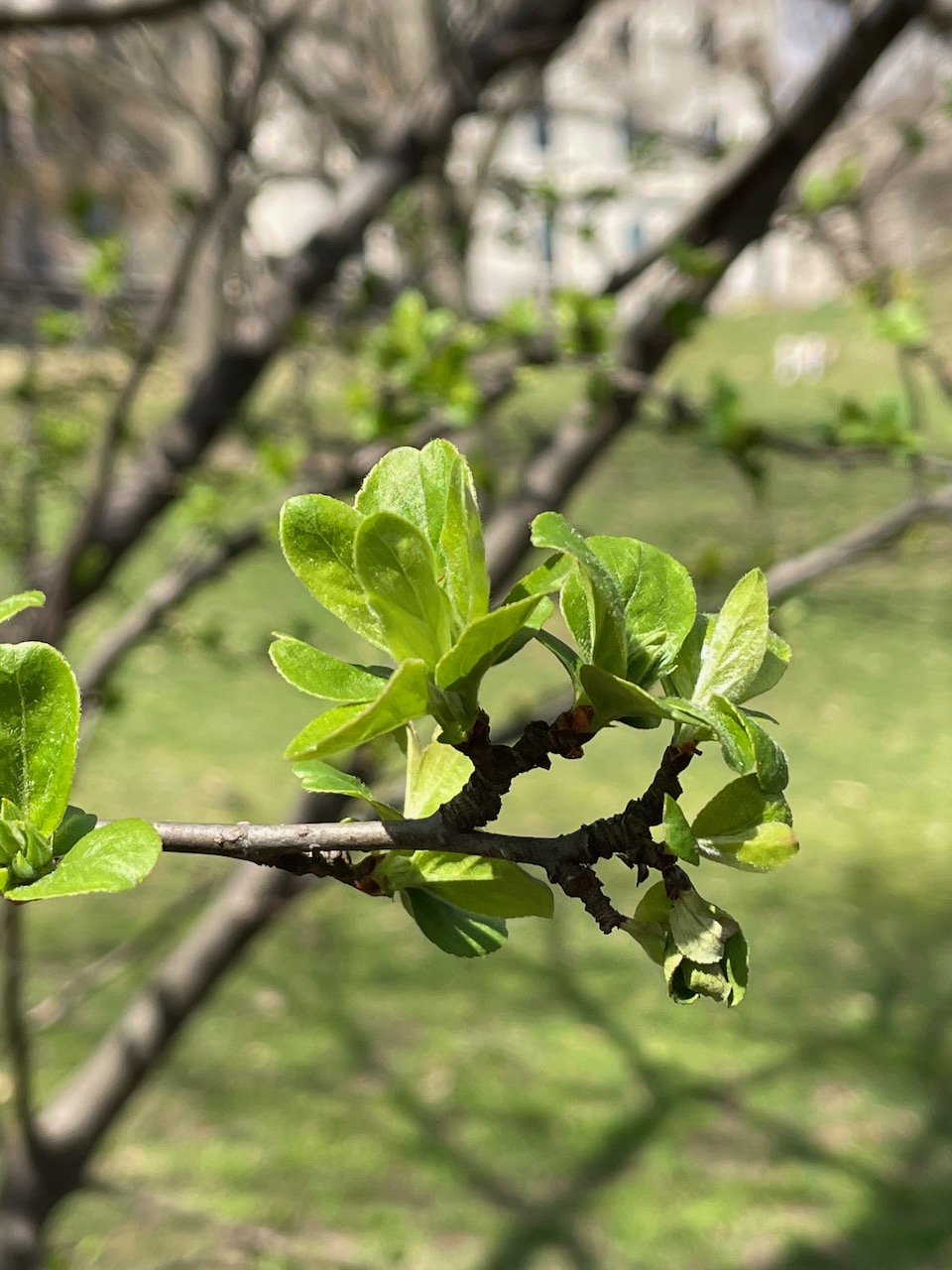
The first tree flowering in Washington Square Park joins me: Amen!
Sunday, March 28, 2021

Saturday, March 27, 2021




Friday, March 26, 2021
The problem of good in the Anthropocene
I've been trying to find a new angle on religion and the Anthropocene, without much success. Lots of other people have interesting things to say, and it's fun to introduce students (or other scholars) to them, but I'm finding the two terms - "religion" and "Anthropocene" - have too many problems of their own to serve as a stable frame for an argument of I want to make. There are definitely what Lisa Sideris calls "religion-like" features to arguments about the Anthropocene, whether the apocalyptic versions or the "good Anthropocene" ones where humanity takes the baton as the "god species," but it's a little tedious to be analyzing others' thoughtlessness, and to be trucking with generic concepts of "religion."
I'm not sure critique of the hubris of the "Anthropocenologists" (Bonneuil and Fressoz's term) is qualitatively different from arguments which have been made for many years now about the ecological dangers of certain kinds of monotheism, and of the patriarchal colonialist capitalist forms of thought with which it was allied in recent centuries and which perpetuate its dangers. What is new - that some of our shameless shenanigans might be leaving a trace discernible by future geologists - isn't obviously important, when (some) humans have been devastating human and other-than-human worlds for half a millennium. Indeed, the supposed novelty of the Anthropocene can serve as a distraction from longer term ecological problems folks have been thinking and organizing about for decades. From this perspective the arrival of "Anthropocene" discourse is an unwelcome reaffirmation of human exceptionalism (the Man!) just as the extent of colonial damage and the delicacy of our entanglement with other species are coming into focus.
Beyond understanding and redressing the forms and structures of devastation (some) humans have wreaked, I find promise in the effort to articulate the "Anthropocene" change in (some, my) people's sense of the harmonizability of human plans with earth and its systems and communities. Isabelle Stengers describes as the "intrusion of Gaia" the experience of a planet no longer content to let (some) humans instrumentalize and exploit it, a world which hurts us back. The experience of the Anthropocene isn't near-invisible layers of geological residue in the future but a widening gyre of devastation from fire and flood and storm right now. This is not the Anthropocenologists' safely sublime experience of newly discovered power - who knew we could be so baaad! - but one of what seems a new difficulty and resistance, frustration and confusion. Bronislaw Szerszynski has suggested that these experiences are giving rise to new "gods" and "spirits," as the no longer safely secular background of the natural world becomes feisty foreground - powers which demand devotion and sacrifice. But Stengers' Gaia can't be placated. The world may seem newly unruly because of what (some) humans have done, but it's not interested in repairing its relationship with us. At at that conference in Indiana three years ago I tried linking this sense of a nature grandly but disconcertingly oblivious to our concerns to the theophany of Job - other scholars had too - but it didn't take. That ancient text may somehow recall an earlier time when human beings were less confident of their place at the table of the world. The Holocene was in fact a lot less stable than it seems to us now in retrospect to have been! But the pertinence of any ancient text now seems open to question. I'll keep bringing Anthropocene questions to Job but only because I'm already working with Job; I don't want to be arguing that this is a text folks not already so oriented should turn to. Its intrusion of Gaia is contained within a relationship, however sublime (a command performance is hardly an intrusion!), with an ordering care that addresses us by name, and, more troublingly, the story is very much one of a solitary human master of the universe experiencing a (passing) crisis of privilege. The former seems important to work through, within a Christian theological framework, but the latter is a formidable problem in this time of clarity. And I realize neither is what I want to bring to the broader Anthropocene and religion discussion. (Even in Indiana I was really rewriting the book to make it less anthropocentric, its form less cyclical.)
But a few days ago I had an idea for a contribution I might be the one to make, a possibility at least. It would connect to arguments I made way back when about the problem of evil - and the problem of good. The main argument then was that until modern times the problems of good and evil were engaged together. The most profound responses, to me at least, linked them - evil was understood as the privation or destruction of good, whose vulnerability was as heartbreaking as its existence was gratuitous. What happened to make the problem of evil so eclipse the problem of good that we don't even hear about the latter anymore was, in part, that the world came to be experienced as stable, habitable, controllable. Order became a background we could take for granted, not a precious or precarious gift, and it was the disruption of order, always the more urgent "problem," that came to monopolize attention. Thus could a Schopenhauer turn the old argument that philosophy begins in wonder on its head and say it had always been wonder at evil that was the source of thought. Modern thought has indeed been fed by and feeds the problem of evil, but I argued that reflection on evil without good was ultimately a hollow thing, undermining the claim of the good as well as our understanding of its nature. (That there is a good - not just varied and competing fancies about ultimately valueless reality - seems to me one of the unnoticed implications of the certainty that there is a universally acknowledged problem of evil.)
Here's the new idea. What if Stengers' "intrusion of Gaia" marks the wobbling end of that confidence in a natural order we felt we could take for granted? Objectively speaking, the Anthropocene centuries (and millennia) ahead will be less stable than the centuries (and millennia) of the Holocene which cradled the development of human civilizations. But until the era when modern science, technology, and fossil fueled fantasies of transcending biological cycles made it feel stable, the Holocene world order, too, felt precarious. Widespread belief that the world order was breaking down may now look to us like part of a deep confidence in cycles of death and rebirth - a confidence no longer warranted! - but they report experience of failing rather than resilient order. As even Job knew, hope has always been hope against hope. It's not clear that all fruits of Holocene culture are rendered obsolete by the Anthropocene, when not indeed complicit in it. The damage wrought by the Anthropocene is vast but recent. Popular and scholarly attention is drawn by "indigenous" traditions thought to have a better grasp of how to live with our non-human kin in a disrupted world, but as Frédérique Appfel-Marglin's "reverse anthropology" reminds us, most people in history - and even today - lived outside the deadly imaginings that drive the Anthropocene. There are many, not few, resources for living on a "damaged planet" if we look beyond colonial capitalist western modernity.
Arguing about periodization isn't a game I want to play. But I'm sensing it might be an intriguing way to dislodge the sense of Anthropocene doom to restore the complementarity of the problems of evil and good. I'd have to venture a historical story, as I sketch above, but what would make it interesting is the resonance the problem of good might now again have. My main work would be evoking how good was conceived and experienced before it became background noise - precious and precarious and mysterious - and then bringing this into conversation with contemporary fumblings with ontology and recoveries of wonder. Gaia will remain implacable, but perhaps we can find better ways to find and sustain refuges from the deceptive claims and compromises of Anthropocenology.(Image: the pre-Holocene "Shigir Idol")
Construction
 Some unwelcome colors are entering our Gothic revival view to the southwest. Reds and oranges, yellows and blues... but most significant is the white scaffolding they're erecting, the spine for the tower which will underwrite - and over-shadow - Union Theological Seminary...
Thursday, March 25, 2021
Sanctuary

Before my volunteering stint at Holy Apostles today I lit a candle for a friend who is gravely ill. This is a space he has known and loved both as church and soup kitchen, communities for feeding body and soul.
Wednesday, March 24, 2021
Bad theology, and good
Two pieces of powerful public theology crossed my path today, addressing painful current events. In one, Mihee Kim-Kort, a Korean American Presbyterian minister, calls out the bad theology which, going hand in hand with patterns of anti-Asian prejudice in the U. S., led to the horrific attacks in Atlanta last week. She recounts growing up within a Christianity which could not imagine a woman preaching.
Later I discovered stories that centered on people on the margins — Black, queer, women and others. These theologies radicalized my faith; I saw myriad possibilities of God in the world. When I looked in the mirror, I saw the divine in myself and in the faces of those around me. This changed everything. The God of grace I proclaim from the pulpit lives in us, loves every single one of us, and this was liberation.
Kim-Kort contrasts this with the inhuman Evangelical "purity culture" which shaped the Atlanta killer, unable to see others as anything but threats - especially Asian women, already denied full reality as Americans by entrenched stereotypes. Reports that the killer had a "strong Christian faith" gave me chills. The stronger Christian faith Kim-Kort describes gives me hope.
The other piece is by James Alison, long a hero, a pathbreaking gay Catholic theologian who manages to rise above rancor at churchly homophobia to prophetic love. In his newest piece he's responding to the recent Vatican announcement that forbade priestly blessing of same-sex unions (not to mention marriage). Alison's response is to describe the announcement as a "tantrum," and to recommend readers not take it personally. The writers are like people who've locked themselves in a small room, a conception of "objective truth" which does not do justice to the reality of God's creation. Their conniptions represent "self-fueling delusion at work." If only they could leave their little room, they'd see a world full of things to bless.
And this is their sadness: our brethren (sic) are locked into an account of objectivity which bears passing little relationship to the reality of creation as we are coming to know it and participate in it. ... Where frightened morality tries to close things down, wisdom, starting from our rejects, opens up the reality of what is, as we undergo being forgiven for our narrow goodness and hard-heartedness, sifting through our fears and delusions. And so we discover our neighbours as ourselves, and how we are loved. ... And so to the matter of blessings given to, received and shared by, same-sex couples: Our Lord teaches us to know a tree by its fruit. He provokes our learning process. And it leads us to find things to bless, forms of blessedness old and new. The power and the glory of the Creator do tend to show themselves through our becoming, as we discern what we are for and who we are. It is a learning which is especially blessed when we find ourselves being forgiven for having categorised groups of people in false ways, and discovering that life is richer and better for all of us when they are encouraged to be who they are.
How different are theologies which exclude and attack the new and the other from those which are able to see in all the work of God, who feel the grace-filled momentum of discovering the divine in more and more of human life! Both Kim-Kort and Alison help us see that a liberating theology, one which liberates us to love the world and all in it, must begin at home with acceptance that none of us is a mistake.
Tuesday, March 23, 2021
Undercover
Transcription miss (or hit!) of the month: when I spoke of "SBNR" (spiritual but not religious) in my prerecorded lecture, the automatically generated transcript had me opining on espionage!
Monday, March 22, 2021
On the prowl
 This is, apparently, a panther as imagined in 11th century France, and the pretty curls are the sweet-smelling breath with which it attracts prey. It resides now at The Cloisters (a coda to our trip, en route to returning the rental car), where one can feel an illusion of safety from the panthers of our time.
Sunday, March 21, 2021


Saturday, March 20, 2021

Friday, March 19, 2021

Subscribe to:
Posts (Atom)