Tuesday, September 20, 2016

Mainstreams and margins


At a faculty development seminar on "Understanding and Navigating Identity as Faculty" today (one of several our faculty has undertaken in response to student concerns that our our courses and pedagogy are inadequate to the era of Black Lives Matter) we were asked to spend 60 seconds recalling a time when we felt marginalized. Then (through a nifty online response site) we were asked to supply words describing how we felt, the attitude of those marginalizing us, and what different response we would have liked to see in them. It was a well-designed and fruitful exercise, and helpful for us as we try to be better teachers.

One-minute exercises don't leave you time to pose, even to yourself, so they can be quite revealing. The times I called to mind weren't times I felt marginalized for being gay, but felt excluded for being single. I recalled many times when I was the only person not in a couple, and how I dreaded hearing them trot out the stories of how they met, etc. Since I was visibly without partner there was nothing for me to say in these situations, and it frustrated me that there was nothing I could do about it. I would have liked the others at least to notice that I was silenced, and to steer the conversation in a different direction.

It's funny that came to mind since I'm single no longer - or maybe that's precisely why it came to mind! I'm acutely aware (or think I am!) of conversations with my close friends, many of them single, happily or unhappily. I cringe a little when I hear myself start a sentence with we.

The seminar, led by the Director of Higher Education Research and Initiatives at Penn's highly regarded Center for the Study of Race and Equity in Education, included the very helpful slide above, which suggested that

We tend to live in the pain of our marginalized identities
and act from the arrogance of our mainstream identities. 

So true! I'm glad to be part of a community striving to discern these patterns and to overcome them. There are many marginalizations I cannot begin to grasp, related as they are to privileges I too casually own, but I feel like we made a good start today in owning that, and committed ourselves to learning to create spaces where larger patterns of marginalization might be mitigated or even overcome.

Monday, September 19, 2016

New York was very tense this morning. The person who'd placed the pressure cooker bombs in Chelsea last night was at large. Many of us were woken up by a text message with the name of the suspect; he was later apprehended in New Jersey. The unease involved both worry about what had happened and worry about the sort of over-reactions it sought to provoke (and, of course, did) - New York has experienced this lethal cascade before. For now, if the man arrested is indeed the perpetrator and acted alone, peace is restored. The unease remains.

Sunday, September 18, 2016

Shiva, the Bodhisattva!

This is, as they say, rich. But then Anagarika Govinda, the German-born Lama whose Way of the White Clouds is still widely read by travelers to Kailas-Manasarovar (this is from page 201), knows how to pile it on.

Saturday, September 17, 2016

Days of yore


Scenes from the original New School on 23rd Street, from a 1925 promotional brochure. (You can read the whole thing here.)

Friday, September 16, 2016

Path to Kailas

Went finally to one of New York's hidden jewels, the Nicholas Roerich Museum on West 107th Street - three floors of a brownstone, with 200 paintings in glorious colors. I know of Roerich (1874-1947) as he's the preferred painter of the Himalaya for many. He even has a series of paintings from the 1930s called Sacred Himalaya! (He also has a
remarkable history involving stage designs for Borodin and Stravinsky, a yoga-inspired school of all arts and a union of religions here in New York.) But I went also to see if there were any painting of Kailash. No - he never made it there, most of his craggy mountains are stylized anyway. But several are called "Path to Kailas"; I bought postcards.

Thursday, September 15, 2016


On the stoop this morning, a first intimation of Fall!

Wednesday, September 14, 2016

Merry trials

Today's New School history class was about how the curriculum of the newly opened school sought to teach not just new things (like social science) but new ways of learning and engaging the world. We'd read in Dewey's Democracy and Education last week about the importance of maintaining the "sympathetic curiosity, unbiased responsiveness, and openness of mind" characteristic of childhood throughout one's life - but how can that be done? What subjects, how taught?
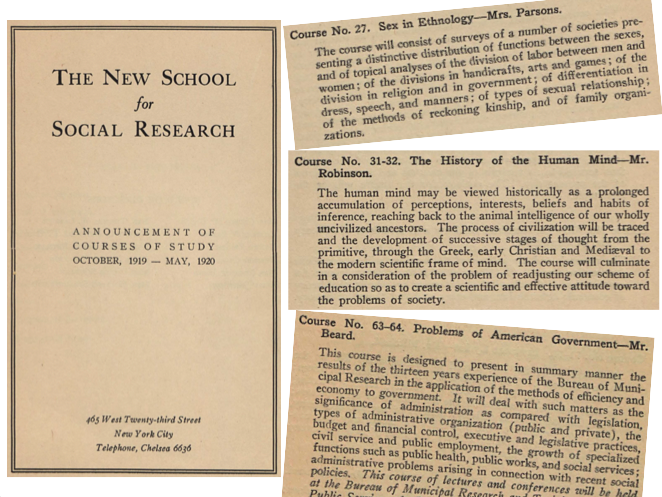
Today we gave a taste of what students in the New School's first year might have encountered in three classes taught here, each in its way exploring new thinking. For instance, we read part of James Harvey Robinson's The Mind in the Making (1921), a brief for a new kind of education which would bring science to the study of human issues. He argued that only by confronting us with the "real causes" of our entrenched and frightened beliefs (through studies in comparative anatomy, psychology, anthropology, comparative religion and other social sciences) could one foster the "creative thinking" demanded by new times.

The "real" reasons for our beliefs are concealed
from ourselves as well as from others. (42)

Robinson and Charles Beard, two of our key founders, were leaders of a movement called the New History, which mobilized the past for better understanding the present and its prospects. My co-teacher J expertly described the the vision and stakes of New History, and illustrated it by looking at Beard's Economic Interpretation of the Constitution of the United States (1913), a book which dared to face down American nationalism and critique its founding document as resulting from the economic interests of its writers. But the most fun, I dare say, was had
in learning about Elsie Clews Parsons, who challenged the gender conventions of her time from the perspective of comparative ethnography. Long before it was fashionable (let alone common sense) she championed premarital sexual experience, divorce, and what she called "trial marriages" - to establish whether two people were really suited to share a life together. Her course "Sex in Ethnography" challenged gender divisions in every department of society. (She taught it only once, but among the students was Ruth Benedict, who was inspired to become an anthropologist by what she heard.) We read part of Parsons' book Social Rule: A Study of the Will to Power (1916), which argued that societies allow people to act out various forms of domination (and self-domination, when internalized) by accepting unexamined "classifications" like gender, class, race, maturity, etc. Comparison with other societies shows both the ubiquity of such classification (especially where gender is concerned, "marriage is on the whole the most satisfactory device yet worked out for the control of one adult by another" [45-46]) and enough variation to suggest it needn't be so. Women might be fully free only when not understood as women at all. As for the "new woman" of Parsons' time:

The new woman means the woman not yet classified, perhaps not classifiable, the woman new not only to men but to herself. (55)


One reason a "New School of Social Science for Men and Women" was needed was precisely this experienced novelty, the way upheavals economic, social and religious and changes in everything from international relations to gender relations had made everyone feel ill served by received classifications, "new" not just to others but to themselves. As open to new experiences as children, as estranged from storied pasts as the new historians, as excited about future possibilities as women coming to suffrage ... no wonder our founders thought the old ways of knowing, learning and teaching needed an overhaul!

The second and third images above are from a 1907 silent film. "Trial Marriages," which lampoons Parsons' proposal in a way showing how threatening it was to inherited understandings of gender relations. (You can watch it here.) J thinks the broker of the film's first ultimately unsuccessful "trial marriage" looks a little like yours truly.

Tuesday, September 13, 2016

Now we're talking

This might not look like much (!), but it's the fruit of an amazingly rich and exciting discussion about religion-making in today's Theorizing Religion class. It's the latest version of the "what is religion?" blackboard exercise, but we came at it in a different, deeper way this time. As well it ought to be: this is the third week of the class, not the first.

The discussion started with students, in threes, sharing their "religion matrix" reflections - a short essay on the role of the category of religion in their lives. The first of three "religion making" exercises over the course of the semester, this was the result of my work with the MetroCITI seminar last year, and is designed to surface, honor and engage students' "prior learning" about religion. Most of the students provided a sort of spiritual autobiography and were startled at how different and similar their classmates' were, whether they grew up in a world where religion was taken for granted (perhaps so much so that they felt they couldn't leave) or one where religion was off the map entirely, or any station or combination between. Many come from mixed religious families and narrated not only their own negotiation of multiple inheritances and loyalties but that of their parents and siblings, too. When we returned to one big discussion we considered if attention the intergenerational was a characteristic of accounts of people's religious state of being...

I'd told them also to think of how we might define religion and religion-making (this second a trick question, of course, since it's a made-up term) as they shared and reflected together. The blackboard sprawl is what emerged when we pooled our thoughts. Needless to say the many ideas which came up around "religion" wouldn't fit into any definition.
So we switched to "religion-making," which some students thought preceded "religion," or was identical to it, its dynamism, a dialectic. Religion, a sort of consensus emerged, is always "on the make" - both in the lives of individuals and communities, as they gather their inheritances and engage variously changing environments, friendly or hostile. This is why religion is always changing, and appropriately so.

Most of the students were thinking about religion-making from the inside, as people (in Orsi's terms) "make and unmake religious worlds," but a few also thought of how religion-language is projected onto the traditions of others, distorting them - closer to the subject of our course. I capped the discussion with a little lecturette on Wilfed Cantwell Smith's urging us to abandon the category of religion, since it's external and implicitly treats all belief as false and all ritual as ineffective - something which didn't happen and, considering all the things tied up with it (see our board-scrawl!), can't.

After a little excursus on inconclusive efforts to settle "religion" through etymology, I ended with Brent Nongbri's suggestion, fifty years after Cantwell Smith, that - understanding its modern western pedigree - we learn to think of "religion" in a "second-order," "redescriptive" way.

What sorts of interests are involved in such decisions of defining religion? Who is doing the defining and why? In other words, a good focus for those who would study “religion” in the modern day is keeping a close eye on the activity of defining religion and the act of saying that some things are “religious” and others are not. (Before Religion: A History of a Modern Concept [Yale, 2013], 155)

This allows "playful" ways of thinking with the concept, compromised though it is. Nongbri doesn't call the first-order practices of description he's historicizing "religion-making," and is all about why we shouldn't assume them to be universal across times and places. He's also concerned with scholars rather than ordinary folk determining what "religion" is and can be for them - but I coopted him for our broader project, one in which modern scholars as well as practitioners are engaged in first- and, I suppose, second-order religion-making. We'll see where our discussions lead us! Perhaps today's discussion will allow students' prior learning more deeply to shape our discoveries.

Monday, September 12, 2016

A peel of Buddhism

The first session of "Buddhism as a liberal art" went nicely, I think. I started, yes, by passing around a basket of tangerines, and later had the class read Thich Nhat Hanh's "How to eat a tangerine," then wordlessly passed the basket around again. (These are the skins of my thoughtlessly consumed and, below, slightly more mindfully absorbed fruits.)
The six students seemed happy to find out this wasn't a regular class (although several had come for, and could clearly use, some Intro to Buddhism; that can be arranged). But the main object of "tutorial advising" is having an extended conversation about what matters, how we live, and how our liberal arts experiences can contribute - something which happens too infrequently in our busy collegiate lives. All were excited at this prospect. Me too!

Sunday, September 11, 2016

Buddhism as a liberal art

I have a third course this semester. An "Advising tutorial," it gathers a small group of students (seven) for ten discussions around education and vocation, offering intensive advising and an academic credit. I offered a version of this as one of the pilots of this program - called "Buddhism and Liberal Arts" - and had a blast. This time someone mistyped my title, and I decided to go with the new one.

Discussing readings is not central in an advising tutorial, and everything will in any case depend on what kind of interests and background the students bring, but for starters I've assembled these readings. (I'm happy to send proper details.) A significant number, I realized with some surprise, are things I discovered in Tricycle magazine.

Thich Nhat Hanh, “Eating a tangerine,” “Action precepts” 
Daniel Fallon, “On the past, present, and future of the liberal arts” 
Sid Brown, A Buddhist in the classroom, excerpt 
Reginald Ray, “The Vajrayana journey is an experience of love, power and freedom” 
“The Bodhisattva Vow: eight views” 
Gary Gutting, “What is college for?” 
Lodro Rinzler, Sebene Selassie, Lama Rod Owens and Qalvy Grainzvolt, “Buddhism in the next generation” 
Hsiao-Lan Hu, This-worldly nibbâna, excerpt 
Georges Dreyfus, The sound of two hands clapping, excerpt 
Thanissaro Bhikkhu, “We are not one” 
Alice Walker, “Suffering too insignificant for the majority to see” 
Eve Kosofsky Sedgwick, “Pedagogy” 
Cynthia Thatcher, “What’s so great about now?”

We start tomorrow as we did last time - with tangerines!

Saturday, September 10, 2016

After seeing it in the hands of several fellow subway riders, I decided to pick up a copy of Viet Thanh Nguyen's The Sympathizer. Glad I did:
it's electrifying. (My edition drips with more medals than this image from online, since it's also won the 2015 Pulitzer Prize for fiction.)

Friday, September 09, 2016

Passage

We're through two weeks of it already but the new academic year 
doesn't quite feel real yet. The light and the heat may be to blame...

Thursday, September 08, 2016

Religion live!

Our little Religious Studies program is small (in fact, we're not even allowed to call it a Program) but we do a lot with our little. We have a casual weekly gathering - a legacy of the brilliant woman who established religious studies here - at which folks (mostly faculty, but also friends and alumni) who have the time hang out, engage in academic small talk and discover big affinities. Case in point, today's. P, a Nepali member of the Kailash project who's teaching a course co-sponsored by our program came, and in no time she and F, who teaches

our Hebrew Bible courses, were discussing how traditions cope when the temples of their gods are destroyed or rendered inaccessible. We spoke animatedly about shekinah and Manasarovar. I'd brought along a pretty book about Kailash by some young French adventurers who said they were following in the footsteps of earlier European travelers like the Sven Hedin. My stepfather wrote his thesis on Sven Hedin!, announced O, our friend from Parsons, sitting down to join us. And so it went...

The book is The Rivers of the Mandala: Journey to the Heart of Buddhism (original title Carnets du Kailash: Voyage au coeur du Bouddhisme) by Benoît de Vilmorin and Simon Allix, 2004. The spread above - ostensibly about the Five Conquerors aligned around Kailash - is one of the less visually tripped-out but you can sense the work's wit from the unremarked juxtaposition with a photo of one of Tibet's ubiquitous outdoor pool tables.

Wednesday, September 07, 2016

Prospective retrospection

In our lecture course on the history of the New School, today was all about why one might care about such a thing. Three of our four readings were from the time when The New School was founded (1916-18), but all were about rethinking the nature of education. My co-teacher J used the original "Proposal for a New School of Social Science" to conjure up the world of American progressivism during the Great War, and presented our understanding of the sorts of concerns driving the founders. Why a new kind of school? Who is it for? What should be taught, and how? In every way, the founders rejected the model of the universities of their time and imagined something new. Good stuff and still resonant.

My task was to discuss John Dewey's Democracy and Education, whose ideas were an important part of the matrix of The New School. There was a problem, though: if ever there was a critic of lectures it was Dewey. Nobody could be expected to learn anything in so passive, so pat a form! Let me try to make the point in Deweyese. One learns only from experience, and experience is both active and passive: engaging the whole learner, it links a "trying" ventured in response to some problem or animating concern to the "undergoing" of the consequences of the try. Intelligence is being reflective about this process, making it iterative. Thinking renders the intelligence explicit, and good teaching makes thinking itself an experience.

Clearly lecturing about this would be worse than self-defeating - like the words which Dewey worried take the place of ideas in the forms of education he challenged, displacing real thought and even making it impossible. So I named the problem, and then hurled a few chunks of our text at the class, chunks chosen to be indigestible. They sound fine until you think about them. What on earth do they mean?

Ungrowth [50]

The educational process has no end beyond itself [59]

All thinking is research [174]

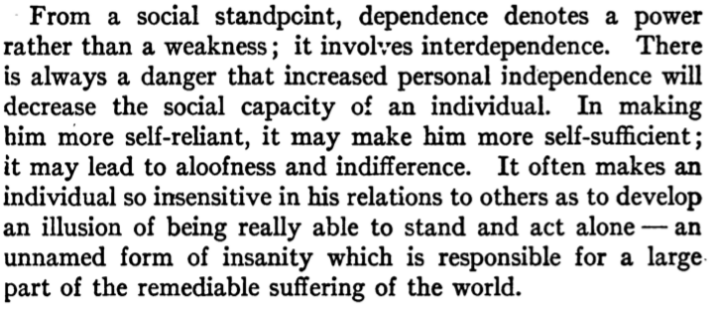
I alternated these with three chunks of text which, I said, were my favorite passages - but they should find their own. Mine (from pages 55, 59, 178) are counterintuitive or at least surprising, and open new vistas - a critique of the delusions of self-reliance, a celebration of childlikeness, and (appropriately for today's classs!) an argument for the benefits of understanding the past for engaging the future:


I'm not sure if this will have worked as a way of making the strangeness and significance of Dewey's ideas interesting enough to the students that they might try to engage them for themselves... I was in any case glad to be able to speak about the value of interdependence, the importance of maintaining childlike sympathetic curiosity, unbiased responsiveness, and openness of mind and the challenges of living in a world not settled or finished - things I suggested New School was set up to try, and things as important as ever in our moment of anthropocene awareness.

Tuesday, September 06, 2016

All in

Ah, the pleasures of an old-fashioned chalkboard!

Monday, September 05, 2016

More Kailashes

Some more images of Kailash... This above is part of a mid-19th century map (north is down) with lots of details of Kailash, including temples, Gauri Kund and even the prayer flag pole at Tarboche. The large lake is Rakshas Tal (all Kailash's streams flow into it); Manasarovar is on the next panel of this seven-paneled map. Not sure about the smaller lake.
And here's a scene from a glossy promotional film made by a Russian yoga group in 2014, advertising its 3-week trip to Tibet. In it gods and buddhas periodically appear in the sky, but here cosmic Kailash itself manifests in the middle of a sunny day, rising out of a sea of clouds and against a backdrop of churning galaxies, topped with Shiva's trident. The traveler is walking along the kora route on the way toward Dirapuk; the actual Kailash (but who's paying attention?) is above him to his right.

Sunday, September 04, 2016

Staycation

New Yorkers leave the city in droves for Labor Day, so we naively thought Herald Square would be empty. Hah! The only place way to avoid views crammed with tourists and shoppers was to look upward from a rooftop bar on 32nd Street. Still, it was nice to remember when gazing at the Empire State Building was a daily thing for me...

Saturday, September 03, 2016

Serving notice

Just finished a most enjoyable book. (I liked it enough to take a line from it as an epigraph for the "Theorizing Religion" syllabus.) Anna Lowenhaupt Tsing's The Mushroom at the End of the World both is and isn't an account of the twisted and tangled supply chain of matsutake mushrooms from forests in various parts of the northern hemisphere to consumers, mostly in Japan. You do emerge from it with insight into every part of that story, from the forests in which matsutake thrive with certain pines and oaks to the pickers, sellers, foresters, researchers and others who make a living of this uncultivatable delicacy. But you also get much more - and, in the getting, learn what Tsing calls the ability to "notice" the sorts of always local and contingent "assemblages" described, an ability the more necessary as our world gets more destabilized by capitalist efforts to turn it into a plantation for mass-produceable commodities.

Matsutake turns out to be the perfect way to tell this story. They thrive in forests which have been disrupted by logging or some other upheaval (though it turns out these forests still need to be managed by humans in one way or other), and even then cannot be farmed, but are harvested by pickers who develop every sense and awareness of ecological connections in learning to find still subterranean mushrooms. It's a precarious living which is pursued by variously disrupted communities, like South East Asian immigrants working in the logging-ravaged forests of Oregon.) Their grounded knowledge, which foresters and scientists try to systematize, is not "scalable" - it's resolutely local, embedded in the histories of particular environments (which, because matsutake flourish a few decades after disruption, usually involves the overreaching of some modern scheme or other). It helps us become aware of what Tsing calls "third nature":


Imagine "first nature" to mean ecological relations (including humans) and "second nature" to refer to capitalist transformations of the environment.... My book, then, offers "third nature," that is, what manages to live despite capitalism. (Princeton University Press, 2015, viii)

This is curiously hopeful. Many of the theorists she engages think that capitalism has ruined things beyond helping, and Tsing doesn't downplay the massive disruptions in ecosystems and relationships brought about by efforts to "alienate" species from each other for greater production; part of her argument is that this deadly logic infects even our (especially American) ecological thinking, which conceptualizes species in abstraction from their necessary entanglements with other species even when trying to conserve them. But the story of life isn't over. Matsutake was apparently among the first plants to emerge in Hiroshima after the atomic bomb.

Capitalism's (or, if you prefer, the anthropocene's) disruptions have changed things for ever, but life goes on in "patches," contingent gatherings of species in always particular places. To recognize and learn from that survival we need to outgrow the temptations of capitalist thinking about environments (isolatable resources, universalizable processes, assured progress). This is an argument for the continued value of anthropology, both cultural and interspecies.

Anna Tsing with matsutake (pic)

It's also an argument for fungi as a model of the way things work. What we know as mushrooms are just the occasional fruit of skeinlike subterranean networks entwining and symbiotically linking the roots of trees and whole forests. (They also send spores into the stratosphere!) This is an argument for living in always complicated and often conflicted history, for more sustainable economies maintained together with other species, for new political visions (with other humans and other species).

It's also a lovely way of rethinking what we're up to - or should be! - in the groves of academe.

What if we imagined intellectual life as a peasant woodland, a source of many useful products emerging in unintentional design? The image calls up its opposites: In assessment exercises, intellectual life is a plantation; in scholarly entrepreneurship, scholarship is pure theft, the private appropriation of communal products. Neither is appealing. Consider, instead, the pleasures of the woodland. There are many useful products there, from berries and mushrooms to firewood, wild vegetables, medicinal herbs, and even timber. A forager can choose what to gather and can make use of the woodland's patches of unexpected bounty. But the woodland requires continuing work, not to make it a garden but rather to keep it open and available for an array of species. Human coppicing, grazing, and fire maintain this architecture; other species gather to make it their own. For intellectual work, this seems just right. Work in common creates the possibilities of particular feats of individual scholarship. To encourage the unknown potential of scholarly advances - like the unexpected bounty of a nest of mushrooms - requires sustaining the common work of the intellectual woodland. (286)

Friday, September 02, 2016

Zest!

After years making do with a parmesan grater, finally got a proper lemon zester. And what a difference it makes! Our maiden voyage was Yotam Ottolenghi's stupendous pasta with walnuts and lemon (zest and juice, along with ample sage, parsley, butter, cream and shaved parmesan), which lifted eight people into an ecstatic trance tonight.

Thursday, September 01, 2016

10th anniversary!

Today marks ten years that I've been blogging - hard to believe! And, wow, this is apparently the 3728th post! Who knew I had so much to say!