Saturday, October 10, 2015

Low destiny


For the India China Institute project, a dozen of us - from India, Nepal, Tibet and the US - are on retreat in rather a posh place. It's a short walk from Long Island Sound in Glen Cove, a reminder of Gatsbyan days. 
I'm not sure what impression this is making on our visitors! For my part I was interested to learn why such manorial estates are not more common (though I suppose new ones have cropped up in this second gilded age).

Friday, October 09, 2015

Thursday, October 08, 2015

Initial meeting

Mount Kailash has come to find me again. New School's India China Institute's Sacred Himalaya Initiative (full name of the project: Sacred Landscapes and Sustainable Futures in the Himalaya) today started a four-day planning meeting with scholars and policy people from India, Nepal, the Tibetan Autonomous Region, and the US. A highlight of today's discussions was a presentation on the campaign for UNESCO World Heritage status for the trinational Kailash Sacred Landscape Conservation and Development Initiative being developed by the International Centre for Integrated Mountain Development. (I.e., ICI's SLSFH is partnering with ICIMOD's KSLCDI.) Actually, the highlight was the ensuing discussion, which brought out the stakes and issues involved in a really exciting way. Let's hope the next days are as much fun!

Wednesday, October 07, 2015

ML410.C13 A15 1995

I'm not sure this worked. Our final "Arts as Social Research" session was on sound, and we read parts of Aaron Copland's What to Listen for in Music (which started as a course at The New School) as well as two of the dialogues in For the Birds (where John Cage describes studying and teaching at The New School, along with his experiments with sound and chance); for the last part of class we heard about our college's innovative major in Contemporary Music, currently in its third year. The room was stuffy, though, and the students were tired; I think classical music is off-putting to many of them, experimental music no less so. I anticipated it might be a tough class, so I planned an activity for us, adapted from something Cage describes in For the Birds (89).
On little cards I had students write

(1) a number between 1 and 5
(2) another number, between 50 and 150
(3) an arrow pointing either upward or downward

These cards were collected, shuffled and redistributed. Next, students had to sprint down to the library (three floors below us), and look around for a book that appealed to them, touch it. Then they were supposed to consult their card, pulling out a book as many books to the right or left as the first number, open to the page indicated by the second number, and copy out, depending on the arrow, the first or last full sentence on the page. For good measure, they should write down the book's call number. And then hurry back to class.

Our first activity was for each person to read out her/his sentence, as if she/he meant it, followed, seamlessly, by another sentence; they could choose however or therefore as the transition. This flowed better as people got the hang of it, so we had a second go around, this time using the transition they hadn't used before. (Turns out however improv is easier.) The content, from books on many subjects (the Nevada State legislature, the publishing history of a comic book, Macy's claims that it had the world's largest store, statistics regarding incarceration, tonal characteristics of the clarinet, the caption to a photograph of some forgotten person, and several scenes from fiction among them), started to seem familiar even as each sentence opened out in a (not always very) different direction than before. Somehow we were all contributing to a discussion of a complicated interdisciplinary something.

Our other activity was a little more conceptual. Students were to address each other by name, but speak only the call number they'd written down. Not everyone had remembered to do so, but there were enough to go around. Call numbers were pronounced as assertions, posed as questions or suggestions, laid down as challenges serious and ironic. "John, BL175 .A4 1990!" "Sandra, GN1558 .R46?" "Federico, PQ3 .C87 1987a...!" "Colleen, HM14 ... G7 ... N411!!" "JG50 .S1919, Sandra."
I suppose the exercise was as much Yoko Ono as John Cage but it got the juices flowing, at least a little. I'm not sure the students have enough experience of seminar discussion to notice how not-unlike some such discussions our activities were (which may be for the best!). We didn't get a chance to reflect on it, as our class visitor - the Director of the BA in Contemporary Music - came in as the call numbers were bouncing around. Cool as a cucumber he said "6 E 16, 1106" - our room number. Did anyone have an M, he asked? That's where he's at home.

Tuesday, October 06, 2015

Rainbow's end

Yesterday, across the Central Park reservoir.

Monday, October 05, 2015

Café Revolución

The Orozco Room was locked when "Seminar in the City" got there today, but that turned out to be for the best. For the best, also, that the A/V request got lost in the ether. It led to more quality time with the murals, and took us helpfully beyond the aura of the work of art.

Waiting for someone to come let us in made the famed Orozco Room seem that much more special, but also forbidding and even forbidden. In its current get-up, in dark earth tones and blacks, it's like entering a cave or a tomb. What fun then to get students, in the space, to imagine it not as a dark and silent holy of holies but as a cafeteria fill of people chatting and the clink of coffee cups and cutlery, the murals set off against white backgrounds and the whole space awash in light from the big windows and the bright open area outside its open doorways to the north! Still, as one perceptive student asked, who thought this was an appropriate topic for a mural in a cafeteria?

She asked this standing underneath the shackled laborers in the middle of the east wall - I'd asked students to move around and then stand in front of a section they wanted to talk about - and I confirmed, from Faculty Senate experience, that it might interfere with one's appetite, if one were paying attention. What were they thinking?

Since the display of audiovisual materials I had planned wasn't going to happen there, we had time to make ourselves at home in the room, spending a good amount of time trying to understand the mural wall by wall. We started with revolution in the East (in 1931, Indian independence was miles off and nonviolence not a proved strategy - Orozco was prophetic, or idealistic) and continued with the storied west wall with the Lenin portrait and Stalin marching in lock step with comrades of all races, all holding hammers (tittering over the curtaining - yellow!). Then to the scene facing the window, workers returning home to a family and a table full of food and books (though nobody read the affect as joyful), and finally across to the focal point of the series, another table, the Table of Universal Brotherhood (where I
noted that visionary Orozco had painted Barack Obama when a black president wasn't even a pipe dream).

I've not had occasion to spend so much time with the murals, and with curious interested people. Hadn't thought of the cafeteria tables between those two tables of the north and south walls, or of what it will have been like to sit between those utopian scenes of a suffering world struggling for redemption. Coffee with the forces of history will have been kinda exciting (or alarming) - if anyone was paying attention.

Approaching them now, though, they're ancient history, dated like the draughting instruments in the image which originally welcomed people into the light-filled cafeteria of the future. We know that Gandhi won and that Stalin lost. There's nothing visionary about it, and the British gas masks and Soviet bayonets are just quaint, as is the all-male Table of Universal Brotherhood. The muffled mural room, open only for meetings and special occasions, is appropriate just for smug resting on one's laurels. Its danger is gone. Its hope, too.

So it was probably a good thing that my sequence of responses and engagements to the murals had to take place in another room - I raced around and found that one of the classrooms on the fifth floor was free, which turned out to be providential, too. In this other room, an unremarkable everyday classroom, I showed the students the electrifying animation updating and exploding the Table of Universal
Brotherhood from the Re-Imagining Orozco exhibition of 2010, the queer response from the Art History MA students of 2012, the "feminist long table" laid out between the mural's two tables in 2014 - and some scenes (including George Bates' brilliant commissioned cartoon) from the "Red Scare, Yellow Curtain" section of Offense & Dissent, last year. I defy anyone not to be axcited by the variety and creativity here displayed!
Seeing these in an everyday room, not in the now exclusive Orozco Room itself as I had planned, made these responses seem more productive, less inward-looking and reactive. People were making new meaning, not just critiquing the old. (And then I showed them some images from the Benton Room, which was on, yes, that very fifth floor, and we briefly discussed the one-sided views of The New School you'd get from having only one of these sets of murals to refer to.) A lot for one class, but, hopefully, exciting - a living legacy!

(Find these and other Orozco images here)

Sunday, October 04, 2015

Little tree that could

Picture story of how a little palm tree, turned out on the street in
Manhattan, found its way through the subway to my place in Brooklyn!

Vivat Snitow!

I can't resist sharing this collage. The work of Bogna Burska, it was presented to one of my senior colleagues at Lang, Ann Snitow, on her receiving the first Courage in Public Scholarship Award of the New School for Social Research-Europe initiative. Ann's one of my heroes, and also one of the heroes of J's and my New School history work. She took our rediscovery of the formative role of women in New School history to frame a big conference on gender studies at the New School, and we've used her essay on the difficulty of telling non-patriarchal stories and, indeed, maintaining memories of movements struggling against patriarchy, in framing our own project. She's also provided invaluable documents, narratives and connections for our work. But while she was fighting the good fight at New School, she was frying bigger fish too, helping ignite gender studies in a dozen ex-Soviet bloc countries.

Saturday, October 03, 2015

Bilbao moon

A Saturday but no Brooklyn Botanic Garden...! But that's OK. Today was wet, so the High Line was available for viewing, like the early days.
I was in that neighborhood to see "Happy End," the inaugural production by the newly consolidated New School for Performing Arts: Drama, Jazz, Mannes. (No photos allowed.) The dean of the division noted that they had long wanted to perform this, the sequel to Bertolt Brecht and Kurt Weill's "Three Penny Opera," written by a Dorothy Lane (=Elisabeth Hauptmann). It is a good fit for a jazz/classical/theater conservatory, and for The New School, which played host to two of Brecht's important collaborators, Hanns Eisler and Erwin Piscator. The story even takes place in 1919, our birthyear, though in Chicago.

It was a good show well performed, my first live theater in a long time, I found myself grinning dementedly at the liveness of it... Not the desired effect of Epic Theater, I don't think. But even with a less delirious viewer it is a challenge. It gives you a "happy end" which is supposed to rankle, but the unholy alliance of Salvation Army and gangsters (possibly through love, if anyone is naive to believe in such a thing) which might have continued the low-life theme of "Dreigroschenoper" in Europe here is charmingly familiar: "Guys and Dolls," anyone? I've seen it before, performed to the hilt by students at the Victoria College of the Arts in Melbourne nine years ago (actually I needed me diary to tell me when and where I'd seen it before) and had pretty much the same reaction. Isn't this too much fun? I was singing the super-catchy deliberately irrelevant song "Bilbao Moon" long after the show ended. Fantaaaastic!

Friday, October 02, 2015

Autumn leaves


Gusty rain brought down yellowing leaves across from my apartment, and flipped over still green leaves in the courtyard outside my office: splashes of white like unexpected flowers. Temps in the fifties - it's definitely Fall! More rain is in the forecast, though perhaps not a hurricane.

Thursday, October 01, 2015

Jeunesse dorée

Found my way today to the Asia Society, which is hosting an exhibition of gold objects from "forgotten kingdoms" of the 10th to 13th centuries. The works, some found 150 years ago but most unearthed in recent decades, show mastery of many different kinds of goldworking skills, as well as participation in networks of trade and religion with other areas of Southeast Asia. They are apparently also a source of great national pride, proof of sophisticated and prosperous civilization long before the arrival of the Spanish. Still, there is a poignancy in gold articles being the only survivals from a culture. The narrator to an attending film averred that elites had filled their graves with gold in "an attempt to extend their social privilege" beyond death, and I felt briefly coopted by that attempt. But the works themselves recall not their owners but the artisans, their great skill and finesse, patience and grace.

Wednesday, September 30, 2015

Natural history

To think I almost dropped David Hume's 1757 Natural History of Religion from the Theorizing Syllabus! Returning to its subtle and not-so-subtle subversions this week has been great fun.

NHR was infamous and important in its time for upsetting the narrative, accepted in the breach by all, that human history must have started in monotheism - didn't Adam and Eve know their God? Hume's argument that polytheism must have been the earliest form of religion seems intuitive now, along with the idea that we must be able to tell a story about how monotheism emerged out of it. (Nobody mentioned that one could accept the former but think the latter the result of revelation.) Current students also aren't shocked at the idea that there is no progress in religious history, just an enless "flux and reflux" of polytheism and monotheism, human needs and ignorance by turns anthropomorphizing the forces of unpredictable nature and then exalting one of these projections to the infinite without end.

What is counterintuitive is the claim that religion, nevertheless, isn't a universal feature of human life, that it's the constantly variable result of the concatenation of human nature and (resolutely thisworldly) experience. Hume's 18th century sense of human nature seems quaint to us: "self-love, affection between the sexes, love of progeny, gratitude, resentment"? It's a richer, more interesting list than self-love and altruism, but of course the point in context is that it lacks anything like a universal penchant for religion. The variety and non-ubiquity of religion means that "[t]he first religious principles must be secondary."
Hume claims to be able to account for every aspect of religion out of thisworldly human need and ignorance. And while he doesn't think religion is likely to disappear, he does suggest that some forms of religion meet human needs better than others - the polytheistic ones! Contrary to the instincts of some of my students he didn't think polytheism a live option; he was more concerned to talk people down from overweening forms of monotheism. In closing he puts it this way:
This didn't sit so well with the class. Was Hume really encouraging "insensibility"? I explained that he shared the view of the ancient skeptics. Since human minds are ever going beyond the available evidence to form opinions which, when inevitably disconfirmed by experience, frustrate us and make us angry and defensive, it's better not to have strong opinions about things like religion. This is more easily said than done, but one way is to use the method of counterposition: when you feel yourself going too far in the direction of one opinion, counterbalance it with a strategically selected piece of evidence for the other side. Is monotheism more rational than polytheism? Maybe. But polytheists are more reasonable. Wisest of all are those who can see both sides - perhaps through an extended study of human history - without getting sucked into either: philosophers. 

I'm not convinced that Hume gets the landscape of human needs right - is there really no need for a relationship with, well, the whole of nature and its God? But I do appreciate the daring of his approach, and the wisdom of his skeptical method. (You can buy into it while still being very religious, witness Hume's predecessor and inspiration Pierre Bayle who, inspired in turn by Maimonides, employed it to clear a space for grace to speak.) I guess it also resonates with my "inconvenient truths" pedagogy, but today it was sounding sort of Buddhist, too. Human beings cling to certainties they cannot have (like "I am..." or "I believe..."), producing suffering for themselves and for others. Modern understandings of religion, as something private and pure, separate and separable from thisworldly human life with others, encourages attachment to false images and judgments of ourselves, too, as well as of others. 

I could tell some of the students thought me, like Hume, too concerned with mere "safety." Is greater "happiness ... not to be dreamed of"? Perhaps they're right... it's fun to be engaging in these debates again!

David Hume, Principal Writings on Religion (Oxford, 1993), 134, 184

Tuesday, September 29, 2015

New Job description

The university lecture course (ULEC) I'm teaching next semester.

Monday, September 28, 2015

Dance as social research

In "Seminar in the City" we've started a three-session section called "Arts as Social Research." That is of course one of the catchphrases of J's and my understanding of New School history: we think the turn to offering courses in and on the modern arts in the 1920s and 1930s was anything but mission drift on the part of a "New School for Social Research" which had lost its founding focus. "Social research" is a capacious term which embraces the study of the social dimensions of all phenomena (diachronic as well as synchronic) as well as new ways of understanding these dimensions in times of change. In the current class we're looking first at movement, then at image, and finally at sound in this way.

Our class readings were by two people who taught Modern Dance or about it at The New School in 1931, John Martin and Doris Humphrey,

and the current experimental dance program at Lang: quite a leap!
But it worked, in part because the Director of the Dance Program came to help us make sense of things. I got a better sense of what animates the current program, and I think he gained a new sense of historic resonance. But the students? They came in excited but skeptical about so apparently non-academic a venture as dance and left, perhaps, persuaded that it could indeed be a form of social research.

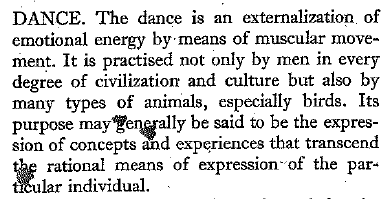
The case for dance as social research was made clearly in the entry John Martin, the nation's first dedicated dance reviewer, contributed to the great New School-based Encyclopaedia of the Social Sciences. (The course described above was given after he wrote this.) What is dance?
It's being described in an encyclopedia of social sciences because of this supra-individual character. Indeed, in the ensuing historical account of forms of dance in ancient and modern societies (including lots on dance and religion) it seems a quintessentially social thing, not just marking social experiences but giving crucial expression to them. For that matter
dance forms can teach us things about social changes before other forms of analysis appreciate them. The modern movement in dance (of which Humphrey was a leader) is more than just a reflection of changing times, however. Like other modern artistic movements it understands itself as offering a distinctively intentional experience of what Humphrey called the drama of life in its moment. I believe that the dancer belongs to his time and place and that he can only express that which passes through or close to his experience, Humphrey wrote. The one indispensable quality in a work of art is a consistent point of view related to the times.

Fair enough, but that was a long time ago. Does anyone still see (modern) dance that way? Does anyone at The New School? The current program in Dance at Lang is distinctive among college dance programs in many ways. One is a suspicion of canonical ways of understanding dance, in general or in its modern and contemporary forms. As the program director explained, the New York location enables them to invite practitioners of all sorts of techniques and understandings to teach: students get to be part of an ongoing experiment. Is it social research? The program doesn't use that phrase but its courses frame dance making as a series of investigatory acts, an arena for research and discovery: close enough! At the New School dance is still a way to think about the world.

John Martin, "Dance," Encyclopaedia of the Social Sciences,
ed. Edwin R. A. Seligman and Alvin Johnson, vol. IV (Macmillan, 1949), 701, 706
Doris Humphrey, New Dance: Writings on Modern Dance,
ed. Charles Humphrey Woodward (Hightstown, NJ.: Princeton Book Company, 2008), 5-6

Sunday, September 27, 2015

Crescendo

I saw the "blood moon" from my roof, but it didn't look like this. (I'm still without a new camera, though I doubt many cameras could capture so faint a light). The supermoon's color was not red but a light ochre, the color of dried blood. But still, very exciting that a cloudy day opened its sky for a bit. What struck me as the coolest moment came a bit before the full-on red/brown disk, but nobody seems to have posted a picture of it. (Our clouds closed before I could see its coda.) The last bit of the moon to be hit by sunlight, the lower right, was still so bright that the red light curving around the earth wasn't visible... except as a reddish crescent, open on the upper left. Reminiscent, I suppose, of many a sci-fi book cover of a different phenomenon - a light breaking from behind a celestial object - it conveyed enough depth to let me feel the so rare alignment of sun, earth and moon this way.

Saturday, September 26, 2015

BBG

 BBG Saturday again! And the season for my favorite filament-seeds...
 

Obstructed view

Well, I wouldn't be a scholar if I didn't also tell you when one of my hypotheses is disproved. The certificate below (found here) decisively disconfirms my excited hunch that people inside the Benton Room could see the lights of lower Manhattan - its windows are south-facing - which then somehow resonated with the city scenes on the walls facing the windows and even seemed to spark with the energy coursing along the aluminum-painted frames. Sorry folks (well, mainly, sorry fantasizing me), by the time The New School opened its 12th St. building, the 9-story building directly to its south had already been there for 6 years. The Benton room was on the 5th floor: open and shut case. Pity, though.

Friday, September 25, 2015

Mysterious beings of the underground

I dunno what it is, but I kinda like it. Art at the 28th Street N/R station.

Building bust

My Empire State Building view is definitely doomed, sigh. The 15-storey apartment block rising in its place (pictured below from Vanderbilt) means that even from my roof the Manhattan cityscape will be gone. I'm heartbroken. But I hope against hope that the ESB will still be visible when my dearest friend from China arrives here on Columbus Day, October 12.

Thursday, September 24, 2015

Gaia for the perplexed

New School hosted the prophet of a new religion today, the author of Dark Green Religion: Nature Spirituality and the Planetary Future (2010). I thought since we're an academic institution (and he's in religious studies) that he'd dwell on the "dark" side of emerging environmental consciousness, as promised in his book (an excerpt below) but it was pretty much all rainbows and butterflies. True,
he started with Val Plumwood's liberating discovery (when she was nearly killed by a crocodile) that she was "prey," but there seemed no downside to people who combined borrowed and invented rituals with romantic conceptions of wilderness, so long as all was undergirded by a naturalistic appreciation of interdependence. While I appreciate his insistence that many folks who consider themselves "spiritual but not religious" in fact behave a lot like the "religions" from which they claim to have freed themselves, he let his "dark green religion" types off easy because they're grounded in world-affirming science rather than life-negating monotheism, their anthropomorphisms comparatively harmless because of scientific humility. I like the biosphere as much as the next person, but as a religious studies person I'm unsatisfied by any account of a religious movement's growing solely because it's, well, true. Why these formulations here (worldwide - really?) and why now?