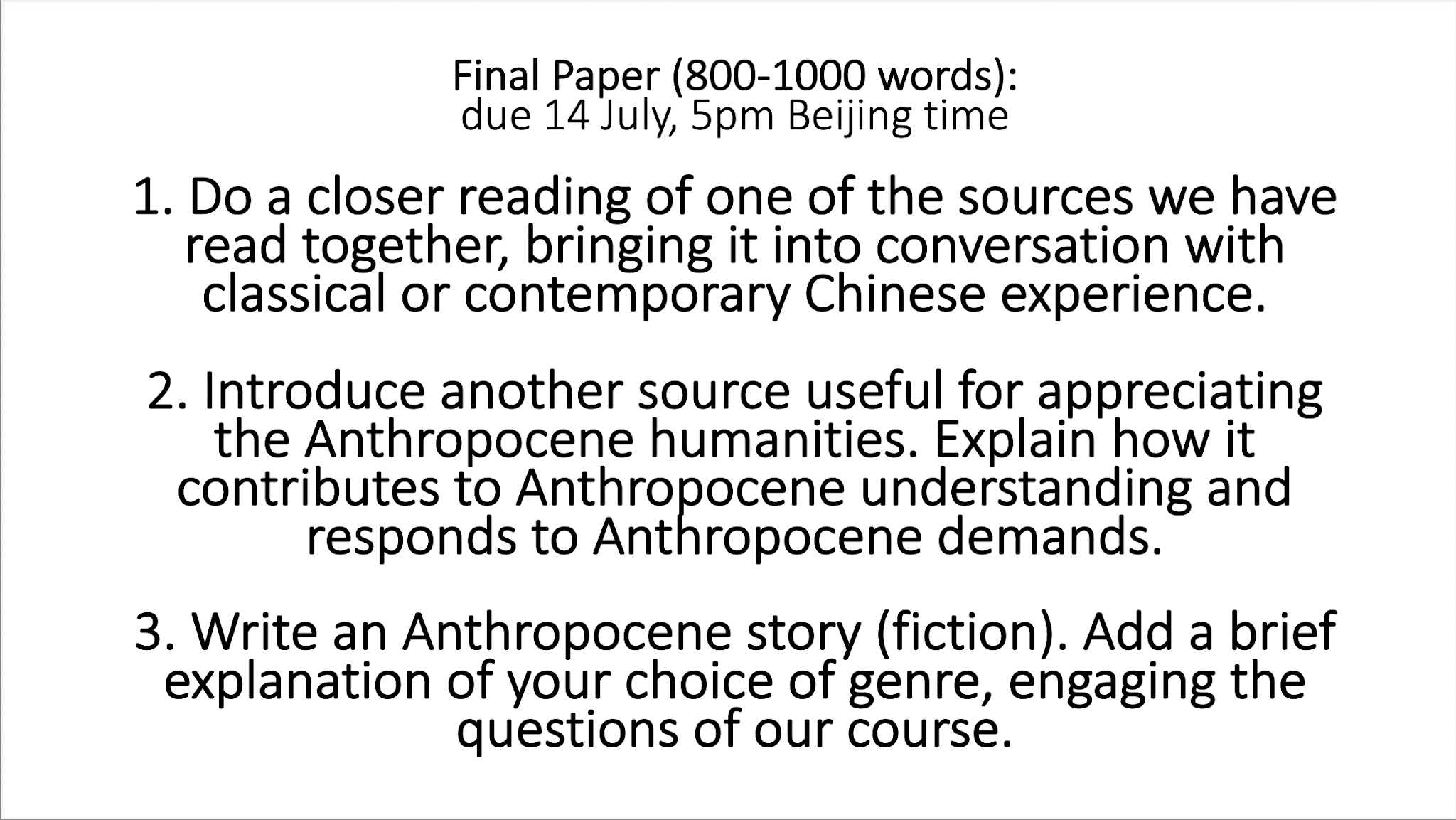
I've made my way through all the final papers for the Renmin summer school. Most are impressive, considering they're written in a second language, in a field far from the student's major - and, of course, a field full of polysyllabic neologisms like "Anthropocene"! The consensus of most of the essay writers seems to be that Chinese tradition has the resources to offer a way out of the Anthropocene. This wisdom was frequently presented in terms of a seamless tradition asserting the unity of humanity and nature (天人合一) stretching from ancient Taoism (not the Daoism I gave them some materials about) and Confucianism to contemporary ideas of "ecological civilization" - so frequently and so seamlessly that I sense the presence of a shared source. Occasionally the Chairman of Everything is even named, though not as often as his wooden slogans about the "community of life" and the "green waters and green mountains [which] are also gold mountains and silver mountains."
The more interesting papers made more complex arguments. One each discussed "ecological socialism" and "historical materialism" by name (who knew the young Karl Marx had anticipated the Anthropocene in distinguishing "free nature" from "humanized nature"!) One suggested that what united the apparent differences between Daoists, Confucians and Legalists (only mention of this important school!) is a civilization-defining "pragmatism" on display also in recent appropriations of socialism and capitalism. One responded to Roy Scranton's argument that the Anthropocene demands we learn to die as a civilization (based on the old saw that to philosophize is to learn to die) with a knowing deployment of Confucius' agnosticism about the afterlife: "how can we know death if we don't know life?" And one exquisitely compared Chinese landscape paintings with western Renaissance perspective to demonstrate the "liquid ecology" James Miller had shown us at work in Daoism, one which dissolves not only the boundary between the human and natural worlds, but between both of these and the supernatural.
One brilliant essay traced a famous ancient folk tale (愚公移山) about a man who thought he could move a mountain with the help of his future descendants, his naive faith rewarded by the gods who granted his wish, from ancient times through a famous discussion of Mao's (the people take the place of the gods) and into the present (where technology lets us do the work of the gods ourselves) through discussion of two recent Chinese sci-fi movies! At the end of the story of "Yugong Moves the Mountain", the Emperor of Heaven was moved by Yugong's sincerity and ordered the two sons of Kua'e to carry on the two mountains. But what the story does not tell us is what is left after the mountain was removed. Is it magnanimous? Is it a gravel wilderness? Or a bottomless abyss?
Another suite of essays introduced me to contemporary Chinese art works, novels and even a fashion collection engaged implicitly or explicitly with the Anthropocene. These works were anguished about the extent of ecological devastation, and less sanguine about the possibility of restoring harmony" Song Chen's "Healing Land," an installation assembling polluted soil samples from around the world in giant "soil babies" on "soil placentas"; the "Story Behind" series of Xu Bing, which recreated traditional landscape scenes out of garbage (I saw two of them in Beijing); Chen Qiufan's astonishing "near Anthropocene" novel Waste Tide (the English translation of which I've started reading); another novel actually called Anthropocene (人类世) by one Zhao Defa (not available in translation but it sounds fascinating); and the Spring Summer 2021 collection of Chinese designer Mithridate, also called "Anthropocene," and presented with great drama at the Serpentine Gallery in London. Students also commended western works, from Ian Angus to Peter Berger's Introduction to Sociology to a BBC series called "Human Planet."
But perhaps the most interesting were the stories which not quite a fourth of the students chose to write - which I'll tell you about tomorrow.