Showing posts with label seminar in the city course. Show all posts

Monday, December 21, 2015

Newly schooled

At semester's end, what have I learned? People always say you learn as much from teaching as your students do, but in a seminar setting I think sometimes the seminar leader makes off like a bandit. For the first year seminar which just ended, it's a little hard to say who got/gave more.

There's a good reason for this: the last three weeks of the class were given over to the students, each of whom was charged with facilitating a "model seminar" on a timely topic of their choice. This means that the last class I "taught" was before Thanksgiving. (And even that one I didn't actually teach; the topic was Sekou Sundiata's "research to performance" method and discussion was led by one of his students.) And the point throughout the semester had been that The New School has always been an asylum run by the inmates, defying received notions of what's worth knowing and how to teach it to engage the challenges of each new day - and throwing ideas of professorial authority to the winds in the process. Remember that discussion about who's best positioned to know what folks need to know today, where faculty weren't even considered?!

I've told you a little about the topics of the model seminars, and the picture of what's worth knowing they implied. But I hadn't at that point received the students' final work, a 5-7 page reflection on the process.
Most of these have been extraordinarily thoughtful, and confirmed that this was a good way to wrap up the semester. Students fretted about their own seminars, told how they'd kept to or departed from their plans, how their classmates had or had not said what they thought they would, and what they'd admired in other students' seminars. Many had never thought about leading a seminar - or about what's actually happening in a seminar discussion - before. Some described paying a new kind of attention to what was going on in in all their classes; all, I dare say, now know what it means to say that a seminar is co-created by everyone present, and will be more engaged in their classes in future. Learning by doing! We've got seminar learning down cold!

Or do we? I have to say I was struck (and a little nonplussed) at just how much discussion the students included in their 20 minute plans, and how little time they devoted to sharing new information with their fellows. Only half assigned material in preparation for their session (I'd told them they could assign up to 5 pages of reading, 10 minutes of video or 15 minutes of a writing assignment), and perhaps knew better than to assume the class had done it. In the seminars themselves a few had minimal powerpoints, only one used the board, none had informational handouts. Instead we had many activities asking everyone to do something (define art, complete a sentence, correct a grammatically questionable sentence, draw something) and share it with the class, and lots of discussion of open-ended questions. I worried that I had gone too far in extolling the wonders of seminar learning, as if everything worth knowing would emerge spontaneously and completely from a discussion even if nobody in the discussion knew much about the topic at hand.

But then it was my turn to learn. Reading the students' reflective accounts of the choices they had made in setting up their model seminars, I found out what was really going on. Engaging the class in enjoyable discussion was the aim, "teaching" secondary if not indeed rejected. They had not forgotten about content. These days you can find most content in seconds from your smart phone once you know about it and know why it's interesting - and if you're not interested, you won't remember what people have told you anyway! They were striving for what you can't get online: encountering the variety of their classmates' perspectives, and the multifaceted view of things which emerged when these diverse points of view interacted with each other.

L, one of the students (her topic was Fluxus, an anti/art movement which emerged out of John Cage's lectures at The New School), described what was going on with great eloquence:

The topic of a seminar is like the foundation layer of a house. It plays a large role in determining how smoothly the seminar goes and how well it works. Obviously, some topics open up a lot more conversation than others. To me, a seminar should be less about getting out facts to the people who are participating, and more about getting to hear what everyone thinks on the subject. So perhaps the walls of the “seminar house” would be the people involved and what they contribute. To be a true, well-functioning seminar, intriguing conversation must happen. Conversation amongst the group is such a key part of this type of learning process. I suppose that the roof would be me, the leader, making sure that the seminar is contained and does not stray too far from the topic. The person running the seminar must also try to be sure that everyone is getting something out of it, something that can be difficult. Finally, the paint on the walls of the house, the furniture inside, the fence around the house, all the aesthetic details, are the visuals used during a seminar to help relay information. I say this because in no way should the visual of the seminar be the focal point or the most important thing, even in a topic about visual art.

My notion of a seminar - a round table with a text at the center - suddenly seems very, well, old school. Thanks, class, for all you've taught me, and for the hope you give me for the ever-new New School!

Wednesday, December 16, 2015

Ever new

So Final Syntheses have come and gone. It's always a moving experience, even when you take into account the pretty-much obligatory "I got a lot out of this class" business. Lang students aren't shy about criticism, though - nor about sharing what really matters to them. The generosity and vulnerability can be overwhelming. And, given the opportunity to express themselves in "a medium that matters to you," they do some pretty cool stuff. Often personal, I can't share most of them. In a way it's nobody's business but the members of the respective class, and part of the joy of these final sessions is feeling the commitment students demonstrate, one last time, to the collective enterprise we've been engaged in, to the community of learning.

I can, however, tell you about my final reflections (which I always do, and share). I'll save the Theorizing Religion reflection for another day - it's about the consequences of making "religion making" the frame of the course, and how to make the class a welcoming place both for prior learning and for concerns in other disciplines and vocations than the academic study of religion. I'll tell you instead about the first year seminar which offered a survey of New School history and devoted its final fourth to "model seminars." A reminder of the course description...
Because the "model seminar" preparation process began before Thanksgiving, the actual coursework of the class seems like a distant memory. (The student whose final reflection I post above provided a welcome reminder of the variety of things we read.) Instead we were treated to seminars on a remarkable range of subjects:

Urban Campus vs College Town • Fluxus • Education for Syrian Refugees • Black Mountain College • MOOCs • Health Crazes • What is Safe Space • The Kim Kardashian Effect • Grading Systems • The Value of Liberal Arts • Educational Access for Girls • Priorities and Life Balance • The Museum of Feelings • Learning from Popular Music • Dress Codes

There were a few connections to what we'd done together - Fluxus from Cage, Black Mountain College as an echo of New School experiments, Frank Alvah Parsons' ideas on art and advertising, various discussions around education - but not that many. There weren't supposed to be. The choice of topic was to reflect students' sense of "the urgent demands of now," or at least something they wanted to share with their classmates. They were interested in each other's choices, too.

As my Final Synthesis I reminded the class of our inconclusive discussion, in connection with the New School College experiment, about who was in the best position to know what an education should offer. The New School tradition suggests that received curricula and disciplines should be scrutinized, that the ever new constellations of social and cultural life demand ever new courses and formats. What's needful for first year college students now? Our discussion was inconclusive because the class came up with arguments for - but even stronger arguments against - entrusting the First Year Curriculum to graduating seniors, to sophomores, to students who'd chosen majors, to recent and not so recent alums... (That faculty in fact make these decisions didn't come up!) At that I suggested that, as they navigated our "open curriculum," they consult as many and and as many kinds of people as possible.

Today I suggested that we might learn from ourselves. What did the topics they had chosen suggest a relevant Lang First Year Curriculum in 2015 might look like? They seemed quite taken by my suggestion:

Art, Values and the Market
Equity: Local and Global
Learning from Popular Culture
Self-Care

What do you think?

Monday, November 16, 2015

How should we think if we wish to think together?

Although unplanned there was something satisfyingly right about my having to use my fingers and the dust, all that's left of our chalk, for the final session of "Seminar in the City" which I'm leading. (The remainder of the class is about student projects, ushered in by a guest presentation on Sekou Sundiata's "Research to Performance" pedagogy Wednesday.) 

The names of Richard Bernstein and Hannah Arendt (at last!) appeared on my board because our final reading was by Elizabeth Minnich, who did her PhD with these two advisers, on John Dewey, at The New School. Even if she hadn't been an importnat part of the New School College, even if she hadn't gone on to do work in interdisciplinary and integral studies consonant with the ethos of The New School, her bringing together feminism (and the European tradition) and pragmatism would have been a sweet way of wrapping up The New School story.

But, of course, Minnich was here for the first stab at a liberal arts college. And her subsequent work, including Transforming Knowledge, the introduction to whose second edition we read, heralds the birth of a "New Academy" very like Lang today. The book's chronicle of the multi-faceted struggle to establish women's studies in an academy devoted to understanding "Man" offers many resources for freeing ourselves from knowledges that  ... derive from and legitimate systems of domination (25) and helping us more fully address crucial questions such as these:

What has it meant to be human? How have these meanings changed across time and across cultures? How can and should we live together not despite but with all our differences? Who are “we”? How should we think if we wish to think together? How, by whom, and to what effects is knowledge legitimated? How do thinking and knowledge relate to “the real world”? Why do such questions matter; why should we care? (6)

Minnich offers tools for seeing and engaging these questions, from using plurals and verbs rather than singulars and nouns to rethinking the Man/Nature contrast, evolutionary narratives, the very idea that there are "kinds" of humans - and religion's baneful tendency to absolutize particulars.

Arendt was no fan of Dewey's, but it was fun to show how Minnich's understanding of knowledge as made in a constant shared process (of which we can become aware, and which we can bend toward greater inclusion) brings together Deweyan pedagogy and Arendtian imperatives on the importance of "thinking." The terrifying example of Eichman's not-thinking provides a strong rationale for developing the kinds of open and participatory thinking Dewey's philosophy of education seeks to foster. I offered Minnich's view as a sort of summa of what The New School has been about - a summa not of knowledge but of understanding the processes by which we make knowledge together, and need to keep at it, lest "knowledge" become the legitimator of domination rather than the way to a more just, more human future.

Then I made a mistake (perhaps). Since it was the last session of class I'm leading, I invited the students to pair up and look back over the syllabus of readings we had just made our way through and tell me how (if) it communicated this ethos: I wanted and needed to know if what I was trying to get across was coming across, and how I might do it better. I left the room to let them discuss freely. 

Their critiques were fine but ordinary: a better course title? shorter and perhaps fewer readings? reading prompts? field trips? a fuller integration of the Parsons story? They didn't say that my readings encompassed a wide range of voices and disciplines, men and women, insiders and outsiders, scholars and practitioners, faculty and students. They didn't say that these voices conveyed the spirit of a place ever on the make, in which there was no settled view of what counted as "knowledge," and in which new knowledges and new pedagogies were regularly being tried out. Perhaps I expected too much. (It is rather meta for students in their first semester of college!) Perhaps I didn't explain it well. Perhaps it's all they know... 

But of course the class isn't finished, though my selection of shared readings is. Let's see how these ideas and issues appear in the class presentations ("model seminars," we're calling them) to which we now devote our efforts.

Monday, November 09, 2015

As simple as two plus two

As the narrative part of "Seminar in the City" comes to a close (the final section of the course is devoted to "model seminars" which the students will lead on topics they choose), we had our Tristram Shandy moment. A course which students might reasonably have expected to tell the story that starts with Lang's birth in 1985 instead ends with this birth. But therein lies the tale - and another instance of 18th century English literary wit.

Not a simple tale, as my attempt to diagram it shows - the vertical axis represents the conventional sequence of four years of high school followed by four of an undergraduate degree and, perhaps, two more in a master's program. What I was trying to show was that it took the New School a good long time to treat the four years of a BA as a single unit.

• The square represents the BA program introduced during WW2, known as the Senior College since it was only for students who began their studies elsewhere. (Contrast with "Junior College.") It's alive and well as BPATS, the Bachelors Program for Adults and Transfer Students.
• The crossed-out circle next to it is the experiment of the New School College, which was a sort of honors program within the Senior College - full-time but still, like the rest of the New School, not residential. It began in 1966 and petered out five years later.
• Next to it is what came to be known as the Seminar College in 1976, a seminar-based curriculum but still only for juniors and seniors. Is it the renamed New School College? Occam's razor suggests so but I have yet to see or hear anyone confirm this.
• Above it was the Accelerated BA-MA Programs, introduced to entice students to stay more than two years, and take advantage of the university's graduate programs (in the social sciences, "management and urban professions," and media studies).
• Below these two was the kernel, as the story is conventionally told, of Lang - the Freshman Year Program at The New School for Social Research, which, starting in 1972, offered a specially designed one-year program for precocious high school students - many came after their junior year of high school, some even after their sophomore year. After the year at The New School, they transferred to universities with conventional 4-year undergraduate curricula.

By the 1980s (the advertisement above is from 1981), all these programs existed together in a sort of symbiosis. The Freshman Year Program was housed in the Seminar College, but each still had its own catalog. Indeed, just a few months after the advertisement above writes The Undergraduate Division consists of two colleges - the Senior College and the Seminar College... The New School ran another ad, describing four different programs, each of which seemed to cater to different students, most of whom came from and went to other universities.
All of this was in keeping with what The New School was - a long-standing alternative (and challenge) to conventional, credit- and degree-focused institutions. This piecemeal array represents a lifelong education approach to undergraduate education - and was par for the course in an institution which experimented with unconventional new forms all the time, seeking to accommodate learners at all different stages of their lives.

It took a presidential initiative, and an endowment, to gather together these pieces into a four-year liberal arts college. It made formal what had been emerging - students entering the Freshman Year Program and staying, making do with three years of the curriculum of a Seminar College originally planned as a two-year (or one-year) experience. Closure, a telos? It's tempting to see it this way, to see these parts as components of a four-year college destined to converge. We're just quirky here at The New School, one is tempted to observe; we've long done things back-to-front - like offering graduate before undergraduate programs, and "extension" even before that!

Not so fast. It wasn't through absent-mindedness or lack of vision that we didn't start with a liberal arts college - the default for American higher education. Perhaps it was through absent-mindedness or lack of vision that we ended up with one. While administratively shaggy (and doubtless frustrating for revenue), the gaggle of undergraduate programs of The New School's 1970s weren't feeling their way to the traditional-aged four-year college student, but seeking out other student bodies, and giving them more possible trajectories.

I think an ambivalence about convergence into a four-year program is to be seen in the first catalog of the still two-year Seminar College in 1977.
The inside front cover, sharing a spread with the grand words "THE IDEA" (but there's nothing about an idea on the following page!), is a line from Alexander Pope's satire of literary pretension, The Dunciad:

Ah! Why, ye Gods, should two and two make four?

Why, indeed? Why not two and two, or two and two and one and three?

Monday, November 02, 2015

Donning the mask of the upholsterer

In "Seminar in the City" today, our theme was Parsons. I'd had students read the history narrated on the Parsons website, skim the catalog to an exhibition put on by the archive a few years ago on a representative change in Parsons' signature Interior Design program in the late 1960s, and read one of the documents quoted there, J. Allen Tate's Notes toward a philosophy of design education (1969).

The new approach was called "environmental design," taking into account psychology and sociology in crafting spaces for human use. Tate quotes Frank Alvah Parsons in advocating a reorientation of design away from questions of taste and service to the rich and powerful toward something more like public service. Shouldn't everyone be able to live in a well-designed environment? Parsons students now worked on hospitals, community centers, correctional facilities. Post-shift Parsons was interested in helping add a sense of dignity to the human condition. Tate cannily quoted Louis Brandeis in arguing that design should be understood as a profession:
 
I'm not sure if my students bought it. The second stipulation in particular sounded out of synch with their sense of a field full of people seeking to become famous. As for public spiritedness, that sounded to them a lot like, well, us, at the progressive liberal arts college overshadowed by Parsons! (They've complained before that nobody's heard of us, but everyone's heard of Parsons.) Surely the ones foregoing "financial return" out of concern for "others" are the utopian liberal arts students, not the practical careerists at the design school, or?

Their skepticism about the compatibility, let alone convergence, of design and progressive liberal arts/social research is interesting at this stage in our history. As I told them, the 1970 merger between Parsons and the New School for Social Research came out of the blue, making sense to neither party. It took a good forty years for the component schools to get over mutually resenting or ignoring each other. But we're an ever more thoroughly integrated "design-led university" now. The web history of Parsons writes from this new synergy, making the merger make a kind of teleological sense - as if the two institutions were already speaking the same language before they found their way together. 

Perhaps we tell the story of Tate's "environmental design" revolution because it fits this narrative need. But I have to confess to enjoying learning about the history and philosophy of interior design. 

Our interior spaces are the interstitial zone between our physical bodies and the built environmentAt times the interior designer continues where the architect left off, moments later he wears the mask of the upholsterer, frequently he may complete the thought of the fashion designer, and occasionally he responds to the urban planner. Interior design is where the built environment meets the user most directly and where many surrounding fields converge.
Danielle Epstein, "Interdisciplinary Shifts," Radical Shifts:
Reshaping the Interior at Parsons 1955-1985 (Parsons School of Design, 2011), 24-34, 24

This inspired me to rhapsodize on the interdisciplinary kudos of interior designers, juggling a dozen approaches and skills, including hearing their clients while still offering them more than they could have come up with on their own. (My ears were still abuzz from hearing a Dutch designer tell me recently that fabrics are philosophical articulations of time - or something like that: I didn't understand what she was talking about, at all, but found I wanted to.) And I really like the ideal of adding a sense of dignity to the human condition. This seems more human-scaled, if perhaps less ambitious, than our current commitment to churn out graduates who'll make for a "more just, more beautiful and better-designed world."

Monday, October 26, 2015

Annabolism

In "Seminar in the City" today, the topic was the New School College - The New School's forgotten first stab at a liberal arts college, 49 years ago. The most planned-out curriculum the New School had offered outside graduate programs (which isn't saying much, since the adult ed curriculum was by design free-wheeling), it also took students' demand for "relevance" seriously - it was 1966, after all. At the end of each academic year, students and faculty sat down to revise the curriculum. Under pressure from students one course originally called "Interdisciplinary Concepts" wound up renamed "Innovation and Tradition" with an explosive syllabus including Aristotle, Marx and Engels, Che Guevara, Djilas, Mao, Marcuse, Arendt, Kuhn, T. S. Eliot, Harold Rosenberg and Camus! "Talk about relevance," observed one commentator. J. Kirk Sale, "The Changing Academic Landscape: IV: The New School at Middle Age," Change in Higher Education 1/4 (Jul-Aug 1969): 37-45, 45

But the more interesting case we read about was when students in one of the 1967-68 social science track courses decided to take it over in real time. The instructor (who wrote an article about it which we read) came in one day to find the class had already begun without him. Class discussion proceeded without his ever being asked to participate; he was the students' "hired consultant," they explained, not unkindly. He decided to go with the flow, and over the rest of the semester the students tried to design a class on what they thought the most important problems of the day. At least in the instructor's telling, though, they found their way back to something not so different from the original syllabus and approach - though they'd discovered it for themselves; they "took conventional academic responsibility seriously under the new rules." Joseph S. Lobenthal, Jr., "The Catabolism of a Student Revolt," The Journal of Higher Education 40/9 (Dec 1969): 717-30, 728

When I came to class today I secretly hoped that my students would direct me to sit the class out. For their part, some of them had expected me not to show up, forcing them to take the class into their own hands. All in the room, I proposed a compromise: turning the discussion over to them, answering informational questions only when asked... but the energy flagged after a while. We should have a debate, one student said, but nobody could come up with a resolution to debate. I proposed "that the graduating senior class should determine the next year's first year curriculum," and quite an interesting discussion emerged. Just nine weeks into college, my students didn't trust seniors (perhaps because they so recently were seniors themselves). Maybe sophomores, fresh out of the FY program? Perhaps people choosing majors? But what about "the real world" of jobs and employers? Alumnae/i, maybe, five years out? That faculty might know a thing or two was never considered, at least not explicitly (and when this faculty member suggested "maybe everyone should learn coding!" he was quickly shut down). But nobody else seemed positioned quite right to be able to determine what a curriculum attuned to the present and its challenges might be, either.

So, sobered, we continue with the set syllabus, at least for now...!

Wednesday, October 21, 2015

Tipping point

Alfred Schuetz' "The Stranger: An Essay in Social Psychology" is such a great text for "Seminar in the City"! Students prepared it for Monday's class, but we had so much fun with urban studies, including our own foray into Jane Jacobs' "sidewalk ballet," that we didn't get to it then. We turned to it today, after some discussion of the new and different experiences and orientations the refugee scholars of the University in Exile brought to The New School starting in 1933.

Schuetz (or Schutz, or Schütz) found his own way to New York in 1934, but became a central figure in The New School, bridging not only philosophy and the social sciences in a quite European way, but also bringing together the phenomenological tradition of Husserl (with whom he had studied) and the pragmatist thought of James and Dewey. The essay, published in 1944, doesn't speak from personal experience, but it must have resonated with the experience of many who found themselves at The New School in those years. (In its concern only with strangers seeking to become part of a new environment, it also fit with the public ethos of the refugee scholars during the war, who worked hard to reassure a xenophobic and often anti-semitic American public that they were not dangerous aliens, let alone agents of Germany.)

The central idea is that the cultural pattern of group life is experienced differently by insiders and outsiders, each of whom is oriented to a different objectivity. An actor, someone making a life in a culture, doesn't have and doesn't need a scholar's (or tourist's) view of his culture as a whole. Indeed, the knowledge of the man who acts and thinks within the world of his daily life is not homogeneous; it is (i) incoherent, (2) only partially clear, and (3) not at all free from contradictions. (500) This is because action is contextual and practical, and each situation has different - and limited - conditions of relevance. No quest for certainty is involved (502).

Indeed, the actor's awareness of relevant things is surrounded and enabled by a near-unawareness of everything else. It is the function of the cultural pattern to eliminate troublesome inquiries by offering ready-made directions for use, to replace truth hard to attain by comfortable truisms, and to substitute the self-explanatory for the questionable. (502) It consists not of theories but an unsystematized welter of recipes for effectively getting things done, but it is experienced as objective because of a certain abstractness:
 
(American Journal of Sociology, Vol. 49, No. 6 [May, 1944], 499-507: 505). Recipes work because they are shared by actors interacting with each other. [T]he objective chances for the efficiency of a recipe are the greater, the fewer deviations from the anonymous typified behavior occur, and this holds especially for recipes designed for social interaction (505)

The situation of a stranger is thus disturbing and discouraging at multiple levels. Unfamiliar with the new culture's recipes for typical interactions, he gets things wrong. But he also finds no ready answers to his questions about what's going on in this impenetrable culture, which are outsider's views, seeking and expecting general norms and rules. In this he shares the objectivity of a disinterested scientific onlooker of the social world (500), but it's not what he needs: the relevant objectivity here is pragmatist: what works? At the same time, his failures confront him existentially with the inadequacy of his own inherited recipes - which he hadn't had to recognize as mere recipes before. The cultural pattern no longer functions as a system of tested recipes at hand; it reveals that its applicability is restricted to a specific historical situation. (502) But the people in the culture he's trying to participate in don't know this of their world, or want to.

The process of assimilation is fraught and complicated in ways Schuetz' account opens up. He intends it to be a general account applicable in many situations, the immigrant ... The applicant for membership in a closed club, the pro- spective bridegroom who wants to be admitted to the girl's family, the farmer's son who enters college, the city-dweller who settles in a rural environment, the"selectee" who joins the Army, the family of the war worker who moves into a boom town (499). I think it illuminates the frustrations involved really well, and the particularly soul-sapping forms of discouragement and alienation, but offers no easy way to get beyond the problem - beyond, I suppose, experience in Dewey's classic sense: "trying" out a hypothesis and "submitting" to what happens next. Eventually one finds one's way into the frame of relevance of the desired cultural pattern, and its myopias.

Still, is he suggesting we need to find a way to shed the objectivity of the outsider or scholar to live? Schuetz' friend (and New School successor) Aron Gurwitsch was appalled at what looked to him like an attack on critical consciousness and, indeed, on the vocation of the philosopher itself (see #3 here). When I first researched this two years ago I reflected: Gurwitsch seems right to sense a kind of assimilationist fatalism in Schütz' account - it does not imagine that anyone might find herself a permanent stranger in a place, or even seek out such a status, even embrace it as an identity and a calling. At play, explicitly and implicitly, are weighty issues of the significance of exile, philosophy, civilization, culture, the everyday, the modern mass society typified by America, and - hidden in plain sight - the perhaps world-historic role of the Jewish outsider.

So many directions one might go... from the experience of what's now called "college transition" to the difference between academic and everyday understandings of things, from all the things celebrated as "critical thinking" to the a Deweyan understanding of "habits" as enabling rather than disabling new learning, etc. but I had time for only a few. So after a rousing discussion of an ideal example of a practice lacking in consistency, clarity and coherence - tipping - I turned our attention back to Jacobs. For Jacobs argues that the genius of cities is precisely the way in which it enlists "strangers" rather than "neighbors" in maintaining a space safe enough for flourishing. My friend J, who led the discussion of Jacobs last week, had mentioned that Jacobs' community of city strangers excluded a lot of people. (One could do an interesting analysis of it as a text in the creation and management of whiteness.) From Schuetz' vantage point, the "strangers" Jacobs celebrates have learned the recipe for safe street interaction. But how does one learn that if one isn't, well, from that kind of neighborhood?

Jacobs describes a scene where an unknown man appeared to be trying to coerce a young girl to go away with him. The street noticed, and moved toward them. It sounds like a scene from a western. That man did not know it, but he was surrounded. In the end, nothing happened. I am sorry - sorry for purely dramatic purposes - to have to report that the little girl turned out to be the man's daughter. (39) But Jacobs has powerfully conjured the power, the violence, of mob justice. Behind the "eyes on the street" lies violence. In 2015, I reflected, it's hard not to read that scene without being grateful nobody had a gun. And to think of all those killed (not just by police) because they look like the wrong kind of stranger, engaging in the wrong kind of typical behavior.

How do people learn to avoid dangerous deviations from the anonymous typified behavior accepted in a city (or anywhere else)? Important issues for the academy and beyond...

Monday, October 19, 2015

No-contact improv

In "Seminar in the City" today my friend J visited and led a discussion of early urban studies at The New School, and Jane Jacobs' famous celebration of the "sidewalk ballet" of a healthy city block:
(NY: Random House, 1961, p. 50) At J's suggestion, students were sent out to observe the scene on a nearby block (West 16th Street between Fifth and Sixth Avenues). They came back with tales of dogs and cauliflowers and moving trucks and piles of unidentified stuff, businesses of various kinds (a "skin laundry"?), and a crowd of teenaged boys in blazers leaving a Catholic school.

As I expected we didn't get to our other reading, Alfred Schuetz' "The Stranger," which is probably for the best. Jacobs describes the city's improvised collaboration of "strangers," at once miraculous and steady, without ever explaining how people know how to play their part in it - and what happens to those who don't know. Wednesday will be fun, too!

Wednesday, October 07, 2015

ML410.C13 A15 1995

I'm not sure this worked. Our final "Arts as Social Research" session was on sound, and we read parts of Aaron Copland's What to Listen for in Music (which started as a course at The New School) as well as two of the dialogues in For the Birds (where John Cage describes studying and teaching at The New School, along with his experiments with sound and chance); for the last part of class we heard about our college's innovative major in Contemporary Music, currently in its third year. The room was stuffy, though, and the students were tired; I think classical music is off-putting to many of them, experimental music no less so. I anticipated it might be a tough class, so I planned an activity for us, adapted from something Cage describes in For the Birds (89).
On little cards I had students write

(1) a number between 1 and 5
(2) another number, between 50 and 150
(3) an arrow pointing either upward or downward

These cards were collected, shuffled and redistributed. Next, students had to sprint down to the library (three floors below us), and look around for a book that appealed to them, touch it. Then they were supposed to consult their card, pulling out a book as many books to the right or left as the first number, open to the page indicated by the second number, and copy out, depending on the arrow, the first or last full sentence on the page. For good measure, they should write down the book's call number. And then hurry back to class.

Our first activity was for each person to read out her/his sentence, as if she/he meant it, followed, seamlessly, by another sentence; they could choose however or therefore as the transition. This flowed better as people got the hang of it, so we had a second go around, this time using the transition they hadn't used before. (Turns out however improv is easier.) The content, from books on many subjects (the Nevada State legislature, the publishing history of a comic book, Macy's claims that it had the world's largest store, statistics regarding incarceration, tonal characteristics of the clarinet, the caption to a photograph of some forgotten person, and several scenes from fiction among them), started to seem familiar even as each sentence opened out in a (not always very) different direction than before. Somehow we were all contributing to a discussion of a complicated interdisciplinary something.

Our other activity was a little more conceptual. Students were to address each other by name, but speak only the call number they'd written down. Not everyone had remembered to do so, but there were enough to go around. Call numbers were pronounced as assertions, posed as questions or suggestions, laid down as challenges serious and ironic. "John, BL175 .A4 1990!" "Sandra, GN1558 .R46?" "Federico, PQ3 .C87 1987a...!" "Colleen, HM14 ... G7 ... N411!!" "JG50 .S1919, Sandra."
I suppose the exercise was as much Yoko Ono as John Cage but it got the juices flowing, at least a little. I'm not sure the students have enough experience of seminar discussion to notice how not-unlike some such discussions our activities were (which may be for the best!). We didn't get a chance to reflect on it, as our class visitor - the Director of the BA in Contemporary Music - came in as the call numbers were bouncing around. Cool as a cucumber he said "6 E 16, 1106" - our room number. Did anyone have an M, he asked? That's where he's at home.

Monday, October 05, 2015

Café Revolución

The Orozco Room was locked when "Seminar in the City" got there today, but that turned out to be for the best. For the best, also, that the A/V request got lost in the ether. It led to more quality time with the murals, and took us helpfully beyond the aura of the work of art.

Waiting for someone to come let us in made the famed Orozco Room seem that much more special, but also forbidding and even forbidden. In its current get-up, in dark earth tones and blacks, it's like entering a cave or a tomb. What fun then to get students, in the space, to imagine it not as a dark and silent holy of holies but as a cafeteria fill of people chatting and the clink of coffee cups and cutlery, the murals set off against white backgrounds and the whole space awash in light from the big windows and the bright open area outside its open doorways to the north! Still, as one perceptive student asked, who thought this was an appropriate topic for a mural in a cafeteria?

She asked this standing underneath the shackled laborers in the middle of the east wall - I'd asked students to move around and then stand in front of a section they wanted to talk about - and I confirmed, from Faculty Senate experience, that it might interfere with one's appetite, if one were paying attention. What were they thinking?

Since the display of audiovisual materials I had planned wasn't going to happen there, we had time to make ourselves at home in the room, spending a good amount of time trying to understand the mural wall by wall. We started with revolution in the East (in 1931, Indian independence was miles off and nonviolence not a proved strategy - Orozco was prophetic, or idealistic) and continued with the storied west wall with the Lenin portrait and Stalin marching in lock step with comrades of all races, all holding hammers (tittering over the curtaining - yellow!). Then to the scene facing the window, workers returning home to a family and a table full of food and books (though nobody read the affect as joyful), and finally across to the focal point of the series, another table, the Table of Universal Brotherhood (where I
noted that visionary Orozco had painted Barack Obama when a black president wasn't even a pipe dream).

I've not had occasion to spend so much time with the murals, and with curious interested people. Hadn't thought of the cafeteria tables between those two tables of the north and south walls, or of what it will have been like to sit between those utopian scenes of a suffering world struggling for redemption. Coffee with the forces of history will have been kinda exciting (or alarming) - if anyone was paying attention.

Approaching them now, though, they're ancient history, dated like the draughting instruments in the image which originally welcomed people into the light-filled cafeteria of the future. We know that Gandhi won and that Stalin lost. There's nothing visionary about it, and the British gas masks and Soviet bayonets are just quaint, as is the all-male Table of Universal Brotherhood. The muffled mural room, open only for meetings and special occasions, is appropriate just for smug resting on one's laurels. Its danger is gone. Its hope, too.

So it was probably a good thing that my sequence of responses and engagements to the murals had to take place in another room - I raced around and found that one of the classrooms on the fifth floor was free, which turned out to be providential, too. In this other room, an unremarkable everyday classroom, I showed the students the electrifying animation updating and exploding the Table of Universal
Brotherhood from the Re-Imagining Orozco exhibition of 2010, the queer response from the Art History MA students of 2012, the "feminist long table" laid out between the mural's two tables in 2014 - and some scenes (including George Bates' brilliant commissioned cartoon) from the "Red Scare, Yellow Curtain" section of Offense & Dissent, last year. I defy anyone not to be axcited by the variety and creativity here displayed!
Seeing these in an everyday room, not in the now exclusive Orozco Room itself as I had planned, made these responses seem more productive, less inward-looking and reactive. People were making new meaning, not just critiquing the old. (And then I showed them some images from the Benton Room, which was on, yes, that very fifth floor, and we briefly discussed the one-sided views of The New School you'd get from having only one of these sets of murals to refer to.) A lot for one class, but, hopefully, exciting - a living legacy!

(Find these and other Orozco images here)

Monday, September 28, 2015

Dance as social research

In "Seminar in the City" we've started a three-session section called "Arts as Social Research." That is of course one of the catchphrases of J's and my understanding of New School history: we think the turn to offering courses in and on the modern arts in the 1920s and 1930s was anything but mission drift on the part of a "New School for Social Research" which had lost its founding focus. "Social research" is a capacious term which embraces the study of the social dimensions of all phenomena (diachronic as well as synchronic) as well as new ways of understanding these dimensions in times of change. In the current class we're looking first at movement, then at image, and finally at sound in this way.

Our class readings were by two people who taught Modern Dance or about it at The New School in 1931, John Martin and Doris Humphrey,

and the current experimental dance program at Lang: quite a leap!
But it worked, in part because the Director of the Dance Program came to help us make sense of things. I got a better sense of what animates the current program, and I think he gained a new sense of historic resonance. But the students? They came in excited but skeptical about so apparently non-academic a venture as dance and left, perhaps, persuaded that it could indeed be a form of social research.

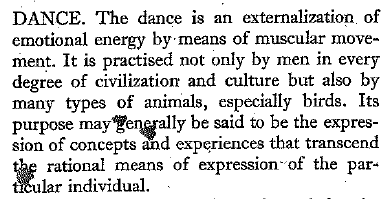
The case for dance as social research was made clearly in the entry John Martin, the nation's first dedicated dance reviewer, contributed to the great New School-based Encyclopaedia of the Social Sciences. (The course described above was given after he wrote this.) What is dance?
It's being described in an encyclopedia of social sciences because of this supra-individual character. Indeed, in the ensuing historical account of forms of dance in ancient and modern societies (including lots on dance and religion) it seems a quintessentially social thing, not just marking social experiences but giving crucial expression to them. For that matter
dance forms can teach us things about social changes before other forms of analysis appreciate them. The modern movement in dance (of which Humphrey was a leader) is more than just a reflection of changing times, however. Like other modern artistic movements it understands itself as offering a distinctively intentional experience of what Humphrey called the drama of life in its moment. I believe that the dancer belongs to his time and place and that he can only express that which passes through or close to his experience, Humphrey wrote. The one indispensable quality in a work of art is a consistent point of view related to the times.

Fair enough, but that was a long time ago. Does anyone still see (modern) dance that way? Does anyone at The New School? The current program in Dance at Lang is distinctive among college dance programs in many ways. One is a suspicion of canonical ways of understanding dance, in general or in its modern and contemporary forms. As the program director explained, the New York location enables them to invite practitioners of all sorts of techniques and understandings to teach: students get to be part of an ongoing experiment. Is it social research? The program doesn't use that phrase but its courses frame dance making as a series of investigatory acts, an arena for research and discovery: close enough! At the New School dance is still a way to think about the world.

John Martin, "Dance," Encyclopaedia of the Social Sciences,
ed. Edwin R. A. Seligman and Alvin Johnson, vol. IV (Macmillan, 1949), 701, 706
Doris Humphrey, New Dance: Writings on Modern Dance,
ed. Charles Humphrey Woodward (Hightstown, NJ.: Princeton Book Company, 2008), 5-6

Monday, September 21, 2015

Kallenism

It was "Beauty and Use" day in my first year seminar today. We read Horace Kallen's rather dense 1939 article by that name, distilled from the identically named course Kallen had been teaching at The New School at least since 1924-25 (above). I've taught about it before, but this was the first time in a seminar setting. It serves several functions. Historically it's a bridge from the founding generation's pragmatist sense of the demands of the new (which we encountered in Dewey's Democracy and Education) to the New School's revised identity as a center of social research in the modern arts: our next three classes focus on new forms of movement, image and sound as social research. Disciplinarily it's our taste of philosophical aesthetics (the class is introducing writing in many disciplines and modes), and its invocation of Keats' famous "Ode on a Grecian Urn" (above) allowed us to spend some time with poetry as well. (One student proved to be an expert reciter of poems, even though she'd not seen it before.) It's also the first of several readings which are the published versions of influential courses taught at The New School. I'm also trying to get students to see and seek out the sorts of influences, contrasts and connections which college-level reflection demands. So we spent much of today talking about "pragmatism" and how similar Dewey on education is to Kallen on art.
Even without a renewed exposure to Dewey (and the Deweyan legacies I'm encountering at Teachers College) I'd try to get students to figure things out, link to things they learned before, notice shared arguments and points of reference, but in a room full of people who've just read Dewey I couldn't help frequently pointing out how what we were doing was just what we'd read about... For several students I could see the "Aha!" when I showed them the pamphlet of Kallen's from 1932 at left. "You know what the title refers to," I said, and then they remembered, yes they did: Dewey's argument for "immaturity" as a power of growth which should never be left behind makes reference to humanity's distinctive "prolonged infancy." (In fact, Kallen's argument is a little different, close to Dewey's critique of education disconnected from life, but not couched in quite the same terms; for Dr. Kallen "infancy" is a state artificially maintained by finishing school-like colleges which shelter students from the real-life experience which alone makes learning meaningful and, perhaps, possible. None of our early faculty had much interest in "traditional" college age students...)

And a final connection - more a sort of parallel, framed by the meeting of the parallel lines half a century later. We also read Frank Alvah Parsons' 1911 address "Art in Advertising" which, in a completely different setting, argued against the idea that art can and must be for its own sake. His view that applied art is no less art for its achievement of some other purpose (like convincing someone to buy something) was interestingly like and unlike Kallen's more abstract argument that beauty is a moment in the adventure of use. I personally think Kallen's argument ("Beauty is accomplished use; use is beauty in the making") a little more profound, but for present purposes it's enough to have raised the question if the New School's turn away from traditional conceptions of knowledge and education can lend its later merger with Parsons a retrospective fitness. Pragmatism and "design thinking," who new?

Tuesday, September 15, 2015

Dewey eyed!

Can I just say what a pleasure it was to get seven pairs of my first years (we were having small tutorial-like meetings) to realize that these lines
in John Dewey's Democracy and Education actually say what they seem to be saying? (From the first edition [1916], p. 52, available here.)