Friday, June 04, 2010

Ode to the dudleya

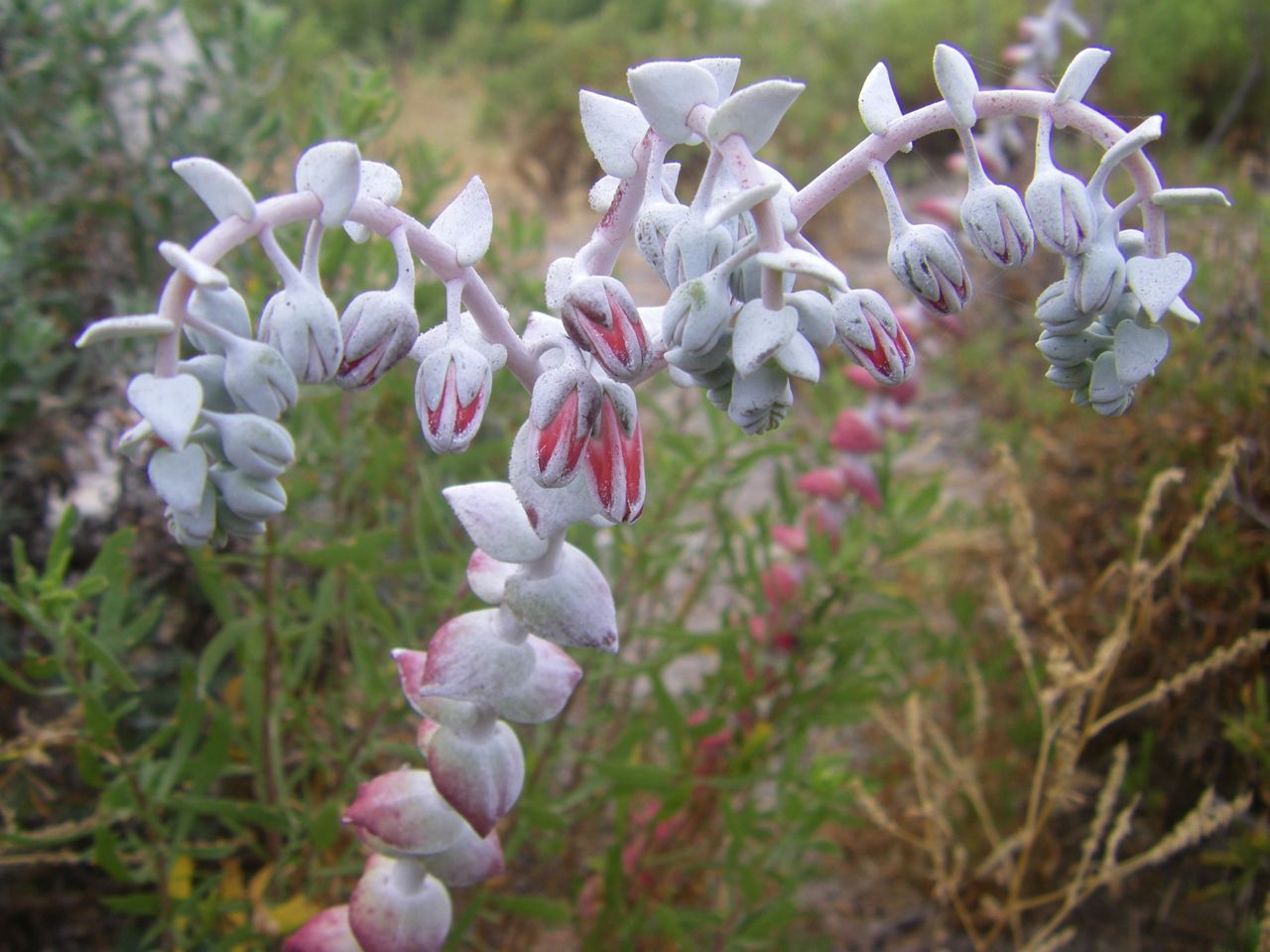
This year, this season, the park is awash with that most fabulously freakish of native local succulents, the lanceleaf dudleya (lanceleaf live-forever) - enough for a body to notice that there are in fact several kinds. Some grow in solitude, others in clusters. Some stems are red, some green, some bicolor. Some fork into two curlicues, others into threes or more. Some flowers point up, others point down. Some buds are round, some triangular, some trapezoidal. Some flowers are one color, some two, some even three! And all of them look to be straight from the work of one of our local artists, Theodore Geisel (Dr. Seuss)!

It's a good year also for their live-forever cousins, the ladyfingers.

Thursday, June 03, 2010

TPSR

Tree or bush poppy; canchalagua; Weed's mariposa/yellow mariposa lily

Seasick

Here's something to turn your blood cold. (Source.)

Wednesday, June 02, 2010

No more Mr. Nice Guy?

I'm working on the chapter of my Job book devoted to midrash and allegorical readings of Job; its main foci are the "Testament of Job," the interpretations of Job in the "Baba Batra," and Gregory the Great's "Moralia in Iob." These are all texts we covered in my recently completed class (hence the hyperlinks), and I'm finding having read and discussed these texts with a room of smart students was very helpful. But it's quite a different thing to offer texts in a seminar - "so, what do you make of this?" "do you really think it's right/wrong?" - than to have to provide your own account of what's going on in them! And discussing one of these texts one week and another the next, letting each have its time in the sun, is dramatically different from choreographing a way for them to share the stage of a single interpretation. Because, of course, they did not share a stage. Of course this is one of my main points: Jews and Christians didn't just read Job differently, but didn't even really read the same text. (Here's why.) I suppose it was naive to imagine I could dodge the "who's right, then?" question by this move, not least as each explicitly or implicitly asserts that the other is not just wrong-headed but headed towards perdition. Oy. Actual religious history is no seminar.

Image: 16th C. Belgian sculpture of Job as a priest, no 81. in Samuel Terrien's hard to find
The Iconography of Job through the Centuries (but UCSD has a copy!).

Tuesday, June 01, 2010

Succulent worlds


Monday, May 31, 2010

Up close

Sunday, May 30, 2010

Beyond the uniform

Went to early mass today at the Spanish-language "mission" maintained by the Catholic parish my mother belongs. It's always a pleasure to hear the mass in another language (I could even follow part of the enthusiastic young Mexican priest's schoolteacherly sermon on the Trinity - well, at least the Q&A with which he started: tres! uno!), and humbling to be at church with people some of whom are migrant laborers, living far from their families. I noticed one older man, his face burnt almost chestnut color from working outdoors, exchanging delighted smiles with a little boy... perhaps he has a grandson that age back in Mexico? Or perhaps he's never been able to have a family of his own? The boy's older sister had a long serious face which in profile looked like something from an Aztec codex. Worlds within worlds. A young woman came up and gave the church a giggly speech of thanks - she's joining a convent this coming week, thanks the congregation for its support. Already a novice, she wore a school uniform-like blue dress over long white sleeves. The music for the mass was provided by a soprano at a spinet next to the altar. She had a lovely singing voice and wore a uniform of another kind: short hair, baggy jeans, teeshirt and hoodie. We hear so much about churches being repressive and conformist, but the picture is always more complicated. If they normalize some forms of human life, they accommodate many more.

Saturday, May 29, 2010

Torrey Pines State Reserve in bloom!

(Mexican pinks with sea dahlia and coastal buckwheat; yellow pincushion and sand verbena; lanceleaf dudleya; golden yarrow; monkeyflowers with black sage; canchalagua; more monkeyflowers and a Torrey pine)

Friday, May 28, 2010

Beach life

I'm back in Del Mar for a spell. A stylish snowy egret made way for me,
but this baby seal was still trying to figure out what to think.

Thursday, May 27, 2010

Marvelous Macabre

Was lucky enough to get a ticket for the New York Philharmonic's "fully staged" production of György Ligeti's opera "The Grand Macabre" tonight. Although most of the Philharmonic's subscribers decided not to come, all three performances are sold out. As well they should be! The opera itself is weird but mesmerizing, the performances were stellar, and the production turned Avery Fisher Hall into an avant garde space. It felt like - well - it felt like an old European opera house taken over by insanely gifted young upstarts. Which, in a sense, is what was happening. "The Grand Macabre" was the culmination of young Alan Gilbert's first season as Music Director, and augurs well for the future. Perhaps he'll do for the New York Philharmonic what Esa-Pekka Salonen did for the Los Angeles Philharmonic: tackling the daunting classics of 20th century classical music, and in the process building a 21st century audience. (Pictures)

Wednesday, May 26, 2010

Forbidden constellations

One isn't supposed to take pictures inside the Metropolitan Opera, but I was in the orchestra yesterday - so far from my usual perch in the Family Circle that the air pressure even feels different - and couldn't resist. I was there for the premiere of American Ballet Theater's new ballet for the season, "Lady of the Camellias," choreographed in the 1970s to music of Chopin (piano solo and concerto) by an American in Europe, John Neumeier, in a manner both classical and contemporary. I'm not sure it entirely succeeded - some of the lifts seemed more difficult than beautiful, women were routinely dumped on the ground (or rolled over by men), and the action often upstaged the dancing - but I could get used to seeing the stars at eye level!

Flat-footed

Animal migrations are astounding in lots of ways. But even so, the latest research on the migrations of small birds is unbelievable. Bar-tailed godwits fly 7,100 miles (11,400 km) across the Pacific without a stop to rest or feed - and in nine days. Arctic terns, meanwhile, make stops along the way, but can fly as much as 50,000 miles (80,000 km) a year. Makes us humans seem as mobile as limpets by comparison!

Tuesday, May 25, 2010

Lang lang ago

The second phase of our New School history project focuses on Eugene Lang College, which celebrates its twenty-fifth anniversary in 2010-11. Part of what needs to be better understood is Lang before Lang... when and how did it start? Lang may be as old as I am! We usually hear that something called the Seminar College was founded in 1973. Something else happened in 1978, I think it was a move to becoming a four-year program. But it turns out there was something much like Lang before any of this, witness this spread from the New School Bulletin in October 1966! That day-in-the-life could be from today (though Lang students today are less likely to go to the Bach organ matinees at Grace Church); the furnishings in the room at upper right are used to this day!

Monday, May 24, 2010

Summer white

Remember that tree up the street that looked so elegant after a snowstorm in December? Well, it's full of white again, part of the last flush of flowers before the greeeeeen of summer sets in.


(July: sources tell me it's a catalpa.)