Sunday, February 09, 2014

But for the Grace

I gave a talk about the Book of Job and my own book at Grace Church (Episcopal) in Manhattan this morning. I planned to cover roughly the same terrain as my talk two weeks ago at St. Michael's, but of course it went its own way. Where the emphasis a fortnight ago was on the way the complicated congeries which is the biblical text forces us to "make a book of Job" even as it resists even our best efforts, this time I kept returning to the value of staging the story, which forces you to decide what words are addressed to whom and also reminds you that Job was perhaps never alone. Perhaps because of this stress on the social dimension, I spoke more eloquently about Job's friends - how they represented his earlier life, values and indeed self (which is why their failure to recognize him precipitated him into such an existential crisis), and how the restoration of the friendships is the frame and foundation for Job's renewed life at the book's end.

There was a nice discussion but at the end of it I was also asked one of the two questions I've been dreading. No, not the question about my qualifications as a Hebraist and Biblical scholar. The other one: what business I have writing this book. That's not quite how it was asked but close. Could I say something about my own view of the nature of suffering in the Book of Job and beyond and its relationship to suffering in my own life. I gave the only answer I could, which was that I do not come at this out of a deep experience of suffering or loss (see my way of making that point in the book at right). I have learned from the Book of Job not to pretend otherwise, certainly not to think that I have vicariously experienced the wrenching and perhaps exalting effects of affliction through working with this book and its interpreters. I have encountered people, past and present, who have learned powerful things from adversity, but I wasn't sure I wanted to learn those things. (Don't give me children and then take them away, I said, a bit maudlin.) In any case, we should perhaps be exploring if there are ways of learning those things without such pain. I'm not sure I like the way that sounded - a little glib, a little unserious - but I suppose that's the point. I wasn't pretending to an authority I don't think I have, or that I think doesn't matter. Did I sound callow? Perhaps it's because I am. I'm willing to face that, for what it's worth. The questioner didn't look satisfied and I felt exposed and a little deflated: a good thing.

Friday, February 07, 2014

Frustrating teachers

Had the unusual pleasure today of being interviewed about my teaching by a scholar of higher education. How I become interested in what I teach was a familiar question, and I often talk to friends about the why and wherefore of particular courses, but I can't recall the last time someone asked me about my own best experiences of being taught.
(Snowy rails at 125th St.)
Three teachers came to mind. One was Rose Sleigh, a legendary, perhaps infamous, English teacher at Torrey Pines High School. She gave the students in her freshman humanities course insanely long and advanced things to read (Walden II, Howard's End, The Gulag Archipelago, etc., in their entirety); parents complained bitterly each year, to no avail. She also taught us how to formulate a thesis, make an argument, write. Once, some years later, I had a moving conversation with her about becoming a teacher: you have to be willing to be like a train station, she said, accepting that all your students will move on to places you won't go, leaving you behind...

But what I recalled today was when she called us up individually halfway through the semester and asked us what grade we thought we deserved. Expecting her to protest I said with false modesty "a B or B+." She called my bluff: that sounded about right, she said. Why was this what I remembered? Was it the moment when a teacher shows you that you're capable of better than you imagined? (I cherish similar memories of students who - if not right away - thank me for giving them their first C.) I described it to the interviewer as the moment when the teacher's pet learned that the instructor's approbation was not the point, something bigger than both of them was at stake.

The second formative teacher I thought of was Sabina Lovibond, one of my tutors at Oxford, with whom I studied the later Wittgenstein. What I remembered was that I found her tutorials intensely frustrating. Every time I left not only with my questions unanswered but with more questions. On reflection this must be the case for any teaching of that material; I didn't realize how effectively she had in fact been teaching me until I read her book a few years later and found every one of its incisive arguments familiar and intuitive. But that's not what I dwelt on today. Rather, I thought - for the first time, in fact - of the lonely generosity of that teacher who won't give students a false sense of comfort or closure. Yes, she communicates to them the open-endedness of inquiry, but a tutorial is a very personal thing - one or two students at a time for an hour a week - and she must have known her students were grousing.

The third was (of course) Victor Preller at Princeton, whose advice when I started teaching was "never pander." He was a frustrating teacher too, like a language teacher who wouldn't simplify for a beginning student, and many of my classmates found it maddening, just couldn't understand what he was talking about in that Godlike voice of his. I must have been frustrated too, but can't remember that; what I remember is when it all made sense - all of it at once. (He called this "when the penny dropped.") I discovered, sooner than some of my classmates, that he was available for endless hours of one-on-one discussion which confirmed that, while no panderer, he was an expert reader of people and fascinated by how each of his students made her way to understanding - what he was teaching, ethics, hermeneutics and religion, connected deeply with our whole lives.

It was interesting to be asked about formative experiences of being taught, and interesting that these are the ones that come to mind. I usually understand and describe my pedagogy as "Weberian," offering "inconvenient truths" for every party position but scrupulously avoiding revealing my own views. (Do I even have a view? Question for another day!) But all of these teachers were sharing things they passionately believed in. On the other hand, none of them let me believe I had arrived when I hadn't - they never pandered. They were attentive and available (and doubtless very patient!), but our interactions were in the service of something bigger than us, like friends (to bring in Victor's beloved Aristotle) united in a love of justice.

I don't know if I measure up to these exemplars at all; you'd have to ask my students. My interviewer repeated from what I said "the frustrating teacher" as if it were a known category: that at least I know I have achieved! I may pander along the way, but most students finish my courses in frustration. "I don't even know what XYZ means anymore!" Am I deluded to think I sometimes hear some gratitude in that, a sense not so much lost and confused as empowered, even liberated? That they've learned that further questions, thought, inquiry, discovery are necessary - and possible? The way I described the aim of my current course to the interviewer was getting students to have a sense of the processes by which a thing called "Buddhism" has become available to people like us, and to appreciate that they can understand and even participate in these processes... a perhaps more democratic perspective I learned from a great teacher I've known only as a friend, Joan Tronto.

Thursday, February 06, 2014

 
Another cold morning paints the sky!

Wednesday, February 05, 2014

Buddhist trifecta

It's turned out to be a very good thing indeed for the "Buddhism and Modern Thought" to start with Walpola Rahula's What the Buddha Taught. (At left is an image of the penultimate cover; our edition strays even further from its Theravada content by replacing the hand lettering in the background with printed Sanskrit, and keeping the clearly East Asian Buddha.) For most of the class this was the first time reading anything of substance about Buddhism, and this is a classic introduction which continues to be used. It'll be useful again when we learn about Sri Lankan Buddhism modernism, and for our more general reflections on how "Buddhism" is concocted in the space of a global modernity. But the trifecta I refer to in the title of this post is something else, something we were able to do already this week. In class I called it "three books in one." The point of departure:

This is Walpola Rahula himself, in his Preface (viii). It allowed us, having once made our way through the book, to consider the implications of sequencing its content in these two ways. Try it yourself:

The Buddha
I. The Buddhist Attitude of Mind
II. The First Noble Truth: Dukkha
III. The Second Noble Truth: Samudaya: ‘The Arising of Dukkha’
IV. The Third Noble Truth: Nirodha: ‘The Cessation of Dukkha’
V. The Fourth Noble Truth: Magga: ‘The Path’
VI. The Doctrine of No-Soul: Anatta
VII. ‘Meditation’ or Mental Culture: Bhavana
VIII. What the Buddha Taught and the World Today

This presents Buddhism as most textbooks do, with the Four Noble Truths as foundational. After an account of the practical orientation of the Buddhist tradition (the parable of the raft, the parable of the poisoned arrow), Buddhism is presented as the solution to an almost philosophical problem. The problem is the unsatisfactoriness (dukkha) of life, which starts as a general statement comparable to the foundations of other world systems and then becomes practical. We discern intellectually that dukkha has a cause in tanha (thirst), and that this in turn is something over which we're told we have potential control. Only then do we turn to the Noble Eightfold Path which tell us how to actually do this. Quite different is the Buddhism presented this way:

The Buddha
I. The Buddhist Attitude of Mind
V. The Fourth Noble Truth: Magga: ‘The Path’
VII. ‘Meditation’ or Mental Culture: Bhavana
VIII. What the Buddha Taught and the World Today
II. The First Noble Truth: Dukkha
III. The Second Noble Truth: Samudaya: ‘The Arising of Dukkha’
IV. The Third Noble Truth: Nirodha: ‘The Cessation of Dukkha’
VI. The Doctrine of No-Soul: Anatta

Here the practical orientation of Buddhism takes you right to practice - the Noble Eightfold Path, the varieties of mental culture, and the service to others which Walpola Rahula thinks incumbent on Buddhists whether monastic or lay. Presumably these are not just to be considered intellectually but put into practice. Philosophical accounts of the nature of dukkha and of the self - are left for those who need them, "when the general sense is clearer and more vivid."

The difference between these two sequences is really enormous, and I have no doubt that the latter is truer to Buddhism as lived (not just thought about as a philosophical system or "religion"). It's certainly how you'd encounter it if you were raised in a Buddhist society. But it also suggests that the significance of the Four Noble Truths isn't really graspable cold turkey - nor, perhaps, so important, at least for some Buddhist practitioners. Perhaps we aren't able to face the overwhelming reality of dukkha before we know from experience, however elementary, that there is something we can do about it, however difficult. Likewise the doctrine of anatta, which is not only paradoxical but paralyzing if we don't already know from experience, however
limited, that and why and how we cling to the idea of a perduring soul - and that we don't have to.

Thinking our way through these two sequences helped us appreciate both why Buddhism, when presented as a religion or philosophy, tends to go the Four Noble Truth way and why the place of these Truths in ancient Buddhist texts is entirely different. They appear, for instance, as one of the latter parts of the fourth of the "Four Foundations of Mindfulness" outlined in the Satipatthana Sutta - and here they are contemplated as "mental objects" (118)! They are of practical use not as the frame and foundation of practice, but, rather, as one of the more advanced forms of a practice based in... what? The experience of the efficacy of practice, of how Right Understanding, Thought, Speech, Action, Livelihood, Effort, Mindfulness and Concentration (the Noble Eighfold Path) ease the frustrations and disappointments of living and and loosen the grip of delusional responses to this dukkha like the fantasy of an eternal Self (and other "religions"!). Beautiful! Thank you, Walpola Rahula, for both books.

But I mentioned three books in one, didn't I? The third is the unnamed structure of the Three Jewels: Buddha - Dhamma (I-VII) - Sangha (VIII). It's not his main message (well, it's complicated) but it's still there.

Tuesday, February 04, 2014

Lengthening daze

This is a semester of early rising for me. In order to be awake and alert (and present!) at my 8:00 class Mondays and Wednesdays at school and the 9:15 Chinese class Tuesdays and Thursdays on the unaccustomed Upper East Side, I'm getting up while it's still dark out. The city's lovely in first pink light - even when there's not sticky snow all over everything! Only problem: I can't get used to going to bed earlier... !

Monday, February 03, 2014

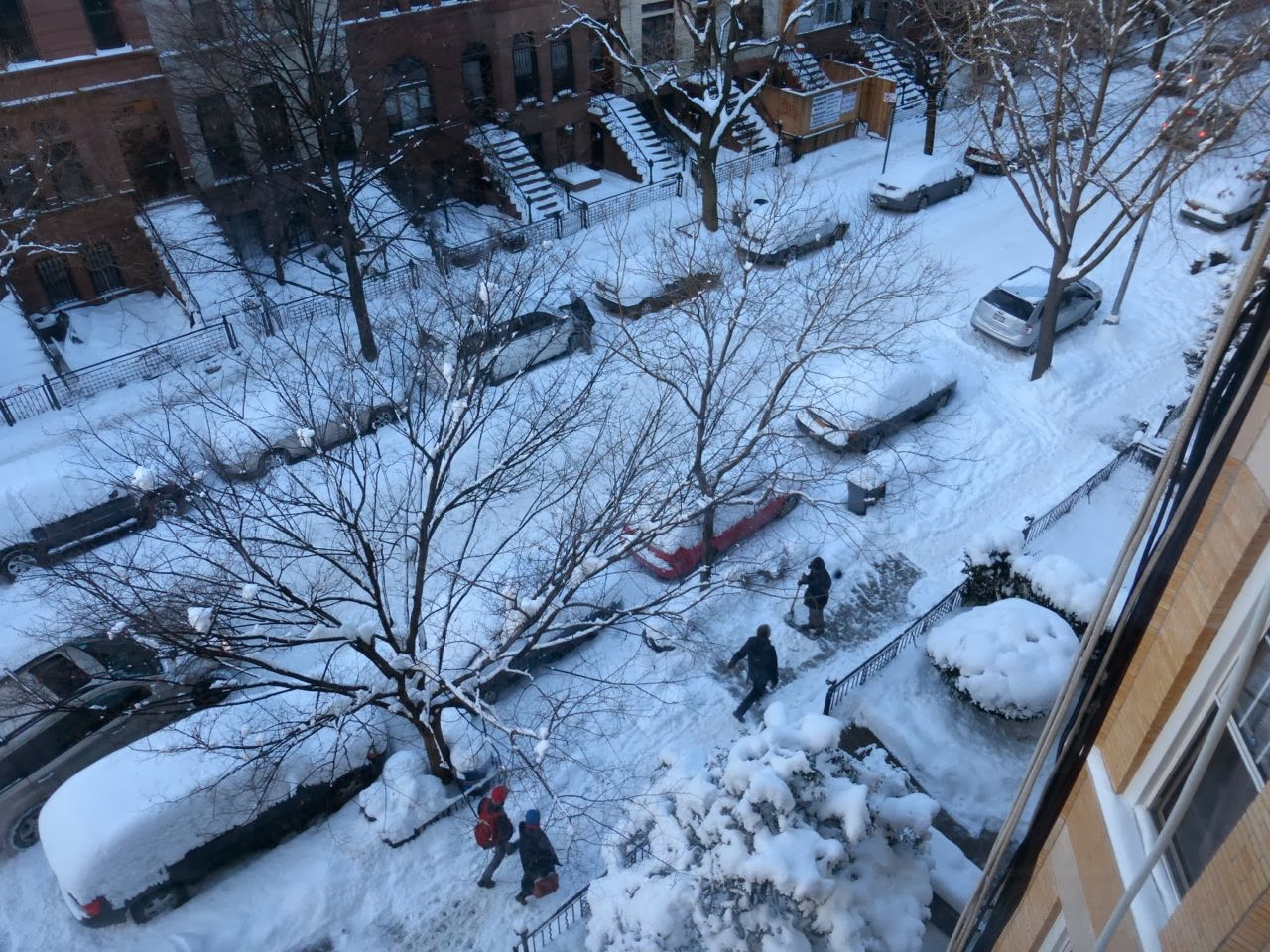
Snow again!


My colleagues I posted this gorgeous photo.

Sunday, February 02, 2014

Coffee heaven


Ever notice what happens to a cappucino if you don't drink it right away?
Or maybe it's something metaphysical they do at Everyman Espresso.

Preach?

Gave my first sermon today. Harder than you might think. Folks think religious studies is close kin to theology, but, at least as I've learned it, they're quite different orientations. (As Joseph Bulbulia put it once, "they study God, we study them.") And while I clearly have a point of view, organizing the interpretations of the Book of Job I present in my book, it is still an academic one: this is how we should study this, how we should understand it. A sermon speaks from within a faith position, and to a faith community.

So when I was asked if I wanted to preach last week at St. Michael's, where I was leading a discussion as part of their adult Christian education series afterward, I said no without hesitation. I don't know how to preach, don't know how to give the kind of reflection that begins with the words May the words of my mouth and the meditations of all our hearts be always acceptable to you, O Lord, our strength and our sustainer. In the book discussion, somewhat to my surprise, I found myself focusing on my own understanding of the Book of Job, but when a parishioner started testifying to the necessity of reading the Book of Job through the figure of Jesus Christ I interjected that I'm a scholar, and that I don't tell people how to read the text but listen to the many ways they do, and to the evidence they give for their readings; I hear truth in many, from many different perspectives, and in my book share as many as I can. It was entirely appropriate, and impressive, for her to read it as many other Christians do; my concern could not privilege this or any other way of reading.

But today I was the giving the sermon, something I agreed to do because it's a little non-denominational congregation, and because I was invited by their part-time pastor, who happens to be a Lang alum, and on condition that he'd give me some pointers. We got together a few weeks ago and had a great conversation about preaching, and about the particular interests and concerns of his congregation. By the end of it I had a good idea of something I might talk about in and around Job. As the date approached, however, I found it harder and harder to finalize my remarks. What I'd planned wasn't in any way specifically Christian, though it noted, as I have done in radio interviews, places where a Christian might take a certain interpretative path. But was that enough, was that appropriate, even for a pretty free-form low-church non-denominational sermon?

In the end, I spoke (for precisely the 15 minutes allotted - I had my cell phone timer on) about the theology Calvin finds in Job, which it seemed I in part share. I got to choose the reading, Job 4:14-21, a terrifying one. At first I spoke about that, and about the theology which sees the gulf between creator and creation as unbridgeable even in thought; when we think of the view of God and look back, there's nothing left of us. But this is only half the point, for God does bridge that gulf, speaking to Job, acknowledging him, as Martin Buber emphasizes, as an individual. And yet, I said, the book doesn't leave us alone with God. The vision reported in 4:14-21 is in fact not Job's but that of one of his friends, Eliphaz. So I gave my usual shpiel (from the book) about how much more important the friends are, precisely as good friends who fail but are restored, than modern views of the "friends of Job" allow.

But then in the conclusion I found had to speak as a Christian, returning to the astonishment of God's concern for us, a concern which went so far as to take human form and live the terror and sorrow with us. (I didn't vocalize what I'd written in my notes: "as a human friend.") I concluded: "The Book of Job begins with one inventory of a good, full life – wealth, social standing, family – and these things are of course restored at the end; they’re important. But along the way the Book of Job also offers us another set of goods. A good, full life has a personal relationship with God, and surrounds us with friends to share the terror, and the astonishment, of being God’s beloved creatures."

So I guess Jesus peeked through for an instant, but only an instant. A start, I suppose! It'll be interesting to see how opportunities to speak to other kinds of groups and communities will shape or channel (or liberate?!) my thinking here.

地獄谷

In Japan - perhaps I'll find this is true in China too - there are places known as jigokudani, "hell valleys," usually uncanny places that smell of sulfur. This creepy picture of a reservoir in Nevada at 3.5% capacity, part of a frightening article about the drought in the American West - worst in five hundred years! - called that phrase to mind...

Saturday, February 01, 2014

Fleeting or contrived

Girls, at some point this semester we're going to have to discuss this.
The first two covers are from 2003, the last is the cover of the current issue, in whose article Buddhism gets really rather short shrift:

Mindfulness is rooted in Eastern philosophy, specifically Buddhism. But two factors set it apart and give it a practical veneer that is helping propel it into the mainstream. One might be thought of as smart marketing. [Jon] Kabat-Zinn and other proponents are careful to avoid any talk of spirituality when espousing mindfulness. Instead, they advocate a commonsense approach: think of your attention as a muscle. As with any muscle, it makes sense to exercise it (in this case, with meditation), and like any muscle, it will strengthen from that exercise.

A related and potentially more powerful factor in winning over skeptics is what science is earning about our brains' ability to adapt and rewire. This phenomenon, known as neuroplasticity, suggests there are concrete and provable benefits to exercising the brain. The science--particularly as it applies to mindfulness--is far from conclusive. But it's another reason it's difficult to dismiss mindfulness as fleeting or contrived.

What more is there to say? Oh but there is one other bit worth noting, a reminder of what a strange transnational thing Buddhist modernism is:

"It was always my intention that mindfulness move into the mainstream," says Kabat-Zinn .... Lately, the professor has also been spreading the gospel abroad. On a November trip to Beijing, he helped lead a mindfulness retreat for about 250 Chinese students, monks and scientists. "This is something that people are now finding compelling in many countries and many cultures, and the reason is the science," he says.

Friday, January 31, 2014

Beauty treatment

Well...! Time magazine covers from January and August 2003, and the current issue.

新年快乐 Happy New Year!

And it's my year, too: the horse. (Cookie courtesy of Joyce Bakeshop)

Thursday, January 30, 2014

Man par excellence

For "Buddhism and Modern Thought" we're reading one of the classics of introductions to Buddhism, Walpola Rahula's 1959 What the Buddha Taught. I dare say it's how I was introduced to Buddhism, too! Returning to it now, older if not perhaps wiser, I can appreciate its achievement - how it fashioned an image of a universally acknowledged original Buddhist core which also happened to be more modern than the best of Western moderns! Behold how brilliantly he begins:

Among the founders of religions the Buddha (if we are permitted to call him the founder of a religion in the popular sense of the term) was the only teacher who did not claim to be other than a human being, pure and simple. Other teachers were either God, or his incarnations in different forms, or inspired by him. The Buddha was not only a human being; he claimed no inspiration from any god or external power either. He attributed all his realization, attainments and achievements to human endeavour and human intelligence. A man and only a man can become a Buddha. Every man has within himself the potentiality of becoming a Buddha, if he so wills it and endeavours. We can call the Buddha a man par excellence. He was so perfect in his 'human-ness' that he came to be regarded later in popular religion almost as 'super-human'. (1)

From this start he can assert that Buddhism isn't a religion. Certainly beautiful customs and ceremonies emerge to support those less advanced ... along the Path (50, 81), and, less happily, noble traditions of meditation deteriorated or degenerated into a kind of ritual or ceremony almost technical in its routine (67). In this lesser Buddhists are like "religious" people everywhere, creating God, the Soul and other errors to console themselves in their ignorance (51). But truest Buddhism, unique among religions and philosophies, is truest humanism!

Whatever issues one might have with its construction of Buddhism (in "Theorizing Religion" I call appeals to timelessly accessible ancient sources which claim it possible and necessary to bypass the long intervening history of barbarous bowdlerizations "Protestant"), Walpola's gambit is a worthy riposte to the hollow humanism of the colonial West!

Walpola Sri Rahula, What the Buddha Taught (Revised Edition) (NY: Grove, 1974)

Wednesday, January 29, 2014

Chin up

I'm taking another course besides Chinese this semester. By happy accident, the very China-focused course on East Asian religion in my own program is running this semester, and it fits my schedule! To give us a sense of the China before it became China, the teacher gave us fascinating short selections to read - Shang dynasty oracle bone inscriptions, the dedication written on a Zhou ritual vessel, exquisite poems from Chu, Mozi on ghosts... A different world in so many ways! But as he was leading us through the ritual vessel inscription he passed around a book of images of ancient bronzes, and it took me way back. These are some of the bronzes at the Met, but I also recalled a gu I saw in Chicago, and, long before that, a course I sat in on at Princeton on Shang bronzes taught by Robert Bagley. A long time ago! (And I remember little more than the word "falange" - I can't remember who recommended it to me or why I pursued it, though I recall showing up out incredulity that something so arcane could have excited someone so). The wonder I experienced there came back to me today. My focus in thinking about the upcoming China trip has been resolutely contemporary, but of course, China goes way back... !

Tuesday, January 28, 2014

Atonal

I knew the tones were hard but not this hard! On this self-administered listening test in one of our class textbooks (each comes with a CD), I got so many wrong I don't even know where to start fixing it. Over the course of its 24 syllables, I managed to mistake pretty much every tone for every other! Our teacher's response, when I showed her the bloody scene, was both discouraging and encouraging: it's hard even for her to make out words without contexts. Nothing to do but keep learning words (with their tones!), and keep training my ears any way I can.I do just fine with the written - my familiarity through Japanese with the way characters works helps a lot. What's (a little) amusing is that as a result I'm finding myself in a situation analogous to that of my Chinese classmates when I was learning Japanese - they could read almost anything, but couldn't recognize anything anyone said. Or, for that matter, many Japanese of my acquaintance, whose knowledge of written English so far outstripped their abilities in conversation as to paralyze them in despondent panic. I'm glad to have a good teacher!

Monday, January 27, 2014

The Dial

Well, I thought the first session of "Buddhism and Modern Thought" was fascinating - not sure how it will have played with the class, whose interests and degrees of experience with Buddhist and religious studies I have yet to gauge. But I'd like to think there was something tantalizing for everyone, and a web of unexpected effects and resonances across times, places and genres interesting enough to make them want to come back for more! (Unfortunately there were no markers for the board so I had to send them this drawing of the dial suggesting an order to all the connections after class.) The room in the new building (we're moving next class) was indeed windowless and a little grim, but there was a bonding experience in being among the first students to meet in the new building - and I was able to invite everyone to the cafe on the same floor after, leading them from the dark cave through a long corridor to the light-filled seating area overlooking 14th Street.

The class has wound up with some very ambitious "learning objectives."
Today's forceful tour was trying to get at the 4th, 5th and 6th of these.

Brecht's poem about the Buddha's parable of the burning house (read in an overpoweringly terrific way by the 80-year-old Käthe Reichel here) tells a story Brecht scholars seem to think was invented by Danish novelist Karl Gjellerup (Brecht was in Danish exile when he wrote the poem).* It really refers to one of the most famous stories in the Lotus Sutra, which I think Brecht will have known and expected his readers to know. (It would be nice to be able to demonstrate this...!) If so it's more than the cry of despair of a revolutionary artist who can't get through to people:

"... One of them,
While the heat was already scorching his eyebrows,
Asked me what it was like outside, whether there was
Another house for them, and more of this kind. Without answering
I went out again. These people here, I thought,
Must burn to death before they stop asking questions.
And truly friends,
Whoever does not yet feel such heat in the floor that he’ll gladly
Exchange it for any other, rather than stay, to that man
I have nothing to say.” So Gautama the Buddha. ...

It's a manifesto for more skilful art: realism, knowledge, truth are insufficient for getting people to see that the mouldering house around them is on fire. The father in the original Buddhist parable doesn't give up but gets his kids out, though not in a very Brechtian way (he doesn't talk about fire - they don't know even know the meaning of fire, of houses, of losing things - but tells them he has gifts of their favorite things for them outside the house). Pretty cool way to introduce upāya, huh - a communist artist, epic theater!

After reading them the parable as recounted in the Lotus Sutra itself, and mentioning its importance for explaining upāya and the mahāyāna, we turned to the year 1844, when it turns out, no less a figure than Henry David Thoreau published a translation of a part of the Lotus Sutra in his friend Ralph Waldo Emerson's journal The Dial: the first English translation of a Buddhist text! (He'd translated it from a Sanskrit edition based on a cache of Buddhist texts sent to Paris from Nepal by British colonial agent Brian Houghton Hodgson in 1837.) 1844 is an important year for western Buddhist studies, as it's also the year Eugène Burnouf - recipient of Hodgson's cache - published his  Introduction à l'histoire du Bouddhisme indien, coining the word "Buddhism" in the process. (Burnouf translated the full Lotus Sutra himself in 1852.)

A little foretaste of learning outcome 3! And a chance to name the orientalist worry (I dropped Edward Said's name). Europeans constructed an image of Buddhism out of texts, rendering it a system of ideas. (Actual practitioners in decadent Asia were not consulted.) But that's not how Buddhism (or any other religion) works. Sutras are recited, transcribed, copied, used as talismans, stuffed in statues, consumed. (Remember Bielefeldt!) And some of them - the Lotus Sutra prominently - are themselves agents. As a Japanese Buddhist intones its name, 南無妙法蓮華経 namu myōhō renge kyō, it's not that you recite the sutra, you lend your lips to the sutra, the sutra is on your lips, the sutra uses your lips, the sutra recites you. Intense stuff - and a little taste of the really mind-bending learning outcome 6.

So next we watched Theaster Gates and the Blind Monks of Mississippi singing "Blood in my veins," a work song composed to honor Dave the Potter, an African American slave potter (at work in 1844, for what it's worth), which resolves into a free jazz-like recitation of the name of the Lotus Sutra: namu myōhō renge kyō. (It starts at 22:30 here.) This was, I grant, a little hard to listen to so early in the morning! And just what was Gates (a masterful upāya user, as the story of Shoji Yamaguchi below right makes clear) up to? Slavery, ceramics and Buddhism? But I'm hoping it makes clear from the start that our inquiry can't confine itself to scholars, and to white Buddhists, and to those forms of Buddhism
which white folks like - first Pali, then Zen, then vipassanā, now Tibetan. For Gates almost certainly learned of the Lotus Sutra through Soka Gakkai, a lay Nichiren movement which has many Americans of color among its members.

And to close the circle, it turns out that Soka Gakkai was founded in Japan in 1930. Placing this up alongside Brecht in 1931 is just sneaky, as, indeed, is arraying all these disparate things around a dial. I'm not suggesting causality here, am I? Or am I? The really mind-bending part of "Buddhist ways of understanding influence" is the suggestion that the world may work in a Buddhist way - there may be bodhisattvas at work, and agencies like the Lotus Sutra. Or at least, as the Soka Gakkai International explanation of the significance of namu myōhō renge kyō makes clear, that we're going to need to push at the usual understandings of causality. The lotus blooms and produces seeds at the same time, and thus represents the simultaneity of cause and effect.

Will they come back for more? We'll see!

*In the 1999 translation of Gjellerup's novel The Pilgrim Kamanita, available here, a brief story of a burning house appears at 163-64, not much like Brecht's; the editors note that nothing like it is known in the Pali canon, and with evident distaste (and inaccuracy) refer to the Lotus Sutra as the likeliest source (415).

Sunday, January 26, 2014

Quinzaine de Job

Today was the first day of a fifteen-day flurry of Job-related activity, which all told will include three talks, a sermon, a radio interview, and a performance (not by me). This morning saw my first talk on the book - at St. Michael's Episcopal Church on the Upper West Side. And this afternoon, I attended a second performance of Outside the Wire's Superstorm Sandy-Job project - this one hosted by the JASA (Jewish
Association Serving the Aged) in Long Beach, Long Island. (That's LB's newly rebuilt boardwalk above, its partly frozen beach below.) I don't have time to give you details right now, as the new semester begins tomorrow morning, 8 am, and a syllabus needs finalizing before then. But I took copious notes, so I'm sure I'll give some report eventually! Suffice it to say I am once again filled with gratitude at all I learned.

Okay (it's Monday night now), something from each.

In the talk at St. Michael's (below) I surprised myself by gathering together all the bits of the book that are actually my ideas. I wasn't going to do that - all messenger, all the time - but somehow it came together that way as I finalized my notes in the subway on the way over. So after framing things in terms of how Job makes every reader or interpreter or user "make a book" of it, I offered two images I'd found helpful for understanding the Book of Job, and two morals of the story:

1. a mobile, different parts of which are in the foreground at any given time (and some perhaps hidden), but whose life and role in people's lives involves just that movement; 
2. a mousetrap, tempting people to try to fix its meaning and then challenging that meaning with some other part which just doesn't fit - a little naughty, perhaps, for a book that demands that we make a book of it! 

1. the "patience of Job" shouldn't be thought to refer only to the Job of the frame story, but to all of the book, showing that "patience" doesn't exclude protest; 
2. the importance of Job's friends - but that you know! 

I'm not sure why this proved my focus (there were, of course, cameos from Jerome to the Midrash to Aquinas to Calvin to Simone Weil to contemporary interpreters like Zuckerman and Newsom); people usually ask for my reading of Job but I usually change the subject. Maybe in the non-academic setting it's easier to own one's voice.

And at "Job in Long Beach," stories of real devastation (far more than we heard in Red Hook): houses, cars, boats lost, and the terrifying sound of a dislodged wooden deck knocking farther and farther into your house with each wave as you cower upstairs. These people have been struggling daily for the last year, some still living with family far away or in substandard rental apartments, frustrated by insurance and other bureaucracies, but also moved by strangers' outpouring of care from the time of Sandy on. For many, the last year has brought new hardships - family members diagnosed with cancer, deaths in the family - and many recounted the moments when they'd felt like Job. (One told of a man behind her in the line for gas who, when her car couldn't make the curve, rolled his eyes and looked heavenward and said, loudly, "Really?!" to which she replied "You tell him!") Many can't trust the ocean, their
erstwhile friend. Ever expecting the next devastating storm, some are still afraid to put things away.

But the reflection which really blew me away came from a rabbi who works in health and human services. Job is different from her clients, she said, because he knows he's innocent. But we mortals are not, all of us are flawed. We all have histories. And when terrible things happen, these histories come back. We wonder if it's because of particular things we did. "We live not just today's traumas." This was a revelation to me - something that makes perfect sense when stated this way, but something I'd not heard anywhere else. (And of course even Job, with a little help from his friends, is doing this, too.) I should add that the Long Beach community is home to many children of Holocaust survivors. The rabbi observed that for survivors she worked with, Sandy brought all that back, too: "Did I fail there too?" People were "overwhelmed, almost to the point of cursing the day they were born."    (Above picture from here)

Bryan, the director and moderator, barely had to ask people to talk about the story of Job. It happened by itself, and not just the woman who said she'd read Job "at least eleven times" since superstorm Sandy. The Book of Job is part of the culture of this community, offering recognition as much as - perhaps more than - comfort. Nobody's waiting for twice the flocks and a new lineup of children. This is very simplistic, said one octogenarian, but the way to move on is to put one foot in front of the other. "Where there's life there's hope," she added.

Again, what a humbling honor to be present for the discussion.

Saturday, January 25, 2014

Signs

 
Another gnomic message, this one West 12 Street...

Skilful means

I think I've got a socko start for "Buddhism and Modern Thought." We'll begin with Bertolt Brecht's 1931-32 poem "The Buddha's Parable of the Burning House," which is an incomplete memory of a famous upāya parable in the Lotus Sutra. So next we'll look briefly at that section of the Lotus, which, conveniently, introduces the great (mahāyāna) and lesser vehicles (hinayāna) - the latter not a term used by the people so designated, of course! Beyond the politics of Buddhist namings, I can also introduce the termnavayāna (new vehicle), used by Ambedkar for his new Buddhism and also used by some people for Western Buddhism. But that's not all! I'll tell the class that the Lotus Sutra was the first translation by the man who coined the word "Buddhism" in 1844, Eugène Burnouf. And then, finally, we'll watch a video of a 2011 performance by Theaster Gates and the Blind Monks of Mississippi which goes from an (invented) African-American slave work song to a chanting of the name of the Lotus Sutra, the central practice of Soka Gakkai, a Nichiren-based lay movement started in Japan in 1930 and currently the most widespread of Buddhisms among Americans of color.

A lot - indeed much too much. But that's the point. My task is to convince students it's worth spending a semester learning more!

(Image of the Buddha delivering the parable of the burning house is from Dunhuang.)

Friday, January 24, 2014

Open for business!

The University Center is officially open - despite the hole in the street!
On a bright winter's day, much of it is overflowing with light. Only disappointment was the room I'm to be teaching in, which is not only windowless but mislabeled by our famous "wayfinding" system: this doorway does not, in fact, lead to room 202, which is in another direction and unlabeled.

Wednesday, January 22, 2014

Coooold

Another polar vortex, bringing snow and temps well below freezing!

Tuesday, January 21, 2014

Snowy landscapes of the city

Snow snow snow, all day long! 

Tour of the provinces

My new course, "Buddhism and Modern Thought," is turning into something quite different from what I originally envisioned. A very good thing! When I proposed it, I was thinking of it primarily as yet another western intellectual history class, but I've been finding material that's allowing me to present the western reception of Buddhism as it should be presented: as ancillary, a provincial development, even in modernity - which I'm not assuming is western or westernizing but multiple. And thanks in large part to bell hooks' visit to The New School last Fall, "western Buddhism" itself has been wrested from the hands of white male Buddhist teachers. It all lets me try to do something I was very excited about a few years ago - imagine a history of modern thought (or of thought, for that matter) that's not Eurocentric.

How do I propose to do it? I'm still moving pieces around, but the current arc of the course starts with Marilyn Ivy's essay "Modernity" from Critical Terms for the Study of Buddhism, then looks quickly at the western construction of the Buddha from Donald Lopez' The Scientific Buddha: His Short & Happy Life and Philip Almond's British Discovery of Buddhism, and then nibbles on some Schopenhauer and Nietzsche. But that'll all be finished by the end of week 3.

Next, we read Walpola Rahula's What the Buddha Taught, an introduction to Buddhism written in 1959 by a Sri Lankan scholar and still very widely used in US universities (I read it when I first studied Buddhism). Rahula argues that Buddhism - he focuses on Theravada - isn't religion at all, but in its rational and experimental nature better understood as science, psychology. We'll appreciate Walpola's skillful playing of western yearnings along with his account of the dhamma.

But then we turn to Buddhist modernisms in Asia - I'll have students give presentations here - starting with Sri Lanka, followed by Japan, Southeast Asia, China and Taiwan, and Tibet and Nepal (sequence determined not by Buddhist history but loosely by the stages of western Buddhist encounter). Students will read the relevant sections from Buddhism in World Cultures (ed. Stephen Berkwitz) and Buddhism and the Modern World (ed. David McMahan), so we'll have a rich and complicated understanding of the emergence of different forms of Buddhist practice and thought in the wake of colonialism, modern science, nationalism, globalization. Among other things, we'll find out that Walpola Rahula was hugely important in his native Sri Lanka, arguing, fatefully, that monks should be involved in politics.

Only then will we return to the western reception and construction of Buddhism, reading David McMahan's Making of Buddhist Modernism. (Actually I think we'll first read an essay by Richard Payne about how important "modern occultism" was both for modern constructions of religion and for Buddhism in American self-help culture.) Not only will it be clear that Buddhism wasn't waiting around for modern western people to revivify it - piles of dusty tomes neglected by ritualistic orientals - but I hope we'll be able to see what western Buddhologists and Buddhists have been doing as part of larger global trends. (Maybe even larger trends understood in Buddhist terms?! David Loy!)

Then it gets a little unclear... I want to tailor the class to the interests of the intrepid dozen willing to sign up for a course that meets at 8 on a Monday morning, and each student will have a research project s/he'll be giving progress reports about through the second half of the semester. If they want Henry Steel Olcott or Hermann Hesse or D. T. Suzuki or Jack Kerouac or John Cage or Chögyam Trungpa or Derek Parfit or Wittgenstein and Nagarjuna or Sharon Salzberg or Marcus Boon or Pema Chödrön or "The Matrix" or DharmaPunk or JuBus or even speculative non-Buddhism, they'll get it (well, some). But we will certainly also read some of The Buddha and his Dhamma by Dr. Ambedkar (who brought Buddhism back to India as the religion of the Dalit movement), some Alice Walker (probably this talk), and Hsiao-Lan Hu's This-Worldly Nibbana (which you've heard me enthuse about before).

What will it all add up to? We'll see - but I'm confident it'll be good. That said, it's still several days until we start; things might yet shift around! And how do I begin? I usually like to use the time of the first class for a film, but I'm open to a series of videos. Maybe Ambedkar?

Sunday, January 19, 2014

Lend me a tenor

Well, I guess we don't know what we don't know. Until yesterday, I'd thought of myself as a baritone, and lustily sang base (except for the notes lower than low G) in church - ours is a singing congregation! But yesterday my friend M, a trained singer whom I'd asked for some singing pointers (China will be a long series of command performances, I'm told), asked if I'd ever sung tenor. Not as long as I can remember! But it turns out our church choir is low on tenors, and in particular needed a tenor for today's service, so I tried singing the tenor line on the week's hymns. With the exception of "Lift every voice and sing," which is stratospheric the way Beethoven's 9th is, I managed. It even felt good!

So I came to the choir rehearsal before church today and rehearsed as one of two tenors. The choir director thinks me a tenor, too: he listens for what notes a singer can project, and indeed, the tenor (II) range is where I have volume. So I got to be in the choir today (vested!), and even got to sing the melody for a favorite hymn.

I didn't sing that well. The higher notes really need to pressed out, like a trumpet. And finding your note isn't as easy as for a base (for whom it's the lowest note, often the key signature, almost always played by the organist's feet). The tenor is there in the thick of things, neither the melody nor the key, but harmonizing, often to a little melody of your own. It took me back to when I arrived at Oxford and auditioned for the college choir. I didn't get in, at least in part because I wasn't able to sing the middle note in various tone clusters. Guess I was a tenor then, too! (Instead I joined the no-audition Kodaly Choir, but that was my last choral experience.) I'm missing church for the next several Sundays (Job gigs at other churches) but will start trying the tenor line on for size.

Friday, January 17, 2014

One smart phone

Well, this Chinese thing is going to be a lot of work. But it's going to be so much easier than learning Japanese was. Not just because I know Japanese (a mixed blessing, I understand - it may hinder as well as help) but because that was 1987 and this is 2013. You used to need three fat dictionaries - English to  Japanese, Japanese to English, and a character dictionary, for looking up unknown characters (by radical, number of strokes or pronunciation) and compounds. Then handheld electronic dictionaries appeared, rendering all the books obsolete. And now (I'm assuming parallel development for Chinese) smart phones apps like Pleco do things one couldn't have dreamed of back then. Not only are there the translating dictionaries, you can input words in Roman letters or by radicals and strokes; you can also draw them! Or scan with the phone's camera! Once captured - the dictionary includes many proper names too (and this is just the free version!) - there are sample sentences; you can also listen to the word pronounced. (I think you can input vocally, too - I'll try when I'm a little more confident on my tones!) And then add it to your flashcards. Hours of constructive fun await!