Sunday, January 14, 2007

Simlacrum

Greetings from India! Our efforts at negotiating a responsible and graceful exit continue another day but I'm afraid I am not optimistic for their outcome. Pious poetic prattle about the superiority of "the Indian understanding of time" notwithstanding, our interlocutors seem content to allow the question whether we depart this afternoon or tomorrow morning to consume time which may well represent the last chance to prevent India from entering years of violent chaos and division. As occurred already in the real Simla Conference, I fear ours too will pave the way for partition.

What am I talking about? I mentioned last month, I believe, that I'm participating in a conference on a new pedagogy known as "Reacting to the Past," which gets students energized about learning (we're told) by letting them enter history through a cleverly recreated historical turning point. The games are so designed (we're told) as to let students experience the importance of persuasion, of ideas in context, of personalities; actual historical events are slightly altered in order to allow some contingency as the game is played - until a final "post-mortem," when students learn what really happened.

One of the two games on offer here (in greatly compressed versions) is about Indian independence, and imagines that the unsuccessful conference to which the British Governor General called leaders of India's political parties in Simla in June 1945 might have achieved something. To prise us loose from the historical record it postulates that the actual Governor General was killed in a bombing on his way to SImla, and two replacements are sent from London. This allows them to quiz the assembled Indian representatives about things Lord Wavell would have known, and also creates a space for new ideas.

By some twist of fate, I find myself one of these two interim Governors General. (The other, by another karmic twist, is from New Zealand - and spent 1997-2006 at Melbourne Uni, before moving to a teaching job at Cleveland State University. We tut-tut together at romantic American notions about coherent and teleological history, and whispered the holy name of Inga Clendinnen.) I am saddened if not entirely surprised to have to report that these Indians seem unwilling to consider the possibility that, just this once, we may truly have their best interests at stake. Or at least that their best interests may, just this once, coincide with ours. It is an unprecedented historical opportunity which might even seem to confirm their loopy views on time (!), but they are passing it up.

I'm not yet a convert to this approach; it is certainly very engaging - if emotionally nearly overwhelming. After the denouement and the post-mortem tomorrow morning, partition may have become inevitable again, but I may find answers to satisfy my worry that the buzz of such a game disrupts students' broader commitment to learning and respect for historical consciousness more than it deepens them. If there were a way to harness its excitement without making the rest of the curriculum seem onerous and unworldly, it would be as much fun to teach as to play.

Thursday, January 11, 2007

Small world...

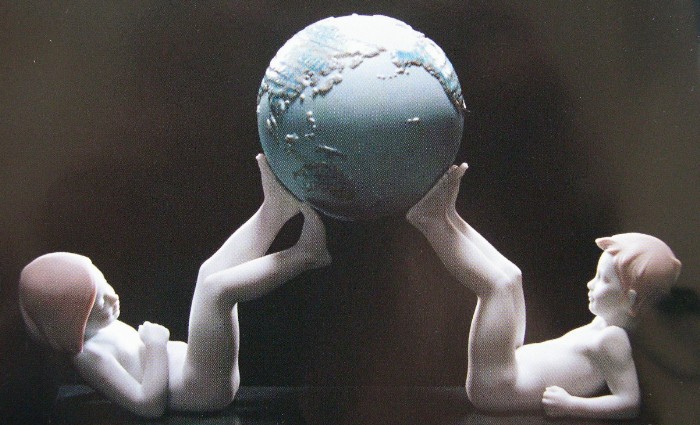
...or maybe not so small. Although the trip here was virtually effortless I was out cold for eleven hours once it came to sleeping! This somehow memorably hideous objet is a Lladro thingie I saw in a magazine in Barcelona a few years ago (When did Atlas have kids?) - I've been waiting for an occasion to get it out of my system! Whatever its other merits, it does show that getting from Australia to California via Japan is not, perhaps, the most direct way after all.

And no, while it may be Friday in Nippon and Oz, here it's still Thursday.

Wednesday, January 10, 2007

Hop skip and jump

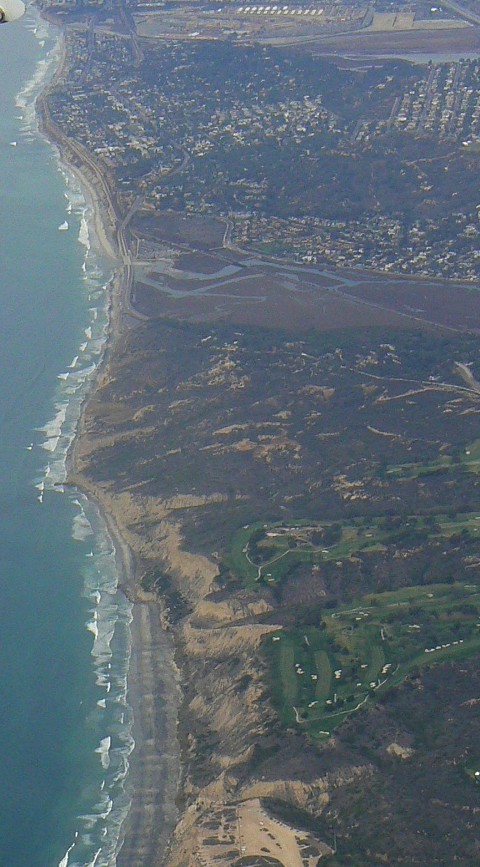
Greetings from California! The (first, quick, lovely) Japan stopover was effortless - no significant timezone change so you hardly notice it. And the change at LAX to a little plane for the last stretch to San Diego afforded me views I've never had before of my childhood stomping ground. Here - from the window of our plane! - is the view. Going north (up) past the Torrey Pines golf course (not part of the stomping ground) you reach Torrey Pines State Reserve (stomp), the beach (stomp, stomp) and above the lagoon, the little town Del Mar (stomp, stomp, stomp), home! I didn't like being from sunny California as a self-conscious nerdy boy - I bodysurfed rather than surfed in part because you can hide in the wave - but now I'm delighted to come home to it, or at least to this little stretch of it. (Del Mar is the home of this blog, too, which began here four months ago.)

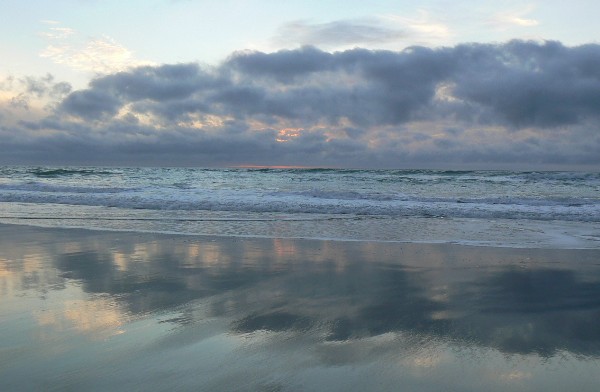
Considering I left Tokyo this evening at ten past five, it was especially sweet to have arrived in Del Mar in time for a walk with my parents on said beach before the sun set at 5:04. Looking west from just above where the lagoon meets the Pacific we saw the sunset above. The clouds give a wintry feel to it all, the red along the horizon - brighter than my photo conveys - warm like a distant fire. But I'm Australianized enough already to have been reminded by the gappy clouds in this picture of light shining through gum (eucalpyptus) trees. Now I'm really seeing things!

Monday, January 08, 2007

In the air

This is my last post from the glorious State Library of Victoria (have I mentioned that this is my new home?). By this time tomorrow I'll be most of the way to Tokyo! In case you missed it (easy enough, I only mentioned it once), I'm going to California - and flying the long way. I'm participating in a conference on an exciting new way of teaching about history (I get to go because I'll be chair of the first year program when I return to school next year). Very happily the conference is in San Diego, where my parents live! And that the ticket I ended up finding (in highest of high seasons down here) goes over Japan with compulsory stopovers adds very pleasing wrapping. But it will be a lot of time in the air. Have you ever noticed that Australia is really very far away from, why, from most anywhere?

I'll try to update the blog regularly, but just so you know where I'll be flying when. (If anyone wants to catch up by phone while I'm in California, I'll give you the number!)
Tuesday 9/1: Melbourne-Tokyo
Wednesday 10/1: Tokyo-San Diego
Friday-Sunday 12-14/1 conference
Friday 19/1: San Diego-Tokyo (arriving. Saturday)
Tuesday 23/1: Tokyo-Melbourne (arriving Wednesday)

But before I leave Melbourne, let me tell you about something strange that's been happening to me; I'd be interested in your thoughts on it. Just in the last few days I have started finding myself recognizing lots of people from New York around here - in the library, the café, the tram. It's not them, of course. But the resemblances are, for a time, striking. What's strangest of all is that this didn't happen at all before a few days ago, and now it seems I can't take a ride in a tram without seeing some ex-student or colleague.

What to make of this? Is it homesickness - or the opposite? (It's not anticipation of being back in New York, since I'm only going to California.) Perhaps my mind has let go of the boundary between there and here, letting me look at strangers' faces here with the expectations of home, expectations which were bracketed out before by constant awareness that this is not home? Or is it that I've now been here long enough that I'm recognizing faces (regular passengers in the tram, waiters, etc.), and so the gates have been opened to a more general expectation of familiar faces? Or maybe I'm just going soft in the head from thinking too much (or too mushily) about the good. Any thoughts?

Sunday, January 07, 2007

Through Australian eyes

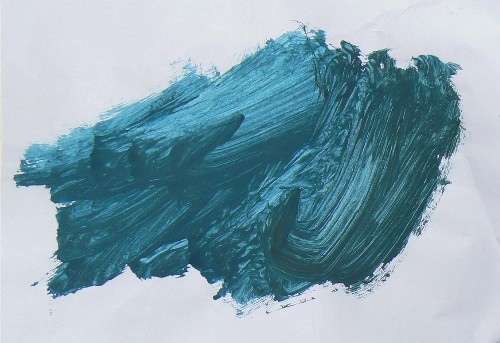
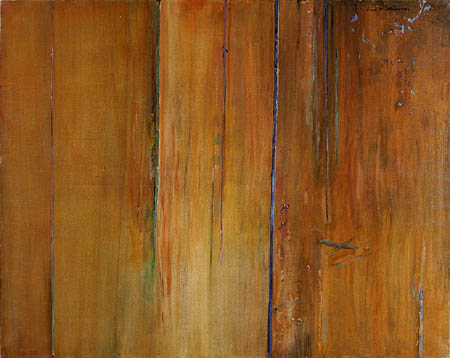
An artist whose work I have been following has entered a new phase. His earlier paintings, in the colors of the Australian countryside, are bold and profound. This one, which hangs on my wall at 450 Lygon Street, manages at once to evoke Noah's flood and the power of the Australian land (whose shape is gestured at). I haven't been keeping you posted on the bush fires, which seem to be under control if not out. I've also not mentioned that some regions had rain, and it led to floods - floods and drought seem like kin here. This is a climate of broad strokes, and here the artist has caught its raw power. Quite different but still full of movement this one, which reminds me of the windy tug-of-war between gum groves and canola fields I saw along the way to Shepparton before the drought dried everything up. (Remember my photo from the train?) The subtlety of the scenery here is nicely captured in the interpenetration of the colors: the animating heart of the green-blue is yellow, and vice versa. This third work shows the primary colors which, beneath the camouflage of dusty greys and greens, are the true colors of the Australian land. Sometimes the sky will call to the red of the earth and turn the whole world reds, peaches and corals (which at dusk may generate an underwater world of blues and purples), but much of the time the primary colors are concentrated in the flight of Australia's birds.

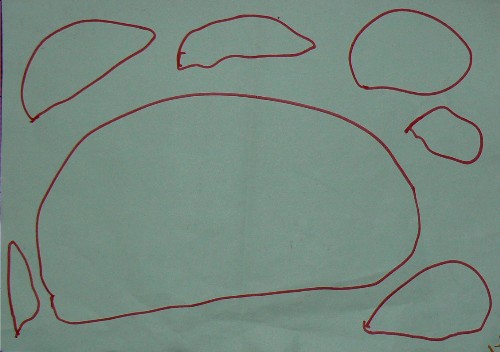
The artist's newest work has gone in an almost disturbingly different direction. Gone are colors and the dynamic, almost terrifying momentum of their interactions. In their place, as in this evocation - or memory? - of billabongs (I suppose), we find barest outlines, mere scratches on the surface of an earth which has turned away from us into a flat parody of green. No more mutual informing of surface and depth, just spaces you can never enter, since every side is outside.

This is what drought feels like.

Saturday, January 06, 2007

Japanese miniature

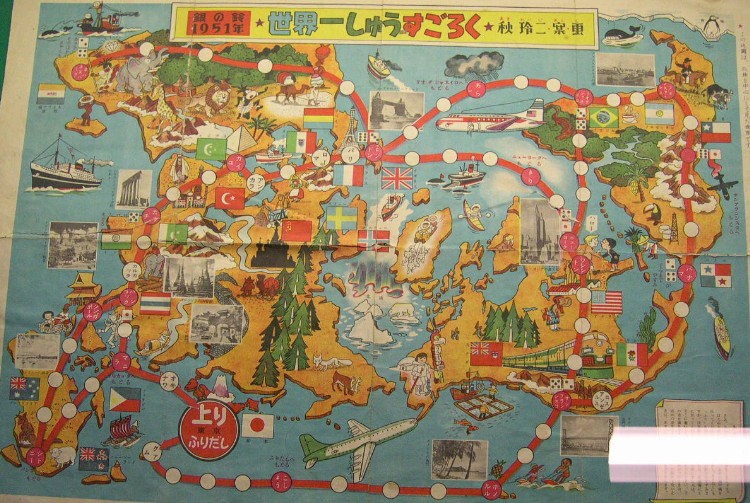
I saw this world map board game from 1951 today a year ago, in the historic Kaichi school in Matsumoto. (Click on it to see more detail.) It shows clearly that going from Australia to California via Japan makes perfect sense! Since that's what I'm about to do - departure is Tuesday morning - this is reassuring. It's also, I dare say, a worthy addition to the assembling of unusual maps with which this blog began.

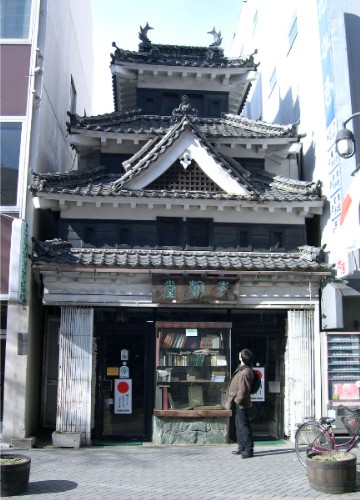
This rather pinched used book store, which I saw the same day with my friend O (that's him in the picture), also seems an appropriate emblem for my embarrassingly super-quick Japan stopovers. My stays in Japan - I have to stop over in both directions - are one and three days, respectively, adding up to a hardly respectable four in all!

For the time being, though, I'm still in Melbourne, frantically trying to crank out a draft, no matter how shaggy, of "the book" before departing. I'm a bit behind but should just squeak through, if very shaggily. Wish me luck!

Thursday, January 04, 2007

We know them

Had coffee this morning with K, my first host and inspired guide to the true, i.e., hidden Melbourne. She’s back for a few weeks from Germany, where she works, and I was reporting on my assignment in her absence, which was to find a fabulous café or bar she didn’t know. The one I wanted to show her — the tiny Café au Soleil in a glassed-over alleyway reminiscent of the less frequented Parisian passages — is closed for the holidays, so we went instead to a little café in Degraves Street. Degraves is one of the cosy, atmospheric and half-hidden “arcades, alleys and laneways” where Melbourne downtown comes to life. (I can’t believe I never got around to posting this map of the self-guided walk of that name; Degraves is bottom left.)

Compared to K the people I see nowadays are recent arrivals in Melbourne, so it was fun once again to experience (however vicariously) the city’s whole cultural life as not more than three degrees of separation away. Well, just the parts of the city worth knowing, needless to say! Several bright and popular places I found back in September were dismissed with “we would never go there” or even (my favorite) “nobody goes there.” This morning I asked her advice on books, since I have yet to find the great Melburnian novel (if there is one). The State Library of Victoria had put together a list of books about Melbourne and she went through it, as often as not saying of authors or their subjects “we know them.”

But I was the one who knew someone in the café. After racking my brain a little I recognized our squinty and slightly shady-looking waiter as having been the male lead in the production of Brecht and Weil’s “Happy End,” the misbegotten sequel to the “Dreigroschenoper” I saw at the Victoria College of the Arts two months ago. Not that he looked remotely shady-looking in light blue shorts and short-sleeve shirt on a sunny morning, even in the shadow of Degraves Street, but I remembered him as a gangster with what passed for a heart of gold in Weimar, swaggering and drawling, spitting and snarling his way through songs like “Bilbao.” I recall thinking he had the perfect mug for the part (he appears to be missing one of his front teeth), so perfect I couldn’t imagine him in anything else. Are you acting in anything right now, I asked? We only just graduated, he said, and now it’s all about going to auditions… He has an agent. But most of the time he’s right here, in the Degraves Espresso.

Wednesday, January 03, 2007

Retrospect

Since I started keeping a daily diary in 2001, it's become something of a tradition to read through each year as it ends. So much one forgets! This picture is actually from January 4th three years ago, on the beach in California near the close of day. The angle of the sun makes the curve of this piece of sea-grass seem more dramatic than it was... but it could be that the exaggerated contours of retrospection show the shape of things better. Or not! (Remember that every picture can be enlarged by clicking on it.)

Anyway, here are three of the things I rediscovered in looking back over 2006. One, something I'd quite forgotten, is a quotation from a book I taught for the first time last (northern-hemisphere) Spring in a class on religion and democracy. The book is John Dewey's A Common Faith, and this sentence neatly encapsulates one of the main points of my own book-in-progress: goods actually experienced in the concrete relations of family, neighborhood, citizenship, pursuit of art and science, are what men actually depend upon for guidance and support, and … their reference to a supernatural and other-worldly locus has obscured their real nature and has weakened their force. Re-encountering it I am confronted again by a nagging question: "how on earth is my argument going to connect up to religion?" which reveals another: "isn't my argument really about how much we can do without religion, and when will I admit it?"

The other things are not rediscoveries in that I haven't and couldn't forget them. 2006 was the year I returned to the stage! Sure, I had only small parts (but there were six of them) (that's how small they were!). And there were only two performances (three including the invited dress rehearsal). And none of the other actors had even been born the last time I acted. But no matter, acting in Cecilia Rubino's documentary theater piece "The Odets Project" was unquestionably among the highlights of the year! It was an amazing experience of collective effervescence, of creating a world together and sharing it.

And the third thing: can there be anything more wonderful than watching children grow up, discovering the world? Unclehood rocks!

I was going to do a "best films of 2006" list but can't be bothered. Just this: "Jindabyne" and "Ten canoes" are terrific Australian films - go see them if you can! The comedy "Kenny" is wonderful too (worth a hundred "Borats," a film to avoid like horsepoop in the road), but I doubt it'll make its way overseas. See "Children of men" rather than "Babel." I really enjoyed "C. S. A.: Confederate States of America" and "A Scanner Darkly," and loved "Volver."

Tuesday, January 02, 2007

Jacaranda

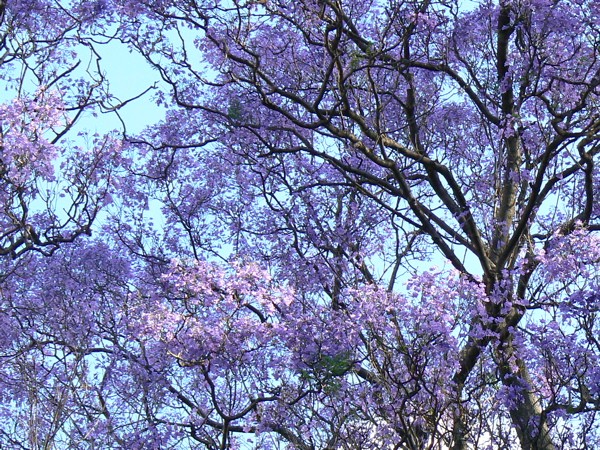
After all the grumbling, I have to say that the sudden featureless sea of time which opens up after the hoopla of the holidays is rather nice warm and in full color rather than a chilly grey. The jacarandas are leafier than when I took this picture a month ago, but it's too pretty to resist posting. And besides, in its lack of green it's still somehow cognate with winter...

Monday, January 01, 2007

Point counterpoint new year!

Well, it almost seems ancient history now (we're already two days into the new year over here), but I had a new year's eve worth writing about this time.

You've heard me winge (whinge?) about the weightlessness of Advent in the middle of summer, and Christmas looked to be even worse, lost in the din of school holidays starting, beaches opening, the summer solstice (!), and the buying bacchanal of Christmas sales. It was starting to seem that the magic of Christmas I was pining for was in fact just the magic of the turn of winter: the pagan festivities on which early Christianity piggybacked in Europe. The great wheel of nature, nothing more. This was rather discouraging, as it made it seem that the hope one feels might really be in response to the solstice, and nothing to do with a babe in manger, the light of the world. (It might also be that there's a different kind of visceral turning brought on by the summer solstice. I do think our bodies are more attuned to these things than we quite realize.)

Lucky for me I'm attending a liturgically fastidious church, one of whose traditions is to celebrate Lessons and Carols not before Christmas as everyone else does, but the Sunday after Christmas, as is apparently proper and as most of the carols demand. This year that Sunday fell on new year's eve, so Christmas had a chance to fight back! And fight back it did, planting a flag on that most pagan of holidays, with a lovely service of carols and music, culminating in "Dieu parmi nous," the ending of Messiaen's La Nativité du Seigneur, whose glorious melding of birdsong and wondrously strange deep descending organ chords (representing "the living God descending to His people") fit right into summer, and hushed it into silent adoration.

And then, after a party, I found my way with a friend to Federation Square (which I've come to love, especially at night, when it looks like a computer-generated landscape, nearly transparent and mysterious) for the fireworks, which were all around us! I've never been surrounded by fireworks before, nor, in the aftermath, by half a million peaceful people flowing like great rivers through the streets of a becalmed nocturnal city. Impossible not to catch the energy of that moment, to dare to hope that that joyous peaceful energy will flow more freely this year, and bring joy and peace to the world.

Sunday, December 31, 2006

Prosit Neujahr!

2007 is about to be upon us, and I’m not ready! (Some of you have sixteen hours more, may I defer to you?) I haven’t fixed on a resolution, haven’t finished rereading the year’s diary in order to put together a list of "best films of the year," haven’t even really thought through what to say in this blog post! Perhaps I’ll just defer to one of the political cartoonists of The Age (not Leunig, but Leunig-like):

May 2007 surprise us all as a year of peace and reconciliation, joy and growth in understanding.

Friday, December 29, 2006

Episodic

Something I’m teasing out for my section "Why are all the good stories about evil?" has unexpectedly brushed up against blogging. My general argument (in no way original) is that satisfying stories require tension — trouble, conflict — and its resolution in some form or another, but the good is no trouble and only contingently involved in conflict. (The only kinds of good which make good stories are heroic goods.) I decided to go back to the source of the view that stories need to have a beginning, middle and end, Aristotle’s Poetics, and found this (he is discussing tragedy): Of simple Plots and actions the episodic are the worst. I call a Plot episodic when there is neither probability nor necessity in the sequence of its episodes. (1451b33-34; trans. Ingram Bywater in The Rhetoric and Poetics of Aristotle [NY: Modern Library, 1954], 235-36)

Now I’ve been trying for a while to find a way of suggesting that the good eludes or stultifies narrative. Shall I say it’s episodic rather than tragic? The good, I want to argue, is not a bounded whole, and we have no interest in enclosing it in a narrative with beginning, middle and end (especially not an end). When we talk about non-heroic good it’s likely to seem episodic, and as dramatically satisfying as a guided tour through a stranger’s family pictures. Of course it’s episodic not because there are no connections – good is all about harmony and openness to connection – but because the sequence in which goods happen to happen is not important. The cheese may ripen before you finish reading the poem, the sunset may bloom just as you stop to smell the roses you’re pruning, an old friend may call unexpectedly just after you noticed your older child smiling at his younger sibling. There may be resonances, and even subtle and complicated causal relationships at work here, but none something as monomaniacal as a single story could capture. (We may also not need to know the connections.) A good life participates in many goods, goods which don’t need to be united or (most of the time) prioritized, and may suffer from the effort to unite them.

[Aristotle has of course acknowledged this:
The unity of a Plot does not consist, as some suppose, in its having one man as its subject. An infinity of things befalls that one, some of which it is impossible to reduce to unity; and in like manner there are many actions of one man which cannot be made to form one action. One sees, therefore, the mistake of all the poets who have written a Heracleid, a Theseid, or similar poems; they suppose that, because Heracles was one man, the story of Heracles must be one story. (1451a17-22; trans., 234)]

So maybe a blog, in its very episodic character, is a good depiction of the good! Its growth with time makes it open to the always surprising newness of goods – one has to find ways of describing things one doesn’t yet understand, and learning to follow them. And hyperlinks are a good way of depicting the rarely linear ways in which things connect without conflict.

On the other hand (there’s always another hand, especially if Aristotle’s nearby), goods take time to grow, and care if they are to survive. A tragic narrative can make this point by showing the fragility of goods. By contrast a merely surface-skimming blog makes things seem random and unconnected, always available and never in need of commitment. Deeper, longer-term goods must be conjured up not as mere episodes, but as living, interconnected realities, works in progress rather than wholes, and works in whose progress the narrator participates, and invites you to, too. I wonder how one does that?

Today’s picture, by the way, is of the weathered wood of a retired Murray River barge. No connection to the content of the post, of course.

Wednesday, December 27, 2006

Brown Christmas

Did my last photo, taken along the Murray River in Echuca, give the impression we had the toasty Christmas I was worried about? (Notice, by the way, how low the river is in that picture.) Nothing of the sort. Melbourne had its coldest Christmas on record, 14 degrees C, and Shepparton may have been even colder. Global warming swings both ways!

Be careful what you wish for, I guess... What we all wish for is rain, of course. The scenery to and from Shepparton, which I hadn't seen in a month, is bone dry. My brother in law reminded me that at this time of year it should be full of lush greens. Instead it's the palate of this painting by Fred Williams, "Upwey Landscape II" (1965), which I found here (I saw one of its companions is in the NGV, National Gallery of Victoria).

Williams is the Australian painter whose work I most enjoy, and a suitable link to Echuca, since he painted some wonderful work inspired by the red gums of Echuca in 1966, including this one (which also has a companion at the NGV, image unavailable).

I have yet to see Victoria green ... and am not likely to, at least not this time around, since I'll be leaving before Spring.

Monday, December 25, 2006

Happy happy

No, I don't know these guys enjoying a common upcountry summer pastime (if you can find water), but they noticed me taking a picture and waved. Let the wave reach you, too!

Sunday, December 24, 2006

Merry merry

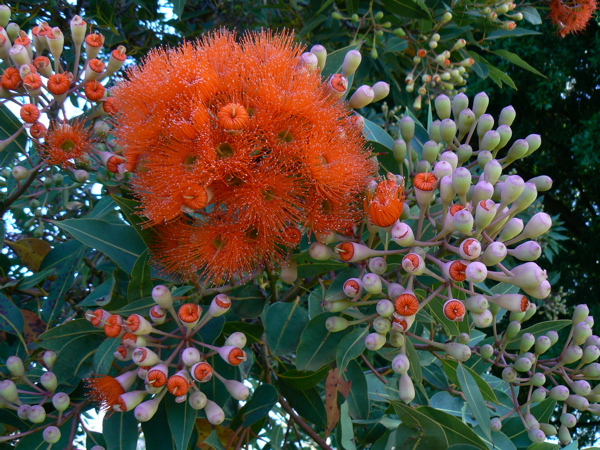
Christmas greetings from Australia, where they may have to lock winter-blooming poinsettias up in dark cold rooms to get them to bloom, but some local plants seem more than ready to fill in.

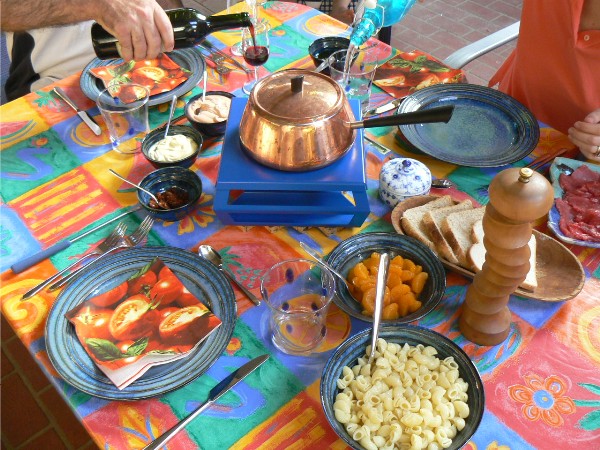
Just had a lovely Christmas eve dinner at my sister's: fondue chinoise, a tradition we grew up with. The only change (besides eating it outdoors!) was that we had not just beef but some kangaroo meat, too, and with it some mint sauce. Very tasty. Indeed it was tasty enough to get my older nephew to try some, no small Christmas concession from someone who ordinarily refuses to eat anything but cereal, peanut butter sandwiches, yogurt and dry noodles!

Friday and again during dinner tonight, we had something even more unexpected: rain. (We spared a few thoughts for the families gathered outdoors in the oval next to St. Brendan's Catholic Church for an early midnight mass in Christmas pageant costumes, but just a few.) Not enough to douse the fires or arrest the drought, but welcome nonetheless!

Wednesday, December 20, 2006

O the weather outside is frightful, and the fire...

Well, I'm off for a few days up-country, bearing gifts (including a Christmas cake the size and weight of a small gold bar and a DVD of Bach's Christmas Oratorio, filmed in a baroque church somewhere in snowy Bavaria). I think we'll have quite a cozy Christmas, if we step out of the air-conditioning and into the blazing heat of mid-summer!

When I return I pledge to tell you a bit more about Melbourne (and about the book, yes, yes), of which I've suddenly realized I've given a most superficial picture. Just the languages on this cut-out sign (part of a special insert on preparing yourself for possible bush fires in today's paper) tell you more about Melbourne, or about more Melbournes, than anything you've heard from me: Italian, Greek, Arabic, Vietnamese, Chinese and Hebrew. If I forget, hold me to it.

My final thoughts about Advent in this part of the world are colored by the almost apocalyptic feeling of a country drying up, and now burning, all around. Smoke from the fires covered Melbourne yesterday, bathing everything in a greyish twilight yellow and tasting of ash. Mild weather has kept the fires from doing too much damage these last days, but a new heat wave, which today has taken Melbourne temps up to 37, promises new horror. One possible horror would be if the fires contaminated Melbourne's already much depleted main reservoir - they're practically lapping at its shores already. Even without that, we switch January first to a stage 3 water crisis, where gardens can be watered at most twice a week; this still verdant city will look more and more like a sepia print. Scary reports of the warmest winter in hundreds, even thousands of years in the Alps, in Russia, etc. and the imminent decimation of the world's fish populations add to the sense of peril.

In the midst of all this, it turns out it's quite a wonderful thing to hear a brass band playing Christmas carols around a street corner.

Monday, December 18, 2006

Wonder not

Yesterday I did something I wasn't going to do. I changed something about the structure of my book plan. Not a big change, and I think it's a good one, but still. I don't want the whole structure suddenly to be be up for grabs, what usually happens when I write a paper and keeps me flailing like someone in a rip current as I go through endless drafts ordering and reordering and arguments, with names like "X draft 2" and "X draft 3+" and "X draft 3+++"! For a project this big, I can't afford that kind of diffusion, so I have just one draft. And have committed to keeping to one outline: seven chapters, four subsections each, 2000 words per. 2000 words is supposed to stop me from getting sucked into endless parsings and bogs of footnotes, and each section is to have its own little arc - a beginning, middle and an end - so it might, theoretically, be read on its own. Ambitious, perhaps, but it's been working. I'm still in one piece, and still have most of my hair!

What was the change I made? Chapter 6, "The invisibility of good," is part of a larger argument that it is in the nature of good that we take it for granted, that - unlike evil - it doesn't force thought. This chapter tries to restore a sense of the goodness of the nonhuman, of things beyond "moral good" conceived in solely human terms; while accepting that why premodern ways of thinking about this cannot simply be revived without bad faith, I suggest ways in which they might still be reclaimed. It's my most out-there chapter, and I'm finding myself taking positions which I didn't realize I held or didn't realize were going to find a place in this book. I've long been a feminist, but it's taken the Australian bush and its custodians to bring out the ecofeminist in me.

The original plan was for sections on (i) order, (ii) design in nature, (iii) Darwinism and its consequences, and (iv) the consumer model of good. Now I've decided to fold (ii) and (iii) together - they make more sense as part of the same arc, though 2000 words feels very tight! But tight is good. And this way I get to add a new (iv) on - or really atacking - ideas of wonder, the sacred, reenchantment. I'll argue that all of these, at least as generally conceived, are implicated in the view of the world the rest of the chapter has been calling into question, of a world essentially inert, indifferent and meaningless, of goods as objects we observe or for reasons of our own desire or possess or consume but don't really interact with. A world in need of reenchantment is already disenchanted, and probably neutralizes or undermines our every effort at enchantment. We wonder at new things - but only until we come to understand them. And the things we call sacred seem to come from another world, to shine through this world, rather than to be part of its working, or indeed, part of our working in it.

Don't suppose any of this makes sense in these abbreviated terms. If there's interest, it might do me good to go into a bit more detail here.

Sunday, December 17, 2006

Wombat divine!

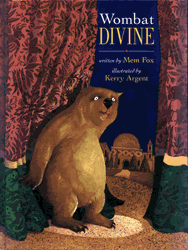
Wish you could see the wonderful windows of the Myer's Department Store on Bourke Street, a Christmas tradition. This year, the five windows tell the story of WOMBAT DIVINE, a worthy continuation of the tradition of the Magic Pudding and the Possum Creek critters. Amazingly, considering 1.2 million people are expected to see them, I can find no images of the windows online (except for two scenes which prurient people found suggestive), so here's the cover of the children's book by Mem Fox on which it's based.

The story is of a Christmas pageant put on by Australian animals, but they just can't find a part for wombat. He's too big to be Mary, too short to be a king, too heavy to be an angel (when the koalas trying to hoist him up give up he lands on a seesaw, sending an unsuspecting platypus flying), too short-sighted to be a shepherd, and too sleepy for everything, tending to curl up and snooze whenever he can. The animals move and gesture, but what's most delightful (to me at least!) is that the designer clearly knows and loves the theater. So we see scenery rolling down and up, lights being tested, a whole workshop of elves making props and sewing costumes, and in the middle window we get to see an entire empty theater with a balcony of velvet-covered seats revealed by scrims and curtains going up!

You can probably guess what role sleepy wombat ends up getting. Though he's a little big for it, he snoozes just like a baby as the kangaroo kings arrive with gifts of gold, frankincense and myrrh!

The fire last time

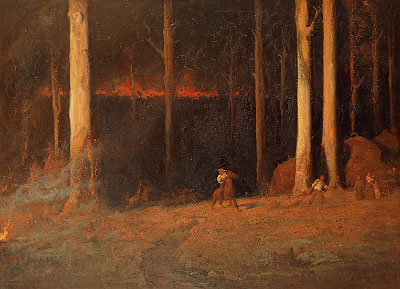
Here's another image of bush fire in Gippsland. It's not a photo, though.
Rather it's a painting I saw it today in the National Gallery of Victoria. It's by John Longstaff and called "Gippsland, Sunday night, February 20th, 1898." The 1898 conflagration, known as the Red Tuesday bushfire, burned 260,000 hectares. 2000 houses destroyed, and a dozen people killed.

The painting itself is very powerful, nearly 1.5 meters high and 2 across, with bolting horses, terrified people, and that frightening line of fire on a horizon which might be distant but is probably close. Especially interesting are disturbances of the paint surface in the tops of the trees and, especially, in the black area at the painting's center. (You can even see them as fine white lines in this photo.) The canvas looks charred! Whether Longstaff managed to create this effect deliberately or whether it's just what happens to deep black paint after a century I do not know, but it adds to the visceral power of the painting, and the danger it communicates. It's almost as if the fire has burnt the canvas from behind.

On a day when you can taste in the Melbourne air the ash from this season's first Gippsland fires (today saw the merging of bush fires which between them have already incinerated 680,000 hectares), you can really understand that Australians live with a sense of natural danger. (Now I see why you might read your children the Possum Creek Disaster stories I described bemusedly two months ago.) The fatalism I sense around me is greater than what we feel about brushfires back in California, regular and destructive though they are, and closer to what Japanese feel about earthquakes.

Saturday, December 16, 2006

Look heeya

I've been meaning for a while to pronounce on Australian vowels. My nephew's way of turning 'here' into a somewhat grating diphthong - sometimes extended as he-YAH - is just a pretext. But it's a good one, since it's in dipthongs and the r where the greatest distinctions lie. Some Americans I know who’ve been in Australia many years sound almost like Australians, at least to me. The American r seems never to go away (though I’ve learned to drop it from Melbourne, pronouncing it Melbin), which may be why these accents still sound American to Australian natives, but it’s hard to resist the siren song of the antipodean vowels.
Australian vowels, even the tamest and most British, sing more than our flat American ones, and achieve heights and depths we can’t muster. (I already tried a while back, not very successfully, to characterize what happens to my name here.) I’ve been trying for months to find a way of recording what happens to the words “thought, word and deed” I hear each week in the confession of sin at church. Something like thort, wööd and düeed, although there’s no ‘r’ in the first - it’s a deeper o, with the mouth making a tall narrow hollow - and the little fillip of ‘deeds’ is so quick as to be rising back before it really falls, more like the sound water makes when you pull your hand down quickly into it.) In the broader accents no diphthong goes unsung and you'll find a dipththong squatting in many a long vowel (as in ‘deed’). In some cases, finally, diphthongs are abbreviated to the component sounds Americans don’t pronounce, making it seem that high and low vowels have swapped places.

So here's a question for you. What was the man after who confounded the Canadian barista on Rottnest Island by demanding an arst kyke?

There's obviously much more to be said on this subject. The diagram above somehow charts gender differences - you must click it to see the coordinates - and is explained, sort of, here. Some of the more common sounds are spit out at you as your cursor moves over them on this site.

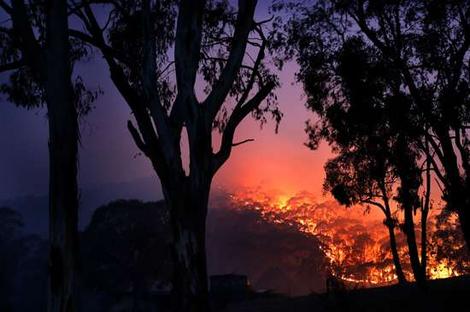
Meanwhile the fires burn on; they claimed a first life the day before yesterday. This is another picture from The Age's website.