Greetings from Orchha, conceivably the only internet connection this week, and hardly a good one. It took 15 minutes just to get to this page! So I'll keep this brief, in case the connection dies.
I'm having a fantastic time. Not only is India a land of wonders, but I'm having to revise my prejudices about organized tours. This one, planned by a company (Melbourne-based!) called Intrepid, seems to have been put together by a master of dramatic timing and contrast. We see such wonderfully contrasting things that we are constantly overcome by delight, at least I am. After Agra's deservedly famous Fort (a dream) and the Taj (bigger than I could ever have imagined but less ornate) we traveled by train and jeep to a little city - once rich and influential - called Chanderi, stopping along the way for chai at a tiny village, at the rim of a vast silver lake (dam-formed and punctuated in places by the spires of an inundated castle), and in the fort up above our town just as the sun was setting... Next day we walked through the town (including a visit to a school where the kids sang the national anthem, very solemn, some with their eyes closed, each in his/her own key), then had a picnic on a lake, admired some 13th century Jain statues carved in a cliff face, bounced along awful roads to a desolate bend in a river where some ancient rock carvings - at least 10,000 yers old, perhaps several times that - have only recently been discovered, then back to our primitive hotel... Today we traveled to Orchha by local bus, a pretty intense experience as people piled and crammed in (one of my tourmates calculated that there were at least 100 people in the bus, not counting those on top), then by open vans through the huge monument-overshadowed Orchha to a resort where we're sleeping in air-conditioned tents fit for a king - our best accommodation of the trip after, perhaps (one can always hope) the worst. Not for the faint of heart, this kind of touring which tries to maximize contact with local people and avoid tourist comforts, but what a fantastic way to discover a place!
Another day in Orchha tomorrow, then the famous erotic carvings at Kajuraho, a national park, and then three pilgrimage sites: a relatively uknown one first, Chitrakoot; the most famous of all last, Varanasi; and in the middle a place which only draws pilgrims every 12 years - Allahabad. But this is one of those years. There may be 5 million pilgrims there when we are! Pray for us.
Thursday, February 08, 2007
Sunday, February 04, 2007
Reality show
Just got back from a movie - nearly three hours in a language I don't understand, in a ratty old cinema called the Regal - but until the last half hour I was having a grand time, cheering with the audience at witticisms and noble sentiments I couldn't understand but somehow got anyway. The film was called "Guru" and told the story - so far as I could tell, and I'm sure I missed most of it - of the rise and fall and rise again of Shakti Polyester Corporation (a true story, I learn from imdb.com), interwoven with the sad but justified slow death of a conniving belly dancer, and starred stars I recognized, and featured its share of bizarrely wonderfully irrelevant music and dance scenes. I had a ball!
I haven't told you about our group though, have I? Well, last night we met on the roof terrace of the hotel here, 10 of the 12 of us in the group, including 2 Aussies, 6 Brits (conveniently 2 posh girls, 2 middle class girls, and a young working class couple), a Dane, myself, and our guide - who's French. A pretty young crowd, and all of us but the Dane India novices. As our guide reminded us that we were on an adventure tour which involved fewer comforts but in exchange more contacts with the culture - just to make sure we knew what we had signed up for - and as we went around the table and gave inert little accounts of who we were and why we here (except me, I had to make people laugh), and then as we sat around a table in a nearby restaurant pretending to be friends already, I felt it was the start of a television reality show. Who will survive?
Amazing, really, since I've only ever seen about three hours total of reality shows. And yet as I recall last night on the roof terrace I'm seeing the hand-held camera swooping around us, and imagine our guide Catherine confiding to a camera what she expects from this quiet one and that squeamish one, that keen one - and the one who had to make people laugh. India will bring out things the members of this innocuous seeming bunch don't know about each other, and may not even know about themselves!
Except for the cameras (perhaps I've internalized being constantly watched), it's all true!
We're off early tomorrow morning for Agra and the Taj Mahal (!) and another, grander, Red Fort; from there we head to a village called Chanderi for two days. The hotel in Agra may have internet; the lodging in Chanderi almost certainly not. So it may be a few days before I check in again.
I haven't told you about our group though, have I? Well, last night we met on the roof terrace of the hotel here, 10 of the 12 of us in the group, including 2 Aussies, 6 Brits (conveniently 2 posh girls, 2 middle class girls, and a young working class couple), a Dane, myself, and our guide - who's French. A pretty young crowd, and all of us but the Dane India novices. As our guide reminded us that we were on an adventure tour which involved fewer comforts but in exchange more contacts with the culture - just to make sure we knew what we had signed up for - and as we went around the table and gave inert little accounts of who we were and why we here (except me, I had to make people laugh), and then as we sat around a table in a nearby restaurant pretending to be friends already, I felt it was the start of a television reality show. Who will survive?
Amazing, really, since I've only ever seen about three hours total of reality shows. And yet as I recall last night on the roof terrace I'm seeing the hand-held camera swooping around us, and imagine our guide Catherine confiding to a camera what she expects from this quiet one and that squeamish one, that keen one - and the one who had to make people laugh. India will bring out things the members of this innocuous seeming bunch don't know about each other, and may not even know about themselves!
Except for the cameras (perhaps I've internalized being constantly watched), it's all true!
We're off early tomorrow morning for Agra and the Taj Mahal (!) and another, grander, Red Fort; from there we head to a village called Chanderi for two days. The hotel in Agra may have internet; the lodging in Chanderi almost certainly not. So it may be a few days before I check in again.

Saturday, February 03, 2007
Miniatures
A day on my own was no problemo at all. The new metro - whose vast cool modern spaces must be as disorienting to most Delhi-wallahs as they are strangely comforting to me - took me speedily to Rajpath, the great avenue between the India arch and the government buildings, across which lies the National Museum, and then back up to Chandni Chowk in the heart of the Old City, where I roamed and got lost but was found by another metro station at Chawri Bazaar and whisked smoothly home in fifteen minutes.
The highlight of the National Museum was its wonderful collection of miniature paintings, each one of which (as the Michelin guides say) vaut le voyage. What exquisite worlds they invite you to, full of details which seem more precise than photographs, hair-thin lines which on inspection turn out to be composites of more than one line and so give figures depth through subtle shading, and all in a somehow translucently deep two-dimensional world of bold bars and boxes of luminous color. Depth without the crudity of foreground and background...
Everything was foreground - in any case there was no room for any background - in the busy alleys of Old Delhi, most of which would fit comfortably, complete with the shops lining them, onto any of the metro platforms. I was following the map from a 20-year-old book a friend copied from me, which was to take me to a lovely quiet lane far from the hustle of the larger streets... but when I found the entry to it, the approaching larger street (at most 10 feet across) was a seething traffic jam caused by a procession of cycle rickshaws squeezing into that every alley, bearing - you guessed it - six pairs of western tourists, one of whom was blithely videotaping the whole melee. Gulp. That not only could be me, but it might be me tomorrow, as our tour of twelve is spending part of the day in the Old City. Not that anyone seemed particularly bothered. Getting bothered seems something one would have to save for far worse things if you're living there...
The highlight of the National Museum was its wonderful collection of miniature paintings, each one of which (as the Michelin guides say) vaut le voyage. What exquisite worlds they invite you to, full of details which seem more precise than photographs, hair-thin lines which on inspection turn out to be composites of more than one line and so give figures depth through subtle shading, and all in a somehow translucently deep two-dimensional world of bold bars and boxes of luminous color. Depth without the crudity of foreground and background...
Everything was foreground - in any case there was no room for any background - in the busy alleys of Old Delhi, most of which would fit comfortably, complete with the shops lining them, onto any of the metro platforms. I was following the map from a 20-year-old book a friend copied from me, which was to take me to a lovely quiet lane far from the hustle of the larger streets... but when I found the entry to it, the approaching larger street (at most 10 feet across) was a seething traffic jam caused by a procession of cycle rickshaws squeezing into that every alley, bearing - you guessed it - six pairs of western tourists, one of whom was blithely videotaping the whole melee. Gulp. That not only could be me, but it might be me tomorrow, as our tour of twelve is spending part of the day in the Old City. Not that anyone seemed particularly bothered. Getting bothered seems something one would have to save for far worse things if you're living there...
Friday, February 02, 2007
Utopias
After just a day, there's too much to report. Entirely to be expected, I suppose! But here's a quick summary.
Swimming along in my chauffered air-conditioned car (I'd forgotten that it was quite so honky and stop-and-starty in yesterday's rather oneiric description, but it does jibe with the quiet I observed, in drivers concentrating on the road as well as in passengers, trying not to) I got to roam around the vast, empty Red Fort in the (not so old) Old City; explore the gardens around Humayan's Tomb, the first great Mughal building and a sort of anticipation of the Taj Mahal, its many tomb chambers divided and united by lacey stone screens just as its 32 surrounding squares of garden were linked and divided by a system of flowing streams and little waterfalls; marvel at the pinkish-beige grandeur of Lutyens' Art-Deco-Indo-Italio-Hispanic New Delhi buildings (not Hispanic, British, you say, but I tell it like I see it, perhaps I'm being reminded of Franco's architecture), which, at the end of the long smoky drive from India Gate (bleachers still lining most of it from last week's Republic Day), seem to be a city floating disconnected and largely unpopulated from the rest of the city; delight in the stacks of stone quarried from destroyed Hindu and Jain temples (and still quivering with memories of their earlier incarnations) in the ruins of Quwwat-ul-Islam, the oldest mosque in India, and smile with the flower-buds at the ends of the strokes of the Arabic calligraphy ornamenting the enormous 13th century tower of Qutb Minar and the remains of a great arched sandstone screen; and feel the power of the relics - they are relics, attracting veneration entirely nonviolently - at the house where Mahatma Gandhi spent his last 144 days and died: how moving to see the glasses through which he looked, the stone he used in lieu of soap to clean himself, his staff. His utopia not the seven-terraced heavens and palatial forts of the Mughals, the detached splendor of the Raj, but a village, any village, every village.
The tour begins this evening, leaving today for me to venture out on my own. Try the new metro (which glides high above the city), check out the National Museum, and perhaps wander a bit around the warren of narrow streets which is Old Delhi. For the first time it'll be just me and the city. Wish me luck!
Swimming along in my chauffered air-conditioned car (I'd forgotten that it was quite so honky and stop-and-starty in yesterday's rather oneiric description, but it does jibe with the quiet I observed, in drivers concentrating on the road as well as in passengers, trying not to) I got to roam around the vast, empty Red Fort in the (not so old) Old City; explore the gardens around Humayan's Tomb, the first great Mughal building and a sort of anticipation of the Taj Mahal, its many tomb chambers divided and united by lacey stone screens just as its 32 surrounding squares of garden were linked and divided by a system of flowing streams and little waterfalls; marvel at the pinkish-beige grandeur of Lutyens' Art-Deco-Indo-Italio-Hispanic New Delhi buildings (not Hispanic, British, you say, but I tell it like I see it, perhaps I'm being reminded of Franco's architecture), which, at the end of the long smoky drive from India Gate (bleachers still lining most of it from last week's Republic Day), seem to be a city floating disconnected and largely unpopulated from the rest of the city; delight in the stacks of stone quarried from destroyed Hindu and Jain temples (and still quivering with memories of their earlier incarnations) in the ruins of Quwwat-ul-Islam, the oldest mosque in India, and smile with the flower-buds at the ends of the strokes of the Arabic calligraphy ornamenting the enormous 13th century tower of Qutb Minar and the remains of a great arched sandstone screen; and feel the power of the relics - they are relics, attracting veneration entirely nonviolently - at the house where Mahatma Gandhi spent his last 144 days and died: how moving to see the glasses through which he looked, the stone he used in lieu of soap to clean himself, his staff. His utopia not the seven-terraced heavens and palatial forts of the Mughals, the detached splendor of the Raj, but a village, any village, every village.
The tour begins this evening, leaving today for me to venture out on my own. Try the new metro (which glides high above the city), check out the National Museum, and perhaps wander a bit around the warren of narrow streets which is Old Delhi. For the first time it'll be just me and the city. Wish me luck!
Thursday, February 01, 2007
Flow
Greetings from India! Before the arrival of the car and driver who'll take me to various sites in the south of the city - sites, actually, of some of New Delhi's seven predecessor cities - and as Brahms' fourth symphony plays rather aggressively in the little lobby of my hotel in Karol Bagh, I thought I'd take advantage of an opening at the free internet terminal to check in. Got in last night, the snug connection at Singapore no problem at all, an airport pick-up waiting for me, the hotel room quiet and clean (number one-naught-six).
The hotel's in a not very busy neighborhood, so my first impression of Delhi was the road getting here from the airport, which was fascinating. As cars, buses, trucks, tuktuks, motorcycles and bicyles hurry along the two-lane road in three constantly shifting lanes, like drops of rain spooling down a windowpane, imminent collision always averted so precisely that it seems like it was all choreographed, you suddenly find yourself not more than a foot away from the inside of another vehicle for a brief moment, before all move on. Each of these vehicular spaces seemed like a little world in the evening light, commuters and families and workers, people in suits, turbans, tuktuk-drivers with shawls to shield their faces from the fumes (tuktuks, if I've got the name right, have no doors at the front - any more than they have lights in the back).
I stilll feel the pulse of that road, the flashes of sudden closeness, the silence beneath the veneer of horns as people headed home, or wherever they were going. And beyond the cars in the somewhat misty air, a backdrop of low apartment buildings, dark trees, and the dark shapes of people - men mainly - standing along the road waiting, congregating, walking. I feel like I've seen the ingredients of the teeming streetscapes of Indian cities separated out like the ingredients in a television cooking program. And now: a tavola!
The hotel's in a not very busy neighborhood, so my first impression of Delhi was the road getting here from the airport, which was fascinating. As cars, buses, trucks, tuktuks, motorcycles and bicyles hurry along the two-lane road in three constantly shifting lanes, like drops of rain spooling down a windowpane, imminent collision always averted so precisely that it seems like it was all choreographed, you suddenly find yourself not more than a foot away from the inside of another vehicle for a brief moment, before all move on. Each of these vehicular spaces seemed like a little world in the evening light, commuters and families and workers, people in suits, turbans, tuktuk-drivers with shawls to shield their faces from the fumes (tuktuks, if I've got the name right, have no doors at the front - any more than they have lights in the back).
I stilll feel the pulse of that road, the flashes of sudden closeness, the silence beneath the veneer of horns as people headed home, or wherever they were going. And beyond the cars in the somewhat misty air, a backdrop of low apartment buildings, dark trees, and the dark shapes of people - men mainly - standing along the road waiting, congregating, walking. I feel like I've seen the ingredients of the teeming streetscapes of Indian cities separated out like the ingredients in a television cooking program. And now: a tavola!
Tuesday, January 30, 2007
Back to school
Today's the first day of the new school year in Victoria - 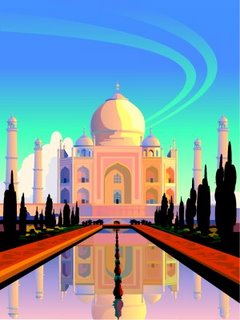 how quickly the summer holidays flew by! As for me, I'm off early tomorrow morning to the great school of religion which is India. Shameful, almost, that I've been in religious studies so long and have never been. Better late than never!
First Lesson: Internet cafés should be easy to find while I'm there so the blog should be updated regularly, but I'm leaving my laptop here so I'll have to do without the aid of pictures. There'll be an education just in learning to make do with only words as I encounter what by all accounts is an overwhelmingly new experience for all the senses!
 how quickly the summer holidays flew by! As for me, I'm off early tomorrow morning to the great school of religion which is India. Shameful, almost, that I've been in religious studies so long and have never been. Better late than never!
First Lesson: Internet cafés should be easy to find while I'm there so the blog should be updated regularly, but I'm leaving my laptop here so I'll have to do without the aid of pictures. There'll be an education just in learning to make do with only words as I encounter what by all accounts is an overwhelmingly new experience for all the senses!
Shadow boxing
Among of the lesser known features of academic life are the weird overlappings generated by its endemic time lags. We tend to plan things much in advance, and the whole process of research and publishing can take aeons, even when you find what you're looking for and someone likes it. The authors we read in books and journal articles only seem close; in fact they're like stars whose light has taken years to reach us. If they're not already dead, they have almost certainly moved on to new research.
A very wise scholar from Trieste named Nadia once told me that the key virtue of academic life was the ability to revive or at least to feign interest in things you cared about years and years ago;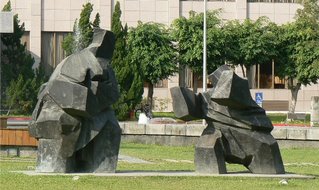 she reckoned it usually took about ten years from the time you finished working on something for someone to invite you to speak on it! It's certainly true that things keep coming back to nag you long after you've moved on to greener pastures - as drafts requiring revision, as proofs requiring checking, and then, if you're lucky, as citations in other works, invites to conferences, or even interested prospective graduate students.
  That's if your lucky. In my experience, sending things out is more commonly like dropping them down a well - no point waiting to hear the splash from the bottom. And if you are lucky enough to hear a splash, it will be from some other well down which you dropped some other thing you can barely remember, years ago!
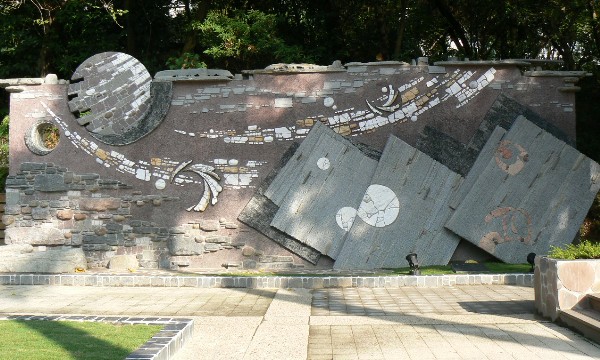
I mention all this because I've just sent off the revision of the talk I gave at Academia Sinica. (The photos are of art from their campus.) Remember? I went to Taiwan in November for what turned out to be a surreal experience of non-inclusion, every other paper delivered in Mandarin and my various attempts to secure summaries or translations even of the titles falling on deaf sinocentric ears. This essay of mine (whose English title is "Theodicy, disenchantment, and Confucianism's place in the theory of religion," for what it's worth) may see print relatively quickly, but it will do me no good. Translated into Chinese it will join the others in perpetual inaccessibility!
I feel a bit strange about the whole thing, like I'm just going through the motions. I don't think it's a bad essay, but I confess I didn't work as hard on it as I might have. If they showed so little interest in engaging me while I was in Taipei, what reason is there to think anyone will actually read the darn thing?! On the other hand, thanks to it I might get invited to some conference in China in 2017 and finally find out what that symposium in 2006 was about!
I need hardly mention the near-miss overlap of my putting the finishing touches on an essay about Chinese religion with an arm aching from last-minute vaccinations for India!
A very wise scholar from Trieste named Nadia once told me that the key virtue of academic life was the ability to revive or at least to feign interest in things you cared about years and years ago;
 she reckoned it usually took about ten years from the time you finished working on something for someone to invite you to speak on it! It's certainly true that things keep coming back to nag you long after you've moved on to greener pastures - as drafts requiring revision, as proofs requiring checking, and then, if you're lucky, as citations in other works, invites to conferences, or even interested prospective graduate students.
  That's if your lucky. In my experience, sending things out is more commonly like dropping them down a well - no point waiting to hear the splash from the bottom. And if you are lucky enough to hear a splash, it will be from some other well down which you dropped some other thing you can barely remember, years ago!
I mention all this because I've just sent off the revision of the talk I gave at Academia Sinica. (The photos are of art from their campus.) Remember? I went to Taiwan in November for what turned out to be a surreal experience of non-inclusion, every other paper delivered in Mandarin and my various attempts to secure summaries or translations even of the titles falling on deaf sinocentric ears. This essay of mine (whose English title is "Theodicy, disenchantment, and Confucianism's place in the theory of religion," for what it's worth) may see print relatively quickly, but it will do me no good. Translated into Chinese it will join the others in perpetual inaccessibility!
I feel a bit strange about the whole thing, like I'm just going through the motions. I don't think it's a bad essay, but I confess I didn't work as hard on it as I might have. If they showed so little interest in engaging me while I was in Taipei, what reason is there to think anyone will actually read the darn thing?! On the other hand, thanks to it I might get invited to some conference in China in 2017 and finally find out what that symposium in 2006 was about!
I need hardly mention the near-miss overlap of my putting the finishing touches on an essay about Chinese religion with an arm aching from last-minute vaccinations for India!
Monday, January 29, 2007
Family daze
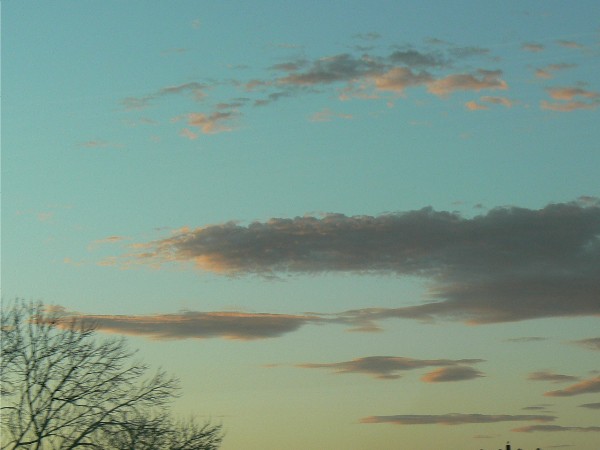 Not much to report but here's a sunset from Shepparton. I suppose I might have mentioned that Friday was Australia Day, but it's the national holiday nobody pays much attention to so I didn't see any reason why I should.
I'm getting pre-stressed about India - departure in 3 days! - but I think I'm over the initial panic attacks (thank you everyone whose first reaction was "you're going to get sick" - what is it about India?!), and now I'm just tangled up in logistical worries. I've never been on a tour before, let alone an "intrepid" one. (Here's the itinerary, if anyone's curious.) What does one do about laundry? Is one guide book enough? Should one bring sandals? Will one be able to charge one's camera? How does one prepare for life-changing experiences? And most unsettling: how can one live three weeks without one's laptop?
Saturday, January 27, 2007
McNaught
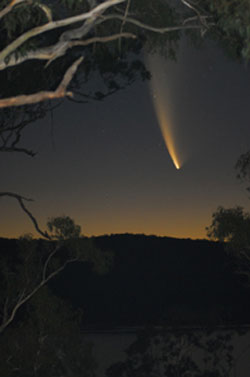 Back in Shepparton with my sister and her family for a few days. Today we took a day trip to Ruffy, a tiny town in the mountains south of here whose general store serves a mean lunch. It was charmingly countrified - except that all the yummy local products we enjoyed were available in well-designed jars and bottles, neatly arranged for sale just like the gourmet shops in Melbourne which are their main customers. My sister finds that Australians don't "do" rustic.
The comet McNaught is lighting up the sky right now, the brightest comet seen in Australia in 40 years. (The picture is not mine, but could be.) It is definitely the longest tail I've ever seen. While I've no recollection of Hale-Bopp (which may or may not have taken along some folks from our California neighbor Rancho Santa Fe - remember Heaven's Gate?), I do recall being amazed at Halley's Comet (which we saw from the vineyards above Vienna). My sister remembers the same occasion without the amazement, so my memory may be embroidering. Or perhaps I was already embroidering the paisley-shape I'm remembering at the time!
Thursday, January 25, 2007
No place like home
 Ah, home sweet home! Melbourne of a mild summer day is delightful, and three days of significant rain while I was away have brought green back where I had thought never to see it again.
Or maybe I'm just relishing the great pleasure of doing laundry after returning from a trip! Why is that so satisfying?
Wednesday, January 24, 2007
I've been to cities that never close down
The trip which wouldn't end is over! Now I have a week to chill, as Indian butterflies gather in my stomach.
I have to say that Qantas is a very nice airline, its seats comfortable, its food tasty, its snacks healthy, its entertainment system (offering 60 movies, lots of CDs, games, etc.) the best I've ever seen. This is clearly an airline which knows how exhausting long haul flights can be - almost any flight out of Australasia is a long haul, except for the very long hauls! - and does a great job of helping the medicine go down. I can imagine the pleasure and pride Australian passengers must take in how well it does this.
My only complaint: I could have done without the 3-song pop music loop during takeoff, descent and landing, but mainly because it was a loop, and the song "The wonder of it all" went from being something I quite liked to something I don't ever want to hear again. But then, as we taxied to the terminal in Melbourne, they put on a children's choir singing "I still call Australia home" and I felt all gooey. (Songs about home, from no matter what country, get me going, even when they're not sung by children.) The song, I learn from the internet, is by Peter Allen (The Boy from Oz):
I've been to cities that never close down
from New York to Rio (Rome) and old London town,
but no matter how far or how wide I roam
I still call Australia home.
I'm always traveling, I love being free,
and so I keep leaving the sun and the sea,
but my heart lies waiting over the foam.
I still call Australia home.
All the sons and daughters spinning 'round the world,
away from their family and friends,
but as the world gets older and colder,
it's good to know where your journey ends.
But someday we'll all be together once more
when all of the ships come back to the shore.
Then I realise something I've always known.
I still call Australia home.
I recognized the song because Qantas has been in the news recently. Australia's de facto national airline is about to be sold to an international consortium of investors. Will the Qantas of the future work as hard to make the world pleasantly accessible to Australians, and Australia pleasantly accessible to its far-flung diaspora?
I have to say that Qantas is a very nice airline, its seats comfortable, its food tasty, its snacks healthy, its entertainment system (offering 60 movies, lots of CDs, games, etc.) the best I've ever seen. This is clearly an airline
 which knows how exhausting long haul flights can be - almost any flight out of Australasia is a long haul, except for the very long hauls! - and does a great job of helping the medicine go down. I can imagine the pleasure and pride Australian passengers must take in how well it does this.
My only complaint: I could have done without the 3-song pop music loop during takeoff, descent and landing, but mainly because it was a loop, and the song "The wonder of it all" went from being something I quite liked to something I don't ever want to hear again. But then, as we taxied to the terminal in Melbourne, they put on a children's choir singing "I still call Australia home" and I felt all gooey. (Songs about home, from no matter what country, get me going, even when they're not sung by children.) The song, I learn from the internet, is by Peter Allen (The Boy from Oz):
I've been to cities that never close down
from New York to Rio (Rome) and old London town,
but no matter how far or how wide I roam
I still call Australia home.
I'm always traveling, I love being free,
and so I keep leaving the sun and the sea,
but my heart lies waiting over the foam.
I still call Australia home.
All the sons and daughters spinning 'round the world,
away from their family and friends,
but as the world gets older and colder,
it's good to know where your journey ends.
But someday we'll all be together once more
when all of the ships come back to the shore.
Then I realise something I've always known.
I still call Australia home.
I recognized the song because Qantas has been in the news recently. Australia's de facto national airline is about to be sold to an international consortium of investors. Will the Qantas of the future work as hard to make the world pleasantly accessible to Australians, and Australia pleasantly accessible to its far-flung diaspora?
Tuesday, January 23, 2007
Traveling sucks
Have I ever said I like traveling? If so, I take it back. Instead of sleeping happily in my comfy Qantas seat (or watching first-run movies on the state-of-the-art seatback entertainment system) I'm in a crappy hotel at Narita Airport. Our flight, scheduled to depart at 8:10 this evening, was delayed - until tomorrow morning! (Narita has an early "curfew"; no flights leaving after 10pm.) So I won't arrive in Melbourne until tomorrow night, losing a day I'd hoped to spend on errands and wending my way to Shepparton. Argh! On top of that, the computer somehow decided to claim I was not traveling on an e-ticket (although I've flown the other 5/6 of this itinerary with it as an e-ticket); this took such a long time to sort out - long enough for the poor counter lady's obsequious Japanese apologies to curdle - that I arrived at the hotel restaurant 2 minutes too late for the dinner buffet, and had to settle for an inflexible "set menu" so paltry as to make one pine for airline food! Arrgghh! Let's just hope we do in fact depart tomorrow morning at 8:30, my luggage doesn't get lost, the computer at Melbourne doesn't decide to claim I don't have an e-visa (which of course I do have, but there's nothing in the passport to prove it), and the taxi gets me speedily home in time for a nice dinner on Lygon Street! And maybe I'll be refreshed by seeing the Red Center out my window - something I wouldn't have been able to do had the flight gone on time.
Old material and new
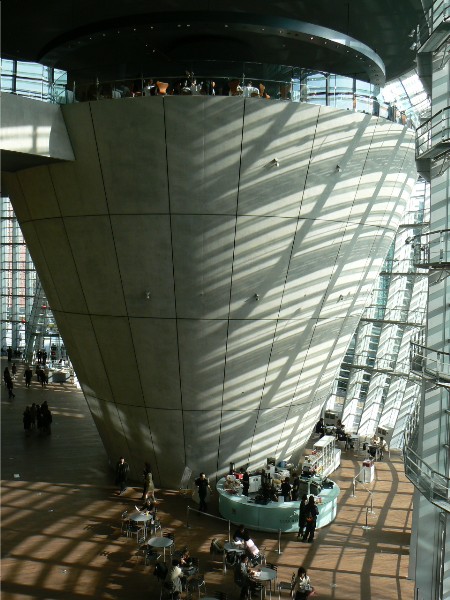
I've seen the future! While my stay in Japan has been an almost insulting 3 days, a vast new modern art museum,  the National Art Center Tokyo, opened during my stay (the 21st to be precise). So I went to have a look. (Notice the wrapped tree!) An exhibition on material objects in 20th and 21st century art was the main exhibit, 500 works by Japanese and international artists from museums and collections here and abroad, taking up all three of the huge exhibition spaces on the ground floor. (There are two more floors besides.) A very rich and ultimately ovewhelming show. What a pleasure, deep within it, to find two unfamiliar and yet entirely familiar Morandis.
The kicker, and the reason "Living in the Material World - 'Things' in Art of the 20th Century and Beyond" is the kickoff for this new museum, is that the museum has and will build no collection of its own. Things - possessions - a standing collection - are (as some people supposedly say) so twentieth century! The museum of the future will be just a space. Makes me feel very with-it, spaced out and generally luggage-free as I am!
Or am I one of the things floating around, from space to space? It certainly feels that way this month... I'm off to the airport, arriving Melbourne tomorrow morning. Interesting to be "going home" from the place I grew up (California) and a place I've been connected to long enough to become adult there (Japan) to a place where I've spent barely four months...
 the National Art Center Tokyo, opened during my stay (the 21st to be precise). So I went to have a look. (Notice the wrapped tree!) An exhibition on material objects in 20th and 21st century art was the main exhibit, 500 works by Japanese and international artists from museums and collections here and abroad, taking up all three of the huge exhibition spaces on the ground floor. (There are two more floors besides.) A very rich and ultimately ovewhelming show. What a pleasure, deep within it, to find two unfamiliar and yet entirely familiar Morandis.
The kicker, and the reason "Living in the Material World - 'Things' in Art of the 20th Century and Beyond" is the kickoff for this new museum, is that the museum has and will build
 no collection of its own. Things - possessions - a standing collection - are (as some people supposedly say) so twentieth century! The museum of the future will be just a space. Makes me feel very with-it, spaced out and generally luggage-free as I am!
Or am I one of the things floating around, from space to space? It certainly feels that way this month... I'm off to the airport, arriving Melbourne tomorrow morning. Interesting to be "going home" from the place I grew up (California) and a place I've been connected to long enough to become adult there (Japan) to a place where I've spent barely four months...
Monday, January 22, 2007
もう20年間になります
Had a lovely reunion yesterday with some old Tokyo friends, both of them moral philosophers. One I have seen pretty much every year, either here or in the US (I've invited him to speak twice). The other I haven't seen since 2000 because of scheduling conflicts - and because two years ago he caught 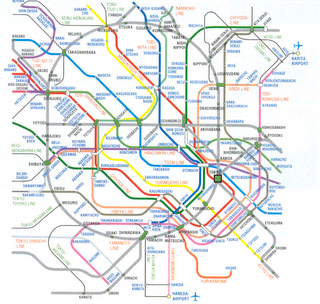 a virus while traveling and spent over two weeks in a coma, and several more unable to speak. Nobody expected him to recover, but as I was delighted to confirm, recover he has!
A scholar of comparative ethics (including religion) he described the ways the world now seems to him very movingly in terms from various traditions. Early in his recovery words seemed only arbitrarily connected to objects, and, he said, medieval nominalism finally made sense to him. Tastes only came back slowly, too, and he understands in a new way ancient Japanese people's sense of gratitude to foods for their tastiness and nourishment. The weeks he spent in a convalescent home made him appreciate the importance of care, and conclude that women are both more attentive and more self-sufficient than men. He worries that young Japanese have lost a sense of themselves as a part of something larger (自分) and not just a disconnected object (自己). (I'm mangling his subtlety here, apologies.) And he's been reading Augustine and finds the idea of creation ex nihilo (無からの創造) suddenly makes sense to him.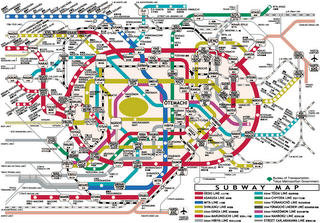 What a joy to see him again, and see him so well. Was it American of me to suggest to him that his rebirth is worth writing down and publishing?
The other friend went through a kind of rebirth last year, too: he turned sixty, which he reminded us is the length of the cycle of Chinese astrology and the five elements (12 x 5). And I'm approaching an even more notional turning point: it was (unbelievably!) twenty years ago that I first came to Japan. Twenty is when one comes of age here; there's even a holiday for it, 成人の日, for which one dresses up in traditional Japanese garb and visits a shrine. I'm not sure whether I ought to go this year or next.
But twenty years...! Much has changed, including the geography of Tokyo - hence the two subway maps above, which describe the same city, but also different cities. The first organizes everything as inside or outside the loop of the Yamanote 山の手 line train, and so Tokyo space was organized until very recently. Then one of the subway companies opened a new loop line, which runs deep deep beneath the surface, and dared to represent it as the true loop. Forgotten neighborhoods suddenly made it onto the map, resonating with the new line's name, Oedo 大江戸, great Edo (the old name for Tokyo). The Oedo circle map exposed for all time the graceless shape of the Yamanote's actual trajectory. (It's the black and white one; the two maps are both in English, should anyone care to try to read them together.) Several of the Yamanote stations, excluded from the new circle, now seem hopelessly peripheral.
Of course when it comes down to it neither the Yamanote nor the Oedo line is anything like a circle, but a fresh-faced 21-year-old turning up for the first time in Tokyo in 2007 would think the Oedo Line the most important boundary.
 a virus while traveling and spent over two weeks in a coma, and several more unable to speak. Nobody expected him to recover, but as I was delighted to confirm, recover he has!
A scholar of comparative ethics (including religion) he described the ways the world now seems to him very movingly in terms from various traditions. Early in his recovery words seemed only arbitrarily connected to objects, and, he said, medieval nominalism finally made sense to him. Tastes only came back slowly, too, and he understands in a new way ancient Japanese people's sense of gratitude to foods for their tastiness and nourishment. The weeks he spent in a convalescent home made him appreciate the importance of care, and conclude that women are both more attentive and more self-sufficient than men. He worries that young Japanese have lost a sense of themselves as a part of something larger (自分) and not just a disconnected object (自己). (I'm mangling his subtlety here, apologies.) And he's been reading Augustine and finds the idea of creation ex nihilo (無からの創造) suddenly makes sense to him.
 What a joy to see him again, and see him so well. Was it American of me to suggest to him that his rebirth is worth writing down and publishing?
The other friend went through a kind of rebirth last year, too: he turned sixty, which he reminded us is the length of the cycle of Chinese astrology and the five elements (12 x 5). And I'm approaching an even more notional turning point: it was (unbelievably!) twenty years ago that I first came to Japan. Twenty is when one comes of age here; there's even a holiday for it, 成人の日, for which one dresses up in traditional Japanese garb and visits a shrine. I'm not sure whether I ought to go this year or next.
But twenty years...! Much has changed, including the geography of Tokyo - hence the two subway maps above, which describe the same city, but also different cities. The first organizes everything as inside or outside the loop of the Yamanote 山の手 line train, and so Tokyo space was organized until very recently. Then one of the subway companies opened a new loop line, which runs deep deep beneath the surface, and dared to represent it as the true loop. Forgotten neighborhoods suddenly made it onto the map, resonating with the new line's name, Oedo 大江戸, great Edo (the old name for Tokyo). The Oedo circle map exposed for all time the graceless shape of the Yamanote's actual trajectory. (It's the black and white one; the two maps are both in English, should anyone care to try to read them together.) Several of the Yamanote stations, excluded from the new circle, now seem hopelessly peripheral.
Of course when it comes down to it neither the Yamanote nor the Oedo line is anything like a circle, but a fresh-faced 21-year-old turning up for the first time in Tokyo in 2007 would think the Oedo Line the most important boundary.
Saturday, January 20, 2007
三日の東京滞在
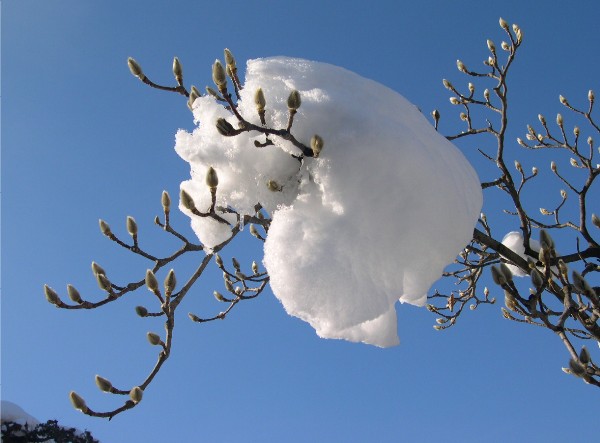 And now I'm back in Japan for a few minutes - well, three days. But it is decidedly mad to do Melbourne-Tokyo-San Diego-Tokyo-Melbourne in just two weeks! (Wish I were going to have more than a week to recuperate and gird my loins for India, which starts February 1st!)
Tokyo's a lot colder than it was, er, last week; I was shivering as I walked from the subway station to my friend's house, and it took a soak in her Japanese-style bath to warm me up again. First wintry temps all season, I'm told. In this strangely mild northern hemisphere winter there doesn't seem to be snow in any of the usual places. (The only snow I heard about this last week was a dusting in the mountains above Malibu, which just reinforces the point!) The picture above is indeed one I took in Japan, but it was last January in Nagano. I still can't understand how that snow got into that tree, or stayed there...
Thursday, January 18, 2007
Commonplace miracles
Today I rediscovered a poet whose work really stirs me, and may have found an epigraph for part of my book (the second part, or perhaps the conclusion) in its first lines.
Miracle Fair
Commonplace miracle:
that so many commonplace miracles happen.
An ordinary miracle:
in the dead of night
the barking of invisible dogs.
One miracle out of many:
a small, airy cloud
yet it can block a large and heavy moon.
Several miracles in one:
an alder tree reflected in the water,
and that it’s backwards left to right
and that it grows there, crown down
and never reaches the bottom,
even though the water is shallow.
An everyday miracle:
winds weak to moderate
turning gusty in storms.
First among miracles:
cows are cows.
Second to none:
just this orchard
from just that seed.
A miracle without a cape and top hat:
scattering white doves.
A miracle, for what else could you call it:
today the sun rose at three-fourteen
and will set at eight-o-one.
A miracle, less surprising than it should be:
even though the hand has fewer than six fingers,
it still has more than four.
A miracle, just take a look around:
the world is everywhere.
An additional miracle, as everything is additional:
the unthinkable is thinkable.
Miracle Fair: Selected Poems of Wislawa Szymborska,
trans. Joanna Trzeciak (NY & London: W. W. Norton, 2001), 119-20
Wednesday, January 17, 2007
A good sunset
 For some reason sunsets are one of the things people name when they try to think of things that are beautiful, or make them happy, or even... are good. Perhaps this is because each sunset is different. This evening's - pictured above a few seconds before the sun disappeared into a bank of cloud - was a three-ring circus! (Give it a click, it's full of lovely details.)
Perhaps it's also because sunsets let us consciously participate in the passage of time. And in a world larger than our own, of which ours is a natural part.
Tuesday, January 16, 2007
Tempest in a teacup?
 A day and a half after the denouement of our India game, I'm still not sure what I learned. Or rather, that as a student I'd be able to separate out what happened in our game from what actually happened, was eigentlich geschah - or even be much interested in it. At the moment my feelings are more like the guilty relief which I used to feel after long Chinese movies: thank goodness I'm not Chinese. Not a desirable teaching objective!
Instead, here's a mysterious picture of a mountainscape within a seascape, er, last night's sunset through an empty hummingbird feeder. I can't stop myself from thinking there actually is a lake somewhere, with foothills and mountains beyond, and a little steep-roofed cottage with a fruit tree next to it, which look just like this... (Not to worry, the feeder's been replenished.)
Sunday, January 14, 2007
Lose-lose
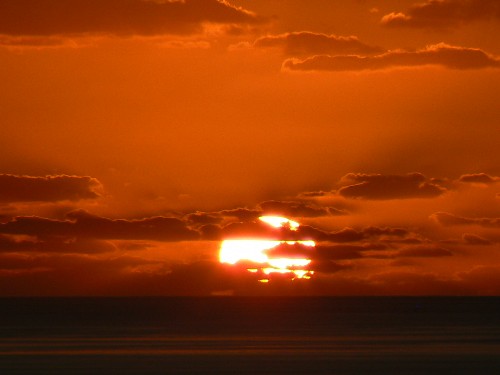 Well, the India game is over and everyone lost. Riots have engulfed the land, the navy has mutinied, and the Simla conference collapsed into irrelevance. We've left, too; no knighthoods likely, though we tried every trick in the book including honesty.
Each player in the "Reacting to the Past" games is given a character and an aim, the failure to achieve which means you lose. Usually someone loses, but this time everyone did. Everyone was crestfallen - except for the Gamemaster, who seemed to be having the time of his life scuttling our every effort (and the American Indians' every effort) to stave off disaster. In the post-mortem he told us that this game was designed to produce this result, and the Instructor's Manual is full of ways in which the Gamemaster can ensure it. If we felt we'd been had with the promise, however counterfactual, that we might have achieved something different, so much the better. Sometimes good outcomes are not possible, a good thing for students - especially Americans - to learn.
Well I don't know. In one sense, yes, obviously it is a fantasy that the past can be changed. But other games - about the trials of Socrates, Galileo and Anne Hutchison, the French Revolution, the Wanli Emperor, etc. - are designed to be genuinely open-ended. (Only in the post-mortem are students reminded that history has already happened.) Why is the India game the exception? As my Kiwi teammate noted, for all its tragedies modern Indian history is actually in many respects a success story, something the materials we received and the content of the "post-mortem" debriefing made inconceivable. If Americans are generally too sanguine about historical opportunities, this experience suggests that the only other option - the flip side - is a grim and sadistic fatalism. It shouldn't, I suppose, be a surprise that the fatalism should show its face here: Orientalism is alive and well. And 'India' is the place in the western imaginary where time dissolves, where complexity overwhelms, where the inconceivable and the intolerable are inevitable.
Oh well, it's just a game, right? When I arrive in India - the real India, the real me - in two and a half weeks, it'll be a truer test. Wish me luck.
(By the way, the picture above was today's sunset. Below in a brief separate post are two other pictures you absolutely have to see.)
Water's hidden artistry
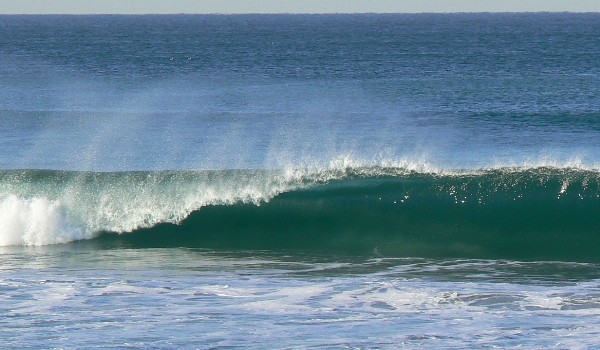
 Although I took them this afternoon, I don't feel I can claim credit for these pictures (especially the second). My camera just happened to be snapping as they occurred. Remarkable, no? The world dances just beyond the threshold of our comprehension.
Subscribe to:
Posts (Atom)