Tuesday, February 27, 2007

India pics: Filled up

Back in Melbourne a day and I still don't know what hit me. In my head catchy Bollywood melodies jangle with memories of temples and towns and rickshaws and rivers and deserts and children and holy men and animals and food and books and flowers and birds ... I feel so saturated with experiences I'm put in mind of the old method of packing as many stones as you can into a container: fill it with big ones first, shaking well; then add smaller ones, which will fill the spaces between the big ones, shaking well; then add smaller still, and so on, and so on. You'll end up close to solid rock.

Maybe I feel so thoroughly filled because, unlike any other place I've been, India has pushed, blurred and in general called in question my bodily boundaries. I'm not referring to getting "Delhi belly" - though having to be constantly vigilant about what's been touched by water, not a friend but an enemy, is certainly part of it - but to things like people grabbing your hands, or coming up to you with red paste on their thumbs making a blessed billboard of your forehead (which seemed to me a terrible violation)...

In any case, here are some more pics. I briefly considered doing thematic postings - animals, temples, calligraphy, etc. - but that would require surveying and sorting the 1100+ photos all at once, which is more than I can imagine doing right now, and probably would make things seem falsely coherent. Instead, I'll follow the route of my travels and try to include big things and small. Today's selection leads to and through Agra, our first stop after Delhi and home of the greatest monuments of Mughal India. The three clustered here are still from Delhi. The first is a picture of an alley in the Old City of Delhi - relatively people-free since it's Sunday. Notice the happy man carrying his tiffin box. The next is of the Jama Masjid in Delhi, largest mosque in India, and the work of the same Moghul emperor responsible for the Taj Mahal. The third shows the platform from which our early morning train to Agra departed.

These two pictures show details from Agra Fort: sandstone carvings on the wall of the palace built for a Hindu princess, on whose gorgeously carved wall (click the picture to see details!) intricate geometrical Muslim patterns try to contain the aesthetic traditions of India. While they are only pretend windows, the charms of the figural seem to be welling up from inside them anyway - and ... overflowing! The floral's accepted as a compromise inside a pavilion for the queen, whose exquisite stonework makes that of the Taj seems crude by comparison (feel free to click this one too!). And then we come to the Taj Mahal, which really truly is not just in a category of its own but beyond category. It seems simply perverse to try to discover a new angle on it. Here it is as seen from the Fort, across the Yamuna (or Jumna) river - the sacred river which meets the Ganges at Allahabad, site of India's biggest pilgrimage. During and after the monsoon I imagine the river would have filled up the whole scrubby riverbed you see here.

Now three pictures of the Taj Mahal from up close. The first is a view across the back side of the high marble platform on which the tomb itself sits, with one of the four minarets and the side-dome of one of the two red and white mosques which flank the tomb. These two little sandstone and marble mosques (actually only one is a mosque and neither is little) are wonders in their own right. Each has a white marble dome like the central tomb's. You can see one of them in the foreground of the picture of the Taj from Agra Fort above. Below is the façade of the other one - the three friends in the doorway show just what grand edifices these are, too! The picture below it is of the tomb itself - notice that the inlaywork flowers are similar to those on the mosque next door, and the Quranic verses which - besides the repeated dome shapes, concave and convex and outlined and the chevron patterns with sometimes inconsistent coloration - form the only ornament of the building. The text, incidentally, is a whole sura describing the throne of God, which suggests to some that with this building the emperor was doing more than just memorializing the mother of his heir; its unprecedented placement off the center of the garden also suggests that his deeper intention was to suggest an analogy of imperial and divine power.

And now I simply must show you the Taj the way you've seen it a thousand times, but it's the way it means to be seen. (You can just make out the domes of the mosque and its twin behind the trees.) Even in the fading light of dusk it draws in the sky above, the world below, and through the stunning symmetry gathers together everything on earth all around. Imperious indeed!

To close, let me explain the picture I started with. It's from the day after we left Agra's troubling mix of architectural purity and urban squalor - the exhilarating view across the vast lake created by the damming of the river Betwa in Madhya Pradesh. The almost ten-mile dam inundated eight-four villages. Look very closely and you'll see some black dots in the distance on the right. They are the tips of the towers of a fortress above one of these towns, visible only in winter. When the monsoon raises the water level back to the red/white line they disappear again.

Sunday, February 25, 2007

India pics: Delhi goodbye hello

I'm off this evening after what now feels like a pretty good first experience of India. It had three acts - the Intrepid tour of timeless India, the shock of the new in Gurgaon, and then a mingling of the two in a strong religious broth in Rajasthan - and a pleasant coda: lovely to have a final weekend just chillin' with my old friend and his family. Feeling anew, indeed, after many years' separation, like the old dear friends we are. I've started going through photos. Well, I've been weeding them out all along with an effort at ruthlessness, and Delhi - Agra - Chanderi - Orchha - Khajuraho - Panna - Chitrakoot - Allahabad - Varanasi - Gurgaon - Jaipur - Amber - Ajmer - Pushkar - Samode in 1000 shots seems not so bad - if still somewhat unwieldy I grant you.

Today I'm just posting six photos from my very first days here, in and around Delhi. (Unusually for me, they all have people in them.) Since I can't move pictures around or interleave them with text from this computer, this list of descriptions will have to do (remember that each can be enlarged by clicking on it):

(1) schoolgirls coming out of the vast bazaar entry of the Red Fort

(2) a security guard who tried to mess up my picture inside the Fort but ended up completing it

(3) an Indian woman taking a picture for (or perhaps of) tourists at Humayun's Tomb, the predecessor monument to the Taj Mahal

(4) an Indian tourist marveling at a ceiling at Qutb Minar (I love this picture)

(5) a manual laborer enjoying the Sunday calm on an Old Delhi street usually thronged with book buyers

(6) guys awaiting a bus before a billboard commemorating one hundred years of Satyagraha (notice the Gandhi symbols - the cartoon outline from behind and the glasses)
More to come!

It's a little strange to be posting these pictures of my first Delhi impressions as I leave, I suppose. Or maybe not: those schoolgirls were coming out just as I was going in. It is in any case a pleasure to look back on these pictures (especially the ones with people in them), and find them already fond and familiar memories. This India feels like a place one could spend more time. And probably should. And very likely will!

Friday, February 23, 2007

Of course

I had a sort of religious experience in Pushkar, though it's probably just voices in my head. It's somewhat embarrassing to recount since I have to admit - this at least is true - that I had before yesterday not been taking India seriously in a religious way at all - not just as a "scholar of religion" armed with sociological, psychological, phenomenological and other theories. The climax of this tale is rather small but the roundabout way to it may be amusing.

The most surprising thing about Pushkar, "holiest city of Hinduism" it claims (along with a few other contenders), is not that it's home to the world's only Brahma temple: that's easily explained by his wife Savitri's curse. When she found he'd married someone else because she was late for some do (and a low caste woman to boot, though she'd been passed through a cow - in the mouth and out the other end - as decontamination), Savitri swore that her husband should be worshipped no other place but here. No, the most surprising thing about this city teeming with temples (400, 500, 1000 depending whom you ask) and not much more is that it is full of Israelis.

What on earth are they doing in this city devoted to nothing if not idolatry? ("Idol" is the standard word used in the temples here.) I learned later that many Isrealis flock to Varanasi and Pushkar after their military service, decontamination of another kind I suppose, but at the time I somewhat naively thought it might have something to do with the fact that Brahma, much maligned and fenced in though he is, is the Creator. A bit more like Yahweh than the rest, maybe?

Perhaps because I'd had this thought, when I finally went to the Brahma Mandir yesterday afternoon - it took some effort since I'd eaten nothing all day and have found Pushkar's temples aesthetically uninteresting - and stood gazing on the idol, his faces pointing in the four directions, I found myself mouthing the words: If you're in there... I didn't finish the phrase till later, mainly out of a sense of grammatical duty. Groping for words I ended up with: ... I salute you. Salute?! What was I thinking?! What I must have meant is I salute you for putting up with all this (!). Not something I'm proud of, but it's what happened. "If you're in there" sort of hovered on my lips the rest of the day, though, a question without a question-mark, - a mantra if you will.

This morning I decided to watch the sun rise over the hills from one of the ghats on the lake, and after that had happened, with the changing light on the lake (pictured above) and the sound of bells and chants and songs picking up all around (the tinny recordings of songs and chants hadn't come on yet), I had a little time on my hands. Not quite on purpose I drifted back to the Brahma Mandir. There were fewer people there than yesterday afternoon, and the golden light of morning. I gazed a bit longer at Brahma, and concluded: Of course you are.

This reminded me - how awkward that it should be three weeks into my three-and-a-half-week trip to India! - of an article I've had scores of students read by Diana Eck called "Is our God listening? Exclusivism, incusivism and pluralism." I use it to at least introduce religious questions to an otherwise humanistic course: if you are of a particular faith, what do you make of the truth claims of others? If you don't bother to ask yourself this, you're not taking the others seriously - or, perhaps also, your own. (Eck's a religious studies bigwig and also the author of an important book on Varanasi, but this is from a book recounting her own return to native Christianity through the experience of spending time in a Hindu holy city.) I realized I hadn't been asking any religious questions (beyond theodicy questions) at all here, despite having been to and through many very important pilgrimage sites. Oops.

But then it was time to go. (Well, first I celebrated feeling better by having some chai - water, tea, milk, spices and lots of sugar thrice boiled - at a non-tourist-oriented street stand, and an old man came up to me and said with wonder "you are drinking tea!") I'd told the driver we were leaving at 9, but checkout of the laid back, affordable and perfectly located Hotel Amar in the heart of town (thank you, Rough Guide) was done by 8:45. As the owner ran off to get change for 1000 Rupees I noticed an old tourist map on the wall, with a grainy black and white photo of a fat American-looking tourist on a camel holding a camera like a weapon. It showed that very near the hotel was a temple I hadn't seen, called Vara (one of Vishnu's early incarnations, as a boar). Shall we look at it? I asked the driver.

He'd already made the temple rounds several times but was happy to go again. The temple itself is unremarkable - whatever was remarkable here must have been among the stuff destroyed by Aurangzeb, last of the Moghuls, whose visit to the Dharga - the tomb of tolerant Khwaja in Ajmer - did not temper his iconoclastic zealotry. But as we walked up the steps we encountered at the top left a goofy-looking statue, perhaps a meter high and deep, round and painted white except for a few thin lines like a simple cartoon, some in red but most in black. (I didn't have my camera along, so I tried to draw it: see above.) The eyes, looking straight at us, seemed wide in amusement. The mouth seemed a silly grin, the lips pressed together as to contain laughter. He's probably supposed to look fierce: the driver told me later that it was Arjuna's powerful older brother from the Mahabharata, Dhram Raj or Yudishtar. But at the moment I saw him and thought him more like a court jester than a king he seemed to say: Of course I am.

Irshadat-e-Aalea [Sayings of the Khwaja] #37: The more you seek God the more you will be surprised.

Thursday, February 22, 2007

Too much of a good thing

Yesterday I had two very high-power religious experiences: at the tomb of the great Sufi saint Khwaja Muin-ud-din Chishti in Ajmer, and here in Pushkar, where I was taken (without my ever exactly consenting to it) through a complicated puja at the sacred lake. So now I have a red daub on my forehead with grains of rice in it, a maroon and yellow string around my wrist (from Pushkar) and (from Ajmer) another yellow and red string around my neck, the gift of my driver. I'd take them off except that the wrist thingie, known colloquially as the "Pushkar passport," protects you from harassment by Brahmins and their innocuous seeming touts (they hand you a flower and say you should place it in the lake out of respect, at which point a Brahmin shows up and starts leaching your money - but if you have the wristband you can brandish it with your fist).

I would be marveling at the demonstrated ecumenism (if that's the right word) of Indian religious life - my driver is a Hindu, but was as delighted to have a chance to make an offering to the Sufi saint as to circle the Pushkar lake - except that, garlanded and bristling with sacred power though I be, I've finally been found by diarrhoea. I suspect it was the fingers of the man in the tomb who pressed rose petals into my mouth to eat, with quite possibly the same hand with which he was ten seconds later demanding money. (At the time I just found the rose petals fragrantly tasty.)

The idea that a religious spot might be a respite from the endless press of demands for money is quickly, brutally refuted here - though I've been spared the truly cruel priestcraft which befell two of our Intrepid group in Varanasi: after beckoning them into his tent saying "no money, no money" a sadhu prayed for them and had them write out the names of their family members, then demanded a big pile of money from each of them; when they refused, he started shouting at them, joined by a chorus of surrounding nearly naked sadhus, then followed them out, cursing them and their families, whose names he knew! Horrible. The only religious spot I've been where nobody pressed me for money was the Pushkar gurudwara. I almost wanted to make a donation out of relief!

Tuesday, February 20, 2007

35 = 10

Okay, so I finished Chetan Bhagat's one night @ the call center. SPOILER: The story is told our narrator by a woman in an overnight train who turns out to be ... the goddess (she's reading a holy text in English translation!) who calls the protagonists at a crisis moment in their lives and helps them achieve their dreams. Nothing more ambitious than that! So two poeple quit their jobs at the call center and start a software company, one quits her cheating husband and another dumps her arranged fiance for the somewhat schlubby narrator, who rediscovers his self-confidence.

The only more than personal dream achieved is to save their call center from being closed down. To do that they - nudged by the goddess - initiate hysteria in the US by calling Americans during Thanksgiving dinner (they know their names, computer model, etc.) and telling them their computers have been infiltrated by a terrorist virus! However, this call center is on it. Lucky for them it's full of Indians, all of whom are geniuses at computers, so everything will be okay so long as they keep calling every 6 hours. This massively increases call volume, which tricks their American bosses into canceling the planned "right sizing of resources" (i.e., terminations).

It's very funny, and captures the weirdness of the flat world and the young people drawn into it - but I'd like to think that the author made up the introductory lecture for new call center recruits which is called "35 = 10" and explains that Americans 35 years olds are like 10-year old children in India, and need their hands held and to be treated with endless patience. Are we the only sort of people who'd take out the lining of our oven in order to make space for an oversized turkey and then wonder why dinner was messed up? Are other peoples really so different when they call a help line with their problems?

Of course, 35 = 10 doesn't even begin to describe the difference between India, which has generated and drawn and mingled civilizations for thousands of years, and America, with its two hundred years and counting. All proportion is lost when you try to wrap your mind around it.

I suppose one way in which I'm but a 10-year-old is in resenting the need to bargain for everything here. Wouldn't all be better served (and not just spectacularly lousy bargainers like me) by clearly marked prices to which sellers and buyers were committed? But as I think about it the issue seems deeper, far deeper. What I desire in my 10-year-old way is the assurance that the price I'm paying is fair - something one can only dream of as a tourist in India where small change to me translates to big bucks to most Indians. There's no proportion. But is it really any different back home, where all prices (except cars) are fixed?

In the book I describe what I call the market theodicy, the belief that a free market allocates goods justly (and indeed spreads the most to the most), and so that social inequality is not a problem. I think it's the dominant neoliberal theodicy, and the backdrop to American life. But here I find myself caught up in it, and seeing in a new way its specious promise. By reducing one's experience of the economic system to discrete moments of regulated exchange - which seem to us fair and square, since we're paying the listed price (if we can afford it) - the broader arbitrariness of the distribution of resources vanishes from view. Not here it doesn't, and I don't think this is just for the foreigner suddenly stricken with wealth. How does the 35-year-old Indian (or older) cope with all this?

Sunday, February 18, 2007

New India

Greetings from a place I couldn't have imagined during our tour - and which would doubtless be even more astonishing to these villagers (who watched us in a remote part of Madhya Pradesh as if it were a horror movie).

Connected to Delhi by a ten-lane freeway lined with shiny new business blocks, Gurgaon bristles with enormously tall luxury apartment buildings. And malls abound: the world's biggest, bigger even than the Mall of America, is in construction - it'll be 1 kilometer long! I spent the afternoon in a 4-storey mall full of international brands with a TGIF on the ground floor - I believe it's called The Metropolitan - whose interior I recognized from some article about the new India I must have read somewhere; across the street is an identical-seeming mall with a Ruby Tuesday on its ground floor. The only visual overlap with what I've seen this past fortnight are the clusters of colorfully decorated cycle rickshaws waiting along the road between the malls, and a few roadside stalls selling their drivers snacks.

It's a new world, the world described in The World Is Flat. Most of India may still live on $2 a day, but its middle class is bigger than the population of the US. My friend tells me that the west and south of India are developing at a galloping rate, while the places we went on with our tour are in states which, if important not so long ago, are now stagnant. My fellow Intrepid travelers (except the two going to Mumbai for a few days) will have no inkling of this new India. Nothing I've seen or read on this trip has prepared me for it. As a crash course in it I picked up a popular new novel at the mall called one night @ the call center. According to the back cover, the plot gets going when a call comes in late one night - from God! Somehow I don't think he'll be reminding them about rural poverty.

I'll have time to read it (along with more discerning fare by the wonderful Amitav Ghosh and the wise Amartya Sen) on the little trip to Rajasthan I've settled on in consultation with my friend and his family: Pushkar via Jaipur and Ajmer, and should these somehow fail to thrill me, Udaipur too. (I'll save the places farther afield for next time.) It makes sense to spend less time en route - it's just a few hours to Jaipur, a few more to Pushkar and Ajmer - and more time exploring. While not off the beaten tourist track (except perhaps Ajmer) this itinerary lets me see pretty desert scenery, a beautiful pink city, a major Sufi shrine and the pool from which Brahma made the universe - not bad for five days!

The Rajasthani trip probably means another little gap in blog postings, but I should be back on in five days, though I may well be more ambivalent and confused than ever now that I've seen Paree. If words fail me I might once again be able to post a picture. (Is the picture above not what you thought I'd post? It's not what I was expecting either but seemed somehow the least inappropriate of my available photos at this juncture. In a little over a week, when I'm back in Melbourne and have loaded the pics in the computer and can resize them, there'll be a river of images. Brace yourselves.)

Saturday, February 17, 2007

Transitions

So, the tour is over! We took the overnight train from Varanasi to Delhi - 16 hours, only 4 more than scheduled - and somehow we were all sort of wistful as we went through where everyone would be in a day: Singapore, Mumbai, en route to Thailand, en route to London - and me in Gurgaon, the face of globalized commercialized India, a village a few decades ago, but well on its way to being a shining city of business and apartment blocks and malls.

I realized on parting with my fellow travelers that many of them are at transitional points in their lives. If they were not all there for India it was because it's not the final destination, its purpose is to help make a break with the old place, an old life. I mentioned that six of our twelve were Brits, and four Aussies, and that India turns out to be the midpoint of an UK-Australia axis (even in being 5.5 hours different from London and Sydney!). What I only realized with time was that three of our Brits are leaving the UK for open-ended stays in Australia or New Zealand, hoping or expecting to make a new life there - the youngish working class couple (who became my closest friends on the trip) and a friendly Mancunian accountant in her thirties who's ready to do something new somewhere new, perhaps running a craft shop? Two of the Aussies are going to London for a few years, perhaps longer (it depends what work they find) and a third - my roommate, 28-year-old dredlocked and tattooed surfer Wayne - is taking his first overseas trip as a way of kickstarting a new life, perhaps back in Australia (but in Perth, not the east coast where he's from) but he's open to suggestions; he's got a few more weeks in India - he's thinking of cycling or mopeding up to Kathmandu or down to Kerala on his own. An unseasoned (sic) traveler he's the only one in our group who never worried about us and them, always drifting away from the group into conversations with people, playing cricket, trying out their bicycles or rickshaws, and a magnet for children: a big heart, a trust of the world and no baggage. I'd love to know what he finds, what finds him. The group thinks he's liable to end up a sadhu.

This is actually an extraordinarily high percentage of people in transit, no? And it probably makes our group, both in its limitations and its general if uncommitted friendliness, unrepresentative. Since India wasn't the destination so much as a stepping stone, a stopover, a palate-cleansing, they weren't interested in it in the way I am (and of course think that people should be, not that I could quite describe my own interest in it, and how it's managed to wait this long to get me over here!). But that doesn't mean they won't have had powerful experiences here: they are at receptive, open points in their lives, and Intrepid does a good job of maximizing the possibilities and varieties of unscripted spontaneous experiences, considering what you can do with a tour. Years from now now, this fortnight in India may turn out to have played a bigger role in their life stories than any of us can now imagine. (I don't exclude myself from this.)

I'm here in Gurgaon for a few days with an old friend and his family - lots of family, since he lives with his parents and brother's family - which will be a nice contrast to the inescapable distance of even "responsible tourism" in search of the local experience. (How fortunate I am to know people in so many places!) And then, since I don't return to Melbourne until next Sunday, I'll take a trip on my own somewhere - perhaps Jodhpur, perhaps (farther away but very tempting) the caves at Ellora and Ajunta, perhaps some as yet unthought of place recommended by my friend's family. Travel in India on my own, if only for a few days! I'll keep you posted.

Friday, February 16, 2007

Crossing the river

(I was going to call this post "You're a better man than I am" so it would jibe with the name of yesterday's post, in case anyone missed the pun. But - assuming you get the pun - you'll have got it already yesterday, and the gesture at humility it contained.)

Today I crossed the Ganges with my student friend. A rowboat took us southeast to the fortress of Ramnagar, where the local maharaja lives. It had a goofy museum, dusty and poorly labeled, with objets from the maharajas' collections - lots of old weapons, an array of vehicles from elephant hausas through chariots to a Ply Mouth 1918, an astrological clock which tells time and date in western and traditional Indian measures, formal portraits, stuffed animals (tigers, crocodiles, a strangely dog-like bear), gifts to the maharaja from other potentates (including a photo with Ronald Reagan), you name it. What made it fun was that we were the only non-Indians there, as evidently in the whole town. This was suddenly the India unscarred by tourism we'd both been mourning in the boat on the way over! An impressive Durga temple nearby to which we went by rickshaw (through a big market with no touts singling us out) might have been in deepest Madhya Pradesh - the place which our group enjoyed most and where we felt the warmth and joy of India most.

All of this just across the river from Varanasi, where - clearly - nobody ever goes, and may it stay that way!

I don't have much else to report, really, except that there is a spreading sweetness as we finish our tour. Arrival in Varanasi is hellacious, but we've been here just long enough to find ways of seeing beyond that (or is it overlooking it) to the weird and wonderful religious bazaar on the ghats, and the constant overlapping of nature/divine and human as people bathe and wash in the Ganga. I didn't do it myself, less because the Ganga is a cemetery than because of pollution from industry upstream. But I was tempted, precisely because it is the same river in which so many bathe.

And of course it was lovely to be with someone I know who cares about things I care about! As we had tea and walked through the rather hippy area of Asi Ghat we bumped into several people he knows, people Indian and foreign I would love, had I but time, to get to know. (Inevitably one of them was from Melbourne.) For the first time I was able to imagine what it would be like to be here as more than a tourist.

And then, as I headed up the ghats (and he headed to get a blood test at a hospital; India's not been nice to him), the light of late afternoon gilding bathers, holy men and strollers alike, the strangest thing happened. Nobody attacked me. No touts, no pan-handling sadhus, no little girls with postcards, no little boys with uncles with silk shops, no people wanting to be photographed or to take a picture with me, and just one drug-dealer. The river side, at least, of Varanasi, showed itself to be part of the joyous India across the river and not just a facade for the frantic and manipulative city behind it.

I was able to feel, fleetingly but sweetly, comfortable here.

Wednesday, February 14, 2007

Ganga din

We arrived yesterday at Varanasi (old name Benares), the terminus of our tour, and have just witnessed a perfect sunrise from a boat on the Ganges (Ganga). Watching the ghats (steps down to the river) fill with bathers, holy men and peddlers - the tourists were mainly, like us, in boats at that hour - as the sky slowly then brilliantly lit up behind us and the great emptiness of the sandbar at the center of the Ganges in non-monsoon it was hard not to feel one was in one of the world's great cities, a city like Venice. However our first impression of the city, coming into the bus station yesterday afternoon, was of a nightmare city of chaotic traffic and crazed rickshaw drivers, messier than usual for the rain of the past few days which left many of the roadside peddlers in the mud. All of that hides or lurks or simmers behind the pastel facades of the buildings along the river. Tempting to let it be a metaphor for India, but I'll resist the temptation, at least for a few paragraphs more.

Since last I checked in it's been a week, I think. That was in Orchha a tiny town only just growing as tourists come to see its ruined palaces, temples, cenotaphs and the famous Bundela frescoes, some of which I was delighted to find in a palatial temple a few minutes walk out of town but deserted. Since then we've been to the thousand-year-old temples at Khajuraho, famous for the erotic among their many lovely carvings, to the edge of Panna National Park (which was closed because of the rain - you don't really want your jeep stuck in the mud in a tiger reserve - so instead we went boating on the river Ken and watched birds), then through the barren country where the film "Bandit Queen" took place to a pilgrimage center called Chitrakut, named in the Ramayana, where we made a barefoot pilgrimage around the base of a mountain lined with shrines and hopping with monkeys (macaque mostly, but also langurs), and to Allahabad, where the Yamuna and Ganges rivers meet a third, mythical river, and where modern India was born - the crowds at Nehru's house were from every corner of India, a wonderful ambience.

I haven't time to go into much detail - everything's been fascinating, nothing's really been digested - but I'll say this:

The biggest disappointment was the Mela, the great festival at the Allahabad Sangam (coming together of rivers), most of whose predicted 30 million pilgrims must already have come for their dip. There were still several tent cities, put up for the pilgrims, who arrived in various vehicles including carts behind tractors. But the crowd at the actual bathing point wasn't more than a few hundred, where we had hoped (feared) we'd be jostled by hundreds of thousands. I guess we came too late, and too late in the day.

The place I'm most glad to have seen which I would never have gone to without a tour was Khajuraho, whose reputation as a center of erotica would have kept me miles away. And yet, in situ, the erotic carvings (only 10% of the total carvings) make a kind of sense and even have a kind of beauty and power. Since we've been off the tourist track we've been a lot closer to nature than I usually am - not just the animals who live alongside people in cities as well as villages, but nightscapes without electric light - sexuality seems an entirely appropriate object of religious celebration, and something available to everyone, unlike the places and tombs of the very rich and powerful in Agra, Orchha, etc. Of course you only get to do it with your appointed spouse, so, like much of religion, it rather loses its luster when you move beyond theory to practice! Unless, of course, you think that in some sense the practice comes first and the religious halo makes it easier to bear.

I'll be glad to see the end of our group - they're nice folks but just holidayers, and for them India is just a more exotic version of Ibiza or Bali or Blackpool, and for many just one of a string of Asian countries they're seeing, Thailand being everyone's favorite. (In fact, I've found myself unwitting at the midpoint of the migrations of Brits and Aussies to each other's countries: four of our six Brits are ending up in Australasia, two for good, and two of our four Aussies are on their way to spend a few years in London.) Our guide has lots of experience taking groups throughout South and Southeast and even North Asia but seems pretty vague about India (she has a tin ear for religion!); she tells us little about where we are and my tourmates seem to think they're learning enough. We've met various people along the way and they've made all the difference, but when there's no guide or the guide speaks only the most broken of English (as in Chitrakut) it's hard to know what's going on. And yet I'm glad to have done this tour, since it's taken me places I'd never have seen, given me an insight into group tourism, but mainly because - as hoped - I've arrived at a kind of comfort level with north India. Comfortable enough, that is, to be able to contemplate coming back on my own, indeed, to feel that India deserves another, more personal visit. (Of course I'm here another week after our tour ends on Saturday, so I'll have a chance to put my money where my mouth is!)

Did I say comfort level? Discomfort level might be closer to the mark. I was more "comfortable" a week ago in Orchha. The sights and the scenery we've been seeing are all different from each other - I remarked on the great sense for dramatic contrast of whoever planned our itinerary - but the poverty of the villages through which we travel has shown itself to be a constant. At first, it too was a sight, and for a while I was diverted by noticing that we'd passed from villages with stone roofs to villages with thatched roofs and then to villages with tiled roofs, but beneath those roofs the same hardship, brought into greater profile by the occasional wedding celebration. When I remarked in my last post that India seemed to me (by "India" I don't, of course mean India, but what little I've seen) a tremendous waste of human potential, it was the breadth of the base of the social pyramid to which I was referring. I don't doubt that full lives are lived there, and that one could learn a lot if one spent some real time here. But I'm enough of a postmodern bourgeois liberal to think there's much these people deserve a chance to experience (education, social mobility and even perhaps travel), and enough of a Marxist to think it's hypocrisy for me to praise the true richness and humanity of their lives, even (especially) where I think I sense it.

Religion, as you might have gathered, is something I study for more complicated reasons than that I love it or even particularly admire it. I study religion because it's there, because it's so important to so many people. That it's occasionally the source of beauty, compassion or cruelty only makes it more important to understand. Like, perhaps, some of the Hindu deities who have gentle as well as violent faces. (Not just Hindu deities are like this of course.) The more actively religious a place is (the unjust neoliberalism-devastated places where evangelicalism and Pentecostalism lives, the corrupt and hopeless societies where religious suicide seems attractive, and the poverty and social stasis here and so many other places), the more Marxist I become. Isn't it "the sigh of the oppressed creature, the heart of a heartless world, the soul of soulless conditions?" If it's ethnocentric of me to use words like unjust, corrupt, stasis, it's an ethnocentrism of which I don't repent. If religion keeps these societies unjust, corrupt, static - let there be less of it.

Enough for today! We're in Varanasi tomorrow, too, so I'll have another chance to blog, and may recant much of what I've just said. For dinner I'm meeting a student from Lang - a religious studies concentrator - who's spending the year here, and he might turn me around. Varanasi has that power.

Friday, February 09, 2007

Tourism

Aha, one more chance at blogging! I won't try to summarize any more of what we've been seeing; eventully I'll sift through my photos and post a few.

It might do me good to try to put in words some of what I'm feeling about being a tourist here. As our local guides lead us through narrow streets and markets I wonder if we aren't seen as another kind of cattle, herded through town by a skilled shepherd. Little children call out "hallo hallo!" in small villages and wave as we pass (in places where tourism is more established "hallo! pen? chocolate? money?"). Our tour description suggests what we will feel like Bollywood movie stars, but I wonder. It's too easy to think that white people look like gods - a common myth about the Spanish conquest of the Americas and in Oceania, effectively dispelled by more recent scholarship - so what are we then? Just rich, strange? Clearly we have some kind of power, or access to powers.

A man next to me in the bus yesterday gave me a clue when he kindly explained reincarnation to me, concluding that if youre very bad you are reborn as an animal and if very good you might be president of the United States (he wasn't being ironic); all the poor people one sees around had clearly been bad in their earlier lives, not like me who was clearly "enjoying your life." I murmured that I felt lucky rather than virtuous, realizing that the contrast makes little sense here. I considered mentioning that Christians think that nobody's virtuous enough to deserve anything, but quickly realized I'd have a hard time explaining the extreme disparities of wealth and poverty one lives with here. But why suppose that the disparities back home, less extreme but still very real, are easier to account for? The buck stops upstairs in either case.

But back to touring. As we are shown around castles and temple ruins and told grand stories about their builders (not the actual builders) and are shown where the best spots for picture-taking are it all seems a bit like a safari, or a hunt. How do the locals, whose ancestors built these things and would never have been allowed in, feel about our taking their treasures home with us?

I'm not at all sure what I think here. But it's easier to be think about than the vast waste of human potential which is Indian life...

Thursday, February 08, 2007

Wonders

Greetings from Orchha, conceivably the only internet connection this week, and hardly a good one. It took 15 minutes just to get to this page! So I'll keep this brief, in case the connection dies.

I'm having a fantastic time. Not only is India a land of wonders, but I'm having to revise my prejudices about organized tours. This one, planned by a company (Melbourne-based!) called Intrepid, seems to have been put together by a master of dramatic timing and contrast. We see such wonderfully contrasting things that we are constantly overcome by delight, at least I am. After Agra's deservedly famous Fort (a dream) and the Taj (bigger than I could ever have imagined but less ornate) we traveled by train and jeep to a little city - once rich and influential - called Chanderi, stopping along the way for chai at a tiny village, at the rim of a vast silver lake (dam-formed and punctuated in places by the spires of an inundated castle), and in the fort up above our town just as the sun was setting... Next day we walked through the town (including a visit to a school where the kids sang the national anthem, very solemn, some with their eyes closed, each in his/her own key), then had a picnic on a lake, admired some 13th century Jain statues carved in a cliff face, bounced along awful roads to a desolate bend in a river where some ancient rock carvings - at least 10,000 yers old, perhaps several times that - have only recently been discovered, then back to our primitive hotel... Today we traveled to Orchha by local bus, a pretty intense experience as people piled and crammed in (one of my tourmates calculated that there were at least 100 people in the bus, not counting those on top), then by open vans through the huge monument-overshadowed Orchha to a resort where we're sleeping in air-conditioned tents fit for a king - our best accommodation of the trip after, perhaps (one can always hope) the worst. Not for the faint of heart, this kind of touring which tries to maximize contact with local people and avoid tourist comforts, but what a fantastic way to discover a place!

Another day in Orchha tomorrow, then the famous erotic carvings at Kajuraho, a national park, and then three pilgrimage sites: a relatively uknown one first, Chitrakoot; the most famous of all last, Varanasi; and in the middle a place which only draws pilgrims every 12 years - Allahabad. But this is one of those years. There may be 5 million pilgrims there when we are! Pray for us.

Sunday, February 04, 2007

Reality show

Just got back from a movie - nearly three hours in a language I don't understand, in a ratty old cinema called the Regal - but until the last half hour I was having a grand time, cheering with the audience at witticisms and noble sentiments I couldn't understand but somehow got anyway. The film was called "Guru" and told the story - so far as I could tell, and I'm sure I missed most of it - of the rise and fall and rise again of Shakti Polyester Corporation (a true story, I learn from imdb.com), interwoven with the sad but justified slow death of a conniving belly dancer, and starred stars I recognized, and featured its share of bizarrely wonderfully irrelevant music and dance scenes. I had a ball!

I haven't told you about our group though, have I? Well, last night we met on the roof terrace of the hotel here, 10 of the 12 of us in the group, including 2 Aussies, 6 Brits (conveniently 2 posh girls, 2 middle class girls, and a young working class couple), a Dane, myself, and our guide - who's French. A pretty young crowd, and all of us but the Dane India novices. As our guide reminded us that we were on an adventure tour which involved fewer comforts but in exchange more contacts with the culture - just to make sure we knew what we had signed up for - and as we went around the table and gave inert little accounts of who we were and why we here (except me, I had to make people laugh), and then as we sat around a table in a nearby restaurant pretending to be friends already, I felt it was the start of a television reality show. Who will survive?

Amazing, really, since I've only ever seen about three hours total of reality shows. And yet as I recall last night on the roof terrace I'm seeing the hand-held camera swooping around us, and imagine our guide Catherine confiding to a camera what she expects from this quiet one and that squeamish one, that keen one - and the one who had to make people laugh. India will bring out things the members of this innocuous seeming bunch don't know about each other, and may not even know about themselves!

Except for the cameras (perhaps I've internalized being constantly watched), it's all true!

We're off early tomorrow morning for Agra and the Taj Mahal (!) and another, grander, Red Fort; from there we head to a village called Chanderi for two days. The hotel in Agra may have internet; the lodging in Chanderi almost certainly not. So it may be a few days before I check in again.

Saturday, February 03, 2007

Miniatures

A day on my own was no problemo at all. The new metro - whose vast cool modern spaces must be as disorienting to most Delhi-wallahs as they are strangely comforting to me - took me speedily to Rajpath, the great avenue between the India arch and the government buildings, across which lies the National Museum, and then back up to Chandni Chowk in the heart of the Old City, where I roamed and got lost but was found by another metro station at Chawri Bazaar and whisked smoothly home in fifteen minutes.

The highlight of the National Museum was its wonderful collection of miniature paintings, each one of which (as the Michelin guides say) vaut le voyage. What exquisite worlds they invite you to, full of details which seem more precise than photographs, hair-thin lines which on inspection turn out to be composites of more than one line and so give figures depth through subtle shading, and all in a somehow translucently deep two-dimensional world of bold bars and boxes of luminous color. Depth without the crudity of foreground and background...

Everything was foreground - in any case there was no room for any background - in the busy alleys of Old Delhi, most of which would fit comfortably, complete with the shops lining them, onto any of the metro platforms. I was following the map from a 20-year-old book a friend copied from me, which was to take me to a lovely quiet lane far from the hustle of the larger streets... but when I found the entry to it, the approaching larger street (at most 10 feet across) was a seething traffic jam caused by a procession of cycle rickshaws squeezing into that every alley, bearing - you guessed it - six pairs of western tourists, one of whom was blithely videotaping the whole melee. Gulp. That not only could be me, but it might be me tomorrow, as our tour of twelve is spending part of the day in the Old City. Not that anyone seemed particularly bothered. Getting bothered seems something one would have to save for far worse things if you're living there...

Friday, February 02, 2007

Utopias

After just a day, there's too much to report. Entirely to be expected, I suppose! But here's a quick summary.

Swimming along in my chauffered air-conditioned car (I'd forgotten that it was quite so honky and stop-and-starty in yesterday's rather oneiric description, but it does jibe with the quiet I observed, in drivers concentrating on the road as well as in passengers, trying not to) I got to roam around the vast, empty Red Fort in the (not so old) Old City; explore the gardens around Humayan's Tomb, the first great Mughal building and a sort of anticipation of the Taj Mahal, its many tomb chambers divided and united by lacey stone screens just as its 32 surrounding squares of garden were linked and divided by a system of flowing streams and little waterfalls; marvel at the pinkish-beige grandeur of Lutyens' Art-Deco-Indo-Italio-Hispanic New Delhi buildings (not Hispanic, British, you say, but I tell it like I see it, perhaps I'm being reminded of Franco's architecture), which, at the end of the long smoky drive from India Gate (bleachers still lining most of it from last week's Republic Day), seem to be a city floating disconnected and largely unpopulated from the rest of the city; delight in the stacks of stone quarried from destroyed Hindu and Jain temples (and still quivering with memories of their earlier incarnations) in the ruins of Quwwat-ul-Islam, the oldest mosque in India, and smile with the flower-buds at the ends of the strokes of the Arabic calligraphy ornamenting the enormous 13th century tower of Qutb Minar and the remains of a great arched sandstone screen; and feel the power of the relics - they are relics, attracting veneration entirely nonviolently - at the house where Mahatma Gandhi spent his last 144 days and died: how moving to see the glasses through which he looked, the stone he used in lieu of soap to clean himself, his staff. His utopia not the seven-terraced heavens and palatial forts of the Mughals, the detached splendor of the Raj, but a village, any village, every village.

The tour begins this evening, leaving today for me to venture out on my own. Try the new metro (which glides high above the city), check out the National Museum, and perhaps wander a bit around the warren of narrow streets which is Old Delhi. For the first time it'll be just me and the city. Wish me luck!

Thursday, February 01, 2007

Flow

Greetings from India! Before the arrival of the car and driver who'll take me to various sites in the south of the city - sites, actually, of some of New Delhi's seven predecessor cities - and as Brahms' fourth symphony plays rather aggressively in the little lobby of my hotel in Karol Bagh, I thought I'd take advantage of an opening at the free internet terminal to check in. Got in last night, the snug connection at Singapore no problem at all, an airport pick-up waiting for me, the hotel room quiet and clean (number one-naught-six).

The hotel's in a not very busy neighborhood, so my first impression of Delhi was the road getting here from the airport, which was fascinating. As cars, buses, trucks, tuktuks, motorcycles and bicyles hurry along the two-lane road in three constantly shifting lanes, like drops of rain spooling down a windowpane, imminent collision always averted so precisely that it seems like it was all choreographed, you suddenly find yourself not more than a foot away from the inside of another vehicle for a brief moment, before all move on. Each of these vehicular spaces seemed like a little world in the evening light, commuters and families and workers, people in suits, turbans, tuktuk-drivers with shawls to shield their faces from the fumes (tuktuks, if I've got the name right, have no doors at the front - any more than they have lights in the back).

I stilll feel the pulse of that road, the flashes of sudden closeness, the silence beneath the veneer of horns as people headed home, or wherever they were going. And beyond the cars in the somewhat misty air, a backdrop of low apartment buildings, dark trees, and the dark shapes of people - men mainly - standing along the road waiting, congregating, walking. I feel like I've seen the ingredients of the teeming streetscapes of Indian cities separated out like the ingredients in a television cooking program. And now: a tavola!

Tuesday, January 30, 2007

Back to school

Today's the first day of the new school year in Victoria - how quickly the summer holidays flew by! As for me, I'm off early tomorrow morning to the great school of religion which is India. Shameful, almost, that I've been in religious studies so long and have never been. Better late than never!

First Lesson: Internet cafés should be easy to find while I'm there so the blog should be updated regularly, but I'm leaving my laptop here so I'll have to do without the aid of pictures. There'll be an education just in learning to make do with only words as I encounter what by all accounts is an overwhelmingly new experience for all the senses!

Shadow boxing

Among of the lesser known features of academic life are the weird overlappings generated by its endemic time lags. We tend to plan things much in advance, and the whole process of research and publishing can take aeons, even when you find what you're looking for and someone likes it. The authors we read in books and journal articles only seem close; in fact they're like stars whose light has taken years to reach us. If they're not already dead, they have almost certainly moved on to new research.

A very wise scholar from Trieste named Nadia once told me that the key virtue of academic life was the ability to revive or at least to feign interest in things you cared about years and years ago; she reckoned it usually took about ten years from the time you finished working on something for someone to invite you to speak on it! It's certainly true that things keep coming back to nag you long after you've moved on to greener pastures - as drafts requiring revision, as proofs requiring checking, and then, if you're lucky, as citations in other works, invites to conferences, or even interested prospective graduate students. That's if your lucky. In my experience, sending things out is more commonly like dropping them down a well - no point waiting to hear the splash from the bottom. And if you are lucky enough to hear a splash, it will be from some other well down which you dropped some other thing you can barely remember, years ago!

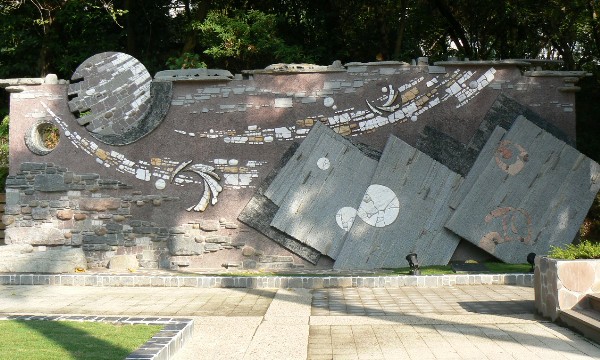
I mention all this because I've just sent off the revision of the talk I gave at Academia Sinica. (The photos are of art from their campus.) Remember? I went to Taiwan in November for what turned out to be a surreal experience of non-inclusion, every other paper delivered in Mandarin and my various attempts to secure summaries or translations even of the titles falling on deaf sinocentric ears. This essay of mine (whose English title is "Theodicy, disenchantment, and Confucianism's place in the theory of religion," for what it's worth) may see print relatively quickly, but it will do me no good. Translated into Chinese it will join the others in perpetual inaccessibility!

I feel a bit strange about the whole thing, like I'm just going through the motions. I don't think it's a bad essay, but I confess I didn't work as hard on it as I might have. If they showed so little interest in engaging me while I was in Taipei, what reason is there to think anyone will actually read the darn thing?! On the other hand, thanks to it I might get invited to some conference in China in 2017 and finally find out what that symposium in 2006 was about!

I need hardly mention the near-miss overlap of my putting the finishing touches on an essay about Chinese religion with an arm aching from last-minute vaccinations for India!

Monday, January 29, 2007

Family daze

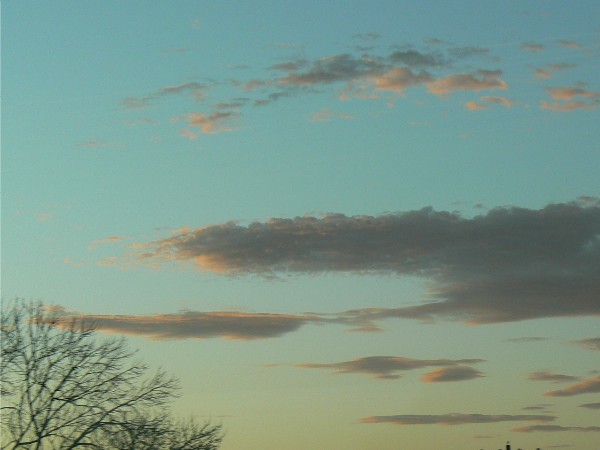
Not much to report but here's a sunset from Shepparton. I suppose I might have mentioned that Friday was Australia Day, but it's the national holiday nobody pays much attention to so I didn't see any reason why I should.

I'm getting pre-stressed about India - departure in 3 days! - but I think I'm over the initial panic attacks (thank you everyone whose first reaction was "you're going to get sick" - what is it about India?!), and now I'm just tangled up in logistical worries. I've never been on a tour before, let alone an "intrepid" one. (Here's the itinerary, if anyone's curious.) What does one do about laundry? Is one guide book enough? Should one bring sandals? Will one be able to charge one's camera? How does one prepare for life-changing experiences? And most unsettling: how can one live three weeks without one's laptop?

Saturday, January 27, 2007

McNaught

Back in Shepparton with my sister and her family for a few days. Today we took a day trip to Ruffy, a tiny town in the mountains south of here whose general store serves a mean lunch. It was charmingly countrified - except that all the yummy local products we enjoyed were available in well-designed jars and bottles, neatly arranged for sale just like the gourmet shops in Melbourne which are their main customers. My sister finds that Australians don't "do" rustic.

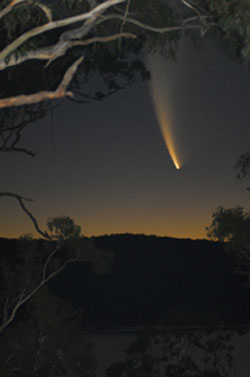
The comet McNaught is lighting up the sky right now, the brightest comet seen in Australia in 40 years. (The picture is not mine, but could be.) It is definitely the longest tail I've ever seen. While I've no recollection of Hale-Bopp (which may or may not have taken along some folks from our California neighbor Rancho Santa Fe - remember Heaven's Gate?), I do recall being amazed at Halley's Comet (which we saw from the vineyards above Vienna). My sister remembers the same occasion without the amazement, so my memory may be embroidering. Or perhaps I was already embroidering the paisley-shape I'm remembering at the time!

Thursday, January 25, 2007

No place like home

Ah, home sweet home! Melbourne of a mild summer day is delightful, and three days of significant rain while I was away have brought green back where I had thought never to see it again.
Or maybe I'm just relishing the great pleasure of doing laundry after returning from a trip! Why is that so satisfying?