Thursday, April 20, 2017

Phafocity

One of the graduate students who led a discussion section for last semester's New School history course was part of a team of philosophy students who met with children recently at the Brookly Public Library. A writer for The New Yorker listened in:

Lemelin attempted to move the discussion forward conceptually. “Do you think I’m the same as I was when I was your age?” he asked. 
“You didn’t do phafosity—whatever it’s called—when you were younger,” a boy said. 
“When you were younger, you didn’t like mushrooms, and now you do,” someone offered. 
“Does liking mushrooms make me who I am?” Lemelin asked. “What makes me me?” 
“Look it up,” one boy replied.

You can find the article here. (Reminds me of that time when....)

Wednesday, April 19, 2017

Roundtable redux!

Postponed because of snow with a slight change of personnel, still an inspiring first airing of LREL's new exploration of the synergies between religious studies and journalism. Biery is a current student, who did sterling work in the course "Literary Journalism and Religion," taught by Korb, who directs our First Year Writing program, along with being a prolific author of books and articles, many on religion. Percy won the 2017 National Magazine Award for Feature Writing for her deeply affecting New York Times Magazine article on survivors of the 2011 tsunami in Japan.

Seed plot

One doesn't often find a record of how a seminar - a real seminar, not a lecture passive-aggressively elicited through socratic questioning - works, but I've happened on one. Abraham Luchins, a fellow professor, attended the seminars of Max Wertheimer, pioneering Gestalt psychologist and leader among the first refugee scholars of the University in Exile, from 1936 until Wertheimer's death in 1943, and reconstructed them from his verbatim notes decades later. I have to take his word for the accuracy of his notes, but what impresses and inspires was that he wrote down everything, from student interjections to what happened in discussions after class officially ended. And he recorded what wasn't said, too. Perhaps it takes a psychologist to notice the classroom dynamics in this way. Here's how he reconstructed the start of Wertheimer's seminar on problem solving and thinking.
Wertheimer soon gets them going - all the participant contributions are transcribed, too - but loses a number again when he pivots from the theoretical discussion about theory and experiment to two puzzles. Here's the first one. (Don't read on until you've tried to solve it.)
Did you figure it out? I confess I didn't, though I imagined her pushing the surface with her already kneaded dough around the tent pole with her hips. Awkward! Nobody in 1936 hazarded a response, either:
Ha! Well, I'm following his urging by passing it on to you. What say you?
But other students were more amenable, wondering, for instance, how children vs. adults would fare in such a predicament, or how results might vary if the story involved a different material than flour. Now we're talking! "These students, incidentally," Luchins observes tartly, "had not been undergraduate major in psychology." (Perhaps flour was important; Luchins frames his own account of what went on with the etymology of seminar as "seed plot." But the Mullah?)

Abraham S. Luchins and Edith H. Luchins, Wertheimer's Seminars Revisited:
Problem Solving and Thinking, vol. 1 (Albany, NY: Faculty Student Association,
State University of New York at Albany, Inc., 1970), 1, 9, 18, 19, iii

Monday, April 17, 2017

New colors (again)

Sunday, April 16, 2017

Happy Easter!

Friday, April 14, 2017

Judas tree

Thursday, April 13, 2017

Coming conference

Starting a week from today!

Repent

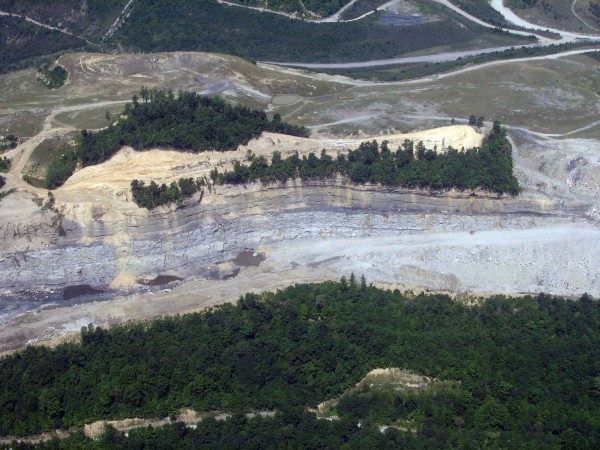
The Sacred Mountains class found itself in this strange place today. It was a bit of a gamble but I think it paid off. The picture is of an old forest cemetery (the hillock at upper left) which is now perched on an island in an Appalachian landscape transformed by mountaintop removal (MTR) mining. (We started by watching this conflicted depiction of the monstrosity of MTR, and then this footage of a "Blesssing of the Mountain," one asserting the value of seeing things from above, the other demonstrating the power of being there on the ground.)
Our reading was from Andrew R. H. Thompson's Sacred Mountains: A Christian Ethical Approach to Mountaintop Removal (University Press of Kentucky, 2015) - our only text explicitly Christian or concerned with ethics - and it's not easy going for people unfamiliar with that field. Predictably and understandably my students were put off by Thompson's assumption that his readers were fellow members of "the church." Most also couldn't fathom his argument for a "theocentric ethics" (based in the ideas of H. Richard Niebuhr), and for how it could prevent the "absolutization" of relative values which bedevils discussions of problems such as MTR. They assumed "theocentric" must mean claiming God for one's own position, rather than the decentering humility of accepting and trusting a God of all whose values one did not claim to understand. It being Holy Week I quite enjoyed laying out the idea that human "imaginations" even of values like justice and inclusion inevitably have blind spots, the pursuit of one's value inevitably bringing "disvalue" to some other; the only alternative is to own one's fallibility (I didn't use the s-word), to repent the disvalues one wittingly and unwittingly does and countenances, ideally in the presence of all affected: church as the matrix for a different kind of sociality. (I didn't get into christology.)
But what about MTR? Thompson gives few concrete suggestions (or rather, he thinks action should arise out of actual engagement in a locality, not reading about it) but it was fun to think with him what "mountain reclamation for God" might look like. We've often argued that mountains should be left alone, or returned to a presumed pristineness, then bellyached over the what and the how, the who and the why. Thompson's argument allows one to think beyond the artificial islands of "sacred mountains," just as it offers a transcendent reframing of relative values. For a moment it seemed like the consequence of setting aside a few special places for preservation, conservation - as sacred heritage - was not qualitatively different from leveling most of the mountains around Kayford, West Virginia but keeping Stover's Cemetery.

Wednesday, April 12, 2017

Destructive destruction


Tom Toles, always spot-on. It's terrifying to see the chaos candidate turn his fervid attention to foreign relations, and discover - after weeks of frustration in domestic questions - that there are foreign policy buttons he can press with impunity. Pray for Korea. Pray for us all.

Tuesday, April 11, 2017

Time warp

Five of our alums, from the classes of 2003 through 2013, shared what they've been up to since leaving Lang at our program's annual "Calling, Career, Commitment" event tonight. Over their accumulated thirty-five years as graduates they've done an astonishing number of things, deftly weaving together internships, further study, part- and full-time jobs, and small and large reinventions over periods of hardship, joblessness and triumph. Hard to think I could have mustered such agility!!

Monday, April 10, 2017

Poesie

I'd nearly forgotten the pleasures of German... I don't read German much, and it tends to be academic - what my teacher and friend V used to deride as "teutonic prose." But here's some limpidly lovely German, part of a poem written by playwright Carl Zuckmayer in 1939. (The full poem, for reading and hearing!) He taught at The New School 1939-42, one of the many granted refuge by the University in Exile. Mostly he taught at Erwin Piscator's Dramatic Workshop, but he also offered one course on "Humor in the Drama," also in 1939. What amazing legacies we have...
Benita Luckmann, "New School - Varianten der Rückkehr aus Exil und Emigration,"
Exil, Wissenschaft, Identität: Die Emigration deutscher Sozialwissenschaftler 1933-1945, ed. Ilja Srubar (Suhrkamp, 1988), 353

Sunday, April 09, 2017

Duck

Our president is sending shock waves around the world as well as domestically. Here's some help from Down Under, from the wonderful sweetly mordant David Leunig (thanks to my sister for sending).

Saturday, April 08, 2017

My turn

For the upcoming ISSRNC conference on "Mountains and Sacred Landscapes," hosted by our India China Institute, I will be part of a plenary panel sharing the findings of our Sacred Himalaya Initiative. Ten minutes isn't very long (for a speaker!) but I'm preparing a longer written version, too. It's called "First there is a mountain: Kailash beyond the world religions." What is it/am I going to say? Structured around a Zennish aphorism-turned popular song you've heard about before, it falls into the category of my writings which might be called "unsolicited advice."

First there is a mountain
I'll start by rehearsing the contemporary myth about a mountain in the Western Himalaya that has not only been an object of reverence and pilgrimage since time immemorial but is sacred to four great religions: it's regarded as the center of the universe by two billion people! This is a mind-boggling thing - you can imagine millions of tour operators salivating - but it is a myth. That mountain has only relatively recently been the object of these attentions. Even before you complicate the modern constructs of "world religions" it is hardly all "Hindus" and "Buddhists" that revere it - just Saivites and a small subset of Tibetan Buddhists, respectively. And when they come together they ignore each other. If it's "common ground," this is hardly seen as important, at best a sign but in no way a constituent of its sacredness. Such religious stories as are told about it aren't about comity either, but about conflict and usurpation: Ravana almost getting away with stealing it, Milarepa evicting the Bön magician Naro Bonchung from it.

Then there is no mountain
Whence, then, this myth? Alex McKay has laid out the components, spanning Hindu, Buddhist, Bön and more modern colonial sources. He argues against understanding the cult of Kailas (which is older and involves several more places than this in the Western Himalaya) in terms of "world religions," starting with the "sanskritization" of those practices too quickly subsumed under "Hinduism." There are stories in ancient texts about a snowy abode of Shiva above two lakes, a source of four rivers. But the people to who actually made their way to this and other Himalayan peaks were "renunciates" outside all formalized "religion." Kailas is mapped onto religions only in modern times, as a British colonial official plans a pilgrimage route to generate revenue in his remote district of the Indian Himalaya. The idea of Kailas as a shared cosmic center comes even later. But the idea of such a place is immediately intelligible. Why? "World religions" discourse constructs religions as isomorphic enterprises. Everyone has heard of the multiple paths to a single summit. And of course colonialism shaped ideas of a "mythical East" attractive in colonial metropoles and peripheries alike. In this context, a western Himalayan hillock's coronation as the most sacred spot on earth seems overdetermined. Wasn't Eden - another source of four rivers - in the Himalaya anyway? (The one who seems to have brought all these together around our peak was the German-born Lama Anagarika Govinda.)

Then there is
The consequence of this might be no more than that some of the travelers to Kailas, gliding in on new Chinese roads, bring with them the baggage not of particular traditions but of a cosmopolitan pluralism. It might not even be a bad thing: isn't it better that religions be thought to be in harmony in this way? Western travelers could stand to learn from the different way in which religious plurality is managed in most Asian settings. And yet (this is where the unsolicited advice comes in) world religion discourse, even in it pluralist form, is not benign, implicitly supporting centralizing and often fundamentalist elites even as it glosses over meaningful differences in cosmology and practice... (I won't go into the ways in which it aligns with the policies regarding religion of the Chinese Communist Party.) Visitors will in any case be coming in ever greater numbers, irrevocably transforming a place once defined by its remoteness. Are there other lessons today's Kailas might teach in the place of the world religion mythology many travelers will bring with them? And not just about historical contingency - which I appreciate only academics take pleasure in.

• What if one made clear that for most South Asians Kailas is part - perhaps not even the most important part - of a complex with Lake Manasarovar, and perhaps with other sites too, like Tirthapuri. This might lessen the charisma of the supposed axis mundi and draw more attention to concrete histories and landscapes, including, crucially, the rivers and lakes intimately connected to mountains.

• What if one laid out its relations and resonances with other mountains, too - other abodes of Shiva, the place of Gangrimpoche in larger Tibetan sacred geographies, regional as well as ritually constructed Kailases? Sacred mountains work in many more, and more edifying ways, than just as single breaks in a horizontal world.

• What if one took the encounter with Kailas as an opportunity to introduce visitors to the dynamic understanding of coupled opposites in Tantra, a pan-religious tradition embracing many of the "Hindu" and "Buddhist" experiences in the region? This could be the start of an understanding of Kailas as not only related to other sacred sites, but as a node in a cosmology of fecund contradiction. Mountains may be conceived as the quintessentially stable features of our world, but mountains in this part of the world change shape, fly...

Each of these would suggest different itineraries for visitors, different places to be shown or told about. A final lesson might be attached to the experience of circumambulation most visitors engage in. (Not all, and even some of these have their peak experience in some contact with the mountain itself...) Going around the mountain, ideally multiple times, could be explained as a ubiquitous practice in South Asian and Himalayan traditions, but it needs to be engaged in actually to mean much. Going even once the circumambulator is impressed by those who move at different speeds (the full body prostrators especially), and by those going in the opposite direction. Going more than once s/he will move beyond experiencing the trip as a discovery, a journey into the unknown, and feel a part of the many who circumambulate here (and elsewhere); they may even realize that the mountain spins.

It's for the individual to decide if the mountain spins or is spun by us.

Friday, April 07, 2017

Meanwhile in the Mojave


California is officially out of drought!

Here's one sign - my mother's photo of a carpet of bloom in the Mojave Desert, which my parents crossed on their way back from skiing in the Sierras... as a new storm promised to add another few feet to the already record-setting snowpack.

Thursday, April 06, 2017

Love work

Had the great pleasure of introducing a room full of students to the life and thought of Sally Ruddick today. Feminist philosopher Ruddick was a major presence at The New School just before I arrived, most appropriate to the class, which is called "Women's Legacy at The New School." I framed our discussion by reading through this course description (from 1977), which allowed me to reflect on her work as a teacher (on the work of teachers), and on the amazing things she did in class. In a way, "Philosophical Aspects of Biography" was a sort of precursor to today's class. Both pleasingly and a little disconcertingly, Ruddick's reflections on the difficulty women have taking their work seriously ("the ability to work" in the course description) seemed to the students still entirely relevant. What a privilege to sharie the reimagining of work emerging from her rejection of the gendered work/love distinction:

In college I learned to avoid work done out of love. My intellectual life became increasingly critical, detached, and dispensable. If I self-deceptively denied my desires for the conventional loves of a man and children, I refused even to recognize the loves that work demands in its own name: love for oneself, love for the ideas and creation of others, love for the people one works with, love for the knowledge, change, and beauty that work alone can achieve.
"A work of one's own," in Working it out: 23 women writers, artists, scientists, and
scholars talk about their lives and work, ed. Sara Ruddick & Pamela Daniels (1978), 136

So much love! And this even before we got to Ruddick's most lasting legacy, "maternal thinking." Work shouldn't be loveless, as thinking shouldn't be careless. Failure to appreciate this (too common still) undermines the quality of love, care, work and thinking!

Wednesday, April 05, 2017

Spring straggles in

Tuesday, April 04, 2017

Feel the love

In class today, the four students who were able to come to Overlook Mountain on Saturday reported on their experience. It was somewhat different from mine! Where I experienced the forest's gentle molting as a crystal miracle, they described feeling "challenged" by the mountain. "As the ice was melting it came pelting down," said one poetically. Another was hit in the head by a piece of ice. "It felt personal," the first added. Not that they weren't glad to have gone! It was still "another world,"
a taste of "sacrality." Yet what moved them turns out not to have been the mountain but the monastery and the winsome monk who showed us around and led an introduction to meditation. They were charmed (as was I) by his challenging us to stop breathing, an uncomfortable blockage; feeling that pain we could appreciate that our usual regular breathing loves us - defined as saving another from pain. Love!
It fell to me to remind them the lesson extended to the mountain. The monk spoke of the mountain as the source of water (one has a view of one of the city's feeder reservoirs) and air (the trees purify it) for New York, and of the work of prayer flags which, moved by the wind, scatter words of healing not only toward the monastery but toward the animals of the forest. Love is all around, an example for us to follow. It's natural - and as powerful - as the breathing of humans and mountains.

Monday, April 03, 2017

五岳真形图

Tomorrow's session of the Sacred Mountains class starts a brief look at Chinese sacred mountains. Here's a 16th century Daoist talisman of the五岳(五嶽) wuyue showing the "true form" of the Five Sacred Peaks. I've been to one - the Northern Peak 恒山 Hengshan, at the lower left.

Sunday, April 02, 2017

Course awareness

Our college is putting together some flyers to introduce the faculty and have asked us for "a fun picture." I'm using this one. A few years old, but definitely fun. I like how it shows me as both inside(r) and outside(r).

Saturday, April 01, 2017

Crystal rain

I had a magical experience today. Talking to the director of the India China Institute about the Sacred Mountains course a few weeks ago, I'd said we were doing pretty well considering there were no mountains to hand. What about that mountain above Woodstock, he asked? It even has a Buddhist monastery on it! That's where we were today, though only four of my students made it (another dozen India China Center-related people happily joined). Driving up the steep hillside to the monastery - the bus driver wondered aloud if it was a road that had been build from the bottom or the top, a profound question - the cute hippie village gave way to woods, then snow, then a range of tree-covered mountains half-shrouded in mist. It's not a big mountain but our ears popped! As we arrived at the monastery (the center of the Kagyu school of Tibetan Buddhism in America) it started to sprinkle snow. As we alit from the bus, we noticed that we were exactly at the frost line. The tops of the trees growing around us, and all those up the mountainsides around us, were a gauzy white with hoarfrost.

We went into the monastery for a few hours of lunch, a tour and a talk on meditation, and when we emerged the frost line had risen a lot. We walked toward the summit for a bit (it was too far to go all the way) and I was depressed to observe that the hoarfrost had all melted. But then, as we ascended, strange things began to happen. In the bootprints in the sludgy snow of the path I started to notice tiny glassy ice cylinders - recently fallen from twigs and branches overhead. It sounded like a light rain was dripping on the snow around us. As we went further, it seemed a light big-dropped rain was falling, but it was all ice from the trees. Before we had to turn back we arrived at the magical place. When you stopped to listen, the woods sounded like we were in a rainstorm, even as the light around us showed a brightening afternoon of clearing clouds. A few high branches still glistened like crystal overhead but we'd caught up with the frost line charging up the mountain. I remembered a scene in "The Matrix" where reality crumbles into a rush of digits, but the woods were still there. It felt like something one might be blessed to witness once in a lifetime, but I suppose it happens daily.