Wednesday, May 19, 2021

人类世人文学

As we ease into summer, I'm pivoting from Religion & Anthropocene to something a little different, at least on the surface: Anthropocene & Humanities. "Anthropocene Humanities" is the name of the course I'll be offering for the Renmin summer school starting end of next month, and also of a First Year Seminar I'll be teaching in the fall. The readings for the former are already set, but the latter will benefit from that attempt, as well as new discoveries (like the books above). I'm excited to be able to bring to beginning students at Lang questions from students in China. 

"Anthropocene Humanities" has a nice ring to it, the clash of Greek and Latin etymologies adding to a sense of potent multiplicity. But what might it mean? Here's the (Lang) course description:

Anthropocene names the new reality – and awareness – that humanity has become a planetary agent, perhaps the single most important factor in the current history of life on earth. The term was coined by natural scientists but has been increasingly taken up by thinkers in the human sciences. This course surveys debates about the meaning and significance of humanity’s new status within the earth system from historical, philosophical, literary and comparative, as well as feminist, postcolonial and postsecular perspectives. We'll employ the tools of the humanities to make sense of the Anthropocene, and use the challenge of the Anthropocene to reimagine the work of a planetary humanities.

The word "postsecular" might give me away. The Renmin reading list, compressed for a summer course as well as non-native readers, lifted the readings not explicitly engaged with religion from my "Religion and the Anthropocene" syllabus. But that doesn't mean the approach will be secular, at least not in an unreflective sense. I'm persuaded by those who think the "secular" human sciences are both beholden to and blind to religious legacies, as well as by those who question if all of the modern western disciplines aren't in fact implicated in the Anthropocene disconnection from the rest of nature. The Anthropocene adds an urgency to such interrogation.

The Renmin course will be a sort of report on these western discussions, inviting comparative responses from students. (Chinese traditions have long been figured as "humanistic" too. Who knows what resonances the Chinese version of the project - 人类世人文学 - offers!) The resulting discussions will, I hope, help make the Lang course not just organically postsecular but more fully "planetary." 

Stay tuned!

Tuesday, May 18, 2021

Return

A week's get-away wrapped up with a picnic with a dear friend under the blooming chestnuts of Philadelphia's Rittenhouse Square. We met the same friend in another Philadephia park on our way back last Fall, masked and distanced. What joy today to see each other's faces and, best of all, to hug!

Monday, May 17, 2021


Some of the delicate denizens of Clifton Gorge...

Sunday, May 16, 2021

Green light Ohio

We've been out of town: marked the achievement of vaccine immunity by visiting our friends in Columbus, Ohio again. Blue blue skies made the bright spring leaves especially luminous - as we drove across Pennsylvania it sometimes felt like the photographic negatives of the fall purples, reds and oranges we saw on our last trip over, in October. For this second visit we got a deeper view of Ohio history,  both geological and human. The inter- and post-glacially cut Clifton Gorge (below) was a dramatic contrast to the flatness of the landscape. But most exciting, for me, were the mutely monumental Newark Earthworks, the largest surviving complex of the Hopewell culture, recently in the news, as the Moundbuilders Country Club complicates nomination of the site as UNESCO World Heritage.

Saturday, May 15, 2021

Unmasked bandit

The latest news from the CDC - that vaccinated people don't need to wear masks outdoors or even indoors, whether interacting with other vaccinated people or with unvaccinated people - is confounding. The masks which we were expecting to continue to wear for the benefit of others aren't needed after all; the unvaccinated can still get infected and infect each other, but we vaccinated people aren't likely to be vectors for it. Still, it's confusing. I don't like masking, but I understand it as a visible commitment to the common good. I don't like looking like I put my own convenience over the health of others, don't want to seem to be encouraging such behavior, don't want to produce incentives for people to put themselves at risk so as not to stand out.


And this is happening as pretty much every other part of the world is suffering from new waves of infection, going back into lockdowns, testing the limits of hospital systems, etc. Going "back to normal" seems obtuse in this context, even callous, but then our normal has never extended that far beyond our privileged selves (even in our own country). Part of the normal I bristle at being urged to return to is that it is one in which I unthinkingly feel invulnerable to the hazards haunting human life in most times and places, and just as unthinkingly accept that others remain subject to them. But I can feel the habit of that invulnerability returning, the caution attending every imagined encounter pre-vaccination a fuzzy memory, almost an embarrassment. 

Does that mean I'll keep wearing a mask? In many cases it's still required - public transportation, at the discretion of shop owners, etc - so I'll still have one along at all times. But encountering others when walking outside I may still mask up as a sign of respect and concern... anf humility.

Friday, May 14, 2021

Commence!

I'm a sucker for pomp and circumstance, I admit it... but that doesn't mean I watched our university commencement live: it's available for posterity here. There were many heartening and inspiring words, and many acnowledgments of the many-layered challenges of the last year. I particularly loved the Parsons student speaker, whose talk begins at 1:06:48 and beautifully captures what The New School does as a learning community, likening the student experience to the deep dives of the narwals, the "unicorn of the sea" which is our mascot. New School narwals dive deeper than any other marine mammal, we learn, and when they resurface, in many and distant places, have learned "to embrace the unexplored ocean rather than to swim away to the safe shore." But the sweetest moment may have come during the conferral of honorary degrees, which went to the President of Ford Foundation, theater director Ping Chong, and - en Español - two people from Colombia, José Alberto and Luz Mery Gutierrez, a sanitation worker who started retrieving discarded books and, with his wife, set up what became a network of community libraries; the first book was a copy of Anna Karenina. In the midst of the rubble of recent years, their story is particularly poignant and hopeful. 


Thursday, May 13, 2021

Graduated!

I know I'm a bit of a pollyanna, and among the things we're all weary of is hearing about the unexpected up-side of zoom... But we just had our recognition ceremony for our graduates (two years' worth, in fact, since last year's got just a prerecorded "memento"), and, while more students might have shown up, those who came were fittingly fêted.  We had a complicated "run of show," with three student and one faculty speakers, a student musical interlude, and the reading of all graduates' names by their department chairs, with intricate zoom choreography of cameras off and on and off again so that everyone might be seen as their name was read, but it worked well enough. It  
was a collective effort and felt like one! And it brought our community together in a way we haven't been for fifteen months. And... it also allowed of something traditional graduations (not to mention socially distanced ones) don't: you could see people close to each other, even as they were in reality hundreds of miles apart... and best of all, you often got to see graduates' friends and family with them, most movingly when one of the student speakers mentioned her "mother and abuela" - and there they were behind her, serious, proud. We've got your back, too!

Wednesday, May 12, 2021

Homesteading in the big lie

If it wasn't obvious before, it is now: the Trumpian cancer on American democracy's has not abated but is metastasizing. I've been watching with dread as small men (it's men, mostly, though they have their publicity-loving gals too) make nests for themselves in the big lie. More than frightened and saddened, though I'm those things too, I'm just confused. What do these people believe, what do they think they're doing? They know it's a lie, don't they? They know that their man tried every sleazy trick in the books and still lost the election, surely? They know that it's a lie and that he's a liar, with a demonstrated contempt for truth and democracy, don't they, a prophet of desparate American carnage loyal to nothing but his own vainglory?

I was going to add that they know that the assault on the Capitol in January 6th, answering a losing candidate's siren song to overturn an election, was a near-death experience for American democracy... but they don't know that. Many evidently believe what the insurgents believed: they feel called to bludgeon into submission a system that doesn't produce the outcomes to which they feel entitled. The battery of "election integrity" laws from state Republicans, competing to outdo each other in cant and cruelty, are like elaborate bandages over feigned wounds; each is also a shot in the arm of the insurgents' distrust of the structures of American democracy. 70% of Republicans think the election was rigged, though nobody can say just how. How can one reason with such unreason?

It's hard now to imagine that January 6th wasn't just a dress rehearsal for what's to come, what is indeed already happening, a hamstringing of American democracy by people convinced that it has become their enemy who somehow don't realize that they have have become the enemy of the civic trust they claim to revere. But I don't actually know what they are thinking, hence my confusion. I don't know what game they think they're playing, though Masha Gessen and Timothy Snyder have shared the playbook of their nihilistic masterminds. Imagine finding a home in a big lie, whether embraced or tolerated, reluctantly or enthusiastically, whether as truth or fiction... Imagine imagining there's no life or future for you in truth, only in lies.

Tuesday, May 11, 2021

Gaudeamus igitur

Another academic year is officially over. The institution came through this stronger than we dared hope - like faculty around the world we pulled out all the zoom stops, and learning happened, though frazzled exhaustion did too - but I worry for graduating seniors. Even in an ordinary year many of our students don't feel they've made it through a right of passage, newly skilled and focused and empowered, but what about this diffused and two-dimensional year? The designers of the Class of 2021 mug doubtless didn't have this in mind, but its loose and sketchy and unfinished look seems all too apt.

Monday, May 10, 2021

Durables

The New School has a new provost, sociologist Renée T. White - only our second one to be selected through a national search. It's an exciting moment, and not only because the rethinking of the structure and nature of the university which the past year's crises seemed to demand has been postponed until her arrival. Strategic planning, especially around the special meaning of the "liberal arts" at our design and social research university, awaits, and her experience and commitments will help shape it. (She has served mostly at small colleges committed to women, doing important reseearch at the intersection of race, gender, inequality and public health). After a time of anxious uncertainty it's a moment of great promise!

Coincidentally I've been revisiting the moment when New School last brought in an outside provost eighteen years ago, the anthropologist and globalization theorist Arjun Appadurai. His appointment was big news, but his tenure was unfortunately brief: this was during Bob Kerrey's embattled tenure as president, as he cycled madly through five provosts and a dozen deans before being hit by a faculty "no confidence" vote when he claimed he could be provost and president at the same time! But the need for academic leadership which Appadurai demonstrated was established, and what had been a bare bones Provost's Office has continued to grow since his time here.

Less successful was Appadurai's effort at getting New School to globalize its curriculum, especially in engaging Asia, which seems to have met more resistance than just a mercurial president. Pretty much the only vestige of the revolution that wasn't is the India China Institute, whose account of its history records an ambition no less compelling today, if harder to imagine realizing: 

[W]e are bringing together key people to rethink vital questions like: What are the truly important issues? How is the world changing? If we can get thinkers in India, China and the United States not only to agree about the biggest questions, but also to decide the shape and scope of them, then the answers will have a certain range of durability that answers in the past have not had. That’s a big ambition. But The New School has always been about big ambitions.

"Durability" is an interesting criterion, especially for the ever-New School! I wish it for Provost White, and, with her guidance, for a distinctive New School vision of liberal arts, global and just.

Sunday, May 09, 2021

Change of aspect

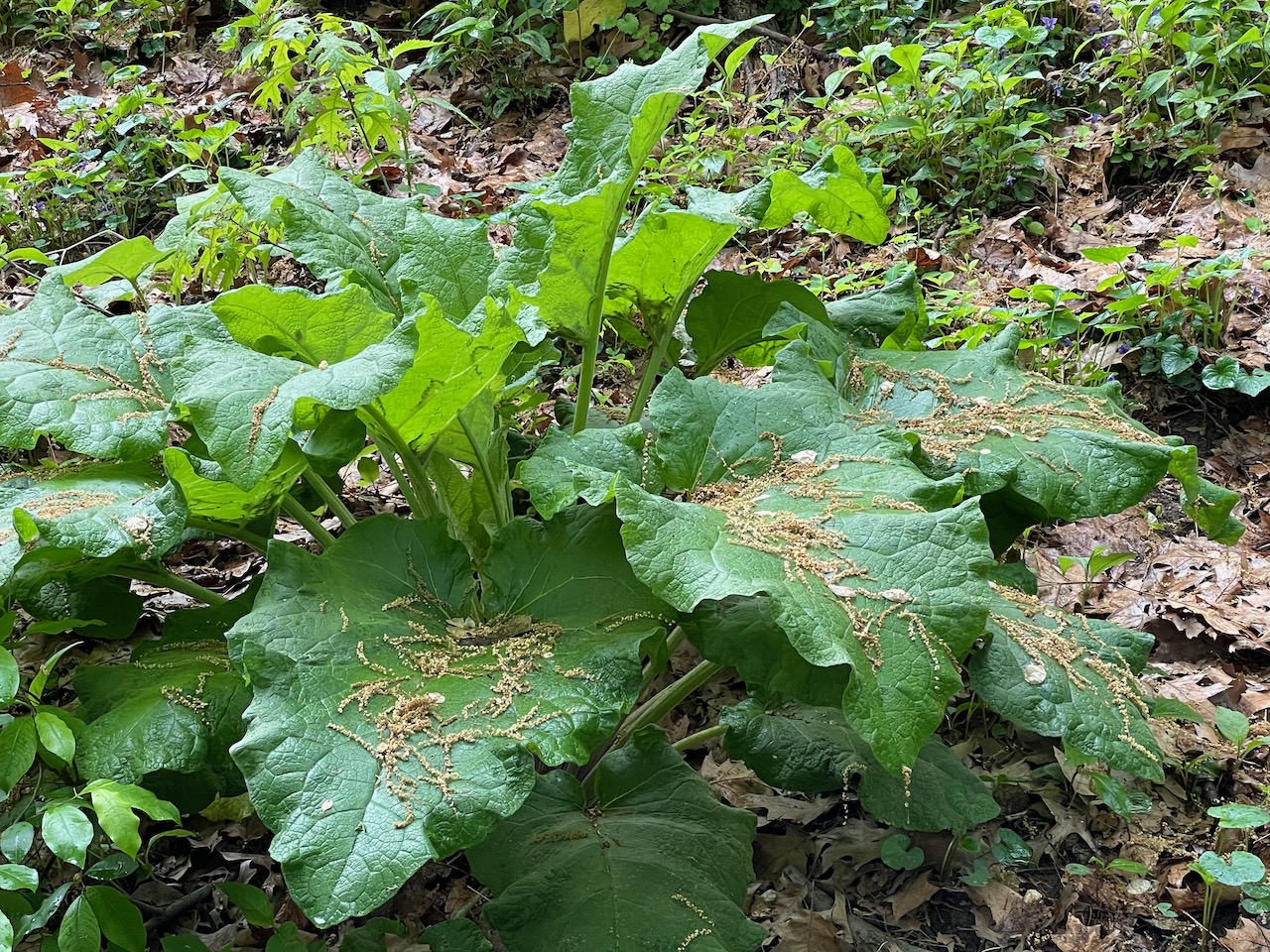
This is a time of busy work in the woods. While new plants push up through last year's amassed leaves from below, trees launch seeds in their millions from the heights. The two meet here, where what seems the fastest growing ground plant spreads out thick leathery 

leaves big enough to catch rosaries of seeds loosed by the trees overhead. But as I was gazing at these yesterday the messiness of it suddenly gave way to another view. I felt I was in the presence of a jewelry seller, with precious wares arrayed for all to admire.

Saturday, May 08, 2021

Friday, May 07, 2021

Rise and subsiding

Our view is changing daily, as the condominium tower being built at Union Theological Seminary rises. The scene is giving me a little déjà vu, as a big building grew into the eastward view of my Brooklyn perch too, but while that effaced the Empire State Building (inspiring me to eloquent ambivalence!), this will merely cover the boxy Interfaith Center. Still, my monkey mind swirls around it, agitated.

Thursday, May 06, 2021

If these walls could talk

After today's final faculty meeting of the academic year, we bid farewell to five beloved faculty members who were moving on. As part of pandemic-forced belt-tightening last year, the university had offered long-serving senior faculty the option of retiring early with some benefits and emeritus status, and five at our college were among those who opted for this. (Many others, myself included, were made the offer and didn't.) The five, all women, have contributed so much the place really is unthinkable without them. Two began as part-time faculty. One came to the New School three times - first as a teenager to the Freshman Year Program, then back to teach after graduate school for a few years, and then for a final burst a little after I arrived. Between them they helped craft some of our most valued departments and programs - cultural studies, arts in context, literature, history, civic liberal arts. One moved from theater to arts in context to writing. Several have worked also in other divisions, two of them have been key to the establishment of the Faculty Senate, and all served in innumerable positions in the ever shifting but never shrinking world of committees where faculty get to know each other. All will be sorely missed.

A zoom farewell is far from ideal, not least because it's not the same when everyone is toasting with a different beverage, but it was lovely nonetheless. You felt people really looking at each other, channeling fondness and care! As resident historian I'd been tasked with supplying the dean with early photos of our departing colleagues, and the chairs of their current departments said a few words, before others chimed in. Stirring tributes and charming memories were shared, but the real activity was in the chat, where the tools we've developed over the year for that kind of discussion participation were put to ideal use. Tributes, thanks, affirmations of others' tributes, gushing forth like a stream. (And the transcript is of course available, along with the zom recording!)

I did my bit in the chat, having fond memories of working with all five though leery of appearing to claim a special relationship in a collective setting, but for one I felt I should actually speak, a professor of literature and environmental humanities who has occupied the office next to mine for a long time. Others with offices nearby had spoken about how "the 4th floor won't be the same without you!" but I had a special in, since Elaine and I share a very thin wall. I thought this was the time to come clean that I had beeen able to hear years' worth of meetings she had with student advisees, and sometimes listened in. (She must be able to hear as much from my end, but although we spoke often about all sorts of things, in her office and mine, in the doorways and in the hallway outside, we've tactfully never mentioned this.) I told of how moved and instructed I have been by the way she tailors her advice to each student, challenges them to take themselves seriously, changes their lives!

This unwittingly provided a motif for the dean, who wound things up referring to how we would never forget these departing colleagues. "You're in the walls of Lang!" Elaine, Elaine, Colette, Sumita, Stefania - thanks for everything.

Aftr Rlgn

And here's what we wound up doing! Notice how many of the class materials are hyperlinked in blue - this was the least text-focused course I've ever taught! (I'm happy to send the links; ask me if you're interested.) 

The first half of the semester unfolded largely as planned, but much changed in the latter half. I'm not sure if you can get a sense of the flow from week to week, but it had an organic feel to it. 

When lecturing in zoom the instructor can't see her students, as the screen is filled with slides. Feeling disconnected from students I decided to prerecord the lectures for weeks 4-12 so I could meet them in conversation during our our scheduled time; I called it "open office hours" and sent each student an invitation. Many (if not most) students availed themselves of this opportunity, and the conversations were sustaining for all involved, including me! Prerecording the lectures was alarmingly easy - I had to laugh at my own jokes - but these conversations kept me connected to the class as a whole.


The course runs again next spring but I'm not ready to assess the whole yet. Materials highlit in our final discussion ranged across the class, from Andrea Jain's critique of "neoliberal spirituality" in the 2nd week to Yuria Celidwen's invitation to indigenous contemplative practices in the 13th but we'll see what the course evaluations say! 

Wednesday, May 05, 2021

Afterreligion

"After Religion" wrapped up today. (I'll share the final syallabus another time.) What had initially been conceived as a showcase of students' final projects was at the last minute replaced by a panel discussion about the fruits of the course. It turns out the larger zoom lecture community isn't one in which students feel safe sharing their often quite personal work, though many have shared their work with me (like the magazine at right). So instead the TAs reflected on course materials and discussions they'd found interesting and useful for their own studies and research - two are sociologists of religion, one an anthropologist, one from Iran, one from China, one Mexican American, all of which made for perspectives different from but complementary to mine - and then we opened up for a general discussion. It went well, effectively reviewing and refreshing our discussions over the course of the semester in a forward-looking mode: not just "what's stayed with you?" but "how will this affect what you do next?"

A few student stalwarts stayed on after our time was up, and one asked my own thoughts about the ULEC (lecture courses for students from liberal arts, design, performing arts) experience. I told her that I enjoy teaching the ULECs because the students, coming from across the university, don't just bring gifts in many genres but are also more international than my liberal arts college seminars. But this past year, where many of the international students were dialing in from their home countries, often in the middle of the night, something more clicked. Knowing it was going abroad made my largely made-in-America material feel parochial. I admitted that, if international students were in my physical classroom I'd think less about the appropriateness of a US-anchored discussion - after all, they'd made their way to study here. But now it was different. A significant part of the argument of the class was challenging the naturalness of the modern notion of "religion," a notion which misrepresents non-western traditions and experiences, and in the practice of colonialism and capitalism, profoundly (mis)shapes them. Important clarifying work, even "decolonial"! Still, many of these students were new to thinking about religion in any form. Did I want to be part of broadcasting the modern notion of religion, even to debunk it? 

This related to another realization I didn't mention, a tension I found myself feeling between the call to contribute to the interrogation of the structural "whiteness" in American institutions and thoughts demanded by this moment, and the somewhat different - if related - issues in internationalizing a syllabus. Next year's version of "After Religion" will be a concrete context for thinking this through, the more grounded if we're able to gather together on campus.

Tuesday, May 04, 2021

Never-ending loop

As the US looks forward to summer relaxation, with more vaccines than people who want to take them (!!), the pandemic can feel over. But as at every stage in covid's march across the globe, there are other parts of the world where the crisis is ongoing and worsening. We hear about India and Brazil, because they are huge and in downward spirals because of Trumpian know-nothing leadership. (One recalls also the brash claims that India had miraculously dodged the bullet.) But the situation is bad in many places, and many are suffering the onset of second, third waves. WHO's global tally of three million two hundred and nine thousand one hundred and nine souls lost is almost certainly an undercount. A New York based writer whose family is in India describes an anguished cognitive dissonance all of us should be suffering:

Although I can look forward to picnics in the park this summer, India’s parks are becoming grave sites. All the justified optimism around me now feels unjust and even irresponsible. For many of us with friends and family around the world, the trauma feels like a never-ending loop: When your immediate situation improves, another loved one enters a crisis.

It would be nice to think that the shared experience of the pandemic would expand our sense of "friends and family around the world" but it seems we have far to go, unprocessed grief, guilt and relief making it hard even to recognize in the terror of Delhi the existential dread New York was facing not much more than a year ago.

Monday, May 03, 2021

Slipping on

Just signed the contract for teaching again in the International Summer School of Renmin University of China this summer, after last year's pandemic-related cancellation. But of course I'm not going to 

Beijing to do it: we're online. (No details yet of the platform but it won't be zoom.) The closest I'll come to Renmin might be these slippers from the university hotel where they put me up in 2019!

Sunday, May 02, 2021

Shape shifting spring

Saturday, May 01, 2021

Pow!