 It's always a thrill to see the Manhattan skyline, even when the air is not so clear...
Thursday, July 15, 2021
Long time no see, New York!


Wednesday, July 14, 2021
More speculative fabulation
Here are three more stories, starting 75 years from now, by students in my Chinese summer school class.
By 2096, I am living on a very different planet -- a planet that is much harder to live on. I have seen the process of rising sea levels, higher temperatures, and more extreme weather events. The areas suitable for human survival have further shrunk, and many island countries have been lost or disappeared altogether. Tropical rain forests were further reduced, glaciers shrank, and as mining and arable land were developed, there was less fertile land, and it became more difficult to extract food/wealth from the soil. Many species that had existed for thousands of years became extinct in the last 75 years. Continued global warming is making catastrophic weather more frequent, sea levels are rising to varying degrees around the world, and New York has built levees to keep out the water. Some coastal cities, such as Houston or Shanghai, have been abandoned due to hazardous weather.I was watching the news at home that something was going to get flooded again, and I couldn't but remember how I had to move away from my hometown by the sea and escape to live on the mainland. Watching my town disappeared in the water wasn’t easy to accept. TV hosts repeatedly stressed that there is no greater threat to the environment, that it is inevitable that cities will be submerged, and that there are precedents in all countries, but it was like the first half of my life had lost its meaning.
Thanks to rapid advances in artificial intelligence and robotics, as well as the promise of biological and nanotechnology, the impact of the climate crisis may be mitigated. Artificial intelligence is increasingly becoming involved in government and corporate public services and control, providing detailed predictions of weather and climate models. Although many have doubts about the use of AI in social affairs, the threat of climate is more immediate so we have to rely on AI's timely warning and social resource allocation to reduce the impact of climate disasters.
The idea of the Anthropocene has become familiar, in order to improve living conditions and survive against a backdrop of gradual environmental degradation. In these 75 years human beings have begun to take measures to slow down the negative impact of human beings and the deterioration of the environment, but this has only slowed down the speed of environmental deterioration. We need to use technology to find a more effective approach. And I hope that I can return to my hometown one day beside the beautiful beach.
Seventy-five years on, the earth's environment has deteriorated and is no longer suitable for human life. Some of the selected humans escaped from Earth in a spacecraft and multiplied on the spacecraft. There are only machines and humans on the spaceship, and humans rely on technology to get material from the universe to survive. Jack saw the image of the earth in the past when looking for information, and had a great yearning for the forest and other natural landscapes. He secretly took a small spaceship to leave the space base and return to the Earth, and searched for the green according to the content of the image. After painstaking efforts to find the target, he finds it is just a projection, an image of green plants. Still Jack decides not to return to the ship, but to stay with the projection and die on Earth.
Today is July 14th, 2096. As a surveillance camera, I stayed quietly on the street and recorded 75 years of life and witnessed 75 years of changes. About 70 years ago, I recognized the word “Anthropocene” from the way humans shaped their mouths, which seems like a very bad time. As the years went by, the streets became less crowded and the corners I could record became more and more dilapidated. By the time I reached my durable years, no one remembered to replace me. I had a vague question: Why did this street go from prosperity to ruin? Why are there fewer and fewer trees in the streets and the whole world changing from green to yellow? Why are there fewer and fewer people? Until, by chance, I connected it all to the word “Anthropocene”. Maybe the Anthropocene is the end of the world, like security cameras that will have reached the end of their lifespan and will have to be disposed of. The beginning of the Anthropocene also means the end of humanity. The emergence of the concept of the Anthropocene was a wake-up call for human beings, but they did not seize the opportunity to change, so their era ended.
If any of the stories individual students have submitted as final projects inspire me the way these do, I'll share them too!
Tuesday, July 13, 2021
Speculative fabulation


Group 1 told of an Anthropocene Museum, built in a submerged state building. A variety of visitors respond in different ways - a bored child eager to return to its robot puppy, an architect nostalgic for the cultural spirit and connotation of the buildings of the past, unlike the functional structures which have replaced them. A middle aged man is briefly bothered and then comforts himself with the thought that surely his generation will escape a similar fate, while an older man, who had moved from a submerged country in the Pacific Ocean decades before worries that lessons haven't been learned. And one more: I'm a cyborg. My body is metal, but I have a human heart. How time flies, the once tall building is now just a ruin. My metallic body has no memory of these ruins. But why is my human heart beating so fast, it seems extremely sad. I'm not a fully human, but disasters still make me feel down.

Group 2 imagined that, by 75 years from now, 90% of the population will have lost their home town and, unless they can find another place to reside, are put by the authority into a deep sleep. They have consciousness, they are still alive, but they can only act in their dreams, where they are scientists developing new time and space technologies and spend their spare time in a VR (virtual reality) game. High-level decision makers are divided into two factions. The power faction advocates the continuation of high-tech industrial production for the purpose of capital. In industrial production, people living in real life are either laborers or managers. While industrial production is ostensibly about keeping the earth running with an artificial ecosystem self-cycling, it is actually about sacrificing a portion of the labor force to meet the needs of the frozen people, because the frozen people need energy replenishment in Cyberspace, in the VR scenario game.
The leaders of this part of the labor force advocate revolution, eventually overthrowing oppression, gaining a voice, achieving communication with the frozen scientists, and seeking a solution for coexistence.

Group 3's protagonist was born on a garbage island, and, having seen most of the rest of the population die of thirst as water sources dry up, decides to pack up their bits of copper wiring and radioactive steel waste and leave the island for a better life. Suddenly, all the people who had fled stopped. They saw the scene across the sea bridge - fire and ruins. People's sanity began to collapse, and they began to run aimlessly.
What exactly is the Anthropocene? Look at the world now and I just hate it. It starts with human beings and eventually feeds back to human beings. If, I mean, if we had controlled our desires earlier and taken more precautions, would we have seen a different human world?
I'll share the other three groups' stories with you tomorrow. All the stories are a little dystopian, as the topic demands! But they also surface "implausible but real nows," introduce us to imaginaries different from but consonant with those my American students might generate. A good number of the students have also availed themselves of the option to write a story as their final paper (many assuring me they've never written one before), so I look forward to even more!


Sunday, July 11, 2021
Frying pan

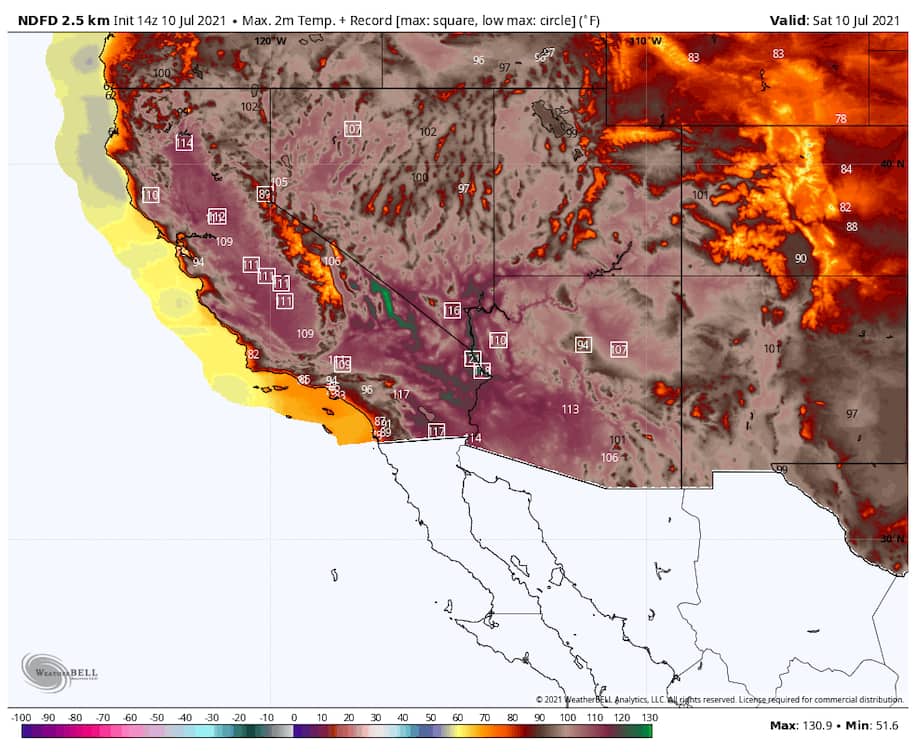
Wish I could superimpose a temperature map on the itinerary of our trip, so you could see how we went from 77˚ on the coast to 116˚ in a few hours on Friday (with a stop in 99˚ Temecula), then back, from 112˚ to 79˚ today (with stop in 100˚ Hemet). This scary map (from WaPo), with counterintuitive colors (the flame colors are 60s to 80s, 100 is ashen but the treacherous 120s are green!), gives an idea...
Saturday, July 10, 2021
Desert heat

Friday, July 09, 2021

Marooned hammocks
 The topic of the latest session of "Anthropocene Humanities" was "Descularizing the Anthropocene," a subject not only dreadfully polysyllabic but, for China, a little delicate. I didn't say "religion" - but then I didn't talk about religion or the religions. I talked about those experiences of surplus feeling, especially in places of complicated interaction with other-than-human forces, which across history have taken the form of spirits. We ended with Bronislaw Szerszynski's brilliant typology of "gods of the Anthropocene" - superhuman agencies arising in ostensibly secular theories of the Anthropocene - but the way in was more subtle.
I started with a brief review of some of the last session's material on apocalypse - which can mean the end of the world but also the uncovering of great knowledge, something new and more true than the "world" which is ending. Apocalyptic times might be the dawning of something radically different, but the main experience is vertiginous, of the collapse of all we've come to think we know. Roy Scranton was our representative Cassandra: our civilization is dead! We're doomed, now what? This is terrifying, a presentiment of the loss of worlds of so many indigenous peoples across the planet, and many more are experiencing it every year - like those discovering that along with hundreds of humans, a billion marine animals were "cooked to death" in the recent heat dome over western Canada.
For others, including presumably most of us in my class, though, it's still just over the horizon, like the steady drumbeat of unassimiliably awful news like that of the Canadian crustacean Apocalype. (A good account of that diffuse unease is Jenny Offill's Weather, an excerpt of which I gave the class to read last week.) To engage these gentler, if also unsettling, experiences I introduced the concept of "solastalgia."
 This term, coined by Australian environmental philosopher Glenn Albrecht, characterizes the psychic distress attending the experience of environmental change, especially in the place you live. It's the paradoxical "homesickness you have when you are still at home." This includes the mourning attending the awareness of things that are no longer present - you used to be able to see X here, there used to be a Y here but it died - but shades into a foreboding about the future, the sense that more loss is certain.
I shared a short video some students at Oxford produced a few years ago, where students used their immobilized faces as canvases for images of widening environmental destruction in the environs where they grew up. (At top, a man from North Dakota depicts nitrification of rivers from industrial agriculture; the woman above is hearing reports on how the air in Seoul will in coming years become harder and harder to breathe. At the end, they reveal their faces, quickly wiping off most, but not all of the paint.) Their mute witness is very powerful, and in many senses brings the Anthropocene home. I asked students in their groups to reflect on why and how this little film was made, and if they had any similar memories. One reported:
The trees near my house were gradually cut down. The buildings replaced the previously heavily wooded area. When I was a kid, I loved tying the hammock to trees and sleeping in them, but now it is hard to find two adjacent trees to tie the hammock. When summer arrived, the whole area was very hot and dry, and everyone was reluctant to go out.
I suppose something like solastalgia is common for most people in China, whose landscape has been transformed beyond recognition with wave upon wave of urbanization. It's not quite the shock at environmental change Albrecht had in mind, but I'll take the image of the child without a second tree to tie his hammock to.
Our discussion proceeded from these disturbed human faces to the "Prophecy" photos of Fabrice Monteiro, where materials found in various pollution and climate-impacted areas in Senegal are brought together (with the help of fashion designer Doulcy) in the form of jinns - spirits defined as much by pain as by power. It's an interesting way into religious imagination, the human form stretched painfully beyond itself. We'll talk next class about some Daoist ideas: more religions. In the meantime, a student shared some images by contemporary Chinese photographer Wan Yunfeng, which employ similar means - that's him, below - to make environmental devastation real to us.


Thursday, July 08, 2021

Wednesday, July 07, 2021

Tuesday, July 06, 2021
Post-apocalyptic
As we started the second half of the "Anthropocene Humanities" course today, the tables turned. We'd wrapped up the first half, which canvassed debates about the nature and timing of the Anthropocene cataclysm among scientists and historians with Clive Hamilton's dark warnings about the godlike pretensions of ecomodernists and Roy Scranton's reuminations on "learning to die in the Anthropocene," since "our civilization is already dead." Pretty depressing stuff, all!

Today's class started with Joanna Zylinska's eerie photo film "Exit Man," included with her book The End of Man: A Feminist Counterapocalypse, in which a digitally altered voice with no inflection or recognizable gender challenges us to see the Anthropocene as the welcome end of the failed experiment of the "stand-alone subject" of modern ethics and politics and a "subjectivity that is pinned to a competitive, over-achieving and over-reaching masculinity." Zylinska's "feminist counterapocalyptic agenda promises liberation" from such distortions and "opens up to the precarious lives of human and non-human others." New possibilities are disclosed in those whose existence has long been rendered precarious by "man": "women and those of nonbinary gender, animals, fungi, microbes."

Students had read two essays. One was a critique of the continued fantasies of control and mastery in the naming of the Anthropocene - man did this, man has to address this! - which led to an overview of queer ecology, the sense that all things are entangled and entangling in ways transgressing our categories and fantasies of boundaries. The other was an argument for dating the Anthropocene to 1610's "Orbis Spike" to signal that its ultimate cause was not capitalism or the industrial revolution (let alone human nature) but colonialism's destruction of indigenous worlds, a severing of relations with the natural world in service of universalizing reason that is now affecting the colonizing cultures, too. This isn't the first Apocalypse.

I ended with a list of alternative names proposed for the Anthropocene, each connected to an account of its nature and origins and to a program for the future. Each adds a further dimension of trouble and even horror, and calls for mourning and perhaps repentance. Yet while haunted by post-apocalyptic trauma they may also disclose ways of surviving, models for the "staying with the trouble" called for by Donna Haraway (final reading of our course).
Was this awkward material to present to a class of mostly (85%?) female Chinese students as a white settler American man? You betcha.
Monday, July 05, 2021
Swell loom
Happened on this gorgeous picture today in the gallery of locally based celebrity photographer Aaron Chang, "Wild Coast," shot recently at Point Reyes, a little north of San Francisco. Mesmerizing! It may be because it shares a color palate with a hand-woven rug a friend brought me years ago from El Salvador, but it looks to me like a

tapestry. Indeed it also evokes the movement of weaving on a loom, a living rug woven and unwoven like Penelope's shroud, the pattern endlessly changing but always beautiful. That's how the surf feels, of course. Chang, building on a long career as a surfing photographer, knows how the waves feel when you're in them, moving with them.
And then of course there's that insouciant seagull...


Friday, July 02, 2021
Dreaming of electric sheep
I asked my Renmin students, divided into six groups, to come up with works of art which might be illuminating for the Anthropocene: three per group. The specificity of "works of art" got lost in the scramble, but the resulting list is still intriguing - especially the science fiction!


I'm familiar with one of the three Chinese works proposed, I read and enjoyed Hao Jingfang's "Folding Beijing" when its English translation won a 2016 Hugo award. The Waste Tide, has apparently just appeared in English, too: I'm adding it to my reading list (and maybe to the syllabus of my fall Lang first year seminar!). The third has an English title but I'll need to ask the students more about it; although it seems the author, Hui Hu, has won prizes for several works, English language searches are revealing little. About the author of The Waste Tide, the preternaturally pretty Chen Qiufan (a k a Stanley Chan), meanwhile, there's more, including a factoid to confirm just what a brave new android world some of my students are confronting:
Chen’s recent short story “The State of Trance,” which includes passages generated by AI, nabbed first prize in a Shanghai literary competition moderated by an artificially intelligent judge [!!!!!!], beating an entry written by Nobel Prize in Literature winner Mo Yan.
Thursday, July 01, 2021
头破血流
 Well, my Renmin summer school course made it through the big centennial hoopla without incident. It certainly was a little strange meeting students the mornings of the days immediately before and after the grand celebration, but I decided it best not to mention it... and none of the students did either. (They had returned to their hometowns from Beijing just as commemorations climaxed.) Instead, they worked in groups to compile a list of works one might consult to make sense of the Anthropocene, which ranged from Rachel Carson's Silent Spring to Michael Jackson's "Earth Song" to Werner Herzog's "Grizzly Man" by way of western and Chinese science fiction (on which more anon). Of recent Chinese history or thinking nothing.

These sites lie deep within the Qilian Mountains, thus rendering the QR codes mysterious cultural “relics” for anyone who stumbles upon them, now or in the future, much like the large installation works created earlier by Zhuang Hui and which he chose to abandon in the Gobi Desert in 2014. The QR codes are functioning, not merely decorative, both in situ and in the gallery ...
Wednesday, June 30, 2021
Tuesday, June 29, 2021
All the time of the world

We have inherited a world shaped by the extraction of coal, along with all the costs and benefits that the life-style of extraction produces: climate chaos, acidifying oceans, loss of biodiversity, and the accumulating toxins in our air, water, soil, and bodies. But this fossil fuel was once a thriving ecosystem. Drawn from interviews with coal miners and paleobotanists, this is an archive of the earth’s past that lies in trust for the present. A guided meditation connects the sensations of our bodies to the temporal topologies beneath our feet. Through listening, we invite you to journey deep into the earth and back in time to the Carboniferous period, when the coal seam was an ancient forest.
And it does indeed invite us to imagine ourselves into the past. (If you have 20 minutes to spare you should really try it rather than let me tell you about it.) Building on a grounding in awareness of your breath common to many kinds of meditation, it invites you to go back in your imagination one year, ten, fifteen, thirty - the time of human lives - and beyond... Now your every breath is a million years ... and now it's three hundred million years and you are a tree - gloriously green inside and out, a lycopod - in a forest of fellows, breathing together.
the oxygen you exhale is filling the atmosphere
At some point waters begin to rise around you, and silt, filling all your crevices. Slowly
you can give up your commitment to the vertical
and gently settle, with other trees, sinking into the earth, compressing together, and eventually crystalizing, fossilizing...
you are still and shiny and hard
And then, after some time appreciating the weight of time above you,
you share this space underground with agents of extraction
(human beings?!) and before you know it
your body is fracturing, it is in pieces... the others are leaving, one by one
After some reflections on the wonder that is coal, woven together with the stories of coal miners, their work and danger and sickness, you slowly reemerge, gently letting the light in.
start to pull yourself up from the ground, stacking your vertebrae, one on top of another.
This can happen slowly, the guide says:
you have all the time of the world
It's a very strange enterprise, very. As I told the students, I had never, never considered what it's like to be coal, though I knew that it was the product of ancient forests - and I love forests. My view was that the burning of fossil fuels is a destructive thing we learn to stop doing; like other fossil fuels, coal would be better left out of sight, out of mind. But what if we extended our mind into it?

I think this material will be more accessible to my American students in the fall, but I hope my breathless enthusing about it can pique the curiosity of the Chinese ones, too.
Monday, June 28, 2021
Ostpolitik

In the context of discussions about anti-Asian hate at the end of last semester, one of my colleagues and I decided to write something about the predicament of Chinese students at The New School - which published today. She's a specialist in Chinese cities who also teaches our university's largest course on contemporary China; we know each other through India China Institute. She works closely with some of our university's many students from PRC, and has shared with me their particular anxieties and disappointments as US-Chinese relations have soured in recent years, and it seemed it might be valuable to share these more broadly in this moment - it was indeed helpful, if more complicated and challenging than I imagined, to give voice to them.
The key concepts in the piece come from my colleague's diagnosis of the traumas these students face. My contribution was to insist that The New School's legacies, as well as the reality of its significantly international student body, position it to address such pressures more fully than we currently do. These students are caught in the cross-fire of often ignorant and belligerent forces on both sides, but as the larger world slides into a new kind of "cold war" it seems more important than ever to support these students as a space of safety, recognition and encounter. Isn't that what we were meant to be?
Subscribe to:
Posts (Atom)