
Enjoying anew Fred Tomaselli's dazzlingly intricate mosaics at the

14th Street station of the 1, 2 and 3 subway lines. Look closer,

there are worlds within worlds within worlds here!


A rather full day - first session of "Varieties of Religious Experience," followed by a five hour "Faculty Retreat on AI and Higher Education." Since I was running out of the adrenaline that has somehow kept jetlag at bay all week, I smushed them together.

I have long defended to my own students the lawfulness of voluntarily adopted faith; but as soon as they have got well imbued with the logical spirit, they have as a rule refused to admit my contention to be lawful, philosophically, even though in point of fact they were personally all the time chock-full of of some faith or other themselves. (2)
James' students, inspired by the apparently high-minded idea that "It is wrong always,
everywhere, and for every one, to believe anything upon insufficient
evidence" (8), are naive about the ways the human mind works (it's
always driven by its passions) as well as the reality of the universe. Deciding not to believe is itself a decision, James argues, and there are worse things than being duped, since one can correct. Sometimes believing is good, even existentially necessary, for the believer. And there may even be cases where faith in a fact can help create the fact (25)!
A stranger set of arguments than many suspect, ranging from epistemology through psychology to something like a theory of religion.
Religions differ so much in their accidents that in discussing the religious question we must make it very generic and broad. ... [R]eligion says essentially two things. ¶ First, she says that the best things are the more eternal things, the overlapping things, the things in the universe that throw the last stone, so to speak, and say the final word ... ¶ The second affirmation of religion is that we are better off even now if we believe her first affirmation to be true. (24-25)
The Varieties of Religious Experience will comes at religion in a different way, as we'll be seeing, more "scientific" and distanced. But it's animated by the same sense that the religious question is not merely academic but deeply personal. Ultimately its terms are as evocatively vague as James' here, but that's part of the Jamesian thing. It might seem, I said, "squishy" to refer not to "eternal" but "more eternal things" (so things can be more or less eternal?!) and what on earth does "overlapping" mean? But I confessed, too, that this squishiness, which can frustrate the more analytical, is part of what I love about James.
In any case, I had to run to our faculty retreat, where the university president was just wrapping up some introductory reflections which apparently centered on the question whether artificial intelligence is really artificial. Our dean added that it seemed an open question whether or not it was intelligence, too.
There followed several presentations by local faculty, a zoom presentation by one of the authors of Teaching with AI, and some invitations to use AI ourselves. (For some of my colleagues, perhaps amazingly, this was their very first time!) A philosopher colleague invited us to feed a scannable article to Mistral's Le Chat (one of six main forms of generative AI, of which ChatGPT is the most famous but not necessarily best), first asking for a summary and assessing it, and then asking it questions until we succeeded in getting it to report something false.
I tried with "The Will to Believe":
Break down the main claims in William James' "The Will to Believe" and suggest more accessible language for these claims.
It did very well with the first half of the prompt. For the second, well...

But I wasn't with students. I was with AI, as a colleague was lecturing about the different ways large language models synthesize data. "Hallucinations," where AI seamlessly segues from plausible to bizarre claims, arise when they're asked questions about things which have not been addressed in the materials they're trained on. As they train farther (and as more people feed them their own prompts and responses), there are fewer and fewer of them. They're driven by the probabilities of proximities of words and concepts.
How can William James' "The Will to Believe" explain the mechanisms and ethics of AI?
It gave me an answer, of course.


You might have heard about the plea the Episcopal Bishop of Washington, D. C. made to the new president. As you told the nation yesterday, you have felt the providential hand of a loving God, Bishop Mariann Budde said; in the name of our God, I ask you to have mercy on the people in our country who are scared now, referring then explicitly to the families of LGBTQ children, and the children of undocumented immigrants. The sermon's main theme was how unity despite and across differences, including political ones, requires recognition of others' dignity, honesty and humility (virtues some cardinally lack), but on her way there she reminded us how our tradition calls us to "be merciful as our God is merciful."
Only women seem to have the courage to talk back to this man. But the Rev. Winnie Varghese, another Episcopal superstar, helps us see that it is also true Christianity at work here, as Bishop Budde is "appealing to a good no one assumes is there, but of course it is." Of course? I confess I find it hard to say that, even as it is what I believe. As Bishop Budde also reminded us, we are called to "pray for those who persecute us."
This is hard to do, especially when these persecutors claim to be Christians. I'm thinking here less of the president, whose professions of faith nobody takes seriously, than of the apparently sincere Evangelicals who are so prominent in his entourage. (We get distracted by the white supremacists, the toadies, the plutocrats, the law-breakers, the greatness = dominance crowd, the serial abusers, the xenophobes, the science-deniers, but many of these also claim to be Christians.) It is they who are responsible for the ignorance and cruelty of his horrifying executive order claiming the right to dictate (on day 1!) that bi-, intersex and transsexual people do not exist!
The "biology" invoked in this catalog of hatred is its own kind of science-denial: "'Female' means a person belonging, at conception, to the sex that produces the large reproductive cell," the executive order asserts, "'Male' means a person belonging, at conception, to the sex that produces the small reproductive cell." [Sec. 2 (d) and (e)] But not only do those who wind up in male bodies at birth all start as females in utero, nobody belongs to any sex "at conception" (nor is yet a person)!
The claim is a theological claim - and a heretical one, as it presumes to know what only God knows and intends. (This presumption isn't only Evangelical; they get it from Roman Catholic "natural law.") Its refusal to acknowledge the reality of biological contingency and sexual and gender diversity is chilling, as is its sad inability to recognize divine purpose in that diversity. It's an example of the prideful, dishonest failure to recognize human dignity which Bishop Budde invited us to acknowledge our shared capacity for. And - of course! - our capacity to overcome.
Will her words soften hardened hearts? Maybe not right away. In the meantime, many who are scared now are finding their worst fears confirmed. Hear them, support them, defend them. For God's sake.

"Religion and Ecology: Buddhist Perspectives" kicked off today. Most of class was dedicated to a discussion of Myōe's "Letter to the Island," which turned out to be a great starter text, but before that I tried to set up what we were doing with some books. The top three are our main sources of material; I brought along Mannahatta to make the point that our thinking should be "grounded" where we are. The course gambit, expressed in the book pile: academic work, introduced in the new (2024!) edition of Grounding Religion: A Field Guide to the Study of Religion and Ecology, should be grounded in the place we are, Turtle Island, with Braiding Sweetgrass helping us learn to recognize our dependence on and obligations to the land and our non-human kin, but also watered by the Dharma-Rain of Buddhist traditions. It'll make more sense in practice!
And speaking of practice, students' first assignment is to write a "Myōe letter" of their own - personal, addressed to a nonhuman they already have a relationship with, modeled on Myōe's. In an announcement explaining the assignment, I wrote
I hope you left our discussion with a strong sense of just how weird Myōe's text is, a first taste of how challenging (and enlightening) Buddhist perspectives can be. I hope you also got an appreciation that "Buddhism" is no one thing but a vast world of ideas and practices from many times and places, often in disagreement, and often, on first reading, very weird. Myōe's letter doesn't just seem weird to us because we're reading it in English translation most of a millennium after it was written, with scant to no knowledge of its sources and context. It was meant to seem weird to the contemporaries who might read it, too. How absurd to write a letter to an island!! But is it just performative?
Your assignment, to write what I'm calling a "Myōe letter," is also very weird, indeed weird in ways you'll appreciate only when you actually sit down to write it. (I'm a firm believer in learning by doing, for pedagogical as well as Buddhist reasons. Talking about religion, especially a practice-based tradition, gives you at most the illusion of understanding it.) To be clear, I'm not asking you to be Myōe or Buddhist or Japanese or to address a Japanese island! The task is for you to write a personal letter to an island or tree or other nonhuman with whom you already have a relationship. Even if you may already hug that tree or dance your thanks to that piece of land, writing a letter is a weird thing to do, so, for the benefit of that mountain or river or whomever, include a few paragraphs, as Myōe does, articulating what an odd thing you're doing in writing the letter and why. If you find this impossible to do, find words for that too. (I can tell you about a woman who, invited to talk to a plant, tearfully apologized to the plant for not being able to speak to it.) We can talk about the assignment in class Thursday as well, but only if you've started to do it. ;)

Haven't seen snow in a bit, so the Heather Garden at Fort Tryon's holding on to last night's fall all afternoon was much appreciated.


Break of a frigid day. But it's also MLK Day, a day to recommit to working to help bend the moral arc of the universe toward justice.

Some quirkier moments from the China trip, more or less in sequence, starting with a reminder that Lunar New Year is around the corner, at West Nanjinglu in Shanghai

Antler display at the Shanghai Natural History Museum

A better-lit Han dynasty zither player at the Shanghai Museum

AI-generated ads in the Shanghai subway

Napkin pack at a fish restaurant: pickles taste better than fish!

The new year is the year of the snake, in a swanky highway rest stop

Buddhist temple inspired figurines at rest stop bookshop

Display of local pride at Quzhou Holiday Inn breakfast buffet

Relics of Confucius' 75th generation descendant in the southern line

Pots in the garden at Quzhou's Southern School Confucian temple

Fried fish with tea leaves in the birthplace of oolong tea, Wuyishan

Dry ice in a mini teapot makes Wuyishan tea special even in a paper cup

Carp and tree reflections at our place in Wuyishan

"Vows of eternal love route" at Wuyishan mobilizes everything for love, marriage and happy families, from cliff formations to bodhsattvas to Neoconfucian academies

Impromptu tree of life at Xiamei ancient town

Museum (closed) at the remains of the short-lived Han era city of Minyue

Quanzhou's best selling Daoist figurine; as he looks at his cell phone, you can (if you have a Chinese phone chip) zap the horse image and get a virtual moon block-informed prognostication

Mascot of something at the Maritime Museum in Quanzhou

The inevitable core values of of socialism, Maritime Museum style


Preparations for new year's for sale in Quanzhou


Young women and girls dress up in the style of nearby Xunpu in Quanzhou

Souvenirs, including Quanzhou's adorably gawky white traffic tower

Arhats (luohan) at Cao'an temple outside Quzhou

Unexpected spring flowers on trees at Cao'an

The newly built Luojia temple on the sea pulls out all the stops

Hakka tulou-shaped ice cream bars in many flavors
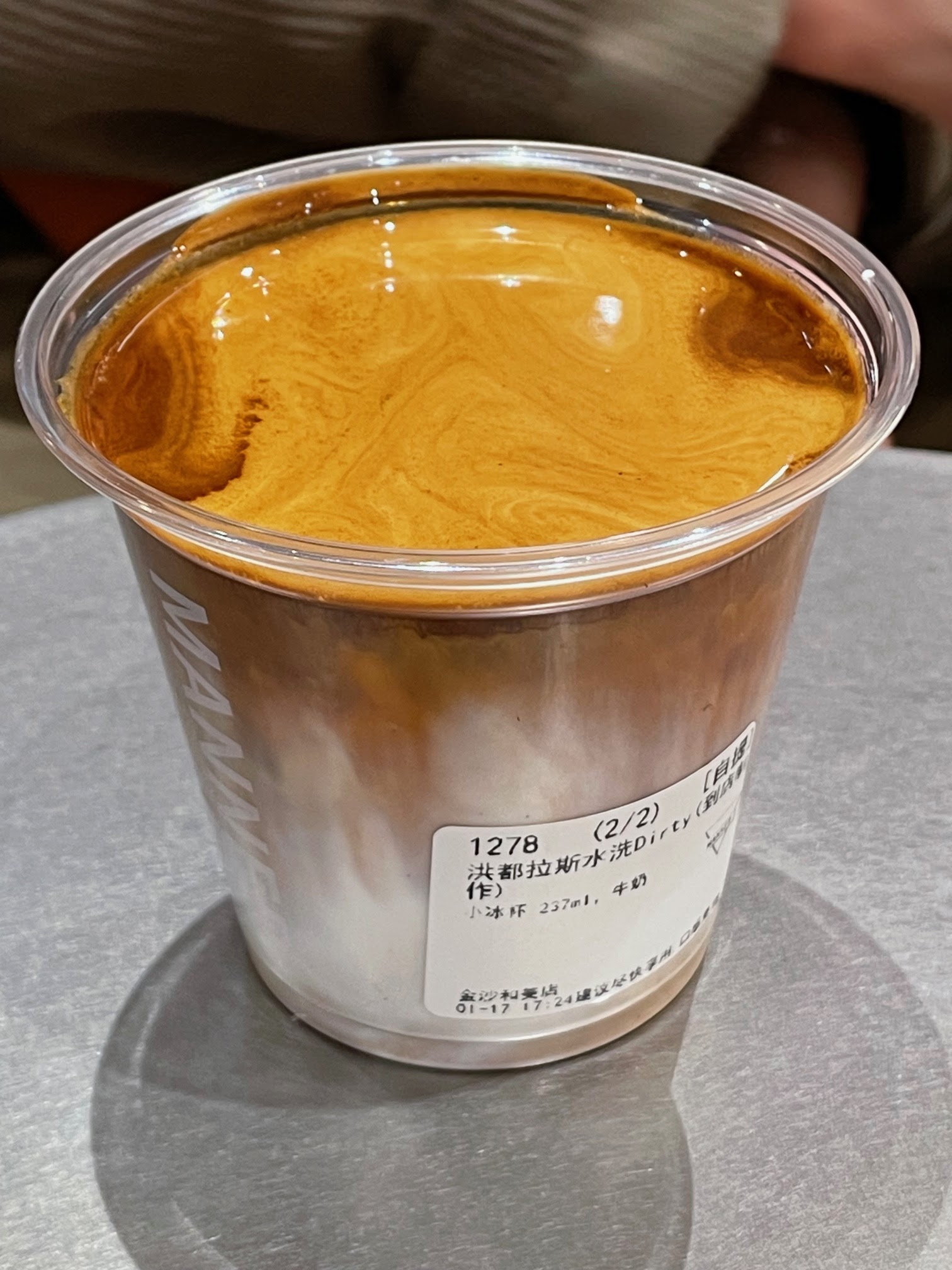
The latest coffee trend, a "DIRTY" (in English) - espresso smudging a glass of chilled milk: delicious!


.gif)