Monday, February 04, 2013

Demands of the universe?!

We have liftoff!

The opening "saints" sequence of "Exploring Religious Ethics" isn't just a tour of different approaches - secular moral philosophy (Susan Wolf), religious studies (William James), Catholic theology (Cardinal Saraiva Martins), folklore (Jataka tales), existentialism (Fear and Trembling) - to our topic. It's also a steady torpedoeing of the idea that ethics is clearly and stably only about how we human beings should treat each other in the here and now. There's more involved, more at stake.

Today's reading was the section "The Value of Saintliness" from William James' Varieties of Religious Experience. Here he assesses the "fruits" of the four characteristics of saints he has derived from his lectures on saints: devoutness, purity, charity and ascetism. The conclusions he draws about each are challenges to his Scots Presbyterian audience. Devoutness is the main source of fanaticism, which gives religion a deservedly bad name, and purity is an unconvincing and unconvinced otherworldliness. The other two, however, which he expects his listeners to dismiss, he finds ways to commend.

It may be true that charity, unconcerned as it is with the qualities of the people it gives to, has negative social consequences, creating dependence, maintaining the unfit, and allowing itself to be coopted by "crocodiles and boa constrictors." Nevertheless, its very unworldliness makes it a precious gift. I'm sure I've quoted this before, but I'm happy to do it again:

The saints, with their extravagance of human tenderness, are the great torch-bearers of this belief [in the essential sacredness of every one], the tip of the wedge, the clearers of the darkness. Like the single drops which sparkle in the sun as they are flung far ahead of the advancing edge of a wave-crest or of a flood, they show the way and are forerunners. The world is not yet with them, so they often seem in the midst of the world’s affairs to be preposterous. Yet they are impregnators of the world, vivifiers and animaters of potentialities of goodness which but for them would lie forever dormant. It is not possible to be quite as mean as we naturally are, when they have passed before us. One fire kindles another; and without that over-trust in human worth which they show, the rest of us would lie in spiritual stagnancy.

I took the name of one of my first Lang courses from this passage: "Preposterous Saints." The saints are fitted not to this world but to the better world which is the human future they open up in their unworldliness.

As for asceticism, it resonates with the mature manly (yes, sigh) view of the converted "sick soul" who recognizes the grim realities of existence but is not crippled by that awareness.

For in its spiritual meaning asceticism stands for nothing less than for the essence of the twice-born philosophy. It symbolizes, lamely enough no doubt, but sincerely, the belief that there is an element of real wrongness in this world, which is neither to be ignored nor evaded, but which must be squarely met and overcome by an appeal to the soul’s heroic resources, and neutralized and cleansed away by suffering.

The saints also show that the heroic virtues of bravery, self-sacrifice, etc., thought by some to be achievable only in war, can be achieved in more pacific ways. Voluntary poverty is a moral equivalent of war. It all comes down to what James rather grandly calls mankind’s common instinct for reality, which in point of fact has always held the world to be essentially a theatre for heroism. In heroism, we feel, life’s supreme mystery is hidden. ... The metaphysical mystery, thus recognized by common sense, that he who feeds on death that feeds on men possesses life supereminently and excellently, and meets best the secret demands of the universe, is the truth of which asceticism has been the faithful champion.

Secret demands of the universe? Weren't we just talking about unusual, perhaps extraordinary human beings? I told the class: We've made our first step beyond the easy pieties of secular ethics. Maybe all people aren't the same, and maybe the universe has higher hopes for us as a species than we know how to have for ourselves... I don't think they were buying it. Besides, trying to present this view compellingly (maybe the universe needs us in order to be conscious of its mystery...) I was sounding a bit like Deepak Chopra. Perhaps they'll fall back on it Wednesday, when confronted with the claim that the saints are, in fact, superhuman and point to a superhuman destination for all of us - conduits of the Holy Spirit in their lives and even more active in death than in life.

What, you mean the meaning of human existence might not be up to us?

Whee!

Sunday, February 03, 2013

Apply heat

It's a little hard to describe this weekend, beyond that it's been a blast. A sleep-over, a faculty training expedition, a look beneath Chicago's hood, all somehow inside the head of a remarkable African American installation artist-musician-impressario. (And... winter! Friday was ve-ry cold, windchill of -16˚ F; then it warmed up enough for snow!) In short: more than a dozen faculty from four divisions of The New School got to know the winner of our Vera List Center's inaugural prize in Art and Politics, Theaster Gates, on his turf.

Theaster's artistic practice grew from training as a potter, although by this time he already had a degree in urban planning. (An MA in religious studies happened along the way, too, and some time in Japan.) Nowadays he seems to shape opportunities for other artists as much as - indeed as - his own clay. His performances and installations always involve craftspeople in the neighborhood (often training new ones) as well as the various citizens of the art world, from beginning artists to carpenters to university folk to big-name philanthropists - if possible in ways that leave an enduring living for someone. It's quite poetic as idea but in practice dizzyingly, almost disturbingly entrepreneurial. And very successful. His star has risen decisively in the international art scene, and has enabled him to become a kind of salvage developer in Chicago's South Side, buying and transforming old buildings into spaces for artists. Many people in many places have participated in his projects, many, by design, spinning off into their own work. Of his team of seven planners he said he's a sort of organic corporation, one body.

The first of these buildings were on South Dorchester Avenue, and it is the "Dorchester Projects" for which he won our prize - old places which have been converted into quirky art spaces. The most recent, known now as Black Cinema House (the red brick building above), is where five of us stayed. Its story with Theaster is fascinating. Abandoned for a long time, he decided to buy it because of its accoustics - he was looking for a place to record some music for his contribution to Documenta, the big German art festival which takes place every 5 years. But more than the music went to the "Hugenottenhaus," a bombed-out shell of a house he restored in Kassel: every usable remnant of wood, etc. from 6901 South Dorchester was shipped to Germany and reused. To food and live music, Documenta visitors got to ponder history and locality, craft and displacement, in a Chicago-ensouled space. Material like wood and lath mutely hum with the forgotten lives they framed and contained.

This meant the house we stayed in, beautifully appointed in other reused materials of black Chicago, had none of its own guts. (We got to see the guts stacked up in his big studio, just returned from their transatlantic voyage.) Instead we had a floor from an abandoned church, a room whose walls were covered with green chalkboards from an old school, stained redwood wainscotting from an old water shed, etc. It's designed to be used as an art house theater, and as a kitchen for the "Soul Food Pavilion" dinners at which traditional African American food is served in hand-made dishes, many made by visiting Japanese potters. Across the street is the Library (the wooden building above) home to an odd assortment of de-accessioned collections, including the glass slide collection of the University of Chicago's art history department); the old Candy Store next door, his original perch in the neighborhood, is being gutted and rebuilt, too.

We also got to see other spaces Theaster's revived, including the Arts Block, an "incubator" of new talent, and the vast disused Anheuser Busch brewery which will be his new studio. He also directed us to meet people he's worked closely with at older institutions engaged with community and art - Hull House, the Experimental Station, the Gray Center for Arts & Inquiry. But it still added up only to what one of my artist colleagues described as an "extended studio tour" - we got to see behind the scenes of his work, but not the work itself. Even the Dorchester Projects aren't just spaces but designed for particular kinds of life. And what life that must be: I've watched some of his performances on youtube with his group the Black Monks of Mississippi, and they're fantastic. Check out the song "I was born with clay in my veins," starting at 22:40 here. Commanding stuff.

And if you listen a bit you'll hear this old work song, perhaps inspired by the life of the slave artist known as "Dave the Potter," yield to something quite different: a religious chant, namu myo ho ren ge kyo. What's going on here? Nichiren Buddhist soul? I'm keen to find out. I was invited to participate in the weekend because religion is important in many ways to Theaster's work. His first words to us were about the importance of the "belief muscle," and we learned also that at a recent musical session he started "scatting in tongues." He understands his work with reused materials as more than reclamation - if not redemption, it is a kind of resurrection. And perhaps a little retribution, too: the above (seen from the side) is one of his works made of deaccessioned fire hose, meant to recall not the putting out of fires but the use of fire hoses use against protesters during the civil rights movement.

We all meet again in a month, back in New York. I think we're all trying to understand just how his practice has widened out to embrace music, exhibition, historical reclamation, curatorial interrogation and urban renewal. I'm wondering if something in the experience of Japanese pottery - especially the waiting for glaze to assume colors and shapes you don't plan (but which also couldn't happen without you) - continues to inform his collaborations. He uses the language of "heat" to describe what he's making. I'll have to ask about the Lotus Sutra, too!

Thursday, January 31, 2013

Chicago again

I'm off to Chicago for the weekend. A multi-media artist named Theaster Gates, the winner of our school's inaugural Vera List Center Prize for Art and Politics, lives and works there. I'm part of a rather large contingent of New School faculty going to explore his fascinating Dorchester Projects - abandoned buildings reclaimed and repurposed as art centers - in quest of curricular tie-ins and ideas for a conference devoted to his work in the Fall. I'm also one of the intrepid few who took up the offer to sleep over in the Dorchester Projects. Yellow submarine, the arctic sleeping bag I bought for the Beatles-themed hostel in Darjeeling last January, is looking forward to a nice workout!

Wednesday, January 30, 2013

Back to religious ethics

Oh how I love "Exploring Religious Ethics"! I like most of the classes I teach a lot, but I dare say this is my greatest love - perhaps I should teach it more than once every two years. This iteration of it is shaping up very nicely, after a rocky start: it was scheduled for 8am, garnered the predictably miniscule enrollment, but then was moved to the quirky but pleasing 3:50-5:30 slot. Even better, we're in one of the original Lang classrooms on the 2nd floor of 65 West 11th Street, overlooking the courtyard. Night falls during class now, but over the course of the next months we'll feel Spring stretching out the days. And we're a perfect sized group - we all fit around a big table (actually cluster of tables).

At the first session on Monday I again showed the first of Kieslowski's "Dekalog" movies, heavy stuff to watch, especially with people you don't know yet, but it established the seriousness of the class. It resonates with some of the larger questions of the class I introduced - the relation of ethics and religion, the limits of the moral community, etc. - and our brief discussion was good. Then I suggested one could see it as a Buddhist movie, too, only to find that nobody in the class had any background in Buddhism. They hadn't even heard of the Four Noble Truths! And so a film about the first commandment led to a discussion about the first noble truth, the truth of dukkha.

Today we discussed Susan Wolf's now classic essay "Moral Saints" (it's more than 30 years old and we're still reading it). Wolf thinks our moral theories commit us to ideals of moral behavior we don't, in fact, think ideal. Someone "whose every act is as morally good as possible" would probably be no fun to be around: saccharine, dull to the pleasures of art and taste, and lacking in a rich inner life. It's fine that there are a few Mother Teresas out there, but we want our friends and family to be more complicated and interesting. Wolf's challenge: can we talk about moral issues in a way more adequate to common sense understandings of the value of rich, complicated lives and pleasures?

The article explicitly raises many important questions, central among them whether a good life is about more than being "good," whether there are such things as "non-moral" virtues and values, and how to think about supererogatory good and its role in the lives of individuals and communities. But the incuriosity about religious lives that it shares with most secular moral philosophy also make it a great start for our course - the more conspicuous for Wolf's appropriation of the category of "saints" without so much as a glance at religious traditions of sainthood. Saints are our topic for the first chunk of the class, which takes in many disciplines and classic as well as contemporary cases:

• Susan Wolf's "Moral Saints"
• William James's "The Value of Saintliness" from The Varieties of Religious Experience
• Cardinal José Saraiva Martins' “The Lives of the Saints Show the World ‘the Divine in the Human, the Eternal in Time'"
• The case for (and against) canonizing Dorothy Day
• Jataka Tales, including the perfect generosity of King Vesantara
• Kierkegaard's Fear and Trembling

The readings lean heavily on the Christian side of our course, but that will be tempered by the more general questions from Wolf and James, and balanced out in the next segment of the course, which focuses on Buddhist questions and traditions.

Tuesday, January 29, 2013

Before good and evil

A friend defended a dissertation on Nietzsche today. (Congratulations!) Among many other things I learned in the ensuing conversations, I found out that the hammer-wielding philosopher's entire oeuvre, including his notebooks, has been digitized. Like this page, from a notebook from 1874. It's comforting, somehow, to know that even he threw out drafts.

Monday, January 28, 2013

Landmark


It's not even finished yet, but The New School's new building at Fifth Avenue
and 14th Street is already at the center of things!

Building

 
Sunday dinner tradition successfully brought into the new year! Last night brought the total number of people who've been part of it to 20. Great fun and, usually, great leftovers too, like this veggie lasagne...

Sunday, January 27, 2013

We'll always have Paris

An alum shared a link to a website with early color photographs of Paris.
 
Unbelievably, these were taken in 1914, 1920, 1920, 1909, respectively!
That doesn't, of course, explain what these orange globes are...

Saturday, January 26, 2013

"Tutorial advising"

Our college is piloting a new kind of academic program this semester, tentatively called "Tutorial Advising." Students will meet regularly in groups of 5-7 with a faculty member, as in a course (they get 1 academic credit for it), but the purpose is discussing the sorts of issues and concerns specific to academic advising. Reflecting on their careers as students, their vocational and career plans, etc., with visitors, excursions, shared meals. I think it's a great idea.

There are four pilots, and I'm doing one. Two are targeted at specific majors - one in screen studies, one in psychology. The other two, including mine, are as wide as the phrase "liberal arts." Mine will give me a chance to continue some of the great discussions which came out of our "Buddhism and the Future of the Liberal Arts" roundtable. In fact, it's called "Buddhism & Liberal Arts." Here's the tentative description:

This advising tutorial uses the phrase Buddhism & Liberal Arts as a kind of kôan, framing a shared journey exploring old and new meanings of learning, vocation, and the meaning of life. We’ll tap into ongoing debates about the nature and relevance of “liberal arts,” in theory and in our own lives at Lang, braiding them with Buddhist questions and practices, and with shared experiences on and (mostly) off-campus. 

Students will help assemble readings and other shared experiences which turn on the dualities of school/life, study/practice, contemplation/activism, personal/political, spontaneity/discipline, self/nonself, and path/destination. We “turn on” these dualities in four ways inspired by the history of Buddhist reflection: 
1) we let a given duality serve as the center of our discussion 
2) we complicate it in every way we can, teasing out its presuppositions and implications and challenging them 
3) we explore ways of breaking free from its constraints, and finally 
4) we consider ways of reclaiming the duality that can make it real and helpful for us as we think about shaping our lives. 

Learning Outcomes: 
• Becoming more intentional about your liberal arts education, and more thoughtful about how to translate it into your life and the wider world 
• Developing a practice of reflecting thoughtfully about your academic journey and life choices 
• Helping to craft questions and conversations for pursuing these concerns with others

We'll meet ten times for 90 minutes, only four of them at school. We'll meet twice at the Rubin Museum of Art, once at MoMA, once in a park, once at a Buddhist vegetarian restaurant, once at my house (to prepare a meal together). I'm quite excited, but it will all depend on finding the right students! That's the task of the next few weeks...

Friday, January 25, 2013

You saw it here first

My essay about teaching "Aboriginal Australia and the Idea of Religion" has seen print!

Thursday, January 24, 2013

Baby, it's cold out there

That's 16˚ Fahrenheit, not Centigrade! In Centrigrade it'd be -8˚.

Wednesday, January 23, 2013

Fire and ice

Wow, can you believe this photo? It's near a warehouse fire in Chicago so the frigid temps were aided in their artistry by water from firetrucks.

How to make it in America

The new ad campaign of the New York State Lottery is so adorable I have to share it with you. Yes, of course, buying a lottery ticket is something like the opposite of feeding your piggy bank, but who cares?
It actually reminds me a lot of ads in the Tokyo subway. I wonder if the artist, apparently named Yumyum, is Japanese?

Tuesday, January 22, 2013

lande of mystery and wo

I can't show you the exquisite little 1538 prymer in Englysshe sette out alonge after the use of Sarum I found at the Morgan Library today, but you'll get to see it, as it's my final missing illustration for my book! 
Instead I offer you a picture of one of the apparently Assyrian lionesses which guard the (no longer used) original entrance to the library, quite an interesting complement to New York Public Library's signature lions.

Here's the translation of the Office of the Dead's final reading, Job 10:

Why from my mothers wombe / hast thou me out brought 
That wolde to god / that I had ben clene 
Consumed away evyn to ryght nought 
So that none eye / me euer myght haue sene 
For then shulde I be / as I had neuer bene 
Nowe brought in to thy worlde / and streyght agayne out sent 
Oh that my lyfe dayes full soone are gone and spent 
Wherefor good lorde spare me yet a whyle 
That I may bewayle my sorowe / or I go 
From whens is no retourne / I meane that wretched yle 
Whiche is the lande of mystery and wo 
Couered all with death / in darknes ouerthrow 
Where is no rule / nor ordre at all 
But horror euerlasting / and payne contynuall 

The Prymer's a pocket book, smaller than my own little book will be, so the image will be big enough that readers can read it, and wonder that these desperate words come just after Job's certainty that his redeemer lives, and on dying

... these same eyes shal se hym manyfest 
This conforte sure remayneth in my brest…

Monday, January 21, 2013

Abundant gifts of this good land

Quite an inauguration after all! I wasn't expecting much, and the President's speech, like most of his recent speeches that I've heard, was a bit disappointing. It seemed like a laundry list of projects and promises, all of them worthy, of course, but loosely and not quite convincingly strung together. It seemed to be leading up to some grand climax which didn't materialize. But I was glad to hear climate change taken seriously, the strongest and most basic case for a welfare state, and of course the rising tide of inclusion encapsulated in the names "Seneca Falls, Selma and Stonewall"! And Obama's address was flanked by eloquent words by a Civil Rights Movement veteran invoking a "great cloud of witnesses," and a gay Hispanic poet's tender evocation of the everyday work, intimacies and decencies of America - all showing as they were telling that this land really is your land, this land is my land.

But I was most moved by the benediction by the Rev. Luis Leon, rector of St. John's Episcopal Church in DC. If you didn't catch it, here it is:

Let us pray: Gracious and eternal God, as we conclude the second inauguration of President Obama, we ask for your blessings as we seek to become, in the words of Martin Luther King, citizens of a beloved community, loving you and loving our neighbors as ourselves. 

We pray that you will bless us with your continued presence because without it, hatred and arrogance will infect our hearts. But with your blessing we know that we can break down the walls that separate us. 

We pray for your blessing today because without it, distrust, prejudice and rancor will rule our hearts. But with the blessing of your presence, we know that we can renew the ties of mutual regard which can best form our civic life. 

We pray for your blessing because without it suspicion, despair, and fear of those different from us will be our rule of life. But with your blessing, we can see each other created in your image, a unit of God’s grace, unprecedented, irrepeatable and irreplaceable. 

We pray for your blessing because without it, we will see only what the eye can see. But with the blessing of your blessing we will see that we are created in your image, whether brown, black or white, male or female, first generation or immigrant American, or daughter of the American Revolution, gay or straight, rich or poor. 

We pray for your blessing because without it, we will only see scarcity in the midst of abundance. But with your blessing we will recognize the abundance of the gifts of this good land with which you have endowed this nation. 

We pray for your blessing. Bless all of us, privileged to be citizens and residents of this nation, with a spirit of gratitude and humility that we may become a blessing among the nations of this world. We pray that you will shower with your life-giving spirit, the elected leaders of this land, especially Barack our president and Joe our vice president. Fill them with a love of truth and righteousness, that they may serve this nation ably and be glad to do your will. Endow their hearts with wisdom and forbearance, so that peace may prevail with righteousness, justice with order, so that men and women throughout this nation can find with one another the fulfillment of our humanity. 

We pray that the president, vice president and all in political authority will remember the words of the prophet Micah, “What does the Lord require of you but to do justice, to love kindness and always walk humbly with God?”

[Gives a brief prayer in Spanish] 

Mr. President, Mr. Vice President, may God bless you all your days. All this we pray, in your most holy name, amen. 

Beautiful, and serious. Religion, and the religion of America, at its best.

Sunday, January 20, 2013

Parting glances

The final component of my Job manuscript is nearing completion - the 12 illustrations, with captions. I have, of course, accumulated many more pictures than that over the years, some of which you've seen here. And I keep finding more. Here are three recent finds: an image of the printing of the first Bibles in China, a Byzantine illustration to Job 9:13, and a summary of the upshot of Job from the Ryrie Study Bible.

Saturday, January 19, 2013

ERSEH

Coming soon, the ERSEH conference, where researchers - some whom we know, some newly joining the project - will be presenting fascinating
new work; I'll be sharing my "resource use decisions" model as part of the first, more schematic session, "Concepts and Debates."

Friday, January 18, 2013

Slice of life

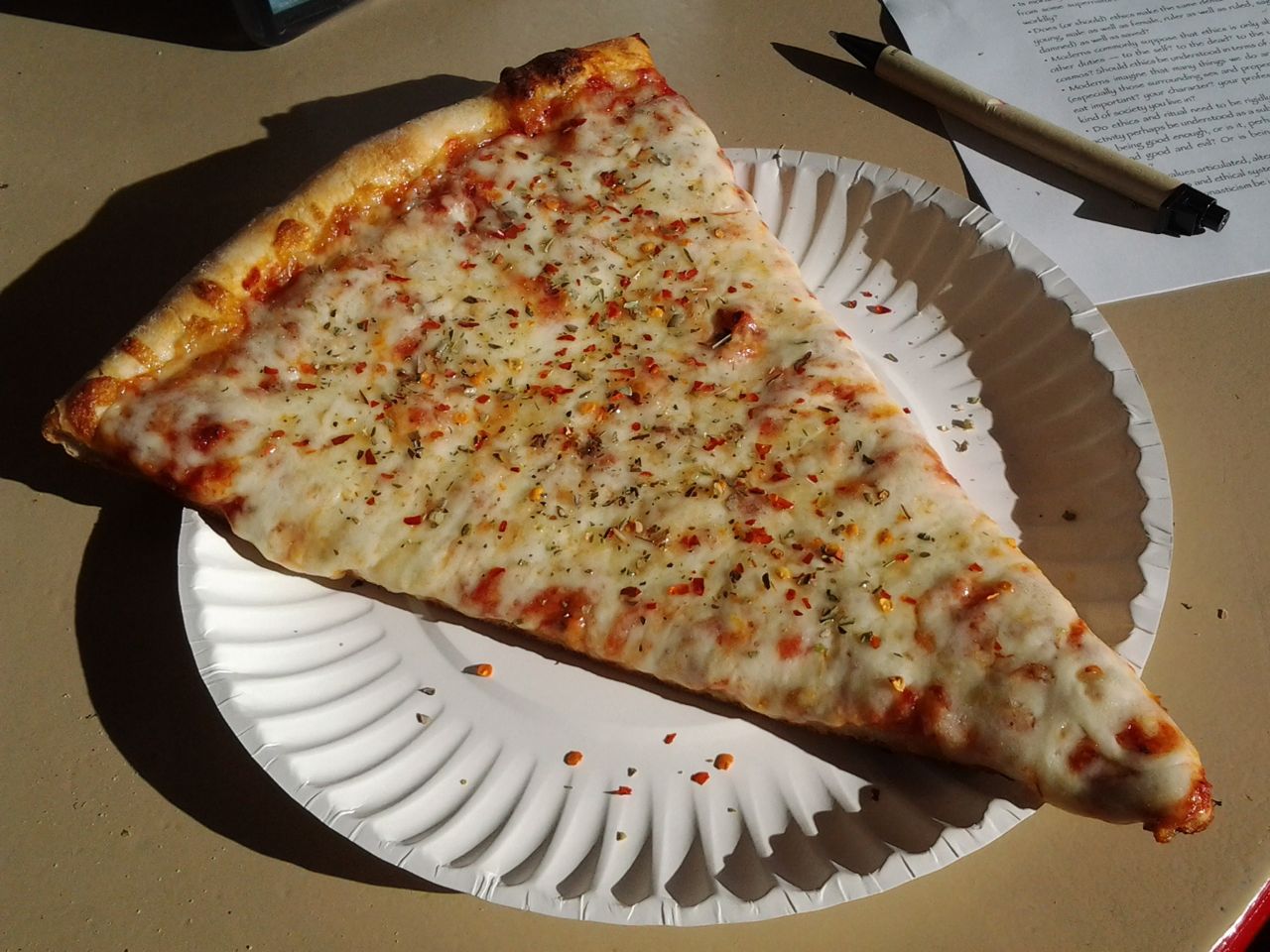
New York slice in winter sun, with a syllabus in mid-revision!

Thursday, January 17, 2013

Divested

Just got back from my final Vestry meeting at Holy Apostles. (I could have run for a second term, but pleaded imminent sabbatical as an excuse for not pursuing it.) I had a chance for some final reflections and mentioned that I was glad I hadn't known that the Vestry was also the board of the Holy Apostles Soup Kitchen as I would not have run, since I lacked the necessary skills. I still may not have the skills but I've learned an immense about non-profit organizations, about budgeting, about how boards work. I've learned also how much work goes into keeping a church going, and how many people work behind the scenes on all sorts of committees - and that the church is in a good place as far as that is concerned, with qualified and dedicated volunteers to serve on them.

It's hard to believe I've been a Vestry member for three years, until you think of how much has changed in these three years. I agreed to be nominated in part because I wanted to see a church go through a leadership transition, and that I have definitely seen. The clergy and most of the staff have changed completely. The physical plant has changed too - the Soup Kitchen serves food in the church now, and the Mission House next door has more spaces for more activities. The unsightly trailer that used to stand next to the church is gone.

But I've learned also to see that - well, not that plus ça change, plus c'est la même chose, because things have definitely changed. In particular, several parishioners have moved to other parishes, and new parishioners have arrived to take their places. Several of my fellow Vestry members resigned before their terms were out, and have been replaced by new people better able to work with the new regime. If I had spent the last three years away and walked in of a Sunday I'd be struck by the changes in the chancel, and by a more racially integrated congregation, and one with (a few) more families with young children. I'd wonder if it was "the same place."

What I've learned to see is that change isn't easy - something has to be given up to make space for the new thing - but it's normal. It is, indeed, the life of an institution. CHA's a different place than it was five years ago, but still a good place. And a good thing that is, too. If places did not survive changes of leadership, which means changes in personality (and personalities) as well as in vision, they would not survive. What keeps it going, what gives the new a chance to take hold and go new places, is a certain amount of inertia - or is it momentum?! - in the physical place, the community, the liturgy. (And, I should add, as an Episcopalian, the polity.)

I rode the subway back to Brooklyn with one of my fellow Vestry members (who is running for a second term), and we talked about the past, present and future of the place. He said he couldn't make out whether I was happy at changes or cynical about them. Maybe both, I said; I'm resigned.

Wednesday, January 16, 2013

It's time

Here's hoping we can bring gun safety to more of the country! We've a long way to go - some nine hundred more fatalities in the month since the Sandy Hook attack, apparently. I'm glad to be in a state which is pressing ahead. It's chilling to see how little regulation there is in most of the land outside the Northeast, California and Illinois. (This chart from the Guardian is interactive, if you want details.)