Monday, June 22, 2015

北京-山西 trip omnibus 1

To share the sense of discovery, and lessen the pressure to overnarrate, I offer you clusters of photos with no more than very brief summary captions at the end.


Beijing's Capital Museum 首都博物馆 was full of school children. The subway offers traditional landscape with dam, and etiquette lessons from a clutch of friendly fruits and vegetables. The sky was by turns blue and green. My talk at Renmin University, some of the remarkable student responses to a writing exercise I gave them, and the set-up for a smashing hotpot dinner with X after my talk. Holly Golightly surprised to find herself on a Venetian holiday - or perhaps to be 3-D printed in a minor Beijing shopping mall!


Scenes from the six-hour trip from Beijing to Datong, including everything from ruined fortresses to Italianate housing complexes.


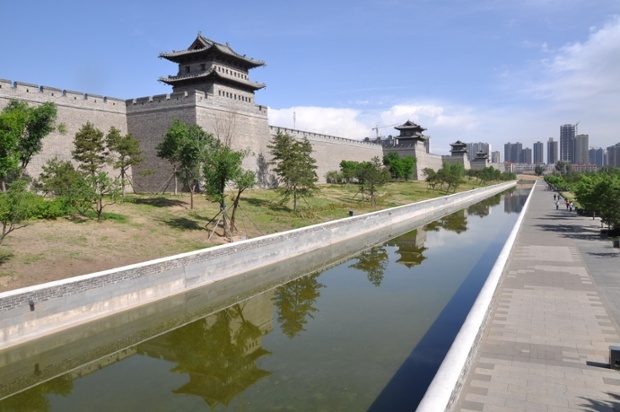
Datong's new-old and virtually deserted city wall, one gate garlanded with streamers advertising housing estates outside town. A mosque which claims to be China's oldest continually operating - since 628! One of several brand-new old structures. The view from 华严寺 Huayan Temple's pagoda shows the new old city and the condemned old town; a Liao dynasty assembly which somehow survived the destruction of most of the rest of the temple; and someone hiding inside a little shrine in front of Huayan's great old bird poop-spattered hall. A Datong dumpling specialty. Oh, and at the top, red onions at a street market.

Saturday, June 20, 2015

在爱里我们在一起

My travels are nearly over... but not quite. I'm spending the long weekend (Monday is the Dragon Boat Festival) at a queer Christian retreat at Sheshan, Shanghai's holy mount. And I hope to touch base again with Nanjing... I'd pledged to myself a return visit to its museum, and now that I've imbibed the north's ancient claims to true Chineseness it might be good to give a south older than Shanghai a chance to reply.

Friday, June 19, 2015

Back to Shanghai


Back the slow way - well, what was the fast way before the building of China's vast high-speed rail system. Overnight train from Datong to Beijing West, arriving 4am... then hanging out waiting for subway to start running and Starbucks at Beijing South to open its doors...

Thursday, June 18, 2015

Wutai blue

Wednesday, June 17, 2015

五台山

The primus inter pares of sacred Buddhist mountains, Wutai. MORE

Tuesday, June 16, 2015

Sacred heights


Went south today to see one of the great sights, the Xuankongsi 悬空寺, variously rendered as the Hanging or Suspended or Floating Temple. Dating back to 491 CE it's all of these things! It nestles in the cliff on an old route (now dammed) to Henghsan 恒山, ancient sacred Daoist mountain. MORE

Monday, June 15, 2015

云冈石窟

The Yungang Grottoes, carved 465-525 CE, are a marvel. On a rainy Monday, we found them practically deserted, and managed to dodge tour groups for much of an afternoon. The stillness in a cave after the jangling echo of guides' patter was each time like drinking purest water. Just four photos for now... MORE


Sunday, June 14, 2015

木塔

Saw the thousand year-old wooden Pagoda at Yingxian 应县木塔 - one of the world's three great pagoda wonders 世纪三大奇塔 (along with those of Pisa and Eiffel!) - as well as China's oldest and world's tallest such wooden structure. There's nothing much else for miles (perhaps how it survived so long?), but a veritable forest of souvenir scale models. MORE

Saturday, June 13, 2015

Old-new

Datong's early Ming fortified city wall is indeed impressive, but, rebuilt from almost nothing in the last 5 years on vast tracts of long settled land, it feels more like an invasion, a noose around the run-down city being cleared to make way for oldnew temples, palaces, etc. MORE

Friday, June 12, 2015

Big skies

Another quick update: my fourth enjoyable Beijing stay, again under blue skies which no longer strike me as exceptional, ended here today. 6.5 hours in a slow train took us through barren craggy mountains and plains to Datong, whose old city skyline impresses in its newly old way!
Tomorrow we explore Datong, then head into the surrounds in a rented car, returning by overnight train to BJ and SH a week from today. MORE

Wednesday, June 10, 2015

A quick morsel

From a faculty dining hall at Renmin University. My talk here is tonight.

Sunday, June 07, 2015

Hitting the road

I'm about to head off for my final trip this Chinese stay - and as usual feel I'd best let you know in case I can't access the blog while I'm away.
The first four days constitute my fourth trip to Beijing (I give a talk Thursday). But starting Friday it will be new vistas, including the spectacular cliffside temple depicted above. Also on the itinerary are
the oldest of China's Buddhistcave complexes at Yungang, the world's oldest wooden pagoda, of of China's five sacred mountains (itself five mountains, see above), and a recovering coal city, whose ancient city
has apparently just been rebuilt (from scratch!), including a fortified wall with sixty-two watchtowers. I'm due back in Shanghai Friday 19/6.

Friday, June 05, 2015

Food for the eyes

I'm becoming quite the fan of Wechat/ WeiXin/微信 (though I suppose other forms of instant messaging allow similar pleasures). For instance, you can cook for someone - the friend who's putting you up, for instance - remotely. Here are the images I sent him yesterday late morning as Moosewood's famous Armenian lentil soup came together, from fetching vegetables from the local market through final taste test (caption: 不错!). They were sent one by one in real time, perhaps slowing down the cooking process a little, but allowing him to savor what's become one of my signature dishes here from a distance!
WeChat photos of metro junction floors speak louder than words, too.

Thursday, June 04, 2015

Top hits

My friend J had a pretty nice first day in China, I think. She walked the 外滩 Bund on a sunny early morning, then met me to stroll through 豫园 Yuyuan's garden, lovely in every season. Another New Yorker now in Shanghai joined us (at a 星巴克 Starbucks) and we took the 地铁 metro to 新天地 Xintiandi to savor 小笼包 soup dumplings and eye relics of the first meeting of the Communist Party before nibbling the namesake pastry at Sunflour Bakery on 安福路 Anfulu. Before bed then enjoying Yunnan delicacies with my close friends at 人民广场 People's Square...
The shrimp-topped xiaolongbao above look a little like some of the lost phylla I encountered in a 360˚ animation of the ocean floor during the Cambrian Explosion at the 上海自然博物馆 Shanghai Natural History Museum, which I visited on Wednesday morning. No, there's no connection between the Cambrian explosion and soup dumplings, just the temporal proximity of my enjoying them. I could conjure one: it's happened before. Isn't a westerner's first encounter with China not a little like discovering the Burgess Shale?!

Wednesday, June 03, 2015

Over the top

My friend J has just landed. The flight - direct from Toronto - was long but not this long!

Teachable

So my last official duty at Fudan is discharged: last night's talk on the impossible subject of The International Image and Impact of Chinese Spiritul Traditions. The subject was not of my choosing - a friend's rather over-the-top effort to avoid the word "religion," as I recall - but drew an interesting audience who let me distance myself from all the terms of the title and seemed happy enough to think together about what Chinese spiritual traditions might be, and how they have traveled or might travel beyond China.

The Norton Anthology of World Religions stood me in good stead as an anchor for my reflections. Since the talk was taking place under the auspices of a class, I was able to send out some readings, and chose the final five selections from the Daoism section. They're not meant to stand on their own (there are 118 others in the 700+ page section!) but it turns out they work well as a a mini-set: eminently teachable!
It's not just that they upend received ideas that "Daoism" is some airy-fairy gently paradox-riding nature mysticism inspired by Laozi, though they do that well. (Laozi here is deified, addressed as "August Emperor of the Chaotic Origin," and prayed to for this worldly success!)
The editorial choices and brief introductions also provide a beautiful sketch of the ways in which Daoist stuff spreads - whether in the Chinese-speaking world through priests (119 is an ordination) or, even more influential, spirit mediums (120 includes the speech of one such), or beyond it through texts (but not necessarily texts produced or authorized by Chinese or Sinologists: 121), the lore of martial arts (122, source of the wisdom at the top of this post), or in the international and national context through the quasi-governmental Chinese Daoist Association (123). We didn't settle the question of "image and impact" but managed to refine it in a manner congruent with current religious studies understandings of how religions work. In fact, one might well use this little bundle of readings to make the general point about religions, not just about Daoism.

The audience, half from the class and half curious members of the general public, got it and ran with it: an exciting discussion about whether there's a religious void in China, whether Confucianism is a religion and/or can exist without hierarchy, whether daily life can be spiritual, whether venerating ancestors is a religious or a cultural practice, whether individualism is compatible with religious practice, etc., etc...

So I was able to deliver a passable religious studies lecture after all. Thank you, Norton Anthology. And thank you, Fudan!

Monday, June 01, 2015

Mircea me


I'm midway between my two parting lectures at Fudan. This morning's was in a survey class on religion anchored in Mircea Eliade 伊利亚德's The Sacred and the Profane, taught by the same generous soul who invited me to speak to the Introduction to Religious Studies course last Fall. My task was to discuss critiques of Eliade, which I did with relish. The class was again long - 100 minutes, so two 45-minute lectures with a break in between.

I spent the first half introducing perspectives on Eliade's life, including the concerns about his fascist sympathies and residues in this thought; as when I teach this in the US I turned the finger of blame back on us - whatever the context for Eliade's activities of the 1930s may have ben in Romania, it's a more pressing question for Americans why his ideas were taken up with such gusto in the 1950s and 1960s. Of course "us" here wasn't Americans but I tried, gently, to suggest the students were entitled and perhaps obliged to ask themselves similar questions, to the extent that they found 伊利亚德's ideas compelling. I hope I didn't sound too much like those who think Chinese universities should avoid inimical
foreign ideas - I was after all putting the responsibility and privilege of critical discernment on the students. I did feel I was not that far from the territory of the anti-Rightist campaigns, though, of clearly exhibiting bourgeois forms of equivocation!

The second part was on sacred space, and introduced the criticisms and alternative understandings of space in J. Z. Smith and Sam Gill - familiar territory for me again, building on Gill's article "Territory" which I have used both in the course on Aboriginal religion and, earlier, the one on religious geography of New York. I think it may have gone a little over people's heads, but perhaps I planted some useful seeds. For understanding both China's Dao-rich past and its hyper-modern present and future, idea of space as movement, performance, journey, encounter may be as congenial as the lore of the sacred center or even the politics of mapping and remapping territories of inclusion and exclusion. In the noble tradition of learning as you're teaching, I made those connections, however tentative, for the first time in putting this lecture together.

Tomorrow night I have to talk about the "International Image and Impact of Chinese Spiritual Traditions" - the picture above shows the poster up at Fudan last week. It's a title I was given and every part of which gives me the heebie-jeebies. But I think I've worked out a way to put it to good use... I'll let you know how I fare! The audience will be mostly international graduate students, unlike today's Chinese undergraduates, so more discussion is likely to ensue in any case.