Saturday, January 21, 2023

Inhabiting ideals


Today the Event Cafe at The New School's University Center, the hub of the One New School occupation which has just recon-vened, was festooned with quotations from the 1918/19 "Proposal for an Independent School of Social Science for Men and Women," a document which inspires an anachronistic originalism in many readers. They'd selected passages I often focus on, and others I'd forgotten about. 

My New School history partner J and I were part of the restart, tasked with describing "New School History and Values" in thirty minutes. We focused on earlier crises, the unintended consequences of heady ideals, and what unexpected things their resolutions brought about. 

The first was 1922, when, just three years in, The New School realized it couldn't make do without an administration after all. The second was Parsons' 1970 bankrupty crisis, solved by a merger with The New School which fatefully changed the trajectories of both. And then there was the 2008-9 faculty vote of no confidence in the mercurial president who had set out to unite the disparate parts of the university. (He didn't leave until the end of his term, though.) 


I'm not sure this was quite what the organizers - committed among other things to bringing about an administration-less New School through no confidence votes in senior leadership - had in mind. But people are always happy to learn anything complicated and contingent about New School history, and to know they're not the first to be wrestling with the messy legacies of a mess of glorious ideals.


The rest of the morning was also devoted to "education." Over zoom a professor at a university in Argentina which has, for three years, attempted a kind of participatory decision-making, shared their experience. Two seniors in the Fine Arts Department shared an eloquent proposal for a revisioning of their program to free them from individualizing and careerist structures of thought and relationship - and invited every department and school to do the same. And a draft of a blueprint for carving out a fundamentally new New School, building on discussions during December's occupation, was read.


I didn't stay for the afternoon, dedicated to working through and honing the blueprint. I'll be interested to see if the Event Cafe and the incredibly generative and galvanizing discussions it's played host to through the Occupation, will change the university's center of gravity as we enter the uncharted waters of a new semester. Humpty TNS Dumpty is in pieces, and needs all the help he can get.

Friday, January 20, 2023

Double takes


Two glimpses from exhibitions: an anonymous trompe-l'oeuil at the Met (not an engraving, not paper, not wood); 7000-year-old female figurines from the Institute for the Study of the Ancient World.  

Pollards

A visit to the Met today provided a chance to check in with its 
pollarded London Planes, gnarly knobs fingering future foliage

Thursday, January 19, 2023

Precipitation

.. but New York City has yet to see winter white this season

Wednesday, January 18, 2023

Visions

A visit to the Morgan Library for a lunchtime concert provided a pretext to check out their current exhibitions. "She Who Wrote: Enheduanna and Women of Mesopotamia, ca. 3400–2000 B.C." is a marvel, building around the figure of priestess and poet Enheduanna, the first surviving author in history, a treasure chamber of images of Sumerian and Akkadian women. The goddesses are familiar but these images of 

women - some of whom the exhibition argues are portraits of individuals - are something different. Consider the woman seated 
with a cuneiform text on her lap (c. 2112-2004 BCE) above, or these scenes of weavers (c. 3300-3000 BCE), an all-female sacrificial scene (c. 2334-2154 BCE) or an all-female banquet (c. 2500 BCE). Even some of the images of goddesses - like this one from c. 2400 BCE - seem like real women!

Had less time for the other exhibits, but enjoyed the drawings of Georg Baselitz, most of which, starting in 1969, he deliberately painted upside-down, allowing him (and viewers) to focus on painting itself without abandoning the figurative; this is Waldweg (1976).

And, keeping with the (inevitable!) theme of trees, here's one of the early drafts of Antoine de Saint-Exupéry's Le Petit Prince, entitled "The little prince on a planet invaded by a baobab" (1942).

Monday, January 16, 2023

Shining bridge

The George Washington Bridge illuminated for the MLK holiday.

Sunday, January 15, 2023

All the company of Heaven

In church this season, we're using liturgical language from Enriching our Worship, a supplement to the Book of Common Prayer approved in 1997 which offers feminist theological alternatives to masculinist language. The celebrant leads into the Sanctus with these words:

All thanks and praise are yours at all times and in all places, our true and loving God; through Jesus Christ, your eternal Word, the Wisdom from on high by whom you created all things. You laid the foundations of the world and enclosed the sea when it burst out from the womb; You brought forth all creatures of the earth and gave breath to humankind. Wondrous are you, Holy One of Blessing, all that you create is a sign of hope for our journey; And so as the morning stars sing your praises we join the heavenly beings and all creation as we shout with joy: ...

This takes the place of the by comparison rather staid Rite II.

It is right, and a good and joyful thing, always and everywhere to give thanks to you, Father Almighty, Creator of heaven and earth. Therefore we praise you, joining our voices with Angels and Archangels and with all the company of heaven, who for ever sing this hymn to proclaim the glory of your Name: ...

It's more than a restatement! Not only do we abstract from "Angels and Archangels"; creation involves aa birth! But I found myself confused by the syntax today. Is it the sea or the world that "burst forth from the womb," and, in either case, whose?

Saturday, January 14, 2023

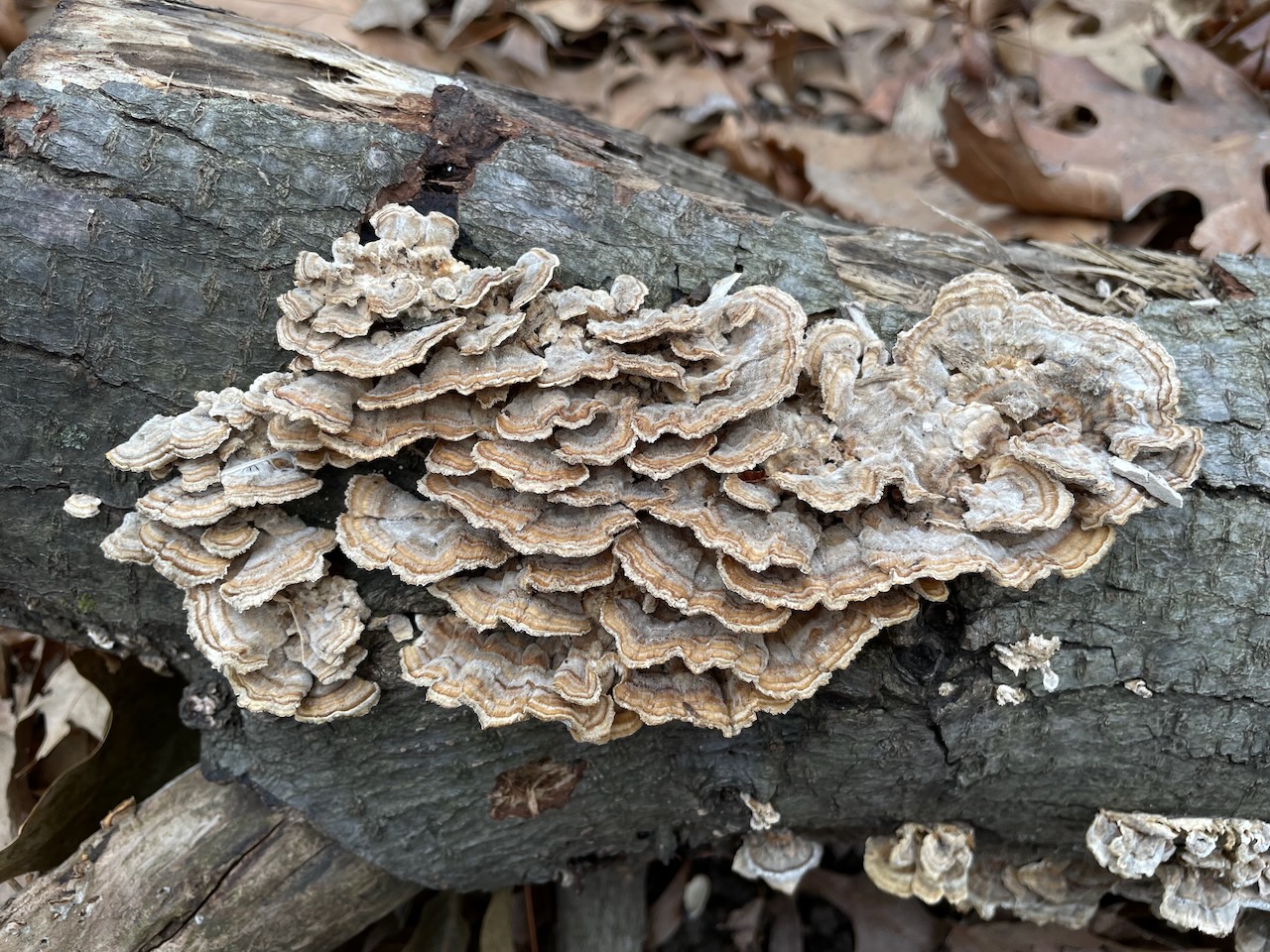
Fungal flourishing


Friday, January 13, 2023

Need for roots

In a fascinating reflection on the mismatch between the persistently Christian affiliations of Congress and the citizenry it is supposed to represent documented in Pew's biennial survey, Diana Butler Bass (whom you've seen here before) has some powerful insights. And she ends them, as she does many of her reflections, with a lovely poem. 

Among the insights, I was particularly intrigued by her parsing of the particulars of Congress' changing Christian affiliations.

Thirty Democrats identity as “unspecified/other Protestants” (11.4% of the total Congress) while a whopping 77 Republicans do (28.4% of the total Congress). Together, the “non-denominational” and “unspecified Protestants” account for the greater numbers of Christians in the Congress (a rise of 14% over the last Congress). 

The main takeaway from this is that while the percentage of Christians in Congress has risen, their ties to traditional Christianity have loosened. That means Christian members of Congress are most likely less influenced by the arguments about church and state honed over generations by thoughtful political theologians and Christian ethicists of the past and more likely to be swayed by the influence of local pastors and popular religious movements. While some politicians may still care about what Thomas Aquinas, Martin Luther, John Calvin, Roger Williams, Elizabeth Cady Stanton, Jane Addams, Walter Rauschenbusch, Dorothy Day, Reinhold Niebuhr, Martin Luther King, Jr., Joseph Bernardin, or Oscar Romero (to name a few) wrote about religion and politics, most do not. 

Of course, the older traditions don’t have all the answers to contemporary questions, but they provide frameworks, ballast, and wisdom for political life and the common good — as well as practices of decision making that allow for humility, self-correction, and the inclusion of new voices. ... 

The religiously unaffiliated aren't the only ones who've come unmoored from traditions - and at least they know they have!

Butler Bass's main point in her reflection is that we - especially those who are members of progressive Christian traditions - need to talk about religion and politics, famously a taboo topic. Not easy. To this end she quotes a poem by Adrienne Rich called "What Kind of Times Are These" (hear the author read it here.).

There's a place between two stands of trees where the grass grows uphill
and the old revolutionary road breaks off into shadows
near a meeting-house abandoned by the persecuted
who disappeared into those shadows.

I've walked there picking mushrooms at the edge of dread, but don't be fooled
this isn't a Russian poem, this is not somewhere else but here,
our country moving closer to its own truth and dread,
its own ways of making people disappear.

I won't tell you where the place is, the dark mesh of the woods
meeting the unmarked strip of light—
ghost-ridden crossroads, leafmold paradise:
I know already who wants to buy it, sell it, make it disappear.

And I won't tell you where it is, so why do I tell you
anything? Because you still listen, because in times like these
to have you listen at all, it's necessary
to talk about trees.

I might need to borrow those last lines for my tree project... 

Thursday, January 12, 2023

Hare brained

Have you heard? Lunar new year starts next week! But all is not as festive as this display in the northeastern city of Shenyang suggests.

In a rare acknowledgment that the Chinese government's abandonment of its people to covid is taking a big toll, citizens have been encouraged not to visit elderly relatives who have not already been infected. “You have all kinds of ways to show you care for them," Guo Jianwen, a member of the state council’s pandemic prevention team, reportedly said, "you don’t necessarily have to bring the virus to their home.” 

The true extent of the calamity is impossible to know. Estimates of five to nine to fifteen thousand dead a day can't be tested, but the official death toll of a mere forty in the last month is breathtaking in its mendacity. Everyone must know it's untrue, but the system is banking on nobody's being able to say with any certainty how untrue. Cynical but brutally effective. I can't but think of the words for which Chloe Zhao's Oscar 2021 triumph was censored in her homeland, that the PRC is "a place where there are lies everywhere."

The authorized story seems to be that, after waiting resolutely until it was scientifically safe, China has quickly and decisively achieved herd immunity from a now largely harmless covid variant. For most people, it's a matter of three days of fever and then they're good to go! The other people, the vulnerable, the unprotected? Nothing to see here, move right along! 

No doubt a coup if it were really true. But how could anyone come to think it was true? Maybe leaving the dead uncounted will be counted "scientific" in a different sense, in terms of a "scientific Marxism" which accepts the deaths of untold victims as part of the historical dialectic. It's happened before. Will they get away with it again?

Wednesday, January 11, 2023

Exhibits

Mid-January, before the new semester begins, is always my chance to catch the exhibitions I missed in the fall, just before they close. This time I saw the big David LaChapelle retrospective "Make Believe" at the New York branch of international photography museum Fotografiska 
(here are "The earth laughs in flowers: Early fall" [2008-11], "Transfusion" [2014] and "1 Samuel 18:1: ... the soul of Jonathan was knit with the soul do David and Jonathan loved him of his own soul" [2021]) 
and the rediscovery of the work of Morris Hirshfield at the American Folk Art Museum. LaChapelle's works are easily recognizable, though the exhibition helped me see that they carry a spiritual intention I hadn't guessed. Hirshfield's untrained works, celebrated by the surrealists and enjoying a brief moment of fame in a solo show at MoMA, is harder of approach.
The sublime "Stage girls with angels" (1945) boasts what may be the only row of angels I've ever seen from behind, but when Hirshfield's 
definitely not-from-life women pose in front of mirrors, as in Peggy Guggenheim's favorite, "Two women in front of a mirror" (1943) and "Inseparable Friends" (1941), back and front go out the window entirely! 
I give the last word to the patterned world of "Zebra family" (1941). 

Tuesday, January 10, 2023

Carrots and sticks

It's syllabus time again! How much can you fit in, how, and where?

Monday, January 09, 2023

Tributary

I've gone a few years without a ready answer to the "what are you working on?" question. For a while I offered the rueful if hopeful "I'm between projects," but really I was waiting for the next project to assert itself. 

What am I working on? In recent years I've described my interests as having moved from philosophy, ethics and theory of religion in the direction of the newer field of religion and ecology. I'm not part of any scholarly (or unscholarly) tribe, though, and my training leads me to chip away at any general term like ecology or - especially - religion! Why suppose any of these terms, each emerging from contingent and contested histories of definition and exclusion, can help us see beyond the limitations of our forebears, the structural biases of our cultures, the ideological torque of "the academy"? My reflection and teaching on the Anthropocene didn't help, raising questions about the salience and sustainability of even relatively new concepts and fields before itself crumbling under questioning!

So it's not without trepidation that hereby plight my troth to "Religion of Trees" as what I am working on, the next project etc.! I have to stop myself from adding scare quotes to its constituent terms, at least at first. It may be the interference patterns of those two rarely conjoined terms that make it an intriguing topic to people I mention it to. I'm going to try to write a short blog essay on some element or issue in the interference pattern each week this semester.


This isn't quite the first such post, but this picture - taken on north Torrey Pines Beach last week - can serve as a promissory note. That's not a tree, of course, and yet it looks that way to us. It tells us that there's something to the form of trunk and branches that may apply to more than trees! But this pattern in the sand is also delightfully unlike a tree. What I've learned is known as "dendridic drainage" starts not at the "trunk" but in the tributary "twigs," which flow together to form "branches" on their way to converging as a "trunk." Quite different from the way trees grow - if not from the way many people draw trees). What to make of this? Is "this" even a thing? More soon!

Sunday, January 08, 2023

Slice of life

or was that spice?

Saturday, January 07, 2023

New year's hopefulness

Governing over gaslighting

While Republicans struggle to get to Square One in the House Speaker vote, it was refreshing to hear the new minority leader, Rep. Hakeem Jeffries, go full alphabet on them:

House Democrats will always put American values over autocracy, benevolence over bigotry, the Constitution over the cult, democracy over demagogues, economic opportunity over extremism, freedom over fascism, governing over gaslighting, hopefulness over hatred, inclusion over isolation, justice over judicial overreach, knowledge over kangaroo courts, liberty over limitation, maturity over Mar-a-Lago, normalcy over negativity, opportunity over obstruction, people over politics, quality of life issues over QAnon, reason over racism, substance over slander, triumph over tyranny, understanding over ugliness, voting rights over voter suppression, working families over the well-connected, xenial over xenophobia, ‘yes, we can’ over ‘you can’t do it,’ and zealous representation over zero-sum confrontation.

Even learned a new word, "xenial"! We'll need all resources we can find to resist the toxic dysfunction on the other side of the aisle, where a fringe of a fringe is holding hostage a paper-thin minority committed to paper-thin principles and intent only on disruption.

Friday, January 06, 2023

Lectured on theology by a machine

I've been enjoying Becky Chambers' A Psalm for the Wild Born, a Hugo-winning novela recommended by a student who took my "Religion and the Anthropocene" course a while back and thought I could use something hopeful. It's a kind of speculative fiction new to me, known as solarpunk, which imagines - and makes imaginable - a future where fossil fuels, oppression and capitalism have given way to sustainable ways of living in harmony with the natural world.

This story takes place on the habitable moon of another planet, where humans and robots, who had become conscious, amicably parted ways two centuries before. The humans live in bucolic renewable energy-sourced peace in one region, while the descendants of the robots inhabit a "wilderness" region. There's been no contact between the two populations until a human, named Dex, restless in their life as a monk for one of six gods the community venerates, sets off in quest of an abandoned hermitage in the wilderness. On the way they encounter Splendid Speckled Mosscap, a third-generation robot, composed sustainably of repurposed pieces from earlier robots, who volunteered for a mission to find out what humans need. A series of gently deep philosophical conversations ensue as they make their way to the hermitage, including some about religion.

Mosscap pointed to the wagon. "These symbols - I should've realized." It quickly stood and walked over to study the mural. "The bear, yes, and the All-Six Sigil, yes, yes, of course." It ran its finger over a stripe of paint. "The symbols are there; I just didn't recognize them. The style is so different." It knelt down, following the colorful swirls. "So much has changed from what we recorded," the robot said quietly.
    Dex's brow furrowed as Mosscap stood in contemplation of the artwork. "I didn't expect you to know the gods."
    "If you mean the custom of human religion, we know everything we observed of you during our time together. But as for the gods themselves, they're everywhere and in everything," Mosscap smiled at Dex. "Surely you know this." 
    "Yes," Dex said tersely. They weren't about to get lectured on theology by a machine. "But just because a bird or a rock or a wagon follows the gods' law doesn't mean those things know the gods are there."
    "Well, I'm not a bird, or a rock, or a wagon. I think like you do. Which makes sense after all. Someone like you made us. How could I think any other way?" ([NY: Tor, 2021], 60)

I'm tempted to bring this slyly profound passage into "After Religion." There's a segment of the class looking at "religion beyond the human" in robots, algorithms and AI, and students have found the questions particularly engaging. But before that I'll need to read the second volume of the "Monk and Robot Duology," which I've ordered myself for my birthday. 

Thursday, January 05, 2023

Spin

Back to NYC, enjoying a playful new route map program on JetBlue.

Wednesday, January 04, 2023

Hidden colors

This almost surreal scene shows Torrey Pines State Beach after big winter surf has scrubbed the beach of sand and replaced it with rocks - except where it hits the lip of the oyster-filled green Del Mar formation hidden beneath the piled strata of sandstone, which reveal their own caches of secret color as they crumble.

Monday, January 02, 2023

Specters

We managed to walk for two hours in the TPSNR Extension today, in the process happening on two unusual views of the eponymous pines. One tree, midway along the Margaret Fleming trail, is a survivor of a lightning strike. Up close its wound's a sap bejeweled stalactite cavern.


The other, spotted on the Daughters of the American Revolution Trail, looked initially like some kind of distrurbing Sasquatch-like apparition.
On closer inspection, it proved the sandstone-encrusted root of a toppled tree, a towering wraith in the bonefield of the beetle-felled.

Sunday, January 01, 2023

Happy new year!