
Tuesday, August 22, 2023
Decomposition

Monday, August 21, 2023

Sunday, August 20, 2023


Saturday, August 19, 2023


Friday, August 18, 2023
.jpeg)

Thursday, August 17, 2023
Hilary
 Hurricanes and tropical storms don't usually come anywhere near Baja or Alta California, but evidently nobody told Hilary.
Wednesday, August 16, 2023

Tuesday, August 15, 2023

Monday, August 14, 2023
Vertigo

 A friend took us on a quick overnight trip to San Francisco, where he used to live. The city's roller coaster topography was especially gripping as we zipped about in his Cooper Mini; my heart is still in my mouth from going over the precipice of Leavenworth! But what most gripped me was the Palace of Fine Arts, which I'd not visited before, perhaps because my view of the city is shaped in ways I hadn't realized by Alfred Hitchcock's film "Vertigo" (but we did also just go to Big Basin Redwoods). It's a weird place.
  Constructed in plaster and wood for the 1915 Panama-Pacific International Exhibition, architect Bernard Maybeck "designed [it] to evoke the sadness and beauty of looking at a Roman ruin." He might have planned it before the great earthquake of 1906, but the strange statues
of weeping women, their backs to us, their heads and arms hidden, will have had special resonance then. The place was rebuilt in steel and concrete in the 1960s, and now looking more like Roman ruins
 than ever. But what made it increasingly uncanny was the nature around it. This included huge spiky-leaved plants with alien-looking seedpods (giant rhubarb?), red-eared slider turtles, and an overgrown island full of predatory birds (great blue and black-crowned herons) poised to pounce. Very creepy!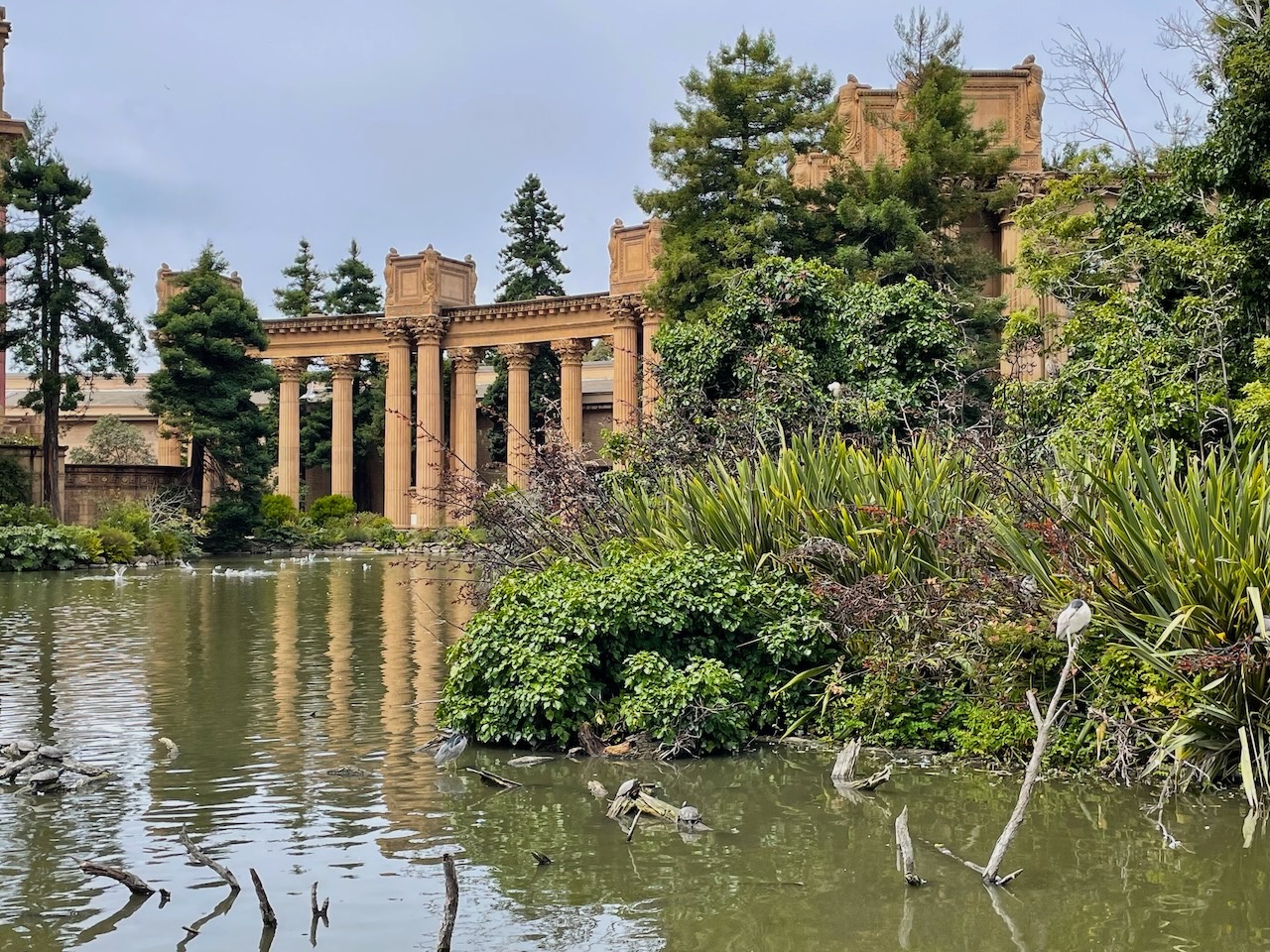
Saturday, August 12, 2023
Sempervivens?

 famously fireproof California redwoods had fallen prey to fire, but three years on most of the trees are apparently recovering!


Friday, August 11, 2023
Agribusiness


Thursday, August 10, 2023

Tuesday, August 08, 2023
UAP


Pine on one side, the edge of the roof, twenty feet away, away on the other - presumably it let the wind from the ocean blow it up there.
.jpeg)
Monday, August 07, 2023

Kingdom of predation
I asked ChatGPT to write a description of a swamp white oak in the style of annie dillard's "pilgrim at tinker creek."
In the quiet realm of the wetlands, where time trickles like honeyed water and the chorus of nature's creatures harmonizes in perpetual symphony, there stands a singular sentinel of grace and resilience: the Swamp White Oak. Annie Dillard herself might have found her heart stirred by the intricate dance of life that this arboreal marvel invites us to witness.
Picture, if you will, a gnarled and ancient oak tree, its trunk wrapped in a weathered tapestry of time, etched with the stories of seasons past. The limbs, like the gnarled fingers of an old sage, extend outward in a gesture of wisdom and benevolence. With each gust of wind, the oak's leaves respond like a choir, rustling in harmonious conversation, revealing the music of existence.
But it is not solely the oak's outward form that captures the imagination; it is the hidden world beneath the surface that truly enchants. Its roots, like curious tendrils, delve deep into the rich, damp earth, exploring the hidden mysteries of the swamp's underworld. They intertwine with the secrets of the soil, forging connections with creatures unseen, a symposium of roots and creatures engaged in a silent dialogue that predates human thought.
In the hush of twilight, when the marshland seems to exhale its final breath before the stars emerge, the Swamp White Oak undergoes a transformation. Its leaves, those same leaves that had whispered in daylight, now become a canvas for the artistry of moonlight. Each leaf becomes a delicate vessel for silvered luminescence, reflecting the celestial glow as if the very heavens were painted in miniature.
And so, dear reader, in the heart of the swamp, where life and death intertwine like vines in an intricate dance, the Swamp White Oak stands as a testament to the enduring beauty of the natural world. It beckons us to ponder the interconnectedness of existence, to hear the symphony of leaves and roots, and to embrace the profound and eternal rhythm that pulses through every living thing. Just as Annie Dillard found revelation in the minutiae of Tinker Creek, so too can we find wonder in the humble, majestic Swamp White Oak – a silent witness to the grand tapestry of life.
I wasn't satisfied with this response: Dillard focuses on the violence as well as the beauty of nature, I wrote. ChatGPT turned on a dime:
In the heart of the wild, where beauty and brutality dance an intricate duet under the watchful eye of nature's unyielding gaze, stands the Swamp White Oak - a paradoxical emblem of both splendor and savagery. Annie Dillard's discerning lens would surely have captured the intricate interplay between these contrasting forces that shape the life of this ancient sentinel in the swamp.
Imagine the gnarled visage of the oak tree, its twisted limbs like contorted contenders in a relentless battle for light. These branches, adorned with leaves as delicate as a butterfly's wing, bear scars and wounds inflicted by storms that have raged through the seasons. Dillard's pen would have traced the stories etched upon the oak's rugged bark - tales of survival and resilience, eternally entwined with the primal violence that courses through the veins of existence.
In the mire beneath the oak's roots, a kingdom of predation unfolds with every ripple on the surface of the water. The swamp's murky depths conceal a relentless cycle of life and death, where the struggle for sustenance is both cruel and essential. Amidst the verdant expanse, predators prowl, and prey retreats, forever enacting the primal ballet of survival. Dillard's poetic prose would articulate the rawness of these encounters, finding in them not just brutality, but an inherent order amidst the chaos.
As twilight descends upon the swamp, the Oak's canopy transforms into a stage where shadows and moonlight waltz in intricate choreography. But even in this ethereal display, there is a hint of menace, a reminder that the beauty we adore can cast a shadow that conceals darker truths. In Dillard's voice, the moonlight would become a spotlight on the stage of existence, illuminating not only the grandeur but also the harsh edges that define the boundaries between life and death.
In the brush of wind against leaves, in the rustling underbrush that may herald a predator's approach, Dillard's adept prose would unravel the tension between the serene and the savage. The Swamp White Oak stands as a living testament to the duality of existence - an embodiment of both creation and destruction, tenderness and ferocity. In the spirit of Annie Dillard, we are compelled to not only embrace the beauty of nature's ballet, but to also recognize the dissonance and discord that give it depth and meaning.
Stunned, I couldn't resist adding: What about the "tree with the lights in it"?
In the midst of the swamp's shadowy embrace, where the pulse of life beats like a heart and the tapestry of existence weaves its intricate threads, stands the enigmatic "tree with the lights in it" - a revelation waiting to be unveiled in the spirit of Annie Dillard's perceptive prose.
Imagine a Swamp White Oak, its gnarled form a testament to the ages it has witnessed. But what sets this oak apart is not just its physicality, but the luminous aura that emanates from its very core. Dillard's words would paint a portrait of this arboreal wonder, a masterpiece fashioned from the dance of light and shadow, beauty and mystique.
As day succumbs to the tender caress of dusk, a metamorphosis takes place. The oak's leaves, bathed in the ethereal glow of moonlight, become iridescent gems, each one radiating a delicate luminescence. These "lights," as Dillard aptly coins them, are not mere reflections but the tree's soul, aglow with a quiet brilliance that speaks of secrets whispered by the universe.
The "tree with the lights in it" becomes a beacon in the obscurity of the swamp, a guiding star for those attuned to the subtleties of nature's rhythms. Dillard's words would unravel the layers of symbolism, delving into the juxtaposition of light against darkness, revealing how even in the murkiest corners of existence, there exists an iridescent magic waiting to be discovered by those who dare to truly see.
In this luminous spectacle, Dillard's prose would echo with the awe and wonder of a seeker standing before a sacred mystery. The tree's illumination becomes a metaphor, a profound reminder that even in the midst of life's trials and tribulations, there exists a luminescent core that defies the encroaching shadows. It speaks to the resilience of the spirit, the undying spark that persists amidst the storms that rage around us.
Annie Dillard's pen, like a brush dipped in moonbeams, would paint a portrait of the "tree with the lights in it" that transcends the tangible and touches the sublime. It would unveil not just a natural phenomenon, but a profound insight into the delicate balance between beauty and enigma, fragility and endurance - a masterpiece that evokes contemplation and reverence in equal measure.
I'm relieved. This is clearly bullshit again, though only readers of Pilgrim at Tinker Creek will know.
Sunday, August 06, 2023

Saturday, August 05, 2023
ROM

Some friends took us to a new art center up the Hudson informed by the work of a Japanese abstract painter named Kikuo Saito. He was part of a world of kindred artists, each of whom is represented by one work. We liked this sculpture by William Noland, called "Read Only Memory" (1985-86).
Overview


 (The plumes of smoke from distant fires were new.) It did occur to me, though, as I gasped with slow rapture at majestic water patterns etched in even the flattest-seeming of dry terrain, that it's a little incongruous that a child of landscapes like these should be thinking new thoughts the gift of trees. ... Or not!
Friday, August 04, 2023
Bad trip
I met an old friend at MoMA yesterday, and passed by again the gargantuan digital work of Refik Anadol, "Unsupervised" in the ground floor lobby. Originally scheduled just for a few months last year, it's been extended and extended. As a work of machine-learning AI - it generates a constantly new stream of images from the database of MoMA's digitized collection - it's more timely than ever. It has three modes - lines, liquids, spray - in some of which it's a little easier to catch a flash of a familiar work, in palette or structure, but it's always on the move, never the same, like a fountain, a volcano, a kaleidoscope, a tumble drier.
The concept?
What would a machine dream about after seeing the collection of The Museum of Modern Art? ... As the model “walks” through its conception of this vast range of works, it reimagines the history of modern art and dreams about what might have been—and what might be to come. In turn, Anadol incorporates site-specific input from the environment of the Museum’s Gund Lobby—changes in light, movement, acoustics, and the weather outside—to affect the continuously shifting imagery and sound.When I saw it first, at the end of November last year, I found it fascinating and disconcerting. In my diary I wrote: You can’t look away from it’s eyepopping colors and apparent three-dimensionality but are dazzled then exhausted by its relentless movement, with a music of the spheresy soundtrack grabbing and holding you too, the eye frantically looking for meaning or significance or beauty, not sure where to look, everything moving too fast, you’ve missed it, forever.
Since then I've seen it in passing a few times, in February with a visiting cousin, who shot the video above, a little less wowed each time. Seeing it again today, I found it quickly oppressive. What's changed? In November I could still see it as art. In fact that's why my eyes went crazy, seeking to take it in and understand it the way one does a work of art, seeking intention and seeking meaning behind every spot of color, every detail of layout (even if, this being MoMA after all, the meaning was deliberately obscure). That's also why I felt a deep sadness at having missed something.
After eight months of AI lapping at every shore, I just saw the churning guts of an algorithm, spinning out meaningless juxtaposition after meaningless juxtaposition of human-made content chewed beyond recognition. It was interesting enough to look at but nothing was a candidate for significance unless we were sucker enough to think there was one, and I wasn't prepared to play. All "hallucinations." Yes, this makes "Unsupervised" kin to works in the collection, abstract or aleatory, using random or found materials, viewer input or newest technologies, but the joke doesn't seem funny anymore. Why would MoMA give all this work of human genius away?
Thursday, August 03, 2023
Preferred pronouns
By what pronouns shall I refer to trees - in my writing, or in class?

In English, trees are referred to as objects, it. At the very level of grammar, Robin Wall Kimmerer argued, the English language gives us permission to commodify, consume, waste and destroy nature. She has proposed "To stop the age of extinction, let's start by ditching 'it'." But a plant is a who, not a what. We might instead, she suggests, use a new word like ki, inspired by the Anishinaabe word for beings of the Living Earth, Bemaadiziiaaki. To be pronounced like key, it sounds like kin to he and she - and its proposed plural is, indeed, kin! I've tried this in classes before, and, if it initially feels contrived, it comes to feel less so with time. I'm not sure anyone else has actually taken up Kimmerer's proposal, though: in English usage there needs to be an accusative and possessive; I can find no trace of them online. Ki can perhaps serve also as the former but the possessive is harder: ki's? We'll have to work out our own grammar. (I'll try to use it in the rest of this post.)
But we shouldn't assume English speaks for most languages, even European ones. In Latin, trees are feminine. In French and German masculine ... though German's always fun: many tree species are feminine (Eiche, Tanne, Kastanie), at least until you add Baum (O Tannenbaum...). Other languages don't gender pronouns, or do things even more fun. In Japanese, I think, you'd use this/that/those (この木、あの木), maybe also その? In Chinese, I think, you could use the impersonal 它 but might also use the measure word for plants 棵, pronounced ke - (这棵树,那棵树) - not quite ki but close! Knowing some of the students registered for the upcoming "Religion of Trees," I think we can have a fruitful polyglot discussion here.
But there are further pronomial challenges worth working our way through. Ki isn't gendered - any more than it is - but aren't trees themselves gendered? One hears about male and female trees, like ginkgo, to avoid whose smelly fruit cities plant only "males." But gingkos are unusual, unrepresentative of trees as a whole.
Biology textbooks inform us that all trees have male and female parts, sometimes within the same flower - remember anthers (the tips of stamens) and pistils? 75% of the world's tree species are like this, too called cosexual in the pie chart below, hermaphroditic elsewhere. Cherries, magnolias, elms, dogwoods fit here. Another 10% are monoecious, having separate flowers or cones but on the same tree: oaks, walnuts, pecans, cedars, firs...

Only 5% of trees are like ginkgos dioecious, with distinct trees for anthers and pistils; willows, cottonwoods and aspens also belong here (and in practice apples which, while cosexual are "self-incompatible"). The remaining 10% are polygamodioecious (regrettably rendered "polygamous" above), who may have cosexual and monoecious flowers, and include ash trees, mulberries, red maples, mango trees...
It's even more complicated than this, as Catriona Sandilands, coiner of the phrase "queer ecology," points out with delight:
Mulberries, at least white mulberries, Morus alba, are normally dioecious, which means that there are pollen producing, quote, male trees and also pollen receiving, quote, female trees, the female ones being the ones that - having received the pollen - produce berries. But it gets a little bit more complicated because some mulberries in certain conditions are monoecious, meaning that they both produce and receive pollen. So they're both male and female. Mulberries also change sex quite frequently. The mulberry orchardists, to their immense frustration, will discover that a certain proportion of their trees have decided to become male, thereby not producing fruit. And the reverse can also be true...
What if white mulberry, rather than ginkgo, were our point of reference? Neither is representative of trees - most of whom are cosexual - but it gets us closer to appreciating the queerness of all plants from a human vantage point: 75% of tree species, remember, are cosexual! In short, trees are queer. And recognizing the queerness of trees can do more than free kin from misplaced human categories. As young plant scientist Will Dwyer recently enthused,
Plants, like queerness, suggest new ways of being, living and loving. They are bisexual, they are trans, asexual, polyamorous, hermaphrodite and gender fluid. They are other; they are in between, alive like animals but seemingly still as minerals. Plants are everywhere, proud and strong and often hidden in plain sight. Like us, they make their presence known by their gifts to the world: shelter, nourishment, a breath of fresh air. Queerness can be all of those things, too: a home, a family, a source of sustenance.
For that matter, does it still make sense to use the language of male and female for plants at all? Biologists Brad Oberle and Emily Fairchild in a brand-new article have argued for replacing the language of "plant gender" entirely, as not only unhelpful scientifically but pedagogically unfortunate.
Beyond our scholarship, any definition of "plant gender" invites confusion: people have gender; plants do not. We must consider the understanding of gender with which students enter our classrooms. Students who are familiar with sex/gender distinctions that originated in the social sciences and permate popular culture may express discomfort about our usage. They might also feel excluded from our scholarly project. History shows that gendered metaphors in botany pose barriers for inclusion - Linneaus's sexual system had such an effect for generations of women and girls whe could not fully participate in the field. What chilling effect might our practices have on students whose genders to not match their sex assigned at birth? We call on instructors to deliberately engage with students about how language has been used, how it can be confusing, and how we could do it differently.
(These issues aren't just rhetorical. Oberle is listed as being at New College of Florida in the article, but has joined the exodus from the school in the murderous crosshairs of Ron Desantis, sworn enemy of inclusion, and is now at NYBG.)
So maybe we make ki explicitly queer (something Kimmerer might or might not welcome). Indeed trees are queerer even than this. Even the cosexual trees can't do it alone, requiring the ministrations of breezes, insects, birds and bats to get their pollen from the right anthers to the right pistils. (Deborah Bird Rose is eloquent on this multispecies erotics: pollinators need to be lured and rewarded, too.)
This opens up a final fruitful complication in thinking about the appropriate pronouns for trees. In all sorts of ways, trees are multiple. They're part of symbiotic multispecies consortia, not just with the animals who spread kin's seeds but with the mycorrhizae who help kin get nutrients from the soil in the first place. And these mycorrhizae are among the ways kin communicate with other trees, of the same species and others, in the forests where most trees live. Trees aren't individuals at all but multiple, composite, each branch and leaf in some ways doing ki's own thing - even detachable from the "tree" - but somehow linked to the whole.
Our queer ki can't be singular as opposed to plural. Plants may be persons, but not in the ways we imagine persons based on our human experience. Articulating and exploring this will be exciting for our sense of who plants are. And of who we are. And, since the project is called "religion of trees," perhaps even more. I remember my excitement on discovering the way Wil Gafney deals with the question of what pronoun to use for God. Drawing on the language of the Bible she proposes not he or she but she, he, they, One who is three, seven, twelve, many. We might need something like that for trees - and for what kin can teach us about divinity.
(There's another post waiting to be written about the feminization of trees - not only in The Giving Tree and Suzanne Simard-inspired talk of "mother trees" and their "daughters," but in Marderian ontophytology, which inverts without displacing the western association of plants and women with passivity and fecundity.)
Wednesday, August 02, 2023
Roerich


 light, too. Now it feels a little like an underground space, or a space station! (A virtual tour of the old layout is still viewable.) All that said, Roerich's colors still dazzle like presentiments of another world. The sketches - like these for paintings of religious figures (1924-33) - are delightful. And a mosaic company in 2021 executed designs of Roerich's, including the "Tree of Life" above, planned for a memorial to his teacher Arkhip Kuindzhi in 1913.
Tuesday, August 01, 2023

It tolls for you

The ringing phrase comes up in the gorgeous chapter "Seeing," as Dillard writes about a book she found describing the experience of people born blind whom a German doctor had found a way to help see, Marius von Senden's Space and Sight (1932, translated in 1960). One little girl, taken to a garden and asked what she sees, von Senden writes, "is greatly astonished, and can scarcely be persuaded to answer, stands speechless in front of the tree, which she only names on taking hold of it, and then as 'the tree with the lights in it.'" (31)
This is but one of a number of other striking quotations from von Senden's book (Another: One girl was eager to tell her blind friend that "men do not look like trees at all" (31)!), but it's the image that stays with Dillard. She returns to the first girl when she wraps up the chapter a few pages later:
I have to look at the landscape of the blue-green world again. Just think: in all the clean, beautiful reaches of the solar system, our planet alone is a blot; our planet alone has death. I have to acknowledge that the sea is a cup of death and the land is a stained altar stone. We the living are survivors huddled on flotsam, living on jetsam. We are escapees. We wake in terror, eat in hunger, sleep with a mouthful of blood. ... Evolution loves death more than it loves you or me. This is easy to write, easy to read, and hard to believe. ... Are my values then so diametrically opposed to those that nature preserves? ...
When her doctor took her bandages off and led her into the garden, the girl who was no longer blind saw “the tree with the lights in it.” It was for this tree I searched through the peach orchards of summer, in the forests of fall and down winter and spring for years. Then one day I was walking along Tinker creek and thinking of nothing at all and I saw the tree with the lights in it. I saw the backyard cedar where the mourning doves roost charged and transfigured, each cell buzzing with flame. I stood on the grass with the lights in it, grass that was wholly fire, utterly focused and utterly dreamed. It was less like seeing than like being for the first time seen, knocked breathless by a powerful glance. The flood of fire abated, but I’m still spending the power. Gradually the lights went out in the cedar, the colors died, the cells un-flamed and disappeared. I was still ringing. I had been my whole life a bell and never knew it until at that moment I was lifted and struck. I have since only very rarely seen the tree with the lights in it. The vision comes and goes, mostly goes, but I live for it, for the moment the mountains open and a new light roars in spate through the crack, and the mountains slam. (35-36)
As a struck bells continues to vibrate for a long time, the image of the tree with the lights in it comes back and back as the book proceeds.
Pilgrim at Tinker Creek - fifty years old next year! - is ostensibly an account of spending a year closely observing nature at a house on a creek in the Roanoke Valley, Virginia, although it was clearly the work of several years. (Still, she was but twenty-nine when it was published!) It overflows with exquisite descriptions of every kind of life, and by turns literate and visionary reflections on what she sees that compass science, philosophy and theology, but the most memorable are the most upsetting. The book begins with Dillard watching a frog who appears strangely listless, only to see its eyes go blank and its insides be sucked out by a giant water bug - another image that reverberates through the book. Tinker's topic is the mysterium tremendum et fascinans of the natural world, its wonder and its horror. In an afterword from 1999, she describes the book as a theodicy of nature, a movement from a via positiva to via negativa (279).
Perhaps the most powerful chapter, called "Fecundity," is the segue from positive accounts of nature's splendor and intricacy to a deep dive into its cruelty: a grand tour of the staggering waste of seeds and eggs in nature, and parasitic insects - 10% of all known species when she wrote in 1974 - and the variously appalling ways they make life out of the death of their hosts. A theodicy problem indeed! (I included the place where Darwin stumbles on the theodicy problem in a parastic wasp in my Problem of Evil anthology - because of Dillard?)
Dillard is always worth quoting at length:
This direction of thought brings me abruptly to a fork in the road where I stand paralyzed, unwilling to go on, for both ways lead to madness.
Either this world, my mother, is a monster, or I myself am a freak.
Consider the former: the world is a monster. Any three-year-old can see how unsatisfactory and clumsy is this whole bsuiness of reproducing and dying by the billions. ... This view requires that a monstrous world running on chance and death, careening blindly from nowhere to nbowehre, somehow produced wonderful us. ...
Or consider the alternative,
Julian of Norwich, the great English anchorite and theologian, cited, in the manner of the prophets, these words from God: "See, I am God: see, I am in all things: see, I never lift my hands off my works, nor ever shall, without end.... How should anything be amiss?" But now not even the simplest and best of us sees things the way Julian did. It seems to us that plenty is amiss. So much is amiss that I must consider the second fork in the road, that creation itself is blamelessly, benevolently askew by its very free nature, and that it is only human feeling that is freakishly amiss. The frog that the giant water bug sucked had, presumably, a rush of pure feeling for about a second, before its brain turned to broth. I, however, have been sapped by various strong feelings about the incident almost every day for several years. (177-80)
Dillard finds a wonderful way - a via negativa way - beyond this dilemma, in no way resolving it.
Of the two ridiculous alternatives, I rather favor the second. Although it is true that we are moral creatures in an amoral world, the world's amorality does not make it a monster. Rather, I am the freak. Perhaps I don't need a lobotomy, but I could use some calming down, and the creek is just the place for it. ...
Let me pull the camera back and look at that fork in the road in the distance, in the larger context of the speckled and twining world. It could be that the fork will disappear, or that I will see it to be but one of many interstices in a network, so that it is impossible to say which line is the main part and which is the fork. (181-82)
In case we imagine that the trees with the lights in them offer an assurance of a purer world beyond this one - she's earlier asserted On the cedar tree shone, however briefly, the steady inward flames of eternity (81) - she wonders if she can trust her experience.
 That the world is old and frayed is no surprise; that the world could ever become new and whole beyond uncertainty was, and is, such a surprise that I find myself referring all subsequent kinds of knowledge to it. And it suddenly occurs to me to wonder: were the twigs of the cedar I saw really bloated with galls? They probably were; they almost surely were. I have seen these “cedar apples” swell from that cedar’s green before and since: reddish gray, rank, malignant. All right then. But knowledge does not vanquish mystery, or obscure its distant lights. I still now and will tomorrow steer by what happened that day, when some undeniably new spirit roared down the air, bowled me over, and turned on the lights. I stood on grass like air, air like lightning coursed in my blood, floated my bones, swam in my teeth. I’ve been there, seen it, been done by it. I know what happened to the cedar tree, I saw the cells in the cedar tree pulse charged like wings beating praise. Now, it would be too facile to pull everything out of the hat and say that mystery vanquishes knowledge. Although my vision of the world of the spirit would not be altered a jot if the cedar had been purulent with galls, those galls actually do matter to my understanding of this world. Can I say then that corruption is one of beauty’s deep-blue speckles, that the frayed and nibbled fringe of the world is a tallith, a prayer shawl, the intricate garment of beauty? It is very tempting, but I cannot. But I can, however, affirm that corruption is not beauty’s very heart and I can I think call the vision of the cedar and the knowledge of these wormy quarryings twin fjords cutting into the granite cliffs of mystery and say the new is always present simultaneously with the old, however hidden. The tree with the lights in it does not go out; that light still shines on an old world, now feebly, now bright. (244-45)
The earlier passages about the experience, unadulterated by galls, have understandably taken on a life of their own. There are moments of transport and ecstasy in nature which haunt and sustain us, even as we search in vain to regain them, and we remain grateful to have been opened up by them: I had been my whole life a bell and never knew it until at that moment I was lifted and struck. But the complete thought is more complex, like a creek flowing through forks and eddies and back. And the book, going through the cycle of a year (while a writer's decision Dillard later said she regretted) reminds us that the story's not over.
I'm very happy to have reread the book. It remains for me unparalleled in its fearless acknowledgment of the beauty and the difficulty of the world, and the mismatch between our human valuings and the prodigality of death-dealing nature. What to do with such awareness? Later in her life Dillard converted to Catholicism, and then left. Our religions are exploded by the gory glory of life.
But, while the tree with the lights in it is a central character in Pilgrim on Tinker Creek, I have to admit that trees are not. (Any more than Moses' burning bush was primarily a bush.) In Dillard's eyes trees host wonders - especially birds - but are not themselves wonders. 1974 was perhaps too early for a settler American to consider that trees might be persons. (But I too sought the divine shimmering fleetingly through rather than pulsing steadily within trees at Church of the Woods last week...)
Dillard's sense of life is animal. In one place, noticing a tiny translucent leaf on a tulip tree sapling - it reminds her of a newborn gerbil she'd seen recently - she acknowledges being fascinated by the "leafing of trees."
There's a real power here. It is amazing that trees can turn gravel and bitter salts into these soft-lipped lobes, as if I were to bite down on a granite slab and start to swell, bud and flower. Every year a given tree creates absolutely from scratch ninety-nine percent of its living parts. Water lifting up tree trunks can climb one hundred and fifty feet an hour; in full summer a tree can, and does, heave a ton of water every day. A big elm in a single season might make as many as six million leaves, wholly intricate, without budging an inch; I couldn't make one. A tree stands there, accumulating deadwood, mute and rigid as an obelisk, but secretly it seethes, it splits, sucks and stretches; it heaves up tons and hurls them out in a green, fringed fling. No person taps this free power; the dynamo in the tulip tree pumps out even more tulip tree, and it runs on rain and air. (113)
Later on she'll note that each of these six-million leaves has untold crenellations! But does the tree offer a relationship with the mysteries of life? She continues:
John Cowper Powys said, "We have no reason for denying to the world of plants a certain slow, dim, vague, large, leisurely semi-consciousness." He may not be right, but I like his adjectives. The patch of bluets in the grass may not be long on brains, but it might be, at least in a very small way, awake. The trees especially seem to bespeak a generosity of spirit. I suspect that the real moral thinkers end up, wherever they start, in botany. (113-14)
I'm a little stupidly flattered by that last line, but Dillard's spiritualizing isn't really botanical. She has long stopped writing (apparently she paints now), but perhaps a Dillardian sensibility might become more attuned to the lives of trees in our day? In the half century since she wrote, our (well, some of our) understanding of nature has expanded to include symbiosis as well as competition. (But Google in 2023 also tells me that the percentage of known animal species which are parasitic is closer to 50%.) All those mockingbirds and dragonflies and muskrats and locusts and water bugs and horsehair worms and snakes and barnacles are still doing their thing, eating others, reproducing and dying, but they do it with other species, in webs and networks of which, in some way, we may be a part. It's easier to develop awareness of these webs with trees, perhaps?
Annie Dillard, Pilgrim at Tinker Creek (HarperPerennial, 2013 [1974])
Subscribe to:
Posts (Atom)