 Today's actually cold and grey with a threat of rain (promise, more like, for this drought- ravaged land), but my pics, as you'll have noticed, are posted with a certain time lag - and not just that it's Friday lunchtime but blogger will tell you it's dinnertime Thursday!
Thursday, October 19, 2006
More local flora
Today's actually cold and grey with a threat of rain (promise, more like, for this drought- ravaged land), but my pics, as you'll have noticed, are posted with a certain time lag - and not just that it's Friday lunchtime but blogger will tell you it's dinnertime Thursday!

Wednesday, October 18, 2006
Meanwhile back in Melbourne
 People look at me funny when I say I'm interested in learning an Aboriginal language, but I suppose I might do the same to an Aussie who came to the US and wanted to learn a native American language. Perhaps after this stay in Australia, (part of) which is in the midst of a facing up to the history of Aboriginal oppression, I'll respond differently.
It's not as though mainstream Australian culture isn't plenty interesting, of course; witness this billboard for one of the shopping centers in the middle of town! 'Course it might make Leonardo warm to Dan Brown.
Tuesday, October 17, 2006
Ngapartji ngapartji
As part of the Melbourne International Arts Festival (it's nonstop festivals in this town) I went last night to a performance called "Ngapartji ngapartji" (I give you something, you give me something). It's a multimedia storytelling of the experience of Aboriginals from the "Spinifex mob," whose land in the southwest of Australia was used by Britain for nuclear weapons tests, resulting in cancer for many and rootlessness for all. The narrator, Trevor Jamieson, told it through his family's trail of sorrows, and he was accompanied by a choir of old women, a Japanese butoh dancer, an Afghan refugee girl (the first foreigner Jamieson's ancestors met was an Afghan, brought in by the British to tame the desert) - and a language teacher.
We were taught to sing in the Pitjantjatara language:
Tjamu, kami
Mama, ngunytju
Kuta, kangkuru, kulali-ya
Ngangatja tjukurpa nyuntumpa ngalimpa
Nyaakun kulira wantinyi nyangatja?
Grandpa, grandma
Father, mother
Brother, sister, listen all of you
This story is yours, ours
Why have you stopped listening to this one?
The performance is part of a larger project which includes internet instruction in Pitjantjatara, "the oldest language in the world." (http://ninti.ngapartji.org/) There's a group of learners just down Lygon Street... I'm signing up!
We were taught to sing in the Pitjantjatara language:
Tjamu, kami
Mama, ngunytju
Kuta, kangkuru, kulali-ya
Ngangatja tjukurpa nyuntumpa ngalimpa
Nyaakun kulira wantinyi nyangatja?
Grandpa, grandma
Father, mother
Brother, sister, listen all of you
This story is yours, ours
Why have you stopped listening to this one?
The performance is part of a larger project which includes internet instruction in Pitjantjatara, "the oldest language in the world." (http://ninti.ngapartji.org/) There's a group of learners just down Lygon Street... I'm signing up!
Monday, October 16, 2006
Aboriginal art
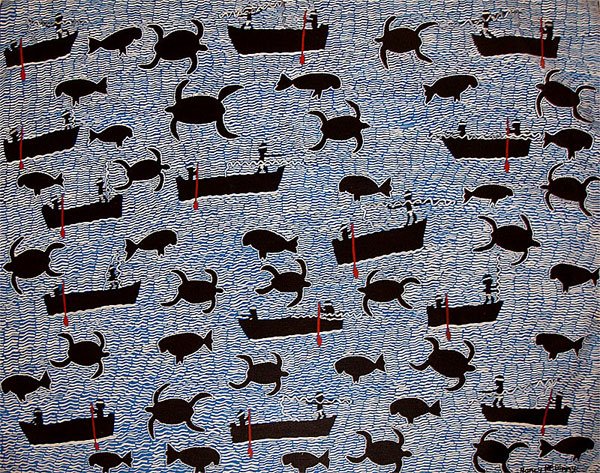 Just found online the image of a lovely work of contemporary Aboriginal art I had the good fortune to see in an exhibit connected to the just-ended Melbourne Fringe Festival (at a gallery called Indigenart): Nancy McDinny's "Dugong and Turtle Hunting." The canvas is quite large and as you swim around in it, fishing boats are as easy (or hard) to make out as turtles or dugong (relatives of the manatee)!
Unsurprisingly, the painting's been snatched up by the Australian National Maritime Museum.
Sunday, October 15, 2006
Landscape zipper
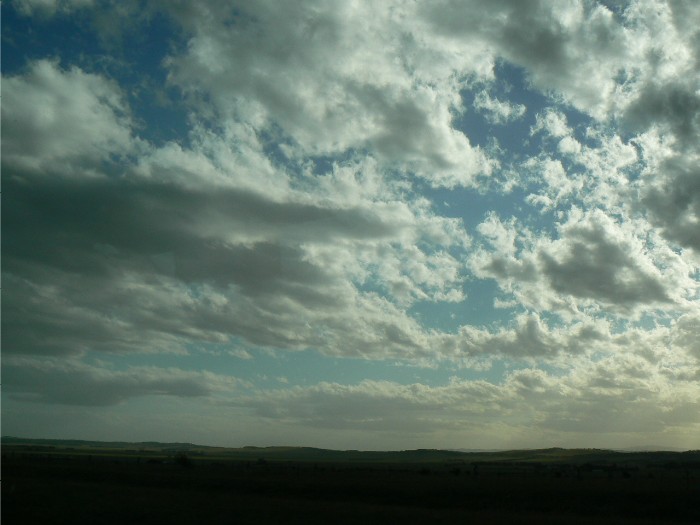 There's not much between Melbourne and Shepparton, leaving plenty of room for sky. All the gums (=eucalyptus trees) sneaking bluffly or cagily by the train window meant I didn't realize the emptiness until I took an evening train which might as well have been in a tunnel for two hours. But from the bus the horizon's far far away and the big sky is visible and endless!
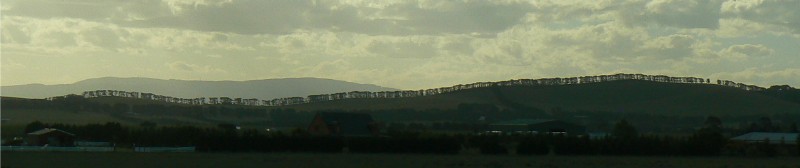
Some interesting phenomena along the horizon eventually when you look more closely, though, a landscape zipper only the white man would think of...
Rural cosmopolitanism
Turns out Shepparton is quite the cosmopolitan country town. In the bus I took back to Melbourne last weekend I was surrounded by Chinese, Italian and Russian speaking passengers. My sister's friends (all mothers in tow to their husband's careers) hail from New Zealand, South Africa, Sri Lanka and Trinidad. An English neighbor lived in Qatar and Boca Raton before winding up here. A little shopping jaunt Saturday morning took my sister and me to a European deli, a fruit and vegetable grocer with five kinds of pasta imported from Italy, and an Indian shop (Sikh) sandwiched happily between two Muslim grocers.  On one of Shepparton's main shopping streets Mustafa's, at left, has a market of Turkish goods, many of which are labeled in Turkish and German.
In fact, it turns out that Shepparton is well known for successful multiculturalism, especially for the settlement of refugees. It has a sizable Iraqi population, another of Macedonians and Albanians, and a new population of Congolese. It makes sense, I guess: refugees from rural areas settle better, and can find work more easily, in an agricultural area than in a city. The Goulborn Valley has long depended on migrant fruit pickers, and seems to be taking well to these populations settling in.
I probably shouldn't be surprised. The latest US census showed that immigrants there no longer head for the big gateway cities, but often go straight to smaller cities and towns. And in Japan I remember hearing that Filipinos and others were being sought to maintain farmlands whose youngsters were bolting to the cities. (Swiss farmers haven't dared think that far.) We tend to hear more about high culture and middle class and suburban trends, but globalization is happening at all levels.
 On one of Shepparton's main shopping streets Mustafa's, at left, has a market of Turkish goods, many of which are labeled in Turkish and German.
In fact, it turns out that Shepparton is well known for successful multiculturalism, especially for the settlement of refugees. It has a sizable Iraqi population, another of Macedonians and Albanians, and a new population of Congolese. It makes sense, I guess: refugees from rural areas settle better, and can find work more easily, in an agricultural area than in a city. The Goulborn Valley has long depended on migrant fruit pickers, and seems to be taking well to these populations settling in.
I probably shouldn't be surprised. The latest US census showed that immigrants there no longer head for the big gateway cities, but often go straight to smaller cities and towns. And in Japan I remember hearing that Filipinos and others were being sought to maintain farmlands whose youngsters were bolting to the cities. (Swiss farmers haven't dared think that far.) We tend to hear more about high culture and middle class and suburban trends, but globalization is happening at all levels.
Saturday, October 14, 2006
Back to work
 After a lovely three days in Shepparton, it's back to Melbourne and back to the books for me. This, by the way, is the (way classy) office the nice folk at the Philosophy Department are letting me use. I may have mentioned that the building, the Old Quadrangle, was the first building of the university campus, started in 1853. (It was 3/4-finished until a few decades ago, which presumably accounts for why the building is represented as an inverted U rather than a square on the map below.) I'm on that computer (a Mac no less!) as we speak. And I may figure out the problem of good on that whiteboard!
Friday, October 13, 2006
Feeling the heat
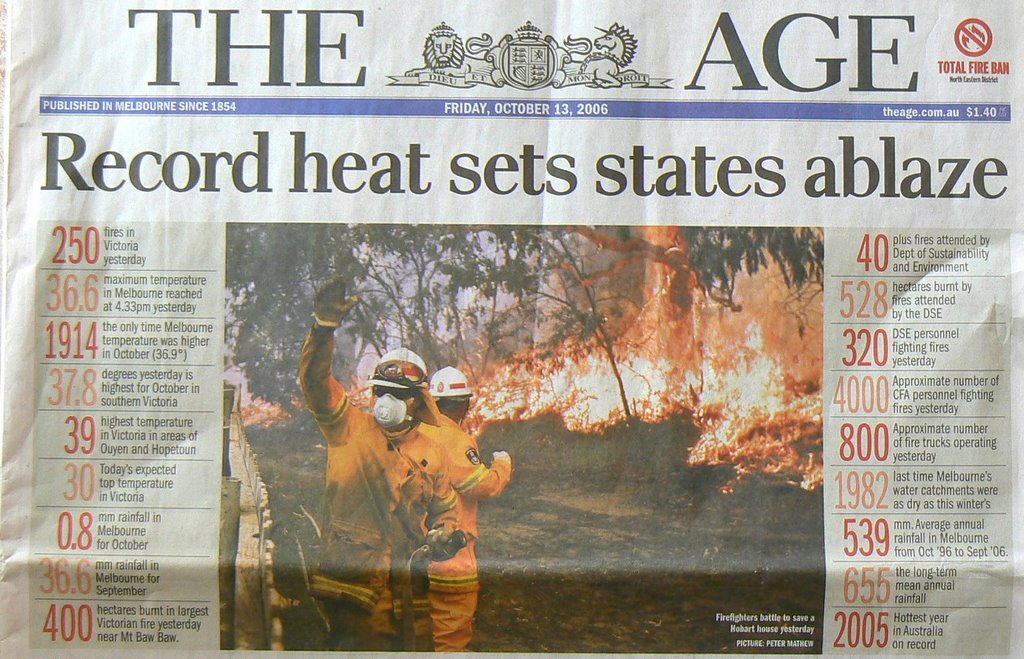 The banner headline in today's Age.
Yesterday's over 36 degrees in Melbourne was the hottest October day since 1914. Nine of the ten hottest years since 1900 have happened in the last decade, 2005 being the hottest of all, thought 2006 is well on its way to giving it a run for its money. 250 bush fires (as they're called here) at a time is not uncommon in the summer, apparently, in a drought they burn faster and there's less water around to put them out. Besides, it's still spring!
I feel the drought more keenly than most Melburnians, since I make my weekly trip to Shepparton. Shepp's the center of the Goulborn Valley, one of the main fruit-growing regions in Australia. And my brother in law is an irrigation engineer. The water shortage is acute - farmer's are getting 20% of what they usually get in water - but the worst thing to happen in my month here was a late frost ("Jack," my brother in law calls it) which nipped half the apricot crop in the bud.
Global warming, we're told, will make hot places hotter and weather everywhere more extreme. Australia, as we're being reminded, is the hottest and driest of the continents...
Thursday, October 12, 2006
Iron lace
 As I was putting up my blinds, I noticed this spiderweb in the iron lace beneath our bull-nosed veranda (to use the terms used in real estate descriptions), unexpectedly marrying two recent images in this blog.
Hope nobody was offended by my description of the spider webs as "hunter gatherer," an unowned allusion to the Aborigenes. I plead guilty to reading everything I see in Australia as related in some coherent way to everything else, despite all my academic training. After nearly a month no question it's a sort of self-indulgence: Roland Barthes' time in "Japan" (described in the infuriatingly wonderful Empire of Signs, our best show and tell of the impossibility of distinguishing "nature" from "culture" in a new place) was only three weeks.
At what point does a suggestible openness to reading everything in a new place as significant, a sign, shade into a refusal to acknowledge the otherness of the other place, the messy webs of thought (and thoughtlessness) which even the finest ethnographer or historian would require years to make out? The issues are only trickier here, where it's so easy to ellide the Aborigenes and the "Australian nature" against which Australia's sea-facing coastal cities define themselves (supposedly) as "culture." Sometimes a spiderweb (or a snail trail) is just that.
Wednesday, October 11, 2006
I just love spring breeze
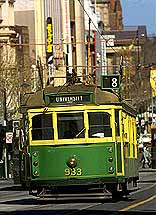 Said our tram driver today, in a gravelly Isaac Hayes-like voice, causing all to smile to themselves and then to each other: "It's a lovely afternoon. ... (Latrobe Street: Melbourne Central, State Library, RMIT) ... I just love spring breeze! ... (Victoria Street) ... This is my last trip through the city. ... (Queensberry Street) ... My day is about over. ... (Grattan Street: Royal Womens Hospital) ... (Melbourne Uni, last stop) ... I'll see you tomorrow, insha'Allah."
Monday, October 09, 2006
Great neighborhood!
So here's the neighborhood where I live! It's just over ten minutes' walk door to door from home [450 Lygon Street, Carlton, VIC 3053, no junk mail please] (on the map just under the es of St. Jude's Anglican) to my office on campus (on the left edge of the map, halfway down, just left of the ME of MELBOURNE).  Other places of note even closer by include Victoria's biggest used bookstore, just around the corner on Elgin Street (where the map says Percy's Bar & Bistro) and the Nova Cinema (south another block on Lygon Street), whose fifteen screens show everything you could possibly want to see. You'll notice that that stretch of Lygon Street has broad sidewalks - it's back to back cafes and restaurants, most of them Italian (this was once Melbourne's Little Italy), along with the Readings bookstore and its multinational rival with the facetious name Borders. Downtown (the CBD) is about five minutes' ride by tram (the dotted red lines) to the south.
Speaking of the Nova, I saw a superb film there yesterday, Rolf de Heer's "Ten Canoes," developed and performed by members of the Ramingining community, Aborigines from Arnhem Land in the swampy north of Australia. The story is narrated by the eponymous Aboriginal actor David Gulpilil, and while addressed to a European audience uncompromisingly presents an Aboriginal story, which grows like a tree outward and not just towards a climax, all played in an unspoiled Australia on which Europeans might never have set foot. Part of what makes the film so effective is the way de Heer uses specifically cinematic effects, fading in and out of black and white, extreme closeups which look like photographs (even, sometimes, European ethnographic photographs from the 19th century), etc. to underscore the weave of the narrative.
"Ten Canoes" has only recently come out here, so may take a while coming to a cinema near you (it won the Special Jury Prize at Cannes this year, so it will come) but when it does - go see it!
 Other places of note even closer by include Victoria's biggest used bookstore, just around the corner on Elgin Street (where the map says Percy's Bar & Bistro) and the Nova Cinema (south another block on Lygon Street), whose fifteen screens show everything you could possibly want to see. You'll notice that that stretch of Lygon Street has broad sidewalks - it's back to back cafes and restaurants, most of them Italian (this was once Melbourne's Little Italy), along with the Readings bookstore and its multinational rival with the facetious name Borders. Downtown (the CBD) is about five minutes' ride by tram (the dotted red lines) to the south.
Speaking of the Nova, I saw a superb film there yesterday, Rolf de Heer's "Ten Canoes," developed and performed by members of the Ramingining community, Aborigines from Arnhem Land in the swampy north of Australia. The story is narrated by the eponymous Aboriginal actor David Gulpilil, and while addressed to a European audience uncompromisingly presents an Aboriginal story, which grows like a tree outward and not just towards a climax, all played in an unspoiled Australia on which Europeans might never have set foot.
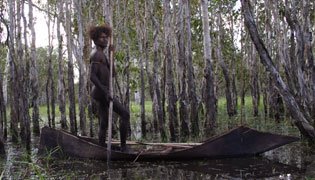 Part of what makes the film so effective is the way de Heer uses specifically cinematic effects, fading in and out of black and white, extreme closeups which look like photographs (even, sometimes, European ethnographic photographs from the 19th century), etc. to underscore the weave of the narrative.
"Ten Canoes" has only recently come out here, so may take a while coming to a cinema near you (it won the Special Jury Prize at Cannes this year, so it will come) but when it does - go see it!
Sunday, October 08, 2006
Jude and Barnabas
 Well, Saturday was my first night in my new room. It's unfurnished, so it was just a sleeping bag on a housemate's extra mattress on the floor, in the striped light from the ratty rattan blinds of my predecessor. Imagine my surprise next morning on peering out of the sleeping bag and seeing a church! I knew St. Jude's Anglican was across the street, but never expected it would try to lodge itself in my window. (No worries, I'm getting Venetian blinds today.) "For heavens sake don't go there!" said the folks at St. Peter's Eastern Hill, the Anglo-Catholic church I've been attending, when I told them. I gather St. Jude's is closer in approach to what the vicar of St. Peter's calls "darkest Sydney," the stridently evangelical part of the Anglican Church of Australia.
Finding a church (and one called Jude!) looking in my window took me back to 1986-87, the last time I shared a house with someone. That was in Jericho, a working class part of Oxford, and it was my last year of college, and out the window of my second-storey room was the dirty brick wall of St. Barnabas Church. (You can see the edge of the house I lived in on the left in the watercolor at www.sbarnabas.org.uk, the red brick one, though the facade was painted.) St. Barnabas is a leading Anglo-Catholic parish but I didn't know what Anglo-Catholic meant at the time; I didn't even know what the Oxford Movement was! I think I looked into St. Barnabas once, and thought it looked neo-Byzantine. I kept clear not just because I was (Roman) Catholic, but also because I knew that St. Barnabas was where the grim final scenes of Thomas Hardy's Jude the Obscure took place.
My experience of St. Barnabas was confined to the brick wall out my window, with a cross in the tan colored brick, and the gappy melody of its automatic carillon - gappy because pigeons roosted in the belfry, and must occasionally have got stuck in one or other of the bells. You'd hear not the ecdg...gdec familar from Big Ben (and Japanese schools) but, say, e..dg...gde.. or ec..g...g..ec!
Saturday, October 07, 2006
Web
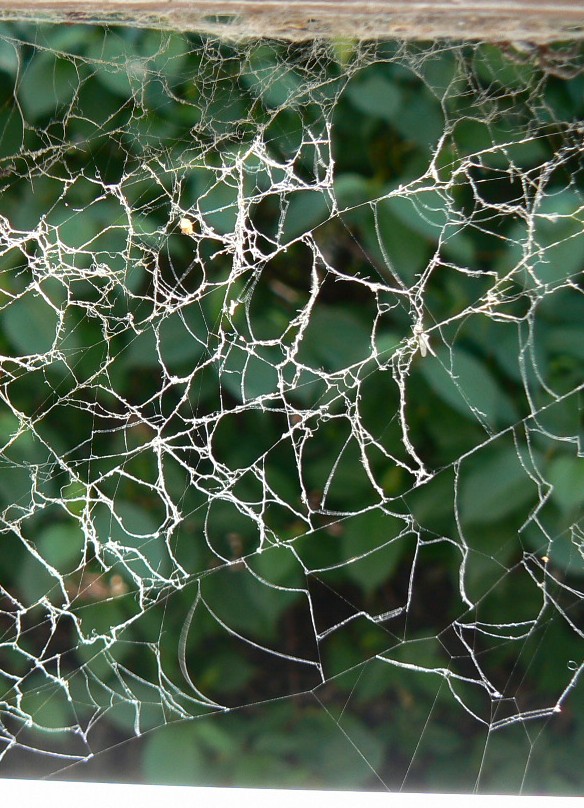 I've seen spiderwebs of decidedly different design here than those I'm accustomed to. (This one's on the campus of Melbourne Uni, but I've noticed the same on my sister's Hills Hoist.) Doesn't seem quite as "rational" as our clockwork-like spiders (are spiders rational?), indeed it seems more of a hunter-gatherer approach. But it evidently does the trick, catching and holding what it needs to catch and hold, and can fill an opening of any shape with a web of uniform density.
Sheepish
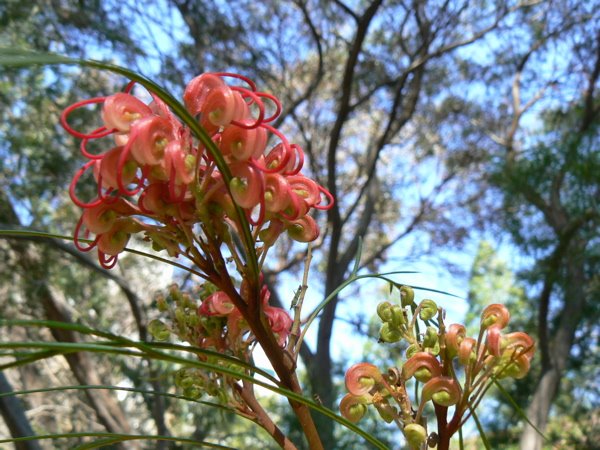 Some native flora, and a thought from Kate Grenville's smashing novel of first contact, The Secret River: A kangaroo was a freak of nature. But Thornhill was discovering that if a man looked at a kangaroo for long enough, it was the idea of a sheep that became peculiar.
Friday, October 06, 2006
Mack my words
I've been meeting a lot of people, almost all of them Australian, and find myself sometimes uncertain how to pronounce my own name. Often someone will introduce me to someone else and say "Have you met Mock?" or, more Australian, "You've met Maa-hic?" (with the a of Mack, nasal, and a rising melody). When someone addresses me, the melody of Maa-hic may even get that tilde shape, going up a note and down to a note below and back up above, d-e-d-c-d-e, but all somehow contained in a single lazily floating syllable!
Wednesday, October 04, 2006
Conviction
Had an interesting chat yesterday with some folks interested in religious studies at Monash University, a huge university in the Melbourne 'burbs. We'd just heard a fascinating paper by Tamara Prosic on the Kol Nidre, a popular part of Yom Kippur services of unknown provenance which various rabbis have tried unsuccessfully to remove from the liturgy over the years. Kol Nidre is a vow annulling vows, and so in a way annuls the Other with whom one has entered into a vow, and seems very close to challenging the Covenant. Prosic argued that it is a kind of collective repetition of the trauma of conversion to monotheism, and spoke eloquently about the challenge of redescribing what had been experienced as a centrally important relationship as null. Kol Nidre, like old scapegoating rituals, makes a space for the renounced god and then refuses to treat him as a god, or even existing.
The discussion broadened out to conversion, monotheism, tolerance, religious pluralism... Someone asked if there were contemporary conclusions one might draw from the analysis, and I suggested that we should realize that religious conversion is a tougher thing than people realize, with ongoing psychic repercussions of which individuals and communities may not be aware.
 But then it became clear I was operating on an assumption others did not quite share - that belief is a good thing, and that people can and should be seeking something to believe. In classes I often stress that conviction is trivialized by a consumerist understanding of religion (as if one could choose to believe something, to be persuaded by something!); the paper suggested that true conviction and conversion are more psychically overpowering than we tend to think, and so likely to cause psychological repercussions for a long time. That's something it would be good for people to know about themselves, as well as about others.
Over beer in the faculty club it became clear that the dark side of conviction was not news. Most belief is feigned, people agreed, but that was probably for the best; the worst may be the people who actually believe. I'm as suspicious as the next person of people who tell you what they believe, but there does seem to be an interesting difference. If America's about belief, Australia's about skepticism. Two societies born of the Enlightenment but so different!
The picture above has nothing to do with conviction. (Or does it?)
It's a work of sculpture made with found wood for the Commonwealth Games, held a few months ago here in Melbourne. It's on the beach of St. Kilda and called Our Lady of St. Kilda. (You can see the St. Kilda pier is behind it.) A quick internet search suggests that St. Kilda is a saint unknown but for an island off the coast of Scotland named after her. This beach may have been named after a boat (Our Lady of St. Kilda) which may have been named after the island, or a woman who lived there. Hence an unseaworthy boat made of already used materials.
Though deliberately ephemeral, this fanciful recreation of the Lady of St. Kilda has proved very popular, and found its way into people's consciousness. An article in The Age reported that an old lady had been overheard saying, "oh, it's been here for years."
The discussion broadened out to conversion, monotheism, tolerance, religious pluralism... Someone asked if there were contemporary conclusions one might draw from the analysis, and I suggested that we should realize that religious conversion is a tougher thing than people realize, with ongoing psychic repercussions of which individuals and communities may not be aware.
 But then it became clear I was operating on an assumption others did not quite share - that belief is a good thing, and that people can and should be seeking something to believe. In classes I often stress that conviction is trivialized by a consumerist understanding of religion (as if one could choose to believe something, to be persuaded by something!); the paper suggested that true conviction and conversion are more psychically overpowering than we tend to think, and so likely to cause psychological repercussions for a long time. That's something it would be good for people to know about themselves, as well as about others.
Over beer in the faculty club it became clear that the dark side of conviction was not news. Most belief is feigned, people agreed, but that was probably for the best; the worst may be the people who actually believe. I'm as suspicious as the next person of people who tell you what they believe, but there does seem to be an interesting difference. If America's about belief, Australia's about skepticism. Two societies born of the Enlightenment but so different!
The picture above has nothing to do with conviction. (Or does it?)
It's a work of sculpture made with found wood for the Commonwealth Games, held a few months ago here in Melbourne. It's on the beach of St. Kilda and called Our Lady of St. Kilda. (You can see the St. Kilda pier is behind it.) A quick internet search suggests that St. Kilda is a saint unknown but for an island off the coast of Scotland named after her. This beach may have been named after a boat (Our Lady of St. Kilda) which may have been named after the island, or a woman who lived there. Hence an unseaworthy boat made of already used materials.
Though deliberately ephemeral, this fanciful recreation of the Lady of St. Kilda has proved very popular, and found its way into people's consciousness. An article in The Age reported that an old lady had been overheard saying, "oh, it's been here for years."
Tuesday, October 03, 2006
Fusion
Well, if you can't change the world, you can at least cook! Last night I followed a recipe from the Sunday magazine of "The Age," the Melbourne newspaper I read every morning. (http://www.theage.com.au is the online edition.) I tried the recipe out of curiosity, as I really couldn't imagine what it would taste like, or that it would taste good, and because it seemed an example of the distinctive Australian "fusion" cuisine I'd been told about. That it's relatively effortless helped too!
Miso in risotto?! Just what I wondered. Risotto in the oven!? My reaction exactly. But it worked, opening up whole new avenues for experimentation!
I made it for my long-suffering hosts, K (no relation of Kafka's K, so far as I know) and A, and we finished off the whole pot. But use more miso, perhaps even twice what the recipe demands. And sprinkling toasted sesame seeds on top instead of extra parmesan might be an even better start for the delicious seesaw of east and west.
Miso, Leek and Tomato Risotto
Preheat oven to 200C. Place 1 litre water, 2 Tbs red miso paste, 1 Tbsp light soy sauce and a pinch of sugar in a saucepan and simmer over medium heat, stirring, until miso is dissolved. Place a splash of light olive oil in a flameproof casserole dish over high heat and stir-fry 1 large leek (washed well and thinly sliced) for 2-3 minutes. Add 1.5 cups short-grain rice and stir for 1 minute. Add 3 roma tomatoes (chopped) and stir for 1 minute. Add the hot stock and stir. Cover pan with a tight-fitting lid and cook in the oven for 30 minutes. Stir through 1/2 cup grated parmesan, 1 Tbsp butter and 1/2 cup parsley (roughly chopped). Serve with extra parmesan on top.
Miso in risotto?! Just what I wondered. Risotto in the oven!? My reaction exactly. But it worked, opening up whole new avenues for experimentation!
I made it for my long-suffering hosts, K (no relation of Kafka's K, so far as I know) and A, and we finished off the whole pot. But use more miso, perhaps even twice what the recipe demands. And sprinkling toasted sesame seeds on top instead of extra parmesan might be an even better start for the delicious seesaw of east and west.
Sunday, October 01, 2006
Disgrace
 Even the prettiest of Spring flowers can't cover the shame and dejection I feel as an American these days. We deserve the contempt and fear of the world.
Remember the start of "Fahrenheit 9/11"? I didn't like the rest of the film - it was sophomoric, self-indulgent and stupidly apolitical - but the first half hour comes back to me now in all vividness. Surely this is a nightmare. Surely it can't really be happening. Surely.
What horror that dozing democracy should permit sleepwalkers to drag others - and even the whole world! - into their nightmare of choice.
Spring!

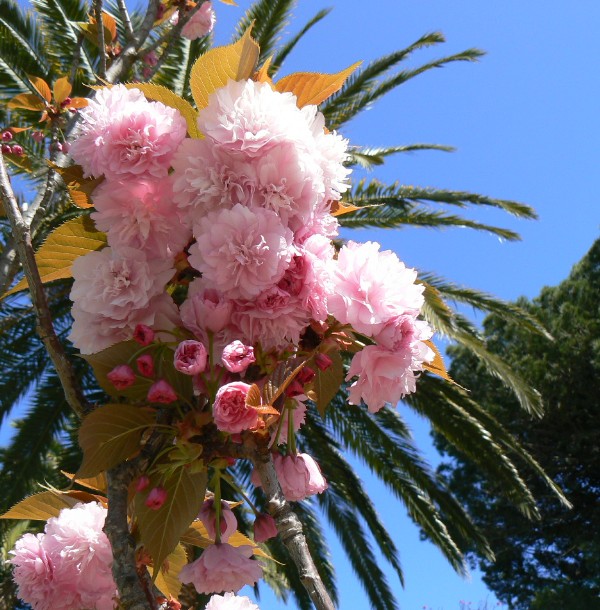 Have I mentioned that it's Spring? Its undeniable delight feels almost undeserved, since I've just come from summer... These pictures were taken in the St. Kilda Botanical Garden, one of Melbourne's myriad parks.
And guess what: it wasn't hay fever after all, but a flu that's been making the rounds. Once I gave up on the antihistimanes, the cough had a final splutter and went its merry way.
It's the first of October here, which means this blog's been up a full month! Any remarks, suggestions, semiotic or deconstructive analyses and well wishes are most welcome as it makes it way forward. I'm open to requests. I expect it'll get over the "gosh, here I am in AusTRAlia!" shtick eventually.
Subscribe to:
Posts (Atom)