separate spreads, this was the sixth) you might recognize the Place des Vosges and the Île Saint-Louis, and the pre-revolution (and of course pre-opera house) Bastille. You can just make out where I was living in the upper left corner. But I share it with you today because of what's on the upper right. What are those things? Stacks and stacks, I realized, of wood. Some presumably was for building, but most will have been for heating and cooking. Before the Anthropocene, when it was living trees - not fossilized ones - that we depended on.
Wednesday, July 06, 2022
Timber
Tuesday, July 05, 2022
Monday, July 04, 2022
Happy Fourth
July 4th - the 246th since the signing of the Declaration of Independence. How should one tell the story of this experiment? I'm partial to the way Jill Lepore narrated it in These Truths in 2018. The idea of equal freedom and dignity for all human beings was better and more far-reaching than its originators could imagine. Their failures and hypocrisies need to be recognized as we strive for a more perfect union, but also so that we recognize that the idea might be better and more far-reaching than we can imagine, too. It's a heartbreaking but thrilling story, and an unnerving one. We know of profound historic exclusions and how right it was that they were overcome -n and how difficult their overcoming...
And the story hasn't finished: the future, if the idea is allowed to realize itself, will be different again than what we can imagine. But of course that's true about democracy all the time, or should be - we entrust the future to a process of which we are just a part: we deliberate, debate, and cast our votes but defer to the articulated wisdom of the majority. What a leap of faith!
It goes without saying that a significant part of the country is no longer willing to make that leap. It looks backward rather than forward, in many cases fetishizing the moment, two and a half centuries ago, when a bunch of propertied English colonists inspired by Enlightenment ideas (and most of them enslavers of Africans) decided to take their story into their own hands. "All men are created equal" was the idea, but they couldn't imagine that this related also to the men whose land they had invaded or the men whom the majority thought they could own, or, for that matter, the men of other continents being colonized by Europeans. Not to mention women: Lepore reminds us that until 1920, the majority of the population had no vote. (When I was growing up, Betsy Ross's sewing of the flag was the beginning and end of women's participation in the story.) The idea was a lot bigger than they knew.
Among those unwilling to make the leap of democratic faith today, many believe the founders where men of Christian virtue whose vision of the world we are bound to, or should be bound to. They don't just ignore the enshrinement of slavery in the Constitution until amendments made possible only by a wrenching civil war, but ignore the exclusion of women's voices in anything articulated by American lawmakers for more than 2/3 of our 246 years. And yet (the Supreme Court's "originalist" decisions on reproductive rights and freedom from fear of being shot tell us) we should defer to historical precedent, the older the better? The farther back you go, the fewer Americans had a chance to contribute to the wisdom of democratic majority - the less, yes, democratic these judgments were. Greater participation doesn't "replace" but completes us.
Unless we are forward looking - unless we dare to be - too easily corruptible American institutions drag us backward. (Arguably, the founders recognized this, initiating a process of constitutional amendment they imagined would continue regularly into the future, keeping the document and its ideals alive in changing circumstances.) Unless we understand the history as one which points beyond the limited vision of any generation, starting with the first and continuing generation after generation, we won't keep alive the ideal we're so privileged to inherit.
O, let America be America again—
The land that never has been yet—
And yet must be—the land where every man is free.
Sunday, July 03, 2022
Spillover
Saturday, July 02, 2022
Friday, July 01, 2022
Past subjunctive
Thursday, June 30, 2022
Standing
The museum itself is beautifully put together, telling with precision and poetry - Des paysages réels et imaginaires nous habite/ real and imaginary landscapes inhabit us - the difficult history of the Wendake people, who were driven here by intertribal conflicts from a homeland near Detroit as European-borne disease and French traders and missionaries arrived in these parts. (Another community of Wendak are now in Oklahoma.) The Wendake were "sold" this land by French Jesuits in 1760 in a contract only rediscovered in the 1990s.
In a special exhibition space we got to see the eeries images of "Mémoires Ennoyées," created by Ludovic Boney for the Québec Biennial earlier this year. Based on data from a sonic bathymetric echo sounder, its video and stills show the forest still standing in two reservoirs built in 1969 in the remains of the Manicouagan meteorite crater, their tops swaying in the current as once they did in the wind.Wednesday, June 29, 2022
Père de l'Amérique Française
It's been a while since I last visited Québec - 17 years! - and I was disappointed to learn that the place I found most diverting then - the Musée de l'Amérique Française, now known as the Musée de l'Amérique Francophone - is only open on weekends. No matter. The chapel to François de Laval (1623-1708), designed in 1993 for Québec's Basilica-Cathedral of Notre Dame, reproduces most of the map I found so délirant on the floor of the Musée. (Laval was beatified in 1980, canonized in 2014, but the map takes you back to late 17th century.) Here is a continent designated Nou[vell]e FRANCE. The only discordant note is a little corner in the northeast, Nouvelle Bretagne.
Québec seems all about the subjunctive contained here, a North America which need not have become anglophone, with just a little pocket of francophones in a northeastern corner! Tongue-in-cheek inversion of what actually happened? I was wittier in 2005, noting crisply in my diary that Québec was the "tip of the long since melted iceberg of Amérique Française." Of course the continent need not have been invaded by European saints and sinners at all. Tomorrow we learn more about the First Peoples of this area.
Tuesday, June 28, 2022
Monday, June 27, 2022
Hors-pays
We're going on a long-planned road trip to Québec City - our first interna-tional travel in two and a half years! But heading to Canada at this point feels like fleeing the chronically unjust United States, as we wait for the rest of the weaponized Supreme Court's rulings undermining rule of law to fall. These trees, barely recognizable under monstrous vines which may well end up killing them, lined the road as we set forth.
Friday, June 24, 2022
Chamber of horrors
Thursday, June 23, 2022
Gundamentalism
I learned a new term a few weeks ago, "gundamentalism," coined by Presbyterian pastor James Atwood a decade ago. An excerpt, quoted by Diana Butler Bass:
Many modern-day shamans and religious gun enthusiasts proclaim God wants all citizens well armed so they can protect our values, even our faith. . . These religious cults have become an integral part of the religion of the Gun Empire that give the idols of power and deadly force what they most need: a divine status. For these men and women the command to love God with all your heart, soul, mind, and strength and your neighbor as yourself, is placed right alongside their new commandment to be ready at all times to defend yourself against your neighbor. . . (They) built an idolatrous religious framework around guns and have worked feverishly to justify biblically their unwarranted fascination with guns. . . Millions worship at this shrine.
Atwood, America and Its Guns: A Theological Expose, 82-83; qtd The Cottage
Bass and Atwood were responding to the American subculture which brandishes Bibles and guns together with no sense of contradiction, something which has been, frankly, incomprehensible to me. An opinion piece by Peter Manseau in this morning's Times, provoked by the explicitly Christian identity of the company which manufactured the assault weapon used to such lethal effect in that elementary school in Texas, argued that many gun owners believe in their guns, and that American gun culture is explicitly Christian. This is part of white Evangelical religion specifically. Most other Christian denominations discourage gun ownership and there seems in fact to be a negative correlation between religious participation and gun ownership. Even among Evangelicals: those most gun-idolizing are those who don't regularly attend worship. But, Manseau argues, the disagreement is at root a religious one. Referencing Paul Tillich's idea of "ultimate concern," it's about the most basic ideas about the way the world is and what matters. To many gun nuts, the world is a battlefield, with Jesus calling us to join his battalion. Manseau concludes
My view is closer to Abbott's fury. Those who believe in guns - who believe that individuals have the right to wield lethal force - seem to to me in thrall not of a religion but of something different and worse, idolotry, even something demonic. Tillich's concept of religion includes a demonic (and he'd agree that much of Christian history is demonic) but Manseau isn't spelling it out, concerned as he is with defending good religion against this bad one. Usually I err in his irenic direction.
But then we get today's latest attack on the common good from the conservative justices of the Supreme Court (all six!), subscribers to another kind of gundamentalism. Their dogmatic interpretation of the Second Amendment is absurd, as clear a case of reading an "unelaborated" right into the Constitution as you can ask for. ("Well regulated militia" - hello?!) It's a sign of the craven soullessness of originalism, kin to the self-righteous dishonesty of biblical fundamentalism.
I have not read the ruling, but it doesn't seem that it allows for any countervailing right not to be shot, let alone to feel safe. How many of these constitutional gundamentalists are also religious gundamentalists? And, yes, in thrall to the demonic?
Tuesday, June 21, 2022
聊天
Don't inhale?
Sunday, June 19, 2022
A fragile handful dangles gently
Just as the Duolingo dialogues with characters who just happen to be queer (most recently Bea mistakes someone she sees in the store for an ex-girlfriend, and Bruno and Héctor disagree about a song which played on their first date thirty years ago) delight me with their normality, I'm loving Queer Nature, an anthology of poems by 200 poets past and present. My first foray introduced me to Judith Barrington's "The Dyke with No Name Thinks about Landscape," whose last stanza, after love, terror and other experiences with people in natural settings, goes like this:
6
Now she is lying on a blanket, the sand below
moulded to the shape of her body.
Sudden swells lap the shore beyond her feet:
a barge has passed by.
trudging down river with its load
like a good-natured shire horse
its throbbing lost now behind the breaking
of that great wave which seems to rise from the deeps.
The turbulence is quick: a lashing of the sand
followed by September’s lazy calm
as the river moves unseen again,
cows from another world low on the far shore
and the seagull’s body, a fragile handful,
dangles gently between its two tremendous wings.
The trouble is not nature, she thinks
But the people who say I’m not part of it.
They’re trying to paint me out of the landscape
says the dyke with no name
but her thighs in hot sand remember a horse’s warm back
as the wind makes a great wave from Oregon to Beachy Head.
Saturday, June 18, 2022
Friday, June 17, 2022
Coup attempts past and present
Thursday, June 16, 2022
多儿鼓励我们从不放弃学习
I'm back to daily conversations in Mandarin (with my teacher in Oslo (go figure!). This past year, with too many classes and too much back and forth between in-person and virtual life, it was on the back burner. I tried to give it the occasional stir with apps, including - inspired by a friend who had recovered his German with it - Duolingo. I raced through its Mandarin only to reach the limit: only four levels.
Most frustrating, especially as I paid for a year's subscription. 怎么办? I decided to try out the Spanish, just for fun. I've never properly studied that language, so it's a better test of the Duolingo method, too. So far so good, but I'm also envious. Not only are there, surely, many levels, but Duolingo Español is full of clever dialogues; Chinese has none.... And even if it did, would they be as worldly and witty?This appears in "La Luna de Miel," in one of the first sets of stories.Wednesday, June 15, 2022
Tuesday, June 14, 2022
Davidia involucrata
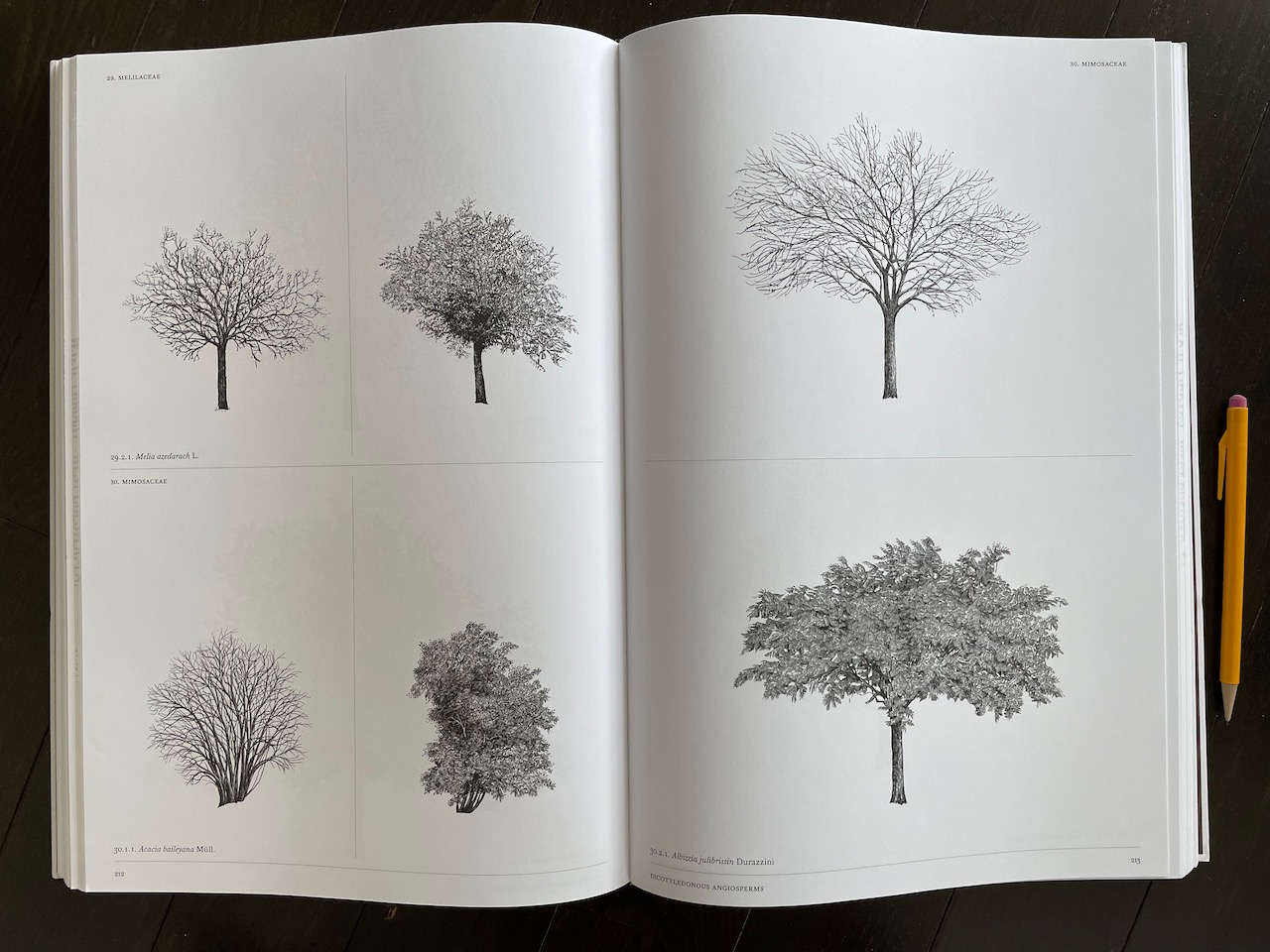
As I showed a random page of a very large book I've recently received on Interlibrary Loan, The Architecture of Trees, to my Chinese tutor in Oslo (!), she said: "左边的是不是handkerchief tree!" Indeed it is! Not for nothing did she recently complete a virtual course in botanical illustration from a Botanical Garden in Scotland. The tree, rarely seen in European gardens, originated in China. The rather gorgeous book, with 1:100 pen drawings by Cesare Leonardi and Franca Stagi of over 500 trees, was originally published in 1982 but newly reedited for the English translation. A few more spreads (with my pencil for scale): And two glimpses of the larger apparatus - a representation of the shadows cast by a tree in Rome at different times of the year, and one of the relative sizes and colors of trees across the four seasons. This seems to be a book for landscape architects, offering yet another way to think about trees in time and space and combination...


.jpeg)

.jpeg)