Thursday, August 18, 2011

Two women wonder about contemporary art


Terrific 2005 sculpture by Ron Mueck at the National Gallery of Victoria. "I think he likes the art."

Wednesday, August 17, 2011

One of the highlights of my year in Australia was the community-building Aboriginal theater piece "Ngapartji Ngapartji." How lucky that I'm here as the latest work of talented actor Trevor Jamieson and Big hART Productions plays in Melbourne's Malthouse theater. Better still, it's about Albert Namatjira (not his real name, we learned), the famous Aboriginal painter of watercolor landscapes of the 40s and 50s, whose life and art inspired several papers in my Aboriginal Australia class.

The story of "Namatjira" is a remarkable one, and it's good that a new generation will learn about it. Namatjira was celebrated by white Australia - met the queen, was even granted citizenship! - and his landscapes graced the walls of many an Australian home at mid-century, but he died of a brokem heart after being imprisoned for supplying grog to non-citizens (who happened to be family). This production, developed with Namatjira's descendants, also explores the important friendship between Namatjira and Rex Batterbee, the white artist from whom Namatjira learned the art - a Digger, we learned, unable to work after WW1 - and the possibilities of a shared Australia it suggests.

The friendship between Namatjira and Batterbee could easily have been the heart of the show, but Batterbee faded from the story at the end. This may be because the story being told was that of the Namatjira family. (They gave Jamieson - who's not even Arrernde - permission to use the name and tell the story.) And in truth the most stirring thing about the performance may have been the presence on stage of three grandchildren of Namatjira. They had no speaking or acting parts, but spent the whole time drawing in chalk on a great chalkboard set details of the landscapes their grandfather made famous, and whose style of painting has been passed to them as family property. Perhaps for copyright reasons, no images of Albert Namatjira's work were used, but here we felt the art living and breathing through his kinspeople, and the continued gift of the Australian landscape which Albert taught many to see and treasure, at once inviting and uncanny in its scale and color.

Tuesday, August 16, 2011

Wattle!


Monday, August 15, 2011

Mt. Macedon

Sunday, August 14, 2011

Protest songs

Some friends took me today to a demonstration at the SLV against fracking in the Kimberley, and then to the launch of a film about the freedom struggle in Western Papua at the Northcote Social Club. At both predictable speeches but good music (especially the Black Orchid String Band, below). I confess that I knew nothing of the situation in West Papua, occupied by Indonesia since a Treaty of New York in 1962 and now suffering ethnic cleansing. One friend said it reminded him of similar gatherings twenty years ago for East Timor. So there's hope!

Friday, August 12, 2011

Tour de Macedon

Melbourne threw a big party for Cadel Evans, the Australian who won this year's Tour de France - the first Australian to do so. (Many were the Aussies who sat up into the wee hours watching the Tour on TV.) My sister and I went down to Melbourne to witness what we thought would be a boisterous crowd and maybe even ticker-tape. Ticker-tape there was not, but a big crowd there was. And yet, boisterous? Nothing of the sort. TV reports have spliced together the few moments when the crowd - provided by the City of Melbourne and BUPA with yellow flags and these rather creepy Cadel masks - cheered (at the MC's urging), but it was otherwise a strangely muted event. Is it because cycling's a solitary sport and its fans, too? Or because Cadel's a quiet understated kind of guy, whose reaction to all the fuss was "to say I'm overwhelmed would be the understatement of at least this month"? Or because he actually lives in Switzerland and said he was just making a stop on his way from Europe to America? (Snaps are from the Mount Macedon Trading Post.)

Newest from the Far West Desert

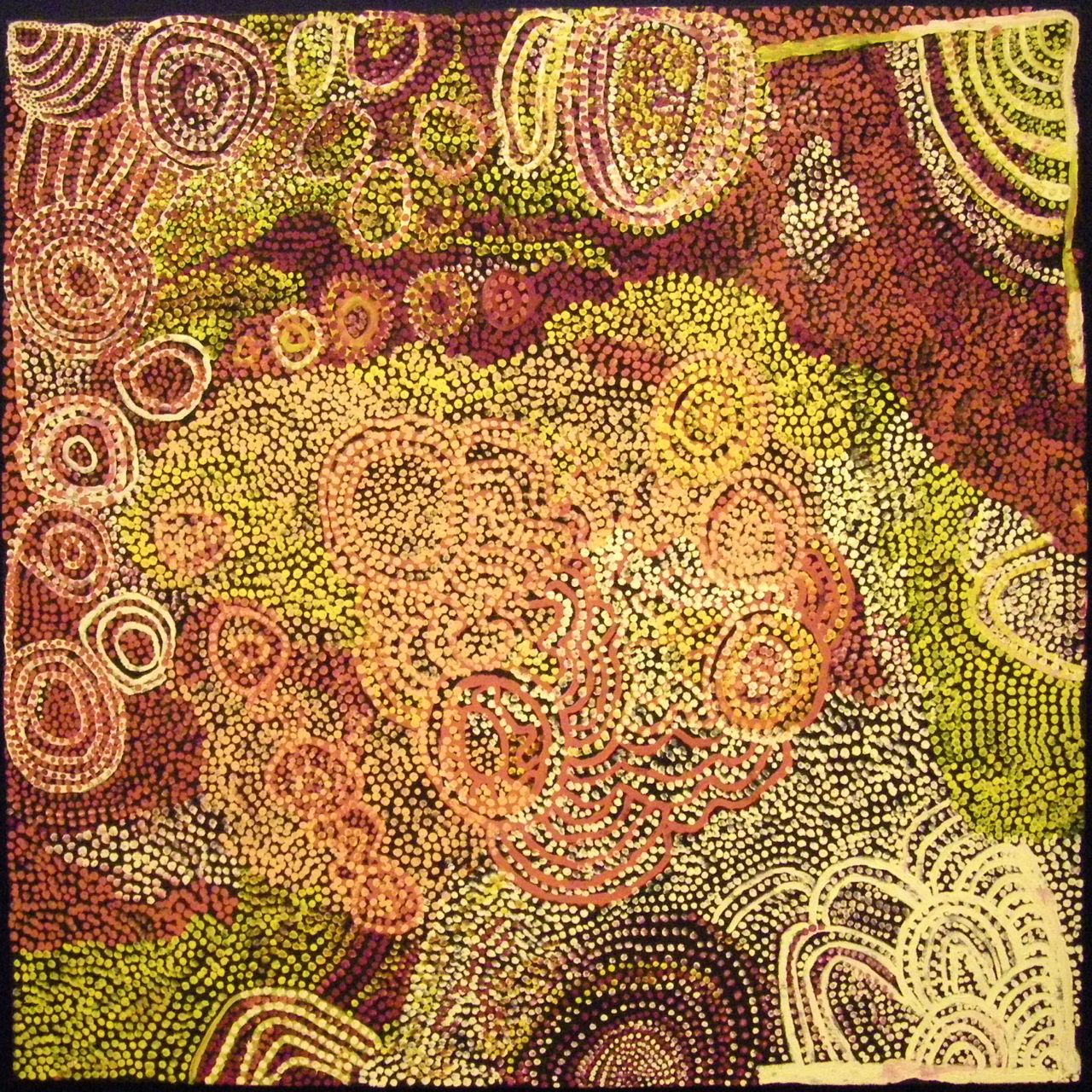
The National Gallery of Victoria's celebrating its sesquicentennial, and the bequest which has brought it many of its treasures, the Felton Bequest, has just brought in a stunning collection of recent art by Far Western Desert Aboriginal artists. The exhibition "Living Water" will show these works for the next year. They're like discovering a new world, again - especially in use of large areas of a single color, unfamiliar colors like blue and turquoise, and almost no dots. Many are totally ravishing.
One work - called "Tjintirtjintir" and painted by eight women - was displayed horizontally, the way all these works are painted, and it was a revelation to see it as it was conceived, without a top or bottom, a new work from each angle. Startling how it rearranges, indeed deprograms, one's sense of how visual meaning is made. It opens up the world anew.
 
It's hard to articulate just how wonderful it is to be in the presence of these works - the experience I thought I'd be able to offer my students this past semester in lieu of actual Australian experience.

Thursday, August 11, 2011

Marvelous Melbourne


Wednesday, August 10, 2011

Keeping count

Yesterday was census day in Australia (100th anniversary census, too). Everyone should have answered, or had answered for them, several dozen questions - far more than are asked in the rather timid US census. (And this one, unlike the US one, is compulsory - failure to respond risks a penalty of A$110/day.) For each member of a household (and anyone who happens to be staying the night of August 10th) details are demanded on ethnic origin, education, income, what kind of work you do, whether you do community service and how much, whether and how much housework or childcare you do, etc. And religion, too.

The religion question is one of the few which are optional. On the accompanying website, it is explained:

Why is it asked?
Church and religious organisations depend on the Census for information about how many people of their religion there are in different parts of Australia. They and others use the information to assess the need for religiously based schools, hospitals, community services and homes for the elderly.

How to answer the question:
Answering this question is optional.
• If a person’s religion is one of those listed, mark the box next to it.
• If a person’s religion is not listed, write the name of the religion in the ‘Other – please specify’ box.
• If a person’s religion is an Eastern Catholic religion such as Maronite Catholic, Melkite Catholic or Ukrainian Catholic, write the name of the religion in the ‘Other – please specify’ box.
• People who have non–theistic religious beliefs or other life philosophies should write their response in the ‘Other–please specify’ box.
• If a person identifies with no religion at all, mark 'No religion’.

I wonder how various kinds of Aboriginal people answer this.

Tuesday, August 09, 2011

Suddenly Spring

 
A delightful surprise: it's Spring-ing in Victoria! These pics are all from Mt. Macedon. All but the banksia and cherries are in my sister's garden.

Sunday, August 07, 2011

Japan retrospect

You can trace my ten delightful days in Japan on the railway map below: arriving at Narita 成田 (the little pink airplane at lower right) into the snarl of Tokyo 東京 (the blue line to meet the innermost circle, the Yamanote line 山手線; Ikebukuro 池袋 is at its top) for four days, including a day trip to Kamakura 鎌倉 (partway down the little black line dangling bottom center), up for two days to Matsumoto 松本 (northwestward to the left edge two-thirds of the way up, where a blue line meets the black), across for two more in Kiryu 桐生 (northeast to change to the pink Shinkansen until a big intersection, then nine stops on the southeastward black line), then back down another blue line for a final two days in the capital and back by blue line to Narita Airport.

Let me hazard a few reflections on my time here - my first visit in 4.5 years, and my first quality time since January 2006 - inevitably subjective and random as they must be. Japan seems to have internationalized decisively. Korean and Chinese translations appear in many places, and Korean pop and film stars are now visible here. 
 
(This sign on Mt. Agaki is in Japanese, English, Hangul, and both PRC and standard Chinese.) I also heard many more non-Japanese people speaking Japanese. I noticed that nobody was surprised that someone who looked like me could understand and speak Japanese, and not just in Tokyo. I gather fluent foreigners are common on TV. Lots of new building, including bulky apartment blocks. Cars in unfamiliar shapes, the aerodynamic lines which define the models big in North America replaced by boxy right angles. Meanwhile the newest shinkansen, faster than ever, has a goofy-looking slender nose 15 meters long. The majority of women have brown or chestnut-colored hair. And the Tokyo Sky Tree is the tallest structure in the world.

But you're probably wondering about how Japan has changed since March 11th, the day of the Northern Japan Disaster 東日本大震災. The shockwaves continue - literally. In ten days I was twice woken up during the night by significant aftershocks; my friends have been feeling them for five months. (The most disturbing earthquake damage in Tokyo was the liquifaction of some reclaimed land in Chiba. Much of Tokyo's recent growth has been on reclaimed land.) The government asked people to try to cut their electricity usage by 15%, and you feel it everywhere - barely cool air conditioning, dimmed lights, disabled escalators, etc., usually with a printed explanation. Apparently people and businesses have been cutting back more, more than 20% on average, so much that it was hurting the economy. We can't allow ourselves to enjoy life, one friend suggested, knowing that five thousand people who were swept away by the tsunami remain unaccounted for. (As in the US after 9/11 there has been a de facto ban on images of the dead, so not just the missing 行方不明 are absent.) Japan's no stranger to natural disasters, but the scope and ferocity of the earthquake-tsunami seem to have had a profound effect on people. A few people I know went up to the affected areas to help out as volunteers; another told of a friend who decided not to buy a long-planned car but to give the money to disaster "refugees" instead.

And then there's the continuing disaster of Fukushima Daiichi, whose scale remains unknown - TEPCO and government alike have no credibility. Last week some pipes - overlooked in past testing - were discovered to be so radioactive they would kill a person in minutes. Because radiation-affected cows and hay from near the reactor were sold to (and bought by) other farms around the country, beef consumption is way down. (The sign at left is from a restaurant in Ginza, detailing not just the provenance of the beef served - Kyushu and Hokkaido - but the numbers of the tested shipments.) But one is uncertain about many other foods, too. The papers reported hoarding of rice - in case this year's harvest, which will be in stores next year, proves radioactive. Someone told me of anxious parents posing questions at a local swimming pool in western Tokyo - has the water been tested for radiation? what about each of the foods in the cafeteria? The same person wondered aloud whether Japanese people as a whole weren't becoming strange へん, and mentioned that people who were outside Hiroshima on the day of the atomic bombing but went back to search through the rubble of their houses died of the same cancers as those who were there, and in the same time: "sick in six years, cancer in seven." The unsettling thing is that radiation is invisible, and its consequences not initially visible either; how can you know something or someone has not been seriously affected? Japanese popular culture and memory are haunted by the consequences of radiation poisoning (wasn't Godzilla ゴジラ the result of radiation?, the same person asked), and the world of dystopian post-nuclear sci-fi seems close. The worry that Japan will simply go under 沈没, literally or figuratively, is apparently widespread, especially among young people.

All is not well, but life goes on. The devastation of the earthquake and tsunami has renewed a sense of national fragility and solidarity, and Fukushima Daiichi seems to have put everyone in eastern Japan into a state of suspended animation. Can life really go on as it has, or has a new era already begun?

Saturday, August 06, 2011

Sayonara

Ten full days in Japan nearly over - in a few hours I fly from steamy Tokyo to chilly Melbourne. This, by the way, is the chirashi sushi I enjoyed with my friend H at a tiny shop - it seats just seven people at a time - in the Tsukiji 築地 market. Freshhhhhh!

Friday, August 05, 2011

Japan modern

In a catalog in the seat pocket in the Shinkansen (Hammacher-Schlemmer Japan?), I discovered some things nobody should be without: a silver cross pendant which doubles as an emergency whistle, a jacket with built-in fans, and - a must have for all in the age of late capitalism - a vase which muffles your screams (also handy for karaoke training!).

Thursday, August 04, 2011

Akagisan critters


Atop volcanic Mt. Akagi, where we fled to escape the heat, we found a surprising number of blooming plants among the green, and many happy bugs.

Wednesday, August 03, 2011

Snaps

Back online, briefly. Here are some pictures - don't know in what order they will appear - from the last few days. I've been to Matsumoto, Azumino and just arrived yesterday afternoon in Kiryu.
Key: The view inside a used bookstore in Matsumoto you've seen before. A water skimmer (amembo) and poisonous caterpillar in the woods above Azumino. Unwanted fortunes outside a shrine in Kamakura. Rice paddies from train approaching Matsumoto. Reflection of red bridge to Matsumoto Castle. Matsumoto Castle. Former Kaichi School in Matsumoto. Linga and yoni in a Shinto shrine above Matsumoto. American Super Girls Conceptual [Love] Hotel, near Azumino.

Tuesday, August 02, 2011

Senko hanabi

Fireworks with friends and their four year old daughter in Matsumoto.