Friday, December 15, 2006

Lawson found

Now I’ve started something… teehee! Or as the 4-year-old who is my Japanese self (never underestimate the effects of a first language teacher) would say: yattaaa! Of course I don’t doubt that lives in Australia are serious. It would be the height of effrontery for me, a mere bird of passage (and one who makes a big deal of sniffing at “Lost in translation” to boot!), to project the thinness of my life here onto the lives of natives. Didn’t I come close to offering an infomercial for Australia as the place to go for life on a truly human scale?

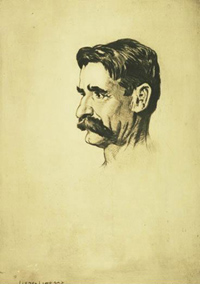
No question there are here, as anywhere, unsung moments of supreme seriousness, nobility or tragedy - the sort described by Australia’s most famous writer (or used to be), Henry Lawson (1867-1922). One of his narrators, digesting the story of secret love, self-sacrifice and tragedy in a tiny bush town just recounted to him by a fellow swagman by a billabong, reflects: I lay awake thinking a long time, and wished Mitchell had left his yarn for daytime. I felt – well, I felt as if the Lachlan’s story should have been played in the biggest theatre in the world, by the greatest actors, with music for the intervals and situations – deep, strong music, such as thrills and lifts a man from his boot soles. (“The Hero of Redclay,” in Henry Lawson, Favourite Stories, chosen by Walter Stone [West Melbourne: Thomas Nelson (Australia), 1976], 53)

And yet I don’t think I’ve entirely misread Joan Makes History. Making a life out here you may need to make your peace with the fact that the great actors and musicians won’t play your story, or even hear of it – just as Grenville’s Joan does. And most people do, of course, everywhere… Maybe Americans are the odd ones out here for living with the illusion that somehow, some day, their life will be the subject of myth or at least a musical! (Not us bloggers, of course...)

Bear with me, folks; I’m used to theorizing about centers and peripheries from within centers (or my own personal periphery within a center), as I’m just starting really to realize!


PS
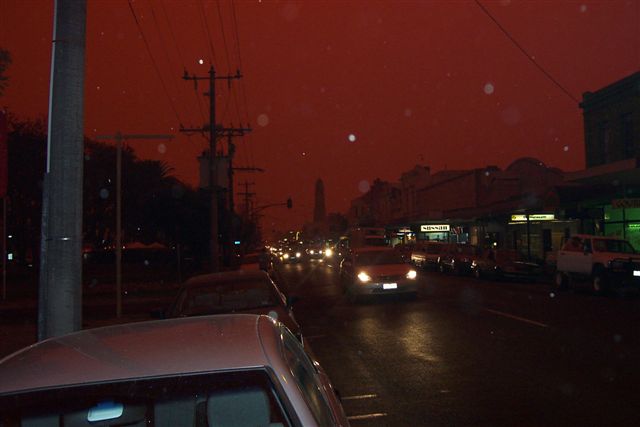
Here's a picture a friend sent me of Bairnsdale, a town near the fire fronts. It's two in the afternoon.

Thursday, December 14, 2006

Kate makes history

A few weeks ago I told you about historian Inga Clendinnen's brilliant critique of novelist Kate Grenville's The Secret River, and with it all historical novels which wittingly or unwittingly project present sensibilities and preoccupations on the past. Well, having just read her utterly delightful contribution to Australia's bicentennial in 1988, Joan Makes History, I understand now that Kate's a greater threat than Secret River and indeed a worthy opponent for Inga.

Joan Makes History is hard to describe without giving too much away, though the magic is as much in how she does it as in what she does. The book alternates chapters narrating, in the first person, the life of a woman, Joan, born the day of Australian Federation in 1901 (a minor character in an earlier novel of Grenville's, apparently), and eleven episodes from Australian history reimagined and narrated by women - always named Joan, and determined to make history - who were there but not mentioned by male historians. Australia's cherished historical myths and turning-points are turned on their heads and sides by convict women, washerwomen, farmers, Aboriginal women, wives (including the admittedly imaginary wife of Captain Cook), and the anonymous woman living off the bush who appears in the apparently very famous painting "On the Wallaby Track" (1896) by Frederick McCubbin (below). Quite a romp: Grenville's a fantastic writer, often raucously funny and as often incredibly subtle and even profound.
By two-thirds of the way through the book, we start to notice more than parallels between the two stories - Australia's and the original Joan's. We come to understand that the original Joan has imagined these episodes not just out of some sense of fun or historical revisionism (though there's that too), but as part of owning and accepting her own life. Here are some reflections from the last pages of the book:

I thought my story was one the world had never heard before. I loved and was bored, I betrayed and was forgiven, I ran away and returned, and all these things appeared to be personal and highly significant history. Oh Joan, what bogus grandeur! There was not a single joy I could feel that countless Joans had not already felt, not a single mistake I could make that had not been made by some Joan before me.
There was a time when I would have raged against such a thought, or grown petulant. But now that I am such an old woman, and so many times a grandmother, I do not grieve but grow pleased and plump at the idea. I swell like an egg: there is nothing I cannot claim as my own now, and although you may not think so to look at me, I am the entire history of the globe walking down the street. (274-5)

This is where the historian slams on the brakes, but you could also see it as a response avant la lettre to Clendinnen. As our Joan tells of all these other Joans - imagined but realer than the protagonists of most popular history - we don't just see Australian historiography get a feminist sorting out, but start to think in new ways about how and why history matters to ordinary folk. (They're both right, of course.)

A quick internet scan suggests that Joan Makes History lives on in feminist and historiographical circles, but coming at it as a sojourner in this land (my three months anniversary was Tuesday) I see it also as a marvelously insightful commentary on the difficulty of being Australian. Joan wants to be bigger than Australia, wants a life like the politicians and artists of the old world who have lives bigger than out of the way Australia could ever make possible (she thinks). Eventually she discovers that history is made every day, and that it's made also (and indispensably) by women and women's work. That story could happen in any country. But that her life involves throwing herself into somewhat shallow passion in college, getting pregnant and reluctantly marrying the good-hearted man from the country who fathered the child and loves her although she never loved him, losing the child and abandoning her husband before eventually finding her way back to him and truer love, motherhood, etc. also tells (I think) a story about the difficulty of taking a life in Australia seriously. (Apologies to my Australian readers: I'm asking to be corrected here. Perhaps I read it this way just because I come from self-important America?)

Maybe it does have to be in Australia after all, since the absence of a grand but cumbersome history or prospects for sudden significance on the world-historical stage don't just carve out a space for discovering history as made by every one, every day, but in some way requires that discovery. For the very lightness of its historical being, Australia offers a stage for living on a truly human scale.

Monday, December 11, 2006

Advent

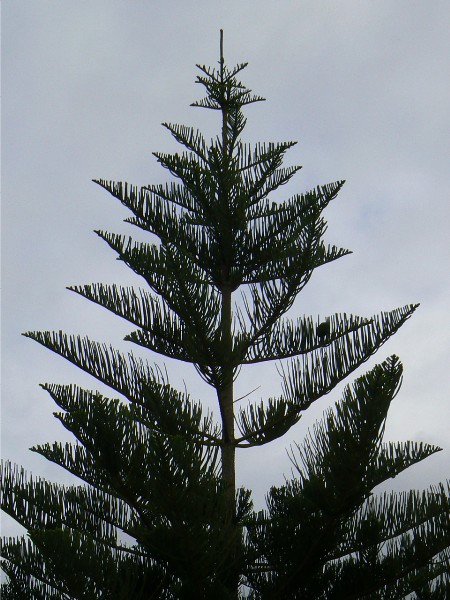
Here’s the top of a young Norfolk Island pine in Fremantle. The branches start out pointing up in a V-shape, and as the tree matures they grow longer and are borne down by their weight to a near perfect perpendicular; the same thing happens with the distinctive lanyard-like needles on each branch. Glorious trees these are; I’m sure I’ll be posting more pictures of them (with, no without apologies to my nature-phobic friend).

We’re almost halfway through Advent, but here (needless to say) the days aren’t getting shorter or darker. In recent years I’ve come quite to enjoy the sense of deepening gloom of New York winters, to be turned around by the gorgeous trio “Schweig, er ist schon wirklich da” in Bach’s Christmas oratorio (which I like in part because it almost fondly recalls the pleasures, and even the comforts, of waiting). In a book called The Spirit of the Liturgy (a title cribbed from Romano Guardini), Joseph Ratzinger, before became Pope Benedict, wrote very interestingly about the ways in which the Christian liturgical year could embrace different climes and seasons, and even should do so, to make things seem more truly connected to people’s lived experiences, and also to discover new meanings in the feasts themselves. The example I remember involved the profound new resonances of an Easter season which coincided with harvest rather than planting, but nothing to help with the runup to a Christmas barbecue in the blazing heat. Any suggestions?

And speaking of blazing heat, bush fires have destroyed several homes in Tasmania, and the fires in Victoria have joined forces to make a 240km firefront. Is this being reported elsewhere?

White Australia

One of my faithful readers has complained that there are too many pictures of nature on this blog, and not enough of people. (I should have known that it was asking for trouble to include my shadow the other day.) Well, my policy not to name names on the blog, let alone show faces, seems vindicated by the arrival this week, for the first time, of responses to the blog from people I do not know. Besides, Australia's all about nature.
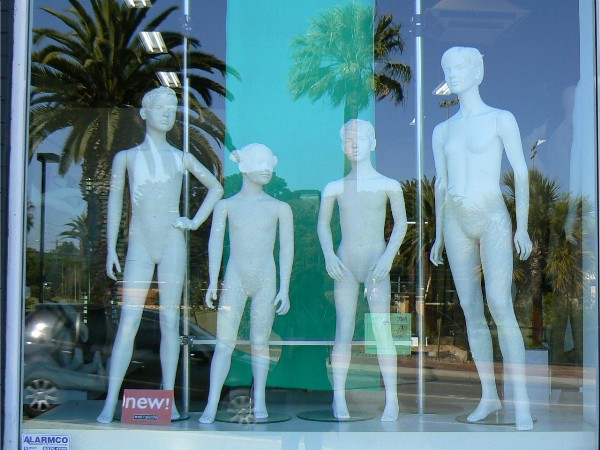
I don't suppose this picture will appease him, but these are in fact the first Perthians I encountered on my walk into town, demonstrating just how seriously (white) Australians take sunscreen!

No quantity of sunscreen would help against the bush fires which go from bad to worse. The newspaper predicts they'll burn for months...!

Sunday, December 10, 2006

The fire this time

While I was fiddling around Western Australia, the bush fire season a parched Victoria has been dreading began, months early. A 100 km line of fire is feared, with flames in places reaching up 70 meters. It's like a crouching cat, said one firefighter, and when it decides to pounce nobody can stop it. The Vicar of St. Peter's said this is more than human power can resist: the fire will burn until it reaches the sea. (This picture was posted by a reader of the The Age.) Meanwhile, we had our hottest December day in 53 years today, the mercury reaching 42.1 degrees this afternoon (108 F), though it cooled nearly 20 degrees over the next hour. "Four seasons in one day" indeed! What we need is rain and lots of it, and that's the one thing nobody's predicting.

Saturday, December 09, 2006

West Coast!

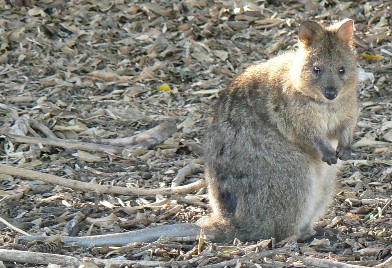
Back in Melbourne, on a day so hot (37 degrees predicted) that walking through it is like pushing through water. Happily our bluestone house remains cool! But it does make me think back wistfully to Western Australia, and gliding through the warm blue waters of the Indian Ocean, seen above through a speed-splashed ferry window (or is it the computer monitor?). I don't need to show you what Rottnest Island looks like, or where it lies - you've already checked that out on maps. google.com (as described a few posts ago). It's 19 miles west of Perth, far enough away to have a distinctive flora and fauna - most famous the quokka, a foot and a half-tall marsupial Dutch explorers mistook for rats (hence Rottnest). I surprised several as I wandered along the southeast tip of the island; they seemed always to be in pairs, and bounced into the brush like balls.
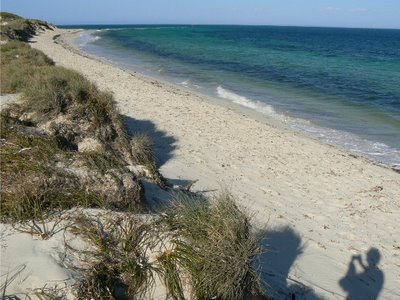
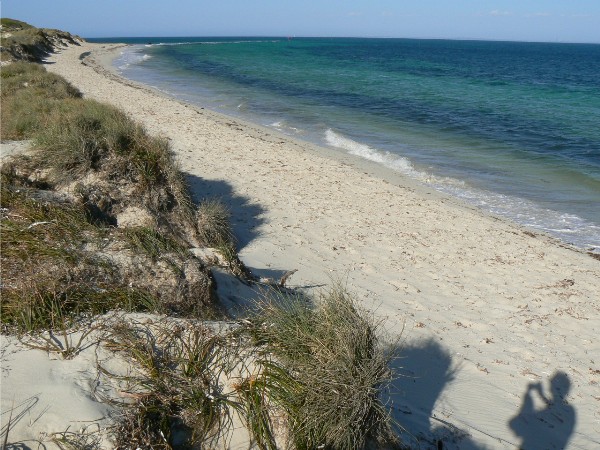
The summer holidays are just around the corner, but I managed to have beaches and bush practically all to myself! This beach on Bickley Bay, on which I saw no other soul, is five minutes' walk from the converted army barracks where I was staying (along with a class of high school students who - but only occasionally - put me in mind of Lord of the Flies).
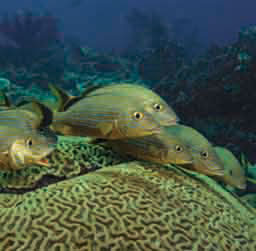
But the real treat came on the north coast of the island (facing... India!), where, courtesy of the Leeuwin current, Australia's southernmost reefs invite even inexperienced snorkelers to make themselves at home. Many kinds of seaweed, corals and lots of friendly fish, just hanging out. I floated around along the tops of reefs, into sudden (shallow) canyons, occasionally guided by a friendly foot-long pale blue fish with yellow spots on his scales. It felt like a kind of bushwalking, with a local guide!

Funny to think of it, but I actually went to Western Australia only because it was the end of the Indian Pacific Railway, and planned to stay a few days only in order to take advantage of a cheap flight home. Now I'm glad to have braved the train out there mainly because it got me out west - and through Adelaide, a delightful little city I'll surely visit again. Rottnest I went to because my sister had been a few years ago - thanks for the tip! The big discovery was Perth and its port town, Fremantle, which I really liked. Perth has that San Diego vibe, and Fremantle a mix of old charm and new trendiness married by a winning sort of flakiness one might even call Californian (a term of praise!). Of course I did have fantastic luck, catching Rottnest before the waves of holidayers, and catching a wonderful concert by the newly formed, Perth-based Arundo Reed Quintet in the courtyard of the Fremantle Arts Centre as exotic birds did their dusk swooping and cheering, where Byrd's "Browning" made me glow, Ton der Doest's "Circus Music" made me beam, and Contrapuctus IV from Bach's "Art of the Fugue" nearly made me weep for delight at - at everything: music, culture, nature, humanity and their unexpected counterpoint. (Both of these pictures are, of course, borrowed, but I'm sure I saw some of those friendly fish!)
Did I mention I had a really nice time out west? If only it weren't all so very very far out! The flight home was, surprisingly, less than four hours. We headed across the southwest tip of Western Australia and crossed the Great Australian Bight. (At left is where the bush which starts a few miles east of Perth meets the broad swath of the West Australian Wheat Belt.) Flying over water (and at least one stray iceberg!) made it seem like it indeed felt: Western Australia's on a different continent than Victoria - the Nullarbor is still a sea.
Thursday, December 07, 2006

Sand dune time

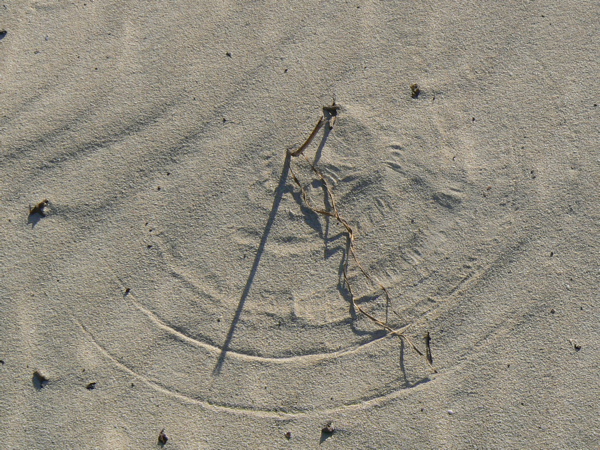
Just a brief post today. To tide you over until the full report, here's a natural sun dial I found on one of the wind-swept dunes of Rottnest Island. Of course it tells sand dune time, which is different from ours: it goes back and forth...

Tuesday, December 05, 2006

Like a backpacker (sort of)

Still in Perth, I'm starting to see how backpackers do it now - this internet cafe is wonderfully affordable. (Back in the day you disappeared when you traveled, now you're in regular contact with your friends back home, SMS'ing and e-mailing and blogging; is it just nostalgia that makes me think something is lost with all this, a sense of real stepping out and away from your life and culture, a real vulnerability and openness to the new?) And posting pics on the blog is easy as a charm. (Having said which, for some reason I can't see the pics on the blog after posting them; trust you can!)

So here are a few more, from the city which prides itself on being the most remote capital in the world. Singapore is closer than Sydney, but not exactly close either. I'm looking forward to getting wet in the Indian Ocean this afternoon!

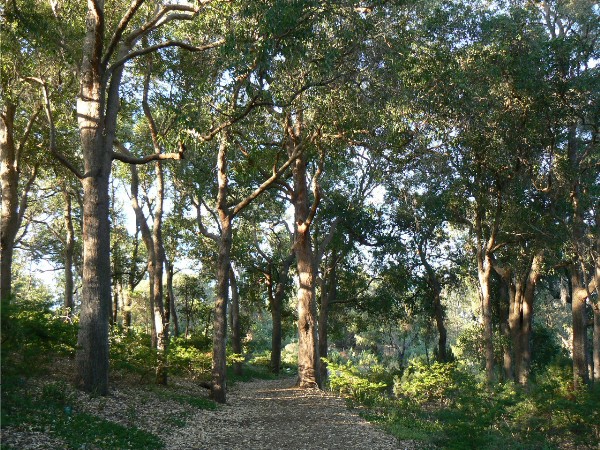
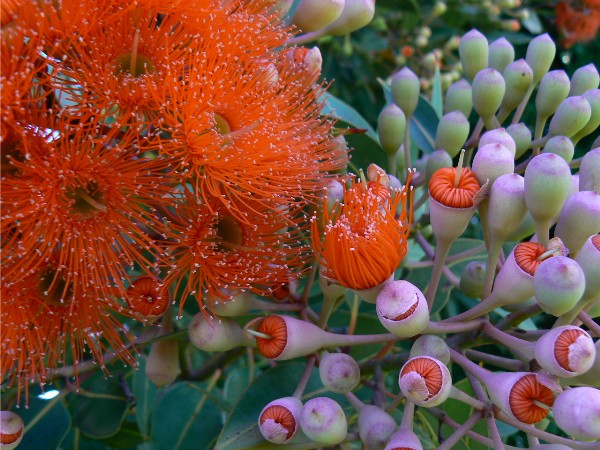
Perth's justly most visited destination is King's Park, a gorgeous botanical garden and park on the hill above Perth overlooking the river, which proudly shows its age - many of these trees were planted over a century ago, so tower most magnificently overhead. I've missed the season of flowers, but you'd hardly know it, what with the many species of eucalyptus (this red one at the top seems to be getting decked out for Christmas, no?), banksia (which I'd always thought a South African plant, but apparently it's Australian - though it may be a survivor of the Gondwana flora which once spread over southern Africa, Antarctica, etc., too), kangaroo paws (which against the sun look like they were drawn by Keith Haring)...

I've no idea how the formatting of these pictures is going, since for some reason I'm able to see the pictures as I post them but not when I open up the blog. Hope they're not all over each other. Tomorrow - perhaps - I should have some more tropical looking scenery for you!

Oh, and my title is "Like a backpacker (sort of)" because I splurged on a decent hotel last night, after three nights sleeping - or trying to sleep - in bus and train seats!

Monday, December 04, 2006

Nullarbor

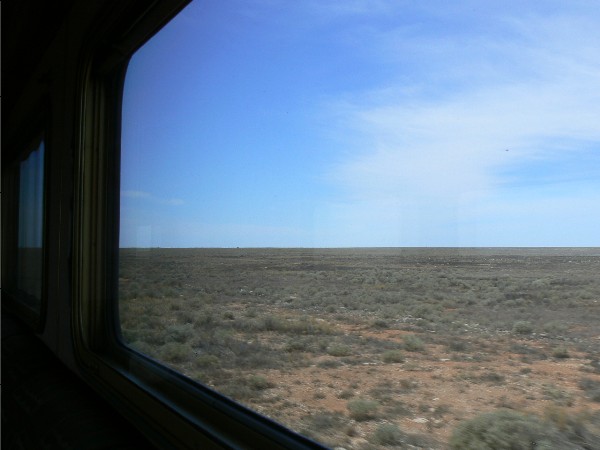
Arrived in Perth having crossed the mighty Nullarbor. Nor sure what hit me, to be honest – the Nullarbor, an ancient limestone seabed which goes for hundreds of miles without a stream or a tree, is so flat and featureless that the better part of yesterday we spent crossing it might have been just fifteen minutes, or a month. The sense of weirdness of the absence of physical landmarks was compounded by temporal uncertainty: South Australia is a cheeky 30 minutes behind Melbourne, Western Australia another 90 minutes beyond that (at least in summer time). Here are some pictures which will inevitably make the empty center of the trip seem even briefer. The top shows the sunset of our first night, gold to the west reflected in the eastward window's pinks and blues. The Nullarbor.
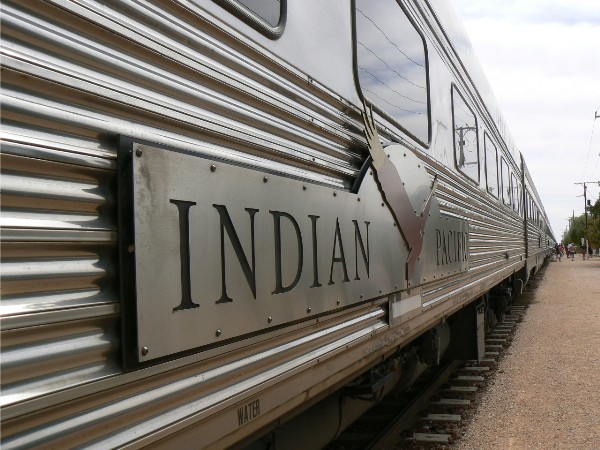
Our train, seen in Cook (population 7), our only stop in the Nullarbor, where there was nothing else to photograph – except other passengers in search of something to snap!
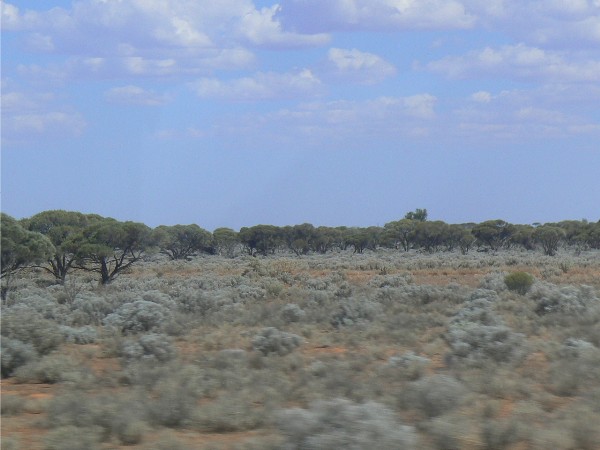
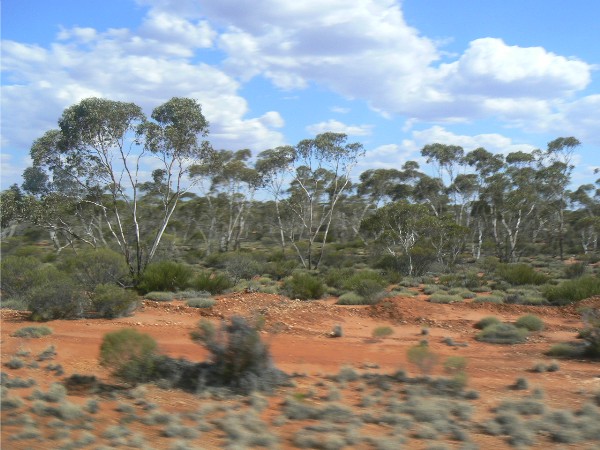
(Top:) Trees start – but it’s not as many as it looks like, this is much zoomed. (Above:) Outback at last!
A storm as we approach Kalgoorlie. Imagine how satisfying that was!!

Friday, December 01, 2006

Out of the office

I'm not going to be able to post anything on the blog for a few days as the great trans-continental journey is upon me. Picture me in this train! (The pic is from the Great Southern Railway website, and will double in size - like most pics on this bog - if you click it.) I'll try to find an internet café when I arrive in Perth on Tuesday. Maybe I'll even be able to post some pictures, though the famously flat and treeless Nullarbor may be hard to surprise with a candid snap, and I may have been reduced to a wide-eyed and inarticulate wow-wow-wowing. Have a good week!

Thursday, November 30, 2006

Roundabout

Just as I'm getting excited about dipping my feet in the Indian Ocean, the Pacific rim calls me back. (A jealous god!) My college back home is sending me to a conference on an interesting new curriculum in history next month. It's in San Diego, my hometown! And I'll get to see my parents, from whom I must confess I feel very distant across the great water.

But I'm not going to cross the great water. Turns out that mid-January is the highest of high seasons down here - summer holidays, of course - and all the cheap and even the not so cheap tickets to the US have long sold out. So I'm taking a roundabout route, via Japan! The fare, still pretty expensive though considerably better than the alternatives, requires stopovers in Tokyo. An inconvenience to most travelers, I imagine...
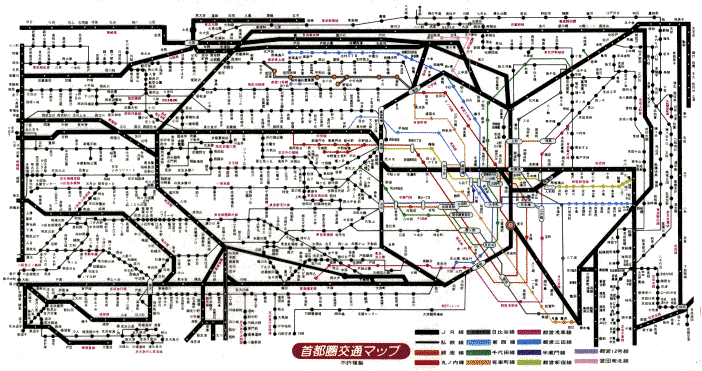
And there I was thinking this was going to be the one year I wouldn't be making it to my old flame, Nippon, as I snuck off to get to know the Chinese and Indian worlds. Another jealous god, or perhaps 腐れ縁 (kusare-en) a karmic connection one can't break, come what may. Can you believe that this rail map of Tokyo and environs sets my heart aflutter?

Wednesday, November 29, 2006

Rug

How do people keep blogs going day after day after day? Not that every day doesn't bring its pleasures and pains, but will there always be something worth hollering about, something to tug at people's sleeves and say "look!"

If you were here I'd make sure you noticed the trees blooming in profusion, get your take on this morning's fizzled attempt to fill the Melbourne Cricket Ground with workers unhappy at the commonwealth (=federal) government's labor policies, ask if you really think the predicted high of thirty-six degrees will be reached today despite a cool and rainy start, demand (for the nth time) that you agree that it's very cool indeed to be going from the Nullarbor to Rottnest Island. If you knew less of Australia than me I might ask if you were familiar with the phrase "spag bol," and if you knew more I might inquire what you think "rug" means in "passengers should bring their own rug and pillow on the train." But since you're not here, I'll just urge you, if you have not already done so, to check out maps.google.com, as described two days ago. It'll blow your mind! And I'll get back to wrangling with finding the right way to argue that the experience of good is not one which demands or easily lends itself to analysis and argument without sounding anti-intellectual or contradicting myself - or both!

PS Oh but there is a piece of news I've forgotten to mention. I've received the go-ahead to team-teach next Fall (2007) a course with a dear friend who was good sport enough to let me be part of a theater piece she wrote and directed last spring. The class will be called "Theater and Religion," and will bring together the study of religion and the practice of acting. I'm so excited!

Early summer buds

Not much to report around here. (You should thank me for not going on at great length about the Cole Inquiry, which confirmed that the leadership of the Australian Wheat Board paid kickbacks of three hundred million dollars over seven years to the régime of Saddam Hussein in order to stay the main exporter to Iraq - this during and despite UN sanctions against Iraq - all without any member of the Australian government noticing it!) The southern hemisphere's perverse need shift into summer at this time of year proceeds apace, with trees blooming everywhere - imports like the originally Brazilian jacaranda at right and presumably native things like the orange-blossomed tree above. A tall glossy magnolia near the Old Quad has started opening its giant flowers. Strawberries and cherries have arrived in the supermarkets!

Monday, November 27, 2006

Sand and sea

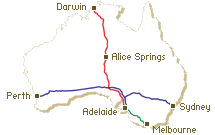
So my first trip across Australia's planned, departure this weekend! After two days crossing the Nullarbor Desert between Adelaide and Perth, I'll spend a night on an island in the Indian Ocean just off the coast at Perth. Then I'll fly back over the Great Australian Bight. This by the way is a map of the rail system. The Indian Pacific is the blue line. I hope by the time I leave Australia to have done all of the lines - the highlight will be the Ghan (the red line) in May, when things have cooled down a bit. The Alice Springs-Darwin bit only opened in 2004.

You can get a sense for the terrain by going to maps.google.com and writing in "South Australia," then choosing from the buttons at top right "satellite" or "hybrid." The rail line's not marked on the hybrid map, but you can certainly swoop in on some pretty amazing territory! (Double-click to zoom in.) You can also get very close indeed to the island I'll be on next Wednesday night. Type in "Rottnest Island, Western Australia" and you're there! Now imagine snorkeling in turquoise seas after having crossed the Nullarbor!

Sunday, November 26, 2006

Looking at you

This pair of galahs took refuge from sun and wind high in a gum tree on the Broken River, visible in the distance from my sister's place - a few hundred meters away. Thank modern technology (my ultrazoom Panasonic Lumix) for making them seem so close they might be looking at us - and blogger for making me seem so close I might be looking at you!

Thanksgiving reloaded

How do you present Thanksgiving to a 3-year-old Australian boy with an American mother and an Australian dad, months from any harvest, and in a household without any conception of Whom thanksgivings might be directed to? Here's what we came up with: roast chicken (too late to defrost a turkey), mashed potatoes, gravy, corn, cranberry sauce, followed by homemade pumpkin pie (with butternut squash, the American manner of pumpkin not being available). We enjoyed these treats under the "pregola" (roofed over patio) on Friday evening - Thanksgiving in the US - the temperatures having generously fallen enough for it to be pleasantly balmy, and it felt like starting or rekindling a tradition.

For at least part of the meal we wore pilgrim hats (made of black card, silver duct tape and cut-out paper plates -- long live the internet) and a colorful feathery headdress (green and orange construction paper), made by yours truly. The story we told was of silly black-hatted English folk who showed up in faraway America unprepared and starved - until a nice Native American offered them a delicious feast. (Since my sister was the provider of the feast, she got to wear the feathers, despite repeated entreaties from my nephew. I won't describe the trauma for him of his younger brother's first birthday this morning - the first time there's ever been present-giving where he received nothing!) And so we give thanks for delicious food, and hospitality, and friends, and family...

Not bad under the circumstances, I think... it's not an easy story to export, though I'm not sure it would have been much easier in the US! What might be nice for future years would be integrating something from the first contact of the British Fleet and the Aborigines around what would become Sydney. As Inga Clendinnen (remember her?) describes in her lovely book Dancing with Strangers, the first thing that happened after the initial awkwardness as the Brits left their ships was that someone started singing a song and dancing to it. One of the Aborigines joined in, and soon everyone was dancing together, songs and dances native and English - there's a watercolor painted by one of the crew to prove it! (You can see part of it at the bottom of the cover picture.) Imagine if that were taught in schools! It's an argument for teaching dance, too!

Wednesday, November 22, 2006

Happy Thanksgiving

I'm off to the country for Thanksgiving... so unless my sister's internet situation has miraculously improved, I'll see you on Sunday.

Tuesday, November 21, 2006

Under where?

So here I am back down under. (The map is from TAIPEI 101. There's one for each cardinal direction, making Taipei seem the axis mundi. They are nice enough to show all of Australia, but somehow forget to mark Melbourne!!)

Taiwan isn't that far above the Equator, but Australia disappeared almost completely from view while I was there. A few people said "I hear you are coming from Australia" but none went on to ask why, or indeed anything about Australia at all - even as Melbourne was in the papers, for the G20 summit (and protests) and also a celebration of the 50th anniversary of the Melbourne Olympics.

So I had no chance to remark that Australia and Taiwan have similarly sized populations (about 20 million), let alone to say "Melbourne is among the world's most livable cities"! It's full of "world class" culture and institutions! We have "four seasons in one day"!

Instead, I found myself thinking unfilial thoughts: If Taiwan's located in a place where rather too many people have passed through it over the years, Australia - especially its south shore - gets no passers-through. It really is indecently far away from the rest of the world! And, most disloyal of all, I thought, Melbourne's so "livable" because it isn't really a city, lacking the hustle and bustle and heat and bother of a place like Taipei: Australian urbia is really suburbia.

And yet it's nice to be back, in a land people from all over have made a home, where you don't need urban stress to have "world class" experiences, where the rivers meander, occasionally liberating a loop as a billabong, and sometimes never making it to the sea at all...

Taipei to Boston

On the way back to Melbourne, I read a special issue of the Journal of Ecumenical Studies containing papers from another international conference at Academia Sinica, this in 2003 and on "Contemporary Confucianism and Western Culture." It was given me by Liu Shu-Hsien, one of the eminences grises at our symposium, and I now finally understand why the question "is Confucianism a religion?" matters to these people (though the other papers remain, shall we say, a bit of a blur) - and perhaps also what I was doing here.

My friend had told me that the people putting on our symposium were "New Confucians," but I confess I didn't try to find out what that means. Now I know, at least a little. New Confucians - not Neoconfucians - are a 20th century movement concerned to revive Confucianism as a tradition of global significance. Fired up by the demise of Confucian China in 1911, its leading lights have been knowledgeable also about Western philosophy; many studied and taught abroad. Kant seems to be very important to them (as he's been for Buddhist and Hindu revivals with similar global aspirations, I feel bound to add). One of my hosts, Lee Min-huei, assured me that Kant would recognize Confucianism as a religion. But Confucianism goes farther than Kant could see, a Mou Tsung-san (teacher of many of the present generation of New Confucians) apparently argued: Kant reserves "intellectual intuition" for God, when in fact it is accessible to human beings.

I'm not sure what that could mean (perhaps my thinking is cramped by theism too)... but this is where the question of Confucianism as a religion is particularly interesting to these people, since it shows Confucianism to involve more than ethics but also "transcendence" and "spirituality." These are all terms against which I've been immunized - at home in the "dialogue of religions" but rigorously eschewed by most scholars of religion as modern pseudo-concepts which couldn't possibly illuminate past or non-western traditions but function mainly to insulate religion from criticism. I suspect I was smuggled into this symposium as a reality check on their understanding of what "religious studies" is - though they would of course contest what's "reality" here!

New Confucianism is not a monolithic thing. Most intriguing to me is the supposed "Boston Confucianism" of two professors at Harvard and two at Boston University described by Robert Neville. The Harvard wing (particularly Tu Wei-ming) seems the main advocate of the "transcendence" and "spirituality" view, while the BU wing (including Neville himself) attend more to the importance of ritual (li) to developing humaneness. As Neville explains, the former (focussing on Mencius/Mengzi) emphasize the fact that the heart would automatically perceive and respond well if society had not taught selfishness, while the latter (drawing on Xunzi) counter that the connection between the ten thousand things and the heart itself needs to be created by appropriate rituals or habitual meaning structures.* Does it make me a terrible cynic (infected still by ideas of original sin even?) that my sympathies lie with the Xunzians?

I think I need to think more about all this. By one of those weird coincidences that some people might take as showing that "reality" is more complicated than often acknowledged, I received my invitation to come to Academia Sinica the very day I gave a talk at Boston University this past Spring. My respondent was ... Robert Neville!

*Robert Cummings Neville, "Conscious and Unconscious Placing of Ritual (Li) and Humanity (Ren)," Journal of Ecumenical Studies XV/1-2 (Winter-Spring 2003), 48-58: 55

Sunday, November 19, 2006

Snaps

My stay in Taiwan ends tomorrow!
It's been a full week, enough to see many places and go back to some, make little discoveries, connect up some dots, jump to some conclusions, revise them, revise them, revise them!

Here are some pictures to test whatever conclusions you've come to - or tempt you to leap to some of your own! (The picture above is my favorite for some reason.)

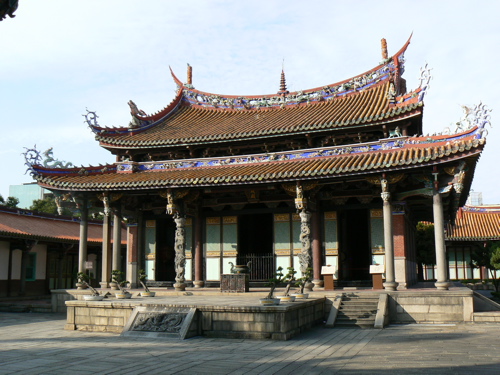
• Confucius Temple, a bit more sober than the Buddhist and, especially, the Taoist ones, is a replica of the temple in Confucius' hometown.


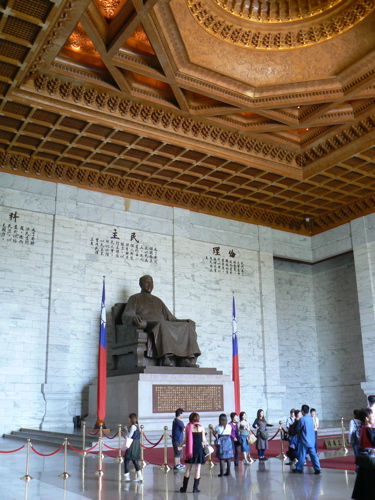
• Chiang Kai-Shek smiling benevolently in his Memorial.


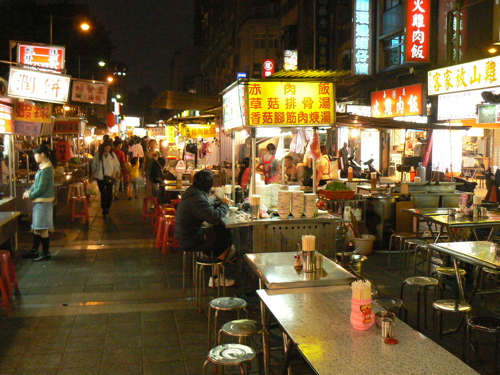
• One of Taipei's famous night markets, where I looked a lot but didn't in the end dare eat.


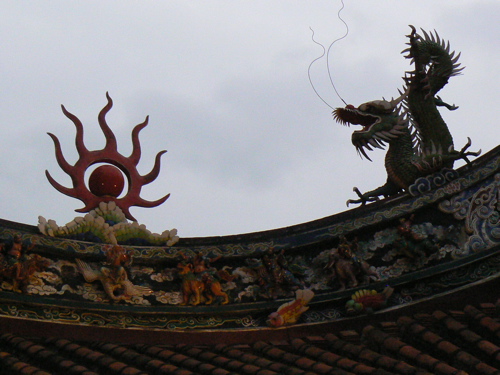
• Decoration atop the roof of the Hsia-Hai Temple of the city god in Dihua Road.


• Motor- cyclists at night - notice all the children!


• Scene in the back of one of the gardens by the National Palace Museum.


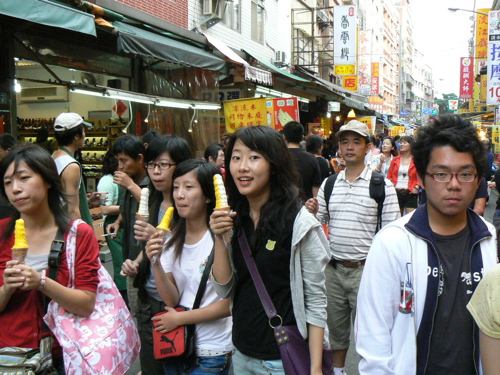
• Young people in one of the overflowing streets of weekend Danshui.


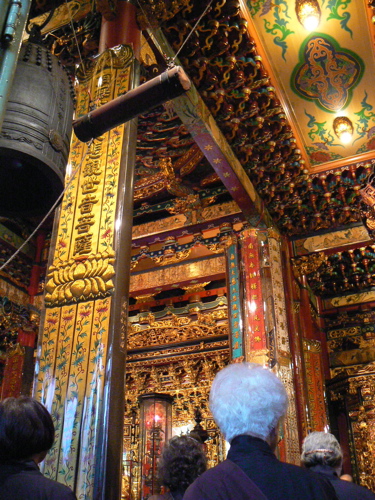
• Volunteers leading the singing of hymns to Guanyin and Amida at Longshan Buddhist Temple, Taipei.


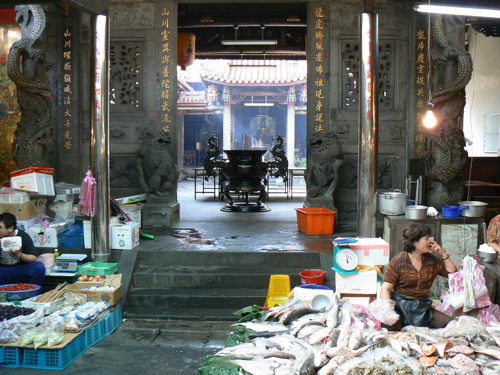
• Longshan Temple, Danshui, completely engulfed by a covered market, including many fishmongers!


Bye bye!